e
magazine
 |
| Over 95 years of building and growth, the Communist Party of Vietnam has led the nation through every challenge, achieving significant accomplishments and laying a solid foundation for today’s successes. |
 |
 |
|
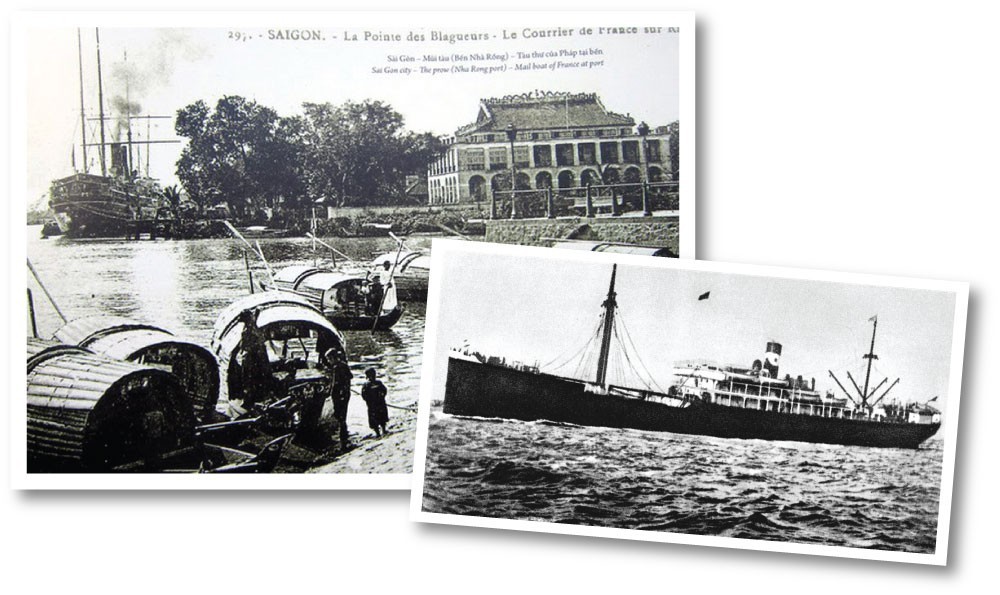
The history of Vietnam in the late 19th and early 20th centuries was a period marked by both tragedy and heroism. After French colonial forces opened fire to invade Da Nang in 1858, Vietnam gradually became a semi-feudal colonial country. The people lived in misery and lost their freedom; numerous patriotic movements led by scholars and intellectuals erupted across the country, but all were brutally suppressed. It was in that dark and deadlocked context that the young patriot Nguyen Tat Thanh (later President Ho Chi Minh) decided to embark on a great historic journey. With lofty aspirations, on June 5, 1911, he departed from Nha Rong Wharf, beginning a journey to find a path for national salvation that would last nearly three decades. |
|
On June 5, 1911, from Nha Rong Wharf, the young patriot Nguyen Tat Thanh boarded the ship Amiral Latouche Tréville, beginning his journey to find a path to national liberation. (Archival photo) |
|
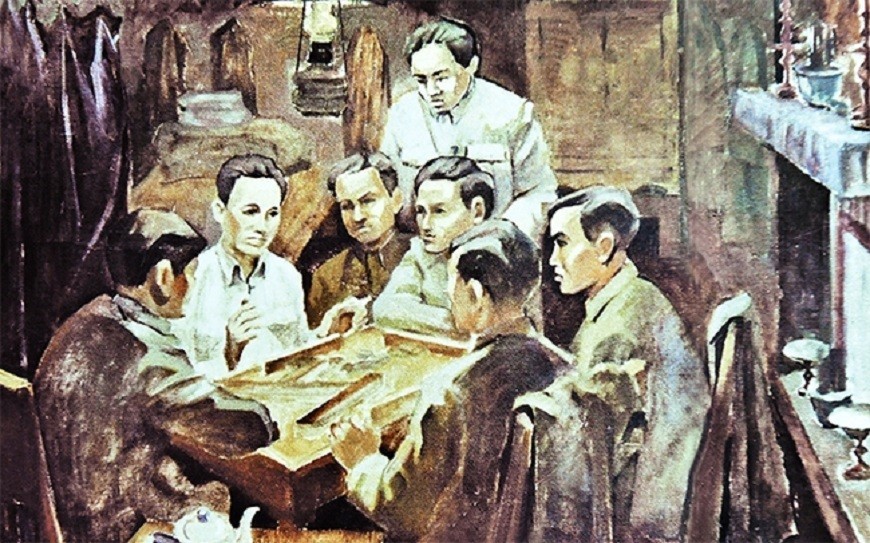
A real turning point came in July 1920, when Nguyen Ai Quoc read Lenin’s Theses. Deeply moved, he exclaimed, “This is the path of our liberation!” - the path of the proletarian revolution. In December 1920, at the Tours Congress, he voted to establish the French Communist Party, becoming the first Vietnamese communist. In the late 1920s, three communist organizations were successively established: the Indochinese Communist Party (June 1929), the Annam Communist Party (November 1929), and the Indochinese Communist League (late 1929). In early January 1930, Nguyen Ai Quoc convened and presided over the Conference to unify these communist organizations in Kowloon (Hong Kong, China) into a single party named the Communist Party of Vietnam. This conference was tantamount to the Party’s founding congress. With the birth of the Party, the history of the Vietnamese revolution turned a new page, ushering in a new era - an era of struggle for national independence closely linked with socialism. |
|
Reenactment of the founding conference of the Communist Party of Vietnam in 1930. (Photo: Nhan Dan Newspaper.) |
|
Just 15 years after its establishment, the Party led the entire nation to successfully carry out the August Revolution in 1945, overthrowing the colonial and feudal regimes and giving birth to the Democratic Republic of Vietnam. Nguyen Duc Ha, former Director of the Department of Party Grassroots Organizations under the Central Organization Commission, affirmed: “Right in the Party’s first political platform in 1930, there were two extremely important contents directly related to the people. First, the Party set the goal of winning national independence. Second, Vietnam was an agricultural country with more than 90 percent of its population being farmers, yet farmers had no land to cultivate, so the Party implemented the policy of ‘land to the tiller.’” This is compelling evidence that from the very beginning, the Party placed the interests of the people first. Immediately after the success of the August Revolution, the country faced countless difficulties and challenges, the most dangerous of which was the enemy’s plot to invade. The Party led the people through nine arduous and heroic years of resistance, culminating in the historic victory at Dien Bien Phu, which forced the French colonialists to sign the Geneva Agreement (1954) on peace in Indochina... Under the leadership of the Party and President Ho Chi Minh, with an iron will and unshakable determination, the Vietnamese people overcame immense hardships and sacrifices, carried out a great resistance war, successively defeated the war strategies of US imperialism, completely liberated the South, and reunified the country in 1975. This victory wrote one of the most glorious chapters in the nation’s history - an event of international significance and profound contemporary value. |
 |
|
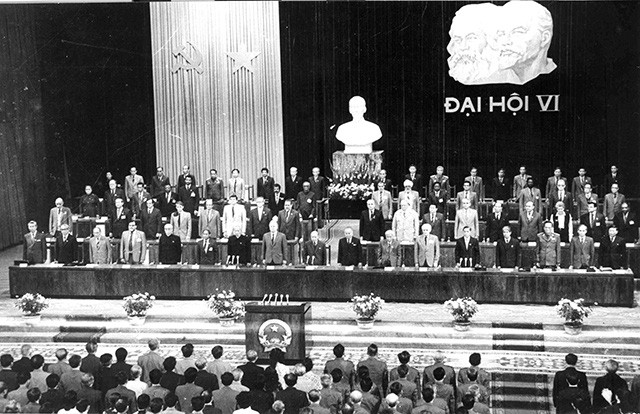
After National Reunification on April 30, 1975, the entire nation stood before a new opportunity for development, yet also had to confront formidable challenges. The consequences of 30 years of war left the country with a backward small-scale economy and a population of 45 million. Vietnam faced encirclement, embargoes, and sabotage by hostile countries and forces. Natural disasters and wars to defend the Fatherland along the southwestern and northern borders pushed the country into a socio-economic crisis beginning in 1979. Confronted with the challenges of the new period, the Party drew lessons from practice, explored new approaches, and formulated a renewal policy with three major breakthroughs. The first breakthrough came at the Sixth Plenum of the Party Central Committee of the IVth tenure (August 1979), when the Party set the goal of “unleashing production,” or in other words, “removing constraints on production,” to create conditions for the development of productive forces. The second breakthrough occurred at the Eighth Plenum of the Party Central Committee of the 5th tenure (June 11-17, 1985), when the Party faced the truth squarely, made an objective assessment of reality, and resolutely decided to abolish the centralized, bureaucratic, subsidy-based mechanism, shifting to economic accounting and socialist-oriented business practices, with prices, wages, and currency identified as the breakthrough point. A crucial aspect of this plenum was the recognition of commodity production and the laws governing it. The third breakthrough was reflected in the Politburo’s conclusions on a number of economic issues on September 20, 1986. These conclusions provided the basis for renewing and finalizing the draft Political Report to be submitted to the 6th National Party Congress, serving as a foundation for addressing urgent issues at the time and marking a renewal in thinking about Vietnam’s path toward socialism, thereby paving the way for the country to emerge from the socio-economic crisis. |
|
The 6th National Congress of the Communist Party of Vietnam. (Archival photo) |
|
Over nearly 40 years of Renewal, the Party and the Vietnamese nation have achieved remarkable feats, profoundly and comprehensively transforming the country and the lives of families and individuals. According to Associate Professor Dr. Vu Van Phuc, Vice Chairman of the Scientific Council of the Central Party Agencies, the achievements of 40 years of Renewal constitute the foundation and key conditions for Vietnam to realize its strategic vision and enter a new era, the era of national rise, toward building a peaceful, independent, democratic, prosperous, civilized, and happy Vietnam, steadily advancing toward socialism. From a country once plagued by poverty and hunger and long dependent on aid and food imports, Vietnam has now made steady progress thanks to renewal. At a press conference announcing socio-economic statistics for the fourth quarter and the year of 2025 (January 5), the General Statistics Office under the Ministry of Finance reported that Vietnam’s gross domestic product (GDP) in 2025 recorded robust growth, estimated at 8.02 percent compared to the previous year. Today, Vietnam is also an attractive market for investment and business, a destination drawing many of the world’s leading corporations. From a country once isolated and blockaded, Vietnam has established diplomatic relations with 194 countries and territories worldwide and is an active member of more than 70 regional and international organizations. The 14th National Congress of the Party, to be held in early 2026, is regarded as the milestone marking the official beginning of the era of national rise of Vietnam. General Secretary To Lam has clearly stated: “The era of national rise of Vietnam is an era of development, an era of strength, an era of prosperity under the leadership and governance of the Communist Party, successfully building a socialist Vietnam with prosperous people, a strong country, democracy, equity, and civilization.” The ultimate goal is for all people to enjoy a warm and happy life, to be supported in development and wealth creation, and to contribute increasingly to peace, stability, and development in the region and the world, as well as to human happiness and global civilization. |
|
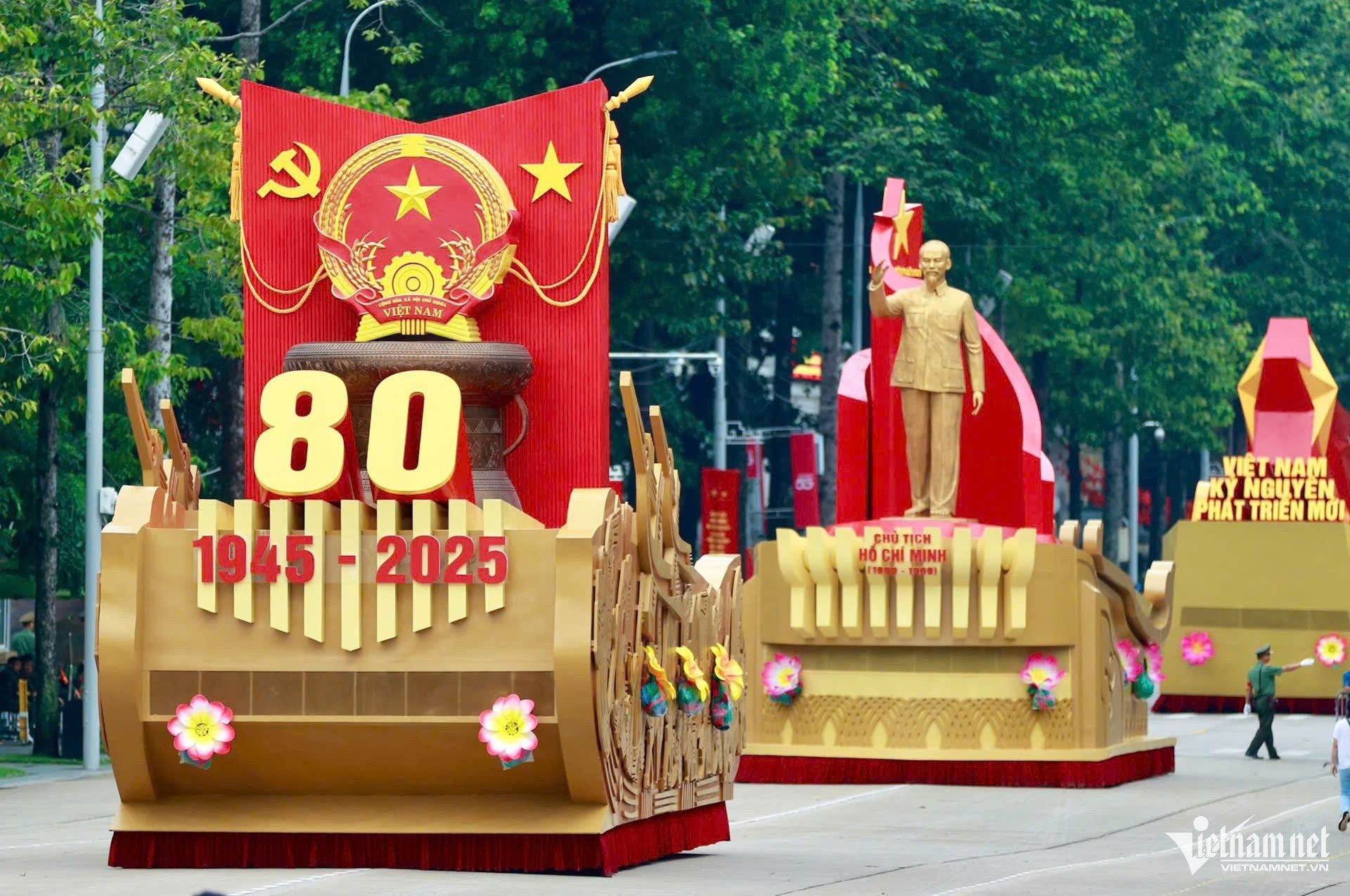
The military parade commemorating the 80th anniversary of the August Revolution and the National Day of the Socialist Republic of Vietnam, September 2, 2025. (Photo: Vietnamnet) |
|
With a solid foundation formed by the great achievements of 95 years of history, together with its current position and strength, Vietnam is now converging sufficient conditions and opportunities to enter a new and more brilliant stage of development. This includes a firm economic base undergoing a strong transformation from raw exports toward high-tech manufacturing and high-quality services; steadily improving infrastructure with modern expressways, seaports, and airports; a young, creative, and industrious workforce; and a stable political environment that builds long-term confidence among investors. It is also an open Vietnam standing before major opportunities arising from free trade agreements and the global shift in supply chains. More importantly, Vietnam carries in its heart the aspiration for partnership, for shared success, and for rising together, an orientation that is both “in harmony with nature” and “in harmony with the people.” Looking back on 95 years of building and growth of the Party, we have every right to be proud and fully confident in the bright future of the Party and the nation. With more than 5.4 million members, the Party’s ranks continue to grow in both size and quality, fully capable of shouldering the responsibility of leading the country forward in the new era. Each Party member embodies the trust, wisdom, and spirit of unity of the entire nation. Under the light of Marxism-Leninism and Ho Chi Minh Thought, the Communist Party of Vietnam will continue to fulfill its historic mission with distinction. |
|
Content: Mai Thuy (compiled) Design: Mai Anh |