
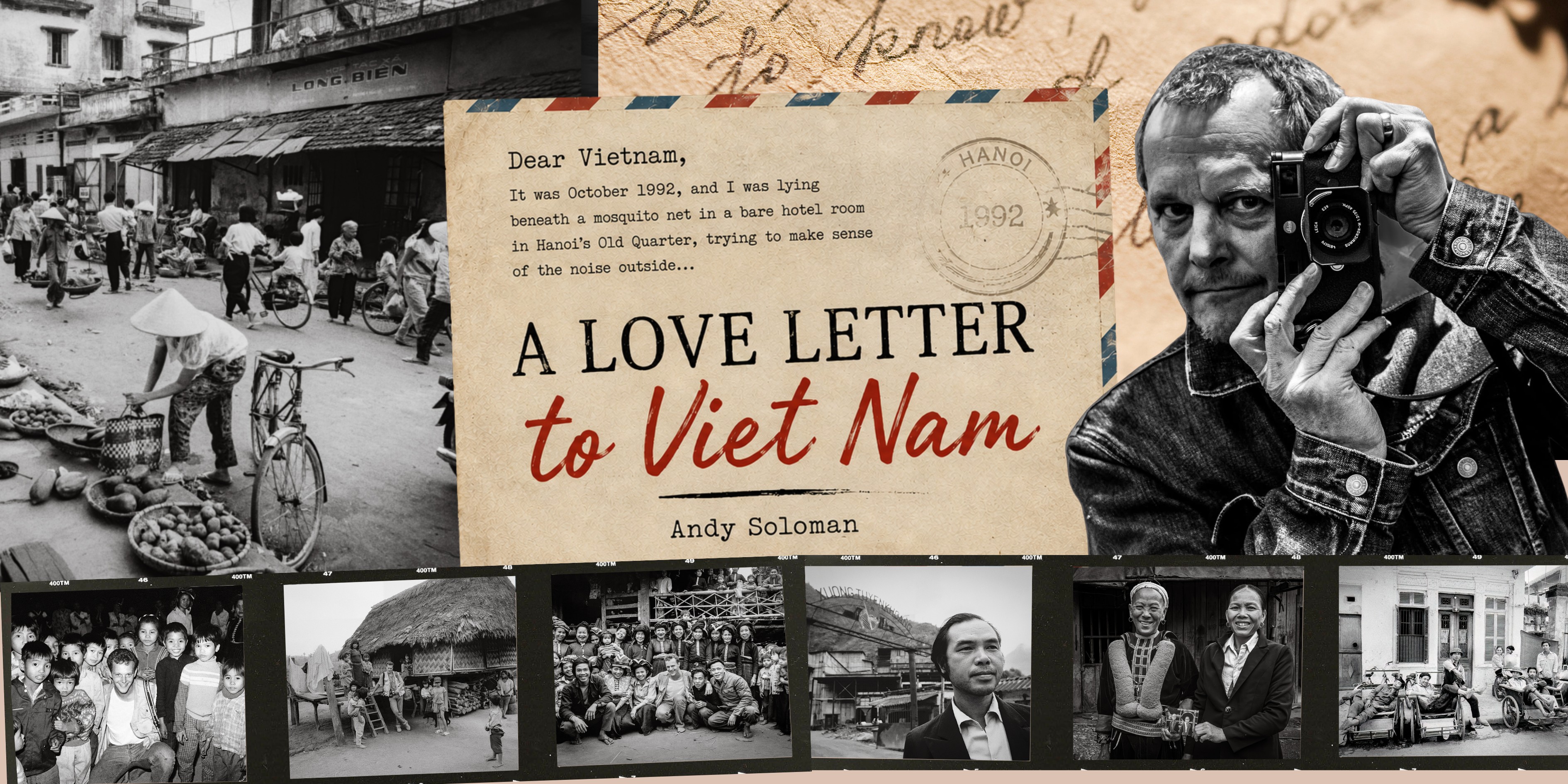
 |
Dear Viet Nam ,
It was October 1992, and I was lying beneath a mosquito net in a bare hotel room in Hanoi’s Old Quarter, trying to make sense of the noise outside. Motorcycle horns occasionally duelled with bicycle bells. Pots and pans clattered as melodic Vietnamese voices rose and fell— sometimes conversational, but more often urgently bellowed so that the whole neighbourhood could hear them. Above me, a wobbly ceiling fan turned slowly, its repeated ‘whop … whop … whop’ inducing a kind of hypnotic surrender.
Sweat clung to me like a second skin.
I opened my eyes. Through the mosquito net I could make out the blur of the fan and, beyond it, the thrilling promise of my first full day in Hanoi. Outside, life was stirring with an infectious energy that was impossible to resist. This was a city emerging from isolation, beginning to open its doors to the world under the renovation policy of ‘doi moi’. I was thrilled to be there.
I climbed out of bed, crossed the stained and tiled floor and opened the wooden green shutters.
|
|
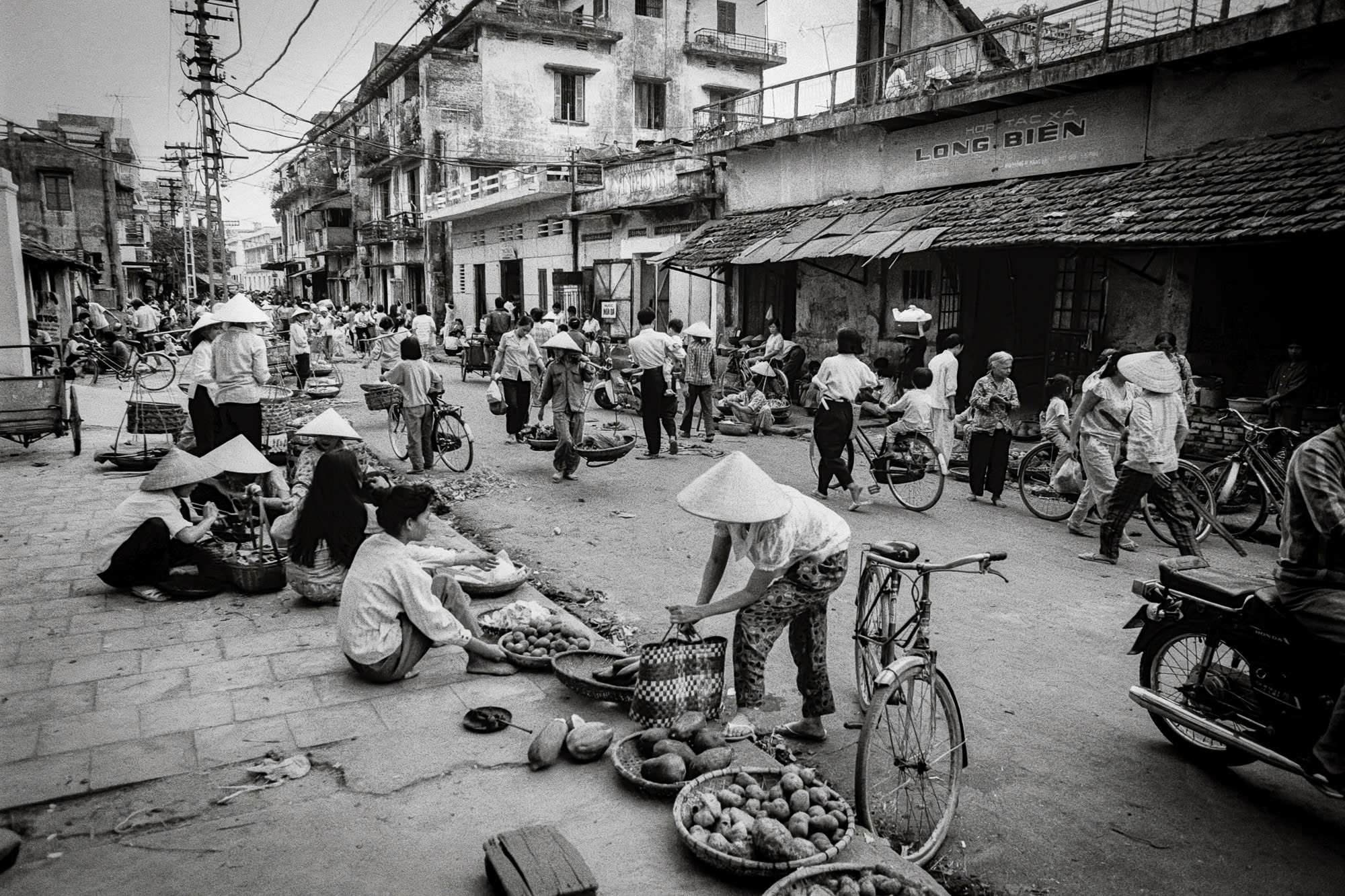
Street vendors at the entrance to Dong Xuan Market, 1992. (Photo: Andy Soloman)
Sunlight flooded through the balcony doors. Opposite stood dilapidated buildings in fading shades of yellow and pink, their crooked emerald shutters and wonky television aerials framed by a tangled web of overhead wires. For a few glorious seconds, the morning seemed perfect. The sky was unblemished blue. The breeze still had a cool edge. Hanoi looked both ancient and expectant, as though it had been waiting patiently for the world to catch up.
Then I stepped onto the balcony.
Below me, in the alley, a collective gasp rose from the people sitting at crowded street stalls. Heads emerged from beneath tatty tarpaulins. Cyclists stopped. Old women carrying heavy loads on bamboo poles paused in the middle of the road. Chopsticks froze above steaming bowls of pho. Faces tilted upwards.
Then came the pointing, laughter and excited chatter.
Only gradually did I understand the horrifying truth.
I was naked.
My pale European body was displayed in the warm morning light for the entertainment of almost everyone in the alley. In panic, I retreated into the room, slumped onto the edge of the bed and sat with my head in my hands, waiting for my dignity to return.
Hanoi, I realised, had embraced me completely—and stripped me bare in the process.
It was an appropriate beginning.
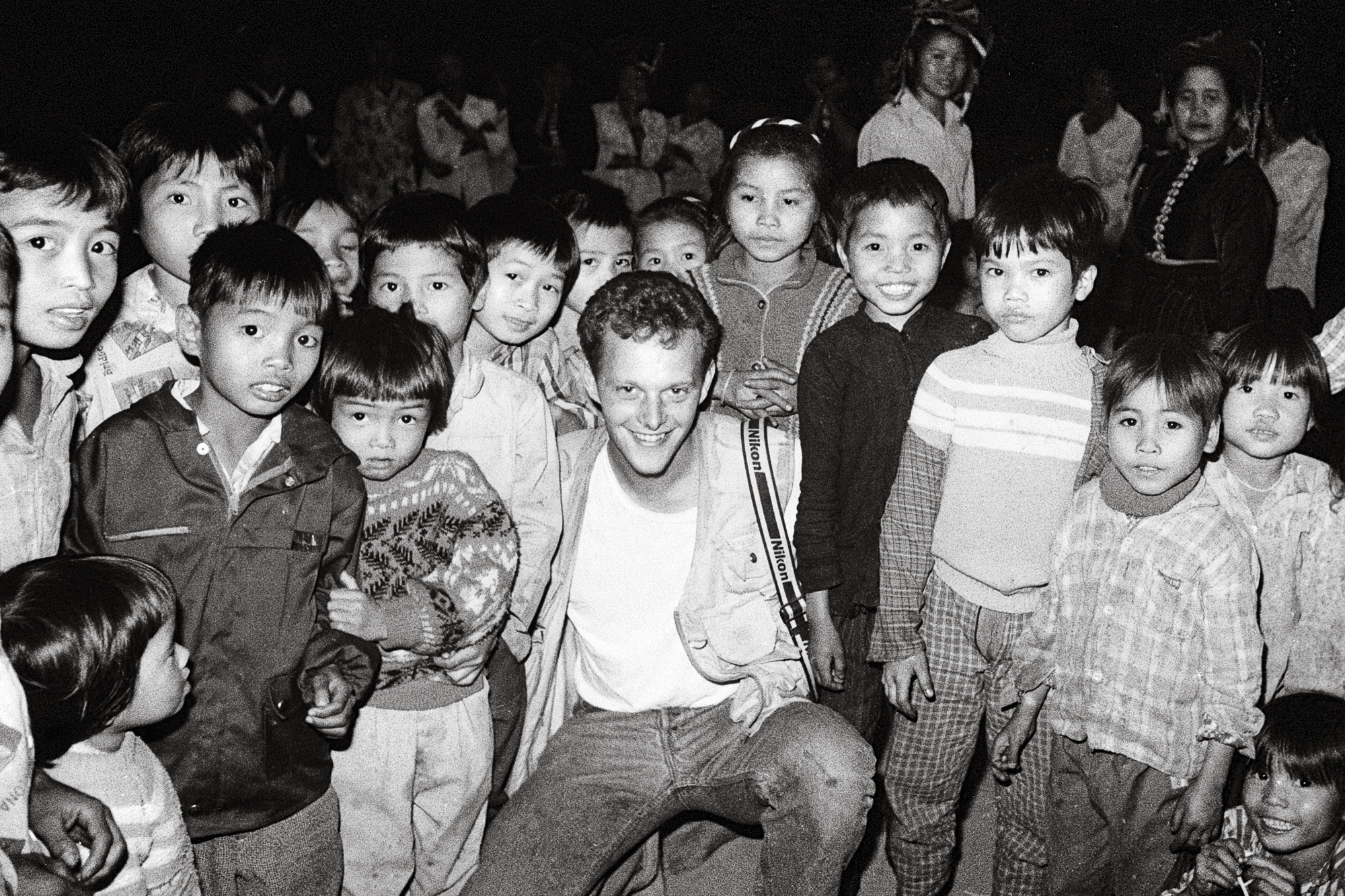 |
Andy Soloman first came to Viet Nam in 1992 on a visa for foreign journalists. (Photo: Andy Soloman)
I had arrived as a freelance photojournalist with two Nikon cameras, 150 precious rolls of 35mm film and a foreign journalist visa. I had no real idea what awaited me. Viet Nam was only beginning to emerge into the world. Viet Nam’s former ally was plunged into crisis and eventually collapsed; the economy was broken; infrastructure was creaking; independent tourism barely existed. Yet private enterprise was beginning to flourish, and everywhere there were signs of a country in motion.
The previous day, my journey from Noi Bai airport into Hanoi had been thrilling, terrifying and surreal. The driver kept one finger permanently on the horn as we swerved around bicycles, ox carts, wobbling minibuses, belching lorries and people walking three abreast. Chickens and ducks hung upside down from bicycle handlebars. Women carried enormous baskets suspended from bamboo poles. The road seemed to belong to everyone and no one.
Yet somehow the chaos worked.
As we entered Hanoi we crossed the Red River, Long Bien Bridge stood nearby, a steel relic of another era. The road descended into a convergence of traffic that seemed, by all conventional rules, impossible to negotiate. But the swarms of bicycles, motorbikes and pedestrians flowed through one another with an instinctive understanding.
I had come to photograph a country that was changing, but I had yet to grasp that Viet Nam would also change me.
Over the next three and a half months, I travelled across the lowlands and highlands, visiting cities, villages, factories, border zones, schools and hospitals. Everywhere I went, I was greeted with immense hospitality. I would arrive as a stranger but somehow always leave as a friend.
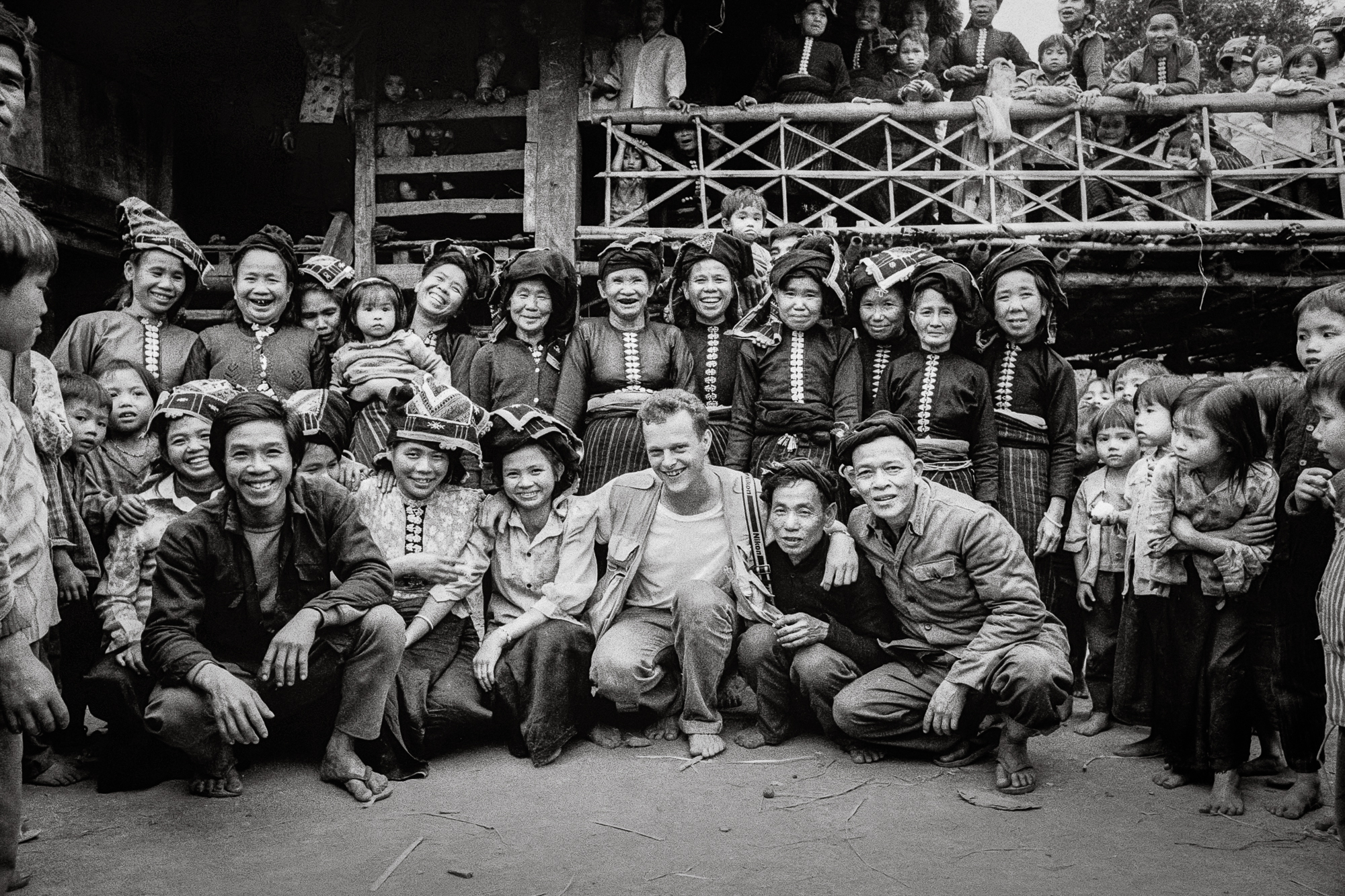 |
Photographer Andy Soloman (front row, third from right) at a wedding of the Black Thai people, 1992. (Photo: Andy Soloman)
In many places, seeing a foreigner was a novelty. Children would creep up, pinch the hairs on my arm and run away as howls of laughter erupted from children and adults alike. In a remote village in Son La, I was invited to a Black Thai wedding and treated as a son.
People would call out ‘Liên Xô’, assuming I was probably Russian. Even in central Hanoi, I was a strange sight. But I soon learned that a lack of shared language was no barrier to friendship. I was invited into modest homes and offered tea and cigarettes, while people smiled and simply stared at me.
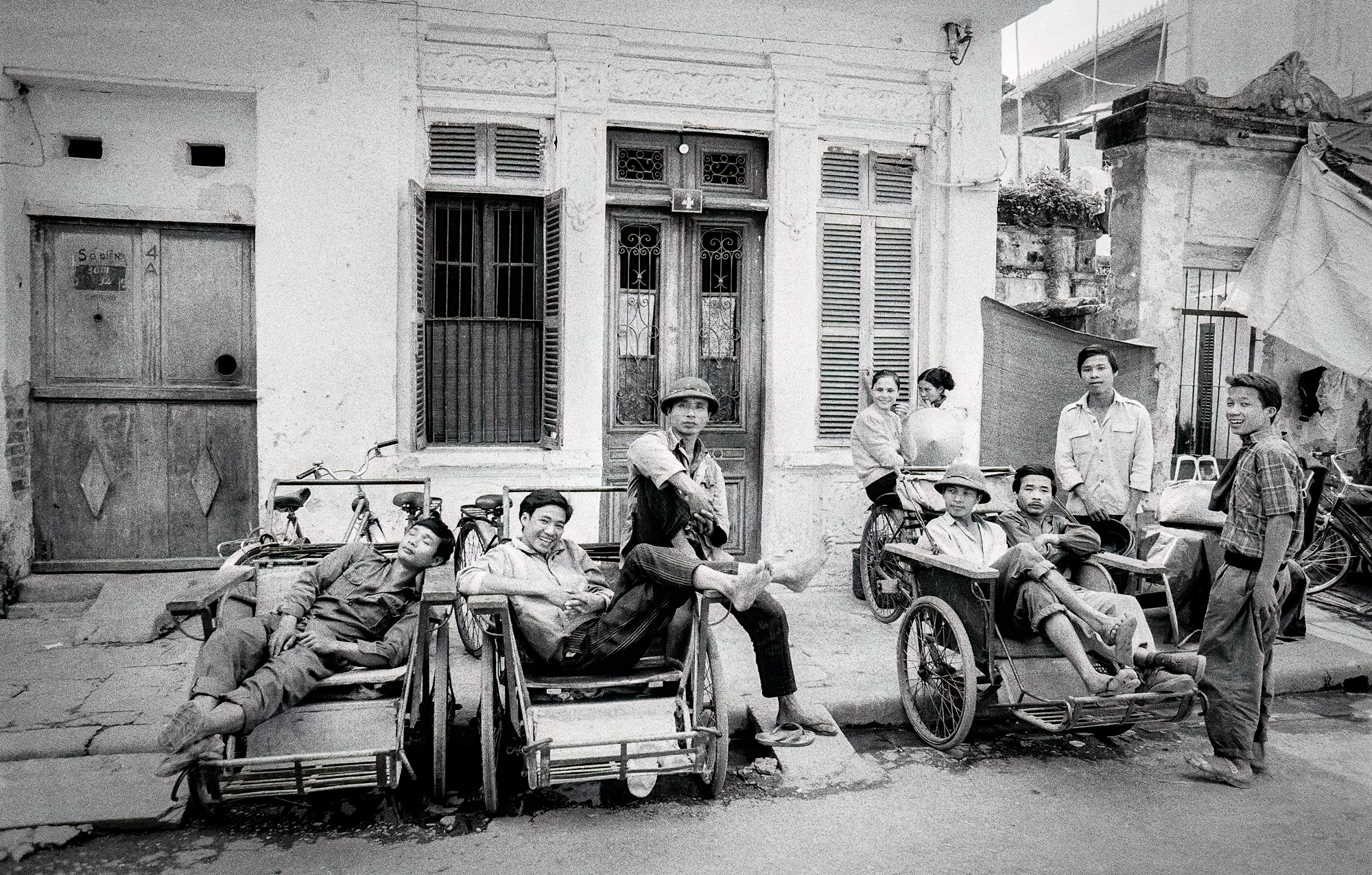 |
Cyclo drivers on Nguyen Quang Bich Street, November 1992. (Photo: Andy Soloman)
On Nguyen Quang Bich Street, a group of cyclo drivers were eating lunch at a street stall. Squatting on long, exceptionally low wooden benches, they invited me to join them. We ate and drank together, but although they were very poor, they would not accept any money.
It was a pattern repeated time and again—and one that continues to this day. Friendship, hospitality and generosity come first: a smile before a frown, an embrace and a laugh. How wonderful.
As I travelled, I began to understand that my photographs would never explain Viet Nam. I photographed the streets, markets, old buildings, workers and faces that met my camera with curiosity, amusement, suspicion or indifference. But the moments that remain most vivid are often the ones I could not photograph: the laughter, the kindness of strangers and the quiet dignity of people improvising solution samid enormous uncertainty.
Hung, the cyclo driver from my first day, saw me as his personal source of income and became part of my education. An army veteran, he was poor, and his olive-green clothing was sweat-stained and patched. He appeared everywhere—outside my hotel, beneath the balcony and in the street—smiling broadly and waving as though we were old friends.
At first, I tried to escape him, but Hanoi was too small, or Hung was too determined. In the end, I gave in.
He was cheeky, persistent and impossible not to like.
 |
More than three decades later, I still carry that first Hanoi morning with me. I remember the noise, the heat, the peeling shutters, the tangled wires and the laughter from below. I remember arriving with the confidence of someone who believed he was coming to observe, only to discover that I was the one being observed.
Since then, through the many many thousands of photographs I have taken, you have given me a way of seeing. You taught me to look beyond the picture, to be wary of easy stories and to understand that a photograph is not a possession. It is a moment entrusted to you.
You also taught me that history is not confined to monuments or museums. It lives in families, streets and the choices people make about what to preserve, what to forget and what to carry forward. It exists in the old and the new occupying the same frame: French villas and Soviet bridges, bicycles and motorbikes, battered hotels and ambitious businesses, traditional meals and uncertain possibilities.
Viet Nam, you are not a still photograph.
You are movement, noise, contradiction and surprise. You are the fan turning above a mosquito net, the cyclo bell in the traffic, the beer shared with a stranger—and perhaps the bowl of chicken blood at a wedding. You are a country that has never allowed me simply to look at you. You have always insisted that I participate.
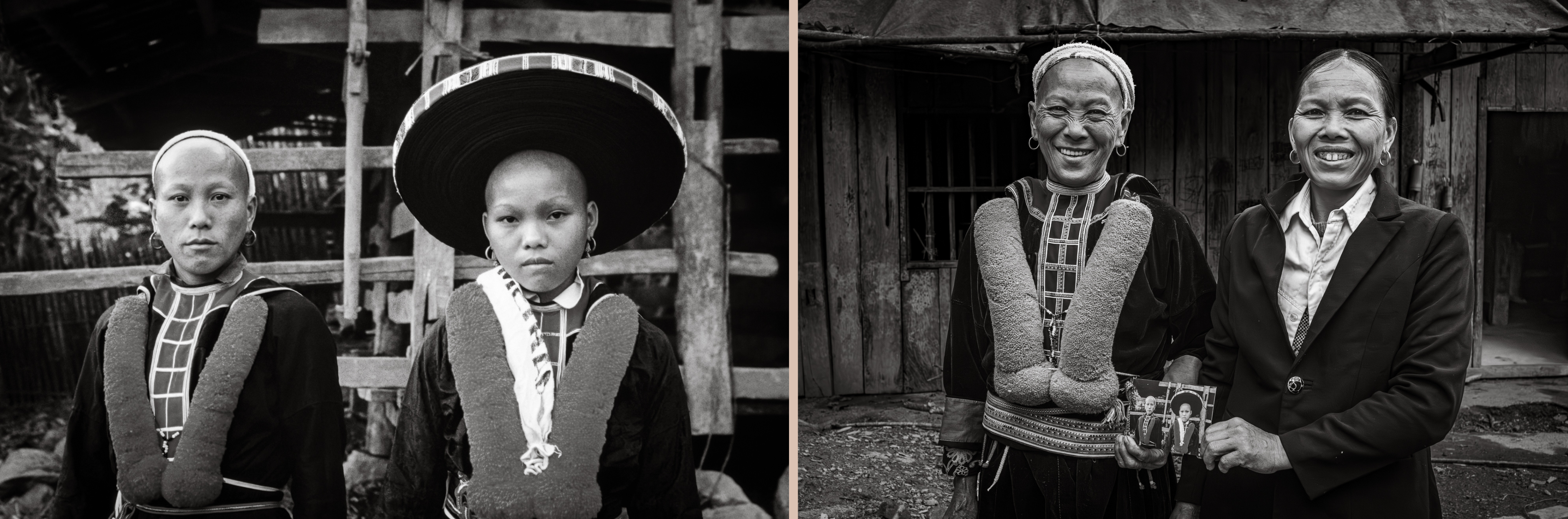 |
A Red Dao mother and daughter in Cao Bang, in a photograph taken by Andy Soloman in 1992 (left), and when they reunited more than 30 years later, in December 2025 (right). (Photo: Andy Soloman)
Whenever I return to my old photographs, I see more than the images themselves. Beyond the vanished time they capture, I see the person I was when I made them: nervous, excited, hungry, occasionally lost and always trying to understand. I see the people who allowed me into their lives, often with more generosity than I deserved. I see the beginning of a relationship that has lasted far longer than I could have imagined.
In recent years, I have wondered what happened to the people who were so kind to me at the beginning. In 2022, I set out to find some of them again. Over the past four years, I have travelled through the Central Highlands, the northern provinces, the Red River Delta and Quy Nhon, seeking out people I first met so many years ago.
The people were still there.
Once more, after more than three decades, they invited me into their lives, humbled me with their hospitality and infected me with their laughter.
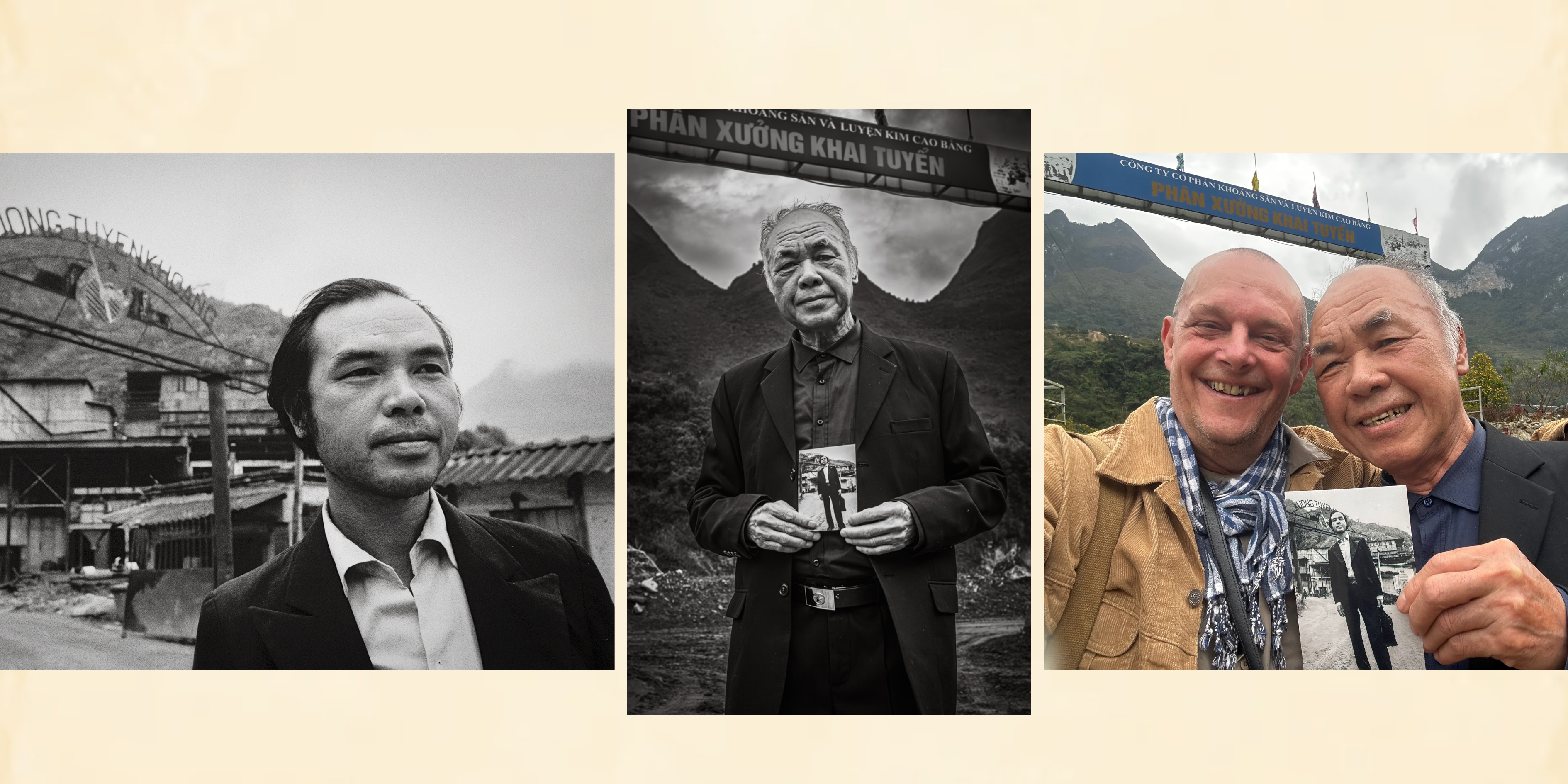 |
Nong Huy Dao in a photograph taken by Andy Soloman in November 1992 (left), and during his return to the Tinh Tuc tin mine in December 2025. (Photo: Andy Soloman)
Late last year, I travelled to Cao Bang to find Mr Nong Huy Dao, a Soviet-trained mining engineer who had been director of the Tinh Tuc Tin Mine. In 1992, the mine was struggling, short of investment and with its tin reserves running low. Yet Mr Dao welcomed me, and we enjoyed a memorable meal where toasts were raised to the words, “We are all miners!”
In 2025, Mr Dao was in his seventies, but together we returned to the mine. It was still working, though on a much smaller scale. Once again, the management invited us to eat. Mr Dao and I embraced, and we raised our glasses: “We are all miners!”
So much had changed, yet in so many ways nothing had changed. That indomitable, endlessly determined and optimistic Vietnamese character remains intact.
Thank you, Viet Nam, for welcoming me with laughter.
And thank you for teaching me that sometimes the best way to begin seeing a country is to admit that, in the beginning, it sees you first.
With love,
Andy Soloman
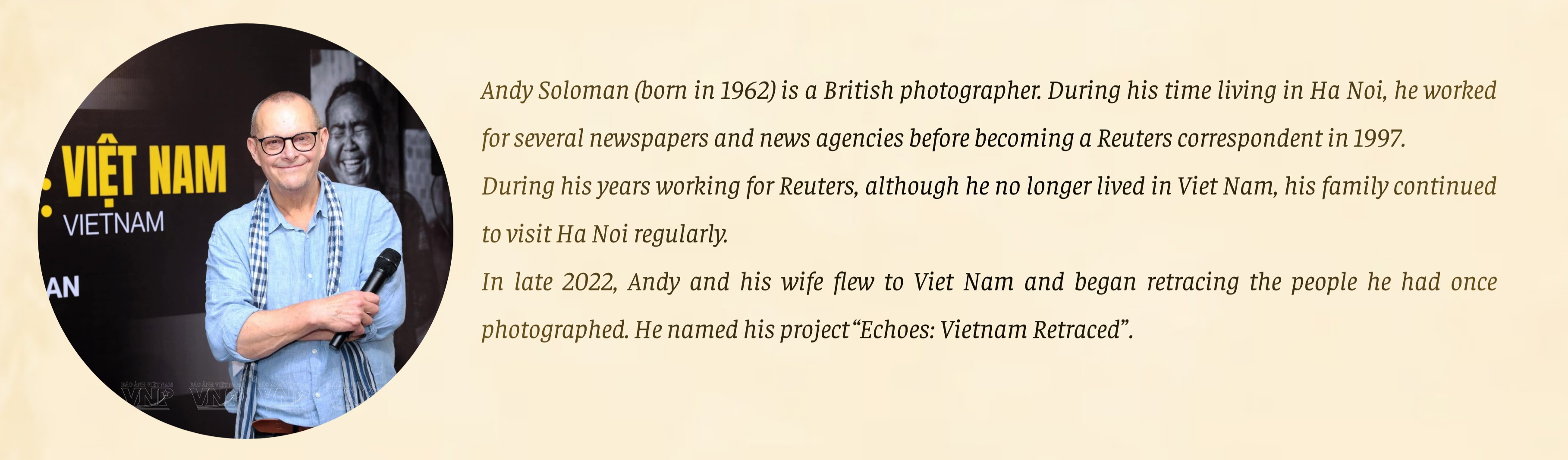 |
Andy Soloman
Design: Thu Phuong