
Ministry: Vietnamese firms should proactively respond to Suez Canal blockage
| Vietnam, EU reiterate commitment to trade, investment deals | |
| Vietnam, EU sign FLEGT-VPA to fight illegal logging | |
| Vietnam, EU show efforts to soon put EVFTA in place |
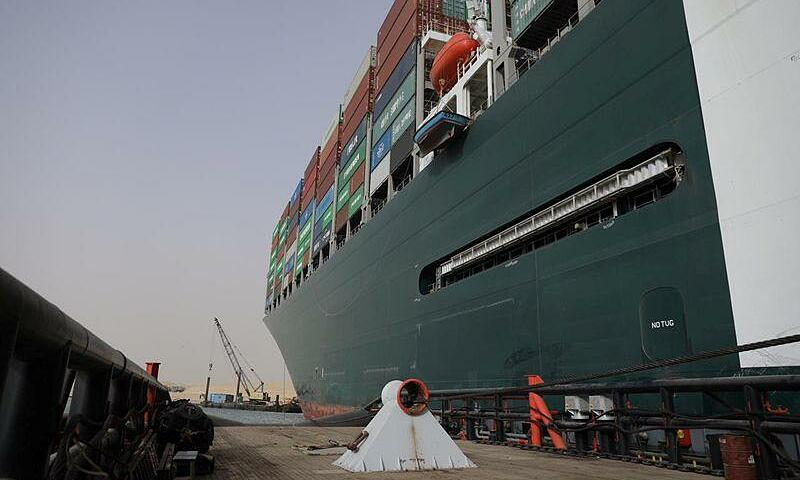 |
| One of the world's largest container ships, Taiwanese-flagged Ever Given, is seen after it ran aground in the Suez Canal in Egypt, photo taken on March 25, 2021. Photo courtesy of Suez Canal Authority. |
The Ministry of Industry and Trade (MoIT) has advised exporters around Vietnam to adopt necessary measures in order to minimise any economic damage posed by the stranded shipping vessel in the Suez Canal, the VNA reported.
The stranding of the 400m-long container ship Ever Given in the Suez Canal where over 10 percent of global cargo and 7 percent of the world’s oil are transshipped is raising concerns about affecting of several Vietnamese enterprises, despite initial successes in the attempt to rescue this megaship.
First Secretary of the Vietnamese Embassy in Egypt and head of the embassy’s Trade Office Nguyen Duy Hung said that there is currently no official statistics on the number of Vietnamese commodities exported to other countries on ships waiting off the Suez Canal, as a number of shipping companies such as Maersk and CMS CGM decided to divert ships round Cape of Good Hope (South Africa) to Europe with the calculation of faster time.
The Vietnam Trade Office in Egypt recommended Vietnamese companies coordinate closely with shipping companies to get updated on the transport capacity, the time of docking and goods loading as well as their insurance against delays or possible damage of goods, especially aquatic products.
Businesses also need to work with importers to address possible problems related to slow delivery to avoid any trade disputes. For support, affected businesses should soon contact with the Vietnam Trade Office.
The 200,000-tonne MV Ever Given veered off course in the Suez Canal on March 23. The incident causes global economic losses of up to US$9 billion each day, worsening the supply chain which is seriously affected by the COVID-19 pandemic.
The course of the ship has been corrected by 80 percent with the stern of the ship currently 102m from the shore, instead of 4m.
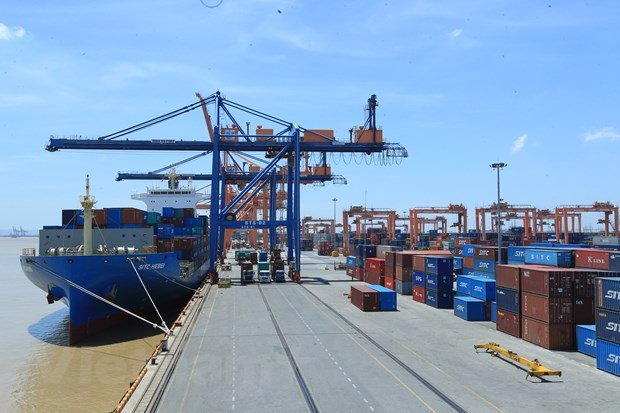 |
| In the two opening months of this year, Vietnam’s shipments to the EU hit 7.5 billion USD, up 18 percent year-on-year. Photo: VNA |
According to the Suez Canal Authority, the number of ships jammed is over 350 and it takes at least 3-6 days to circulate all of the above.
The stranding of the Ever Given in one of the most important global trade routes is affecting Vietnam’s exports to Europe.
Apart from a small volume of goods transported by air and rail, nearly all trade between Vietnam and Europe is conducted by sea and passes through the Suez Canal.
The MoIT has directed the Vietnam Trade Office in Egypt to keep a close watch on the incident and keep export-import enterprises updated on the situation.
The ministry has also coordinated with the Ministry of Transport to take necessary measures if the blockage continues.
According to the ministry’s Import and Export Department, along with the scarcity of containers and the rising cost of shipping due to COVID-19, the stranding of the Ever Given has seen Vietnamese import-export enterprises face yet more difficulties.
MoIT and Vietnamese enterprises need to actively adapt to market fluctuations or cases of “force majeure” such as this, the department said.
The Ever Given, one of the world’s largest container vessels, is still wedged in the Suez Canal, blocking the movement of all other ships in both directions. The economic effects of the incident are beginning to be felt.
Figures from MoIT show that Vietnam’s export turnover to Europe hit US$43.7 billion in 2020, while US$18.5 billion was outlaid on imports from the market.
In the two opening months of this year, Vietnam’s shipments to the bloc hit US$7.5 billion, up 18 percent year-on-year.
Europe remains Vietnam’s fourth-largest trade partner, after China, the US, and the Republic of Korea.
Suez blockage threatens Vietnam’s trade with Europe, US
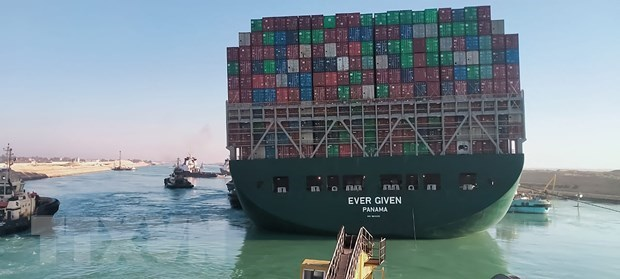 |
| Ever Given refloating on March 29. Photo: AFP/VNA |
The Suez Canal blockage caused by the Taiwanese container vessel Ever Given is threatening to delay some of Vietnamese’s exports and imports, according to Vnexpress.
The longer it lasts the more losses Vietnamese seafood exporters would suffer since they are the one in charge of shipping seafood to their partners, according to Truong Dinh Hoe, general secretary of the Vietnam Association of Seafood Exporters and Producers (VASEP).
"Vietnam and many other countries are short of containers for exports and face surging freight rates. The Suez blockage could make freights rise even higher, putting Vietnam’s seafood export firms in difficulty," he told local media.
The blockage would temporarily increase Vietnamese exports’ transportation time to the U.S. and Europe by at least one to two weeks since ships have to go around the southern tip of Africa.
Maersk, a Danish shipping company, said it has three vessels stuck in the canal and 27 others waiting to enter, with two more expected to reach the site on March 28.
The company has decided not to wait for Ever Given to be extracted and instead redirected its vessels around the Cape of Good Hope, adding 10-14 days to their itinerary to U.S. ports.
"In Vietnam, shipping route TP17 from the Cai Mep-Thi Vai Port in the southern province of Ba Ria-Vung Tau to the U.S’s east coast, which goes through the Suez Canal, is affected," a spokesperson for a Vietnamese logistics firm said.
Multinational electronics companies in Vietnam will be affected if the blockage prolongs since it will delay imports of components.
Tran Thanh Hai, deputy director of the Agency of Foreign Trade, said the impact of the blockage on Vietnam-Europe trade would depend on the time it takes to dislodge the ship./.
 | Vietnam, US explore ways to raise export and import turnover of farm produce The Ministry of Agriculture and Rural Development (MARD) held a meeting with businesses in Hanoi on September 14 to promote the import of agricultural products ... |
 | Vietnam, US enhance farm produce trade Vietnam has so far granted licences to 460 US producers of meat and meat products and 210 exporters of aquatic products, said Deputy Minister of ... |
 | Vietnam, US sign cooperation agreements worth USD 21 billion Party General Secretary and President Nguyen Phu Trong and President Donald Trump witnessed the signing of four cooperation agreements between Vietnam and the US with ... |

Most read


Recommended
 Economy
Digital Economy Opens New Growth Opportunities for Vietnamese Businesses
 Economy
Vietnam - Myanmar: Working Toward USD 1 Billion Trade Target
 Economy
Technology-enabled Safe Food Kiosk - VIVINA Food Hub: Turning “Touchpoints” into a Digital Business Model
 Economy
India plans first tokenised bond issue in September, sources say
Popular article
 Economy
Unbox the Ease: ECOVACS Turns Everyday Living into a Discovery Experience at Singapore Pop Toy Show 2026
 Vietnamese Herbal Tea
A Simple Scratch Brings VND 50 Million Prize to Thanh Hoa Factory Worker
 Economy
Porsche Inks $1.5 Billion AI Deal With India’s Tata Consultancy
 Economy