
Hanoi People's Council Considers Key Resolutions to Drive Growth
| Hanoi Lays New Foundations to Attract High-Quality Investment People-to-People Diplomacy Must Align with Capital Development Goals |
On July 14, the 17th-tenure Hanoi People's Council opened its regular mid-year session for 2026 (the fifth session). The meeting is scheduled to run through July 16.
Renewing operations and enhancing the effectiveness of oversight
Reporting at the session, Standing Vice Chairman of the Hanoi People's Council Tran The Cuong said that, at the beginning of the year, the Council's Standing Committee had issued a work programme comprising 106 key tasks, closely adhering to the guiding principle of “six clearly defined aspects and one consistent approach.”
In addition to its regular duties, the Standing Committee and the Council's committees had proactively addressed more than 40 emerging issues in response to directives from the central authorities and practical requirements. These activities were carried out on the basis of close coordination among the Party, the People's Council, the People's Committee and the Vietnam Fatherland Front Committee of Hanoi.
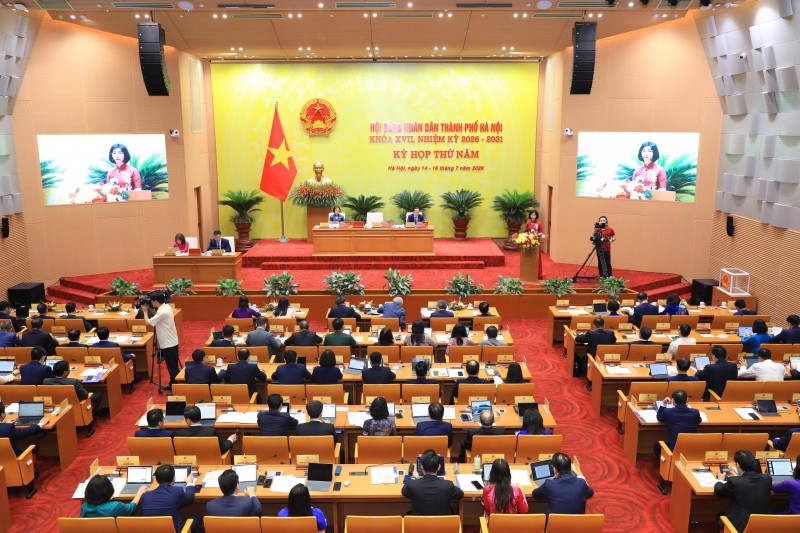 |
| The Hanoi People's Council convenes to discuss key tasks relating to socio-economic development, national security and defence, and the capital's budget revenues and expenditures. (Photo: T.L) |
In the first six months of the year, the Council held six sessions and adopted 116 resolutions, making decisions on important matters concerning organisational structure, planning and the capital's development. Following the elections of deputies to the National Assembly and People's Councils at all levels, the first session of the 17th-tenure Hanoi People's Council consolidated its key leadership positions and adopted several resolutions laying the groundwork for the capital's long-term development.
Notably, the Council adopted 59 resolutions to concretise the 2026 Capital Law, providing a basis for the implementation of new mechanisms and policies from July 1, when the law took effect. Procedures for organising Council sessions have also continued to be renewed in a more scientific and transparent manner, promoting the collective intelligence and sense of responsibility of its deputies.
Oversight activities have been made more substantive, focusing on key sectors and bottlenecks hindering development. The Council oversaw the implementation of key projects under National Assembly Resolution No. 258/2025/QH15; the operations of the Public Administration Service Centre; drainage and flood prevention projects; and the implementation of oversight conclusions, responses to questioning sessions and the resolution of voters' petitions.
The Council's committees also conducted numerous thematic oversight sessions covering public investment, transport, the environment, education, food safety, administrative reform, digital transformation and pollution remediation along the Cau Bay River. According to preliminary assessments, approximately 85% of recommendations made following oversight activities and questioning sessions had been acted upon by the Hanoi People's Committee and relevant departments and agencies.
A notable highlight of the Council's activities has been its accelerated digital transformation. The city has put into operation a centralised management platform for the National Assembly Deputies' Delegation and the People's Councils at both levels, connecting the municipal level with 126 communes and wards. All work-related documents are now processed digitally, while a “paperless session” model has also been introduced, contributing to improved governance and the quality of the elected body's operations.
Public investment plays a leading role in driving growth
Reporting on the socio-economic situation, Vice Chairman of the Hanoi People's Committee Nguyen Xuan Luu said that the capital's gross regional domestic product (GRDP) grew by 8.22% in the first six months of 2026. Total social investment capital reached VND 254.5 trillion, up 14.1%, while state budget revenue totalled approximately VND 404 trillion, equivalent to 62.2% of the annual estimate and up 29% year on year.
Infrastructure continues to serve as a key growth driver for the city. In the first half of the year, Hanoi addressed 39 of its 51 traffic congestion hotspots. The proportion of waste treated using waste-to-energy incineration technology reached 83%. The city also terminated 24 off-budget projects that had been delayed or left unimplemented, with a view to improving the efficiency of land use and investment resources.
Alongside these achievements, the Hanoi People's Committee also identified several shortcomings, including slow disbursement of public investment capital; delays in translating certain mechanisms under the Capital Law into specific regulations; lax administrative discipline at some agencies; and the inefficient utilisation of certain public properties and land following administrative restructuring.
To achieve all 22 of its 22 development targets for 2026, the city will manage growth on a monthly and quarterly basis, across sectors and localities. Progress will be reviewed weekly and results assessed monthly, with direct accountability assigned to the heads of departments, agencies and grassroots administrations.
The city will also prioritise resources for strategic infrastructure projects and works, setting specific implementation schedules and disbursement targets for each project owner and project. Capital will be resolutely reallocated from projects with slow disbursement or no realistic prospect of implementation.
Addressing the session, Secretary of the Hanoi Party Committee Tran Duc Thang called on the People's Council to thoroughly deliberate on resolutions concerning economic and budgetary matters, ensuring balanced resource allocation, establishing appropriate priorities and improving investment efficiency. According to the Party Committee Secretary, public investment must play a leading and pioneering role in paving the way for and mobilising social capital. At the same time, the city must resolutely prevent land, projects and budgetary resources from remaining idle or being delayed in their contribution to the capital's development.
Regarding policies on culture, education, healthcare and social welfare, their consideration and implementation must ensure fairness and enable people, particularly disadvantaged groups, to access quality services. At the same time, such policies must safeguard budget sustainability and generate momentum for long-term development.
| Scheduled to run through July 16, the session will consider 48 items, including 16 reports and 32 draft resolutions covering economic and budgetary affairs, legal affairs, science and technology, the environment, urban development, culture and social affairs. |
 Hanoi Recognizes Additional Historical and Scenic Sites |
 More Than 80% of Hanoi Students Gain Admission to Public High Schools for the 2026-2027 Academic Year |


Most read

Viet Nam News Today (Nov. 23): Vietnam, Indonesia Step Up Comprehensive Strategic Partnership

Viet Nam News Today (Nov. 22): Science, Technology - Promising Pillar of Vietnam-Türkiye Cooperation


Recommended
National
Viet Nam News Today (Nov. 23): Vietnam, Indonesia Step Up Comprehensive Strategic Partnership
 National
Viet Nam, Azerbaijan Issue Joint Statement
National
Viet Nam News Today (Nov. 22): Science, Technology - Promising Pillar of Vietnam-Türkiye Cooperation
 National
Viet Nam News Today (Nov. 21): Top Leader Calls For Strategic Connectivity Between Viet Nam And Southwest China
Popular article
 National
Top Leader Meets Vietnamese, Chinese Youth Participating in “Red Journey” Programme in Yunnan
 National
Viet Nam News Today (Nov. 20): Viet Nam Assumes Role as APEC 2027 Host
 National
Top Leader Visits President Ho Chi Minh Relic Site in Kunming
 National