
India's first indigenous bullet train is being built
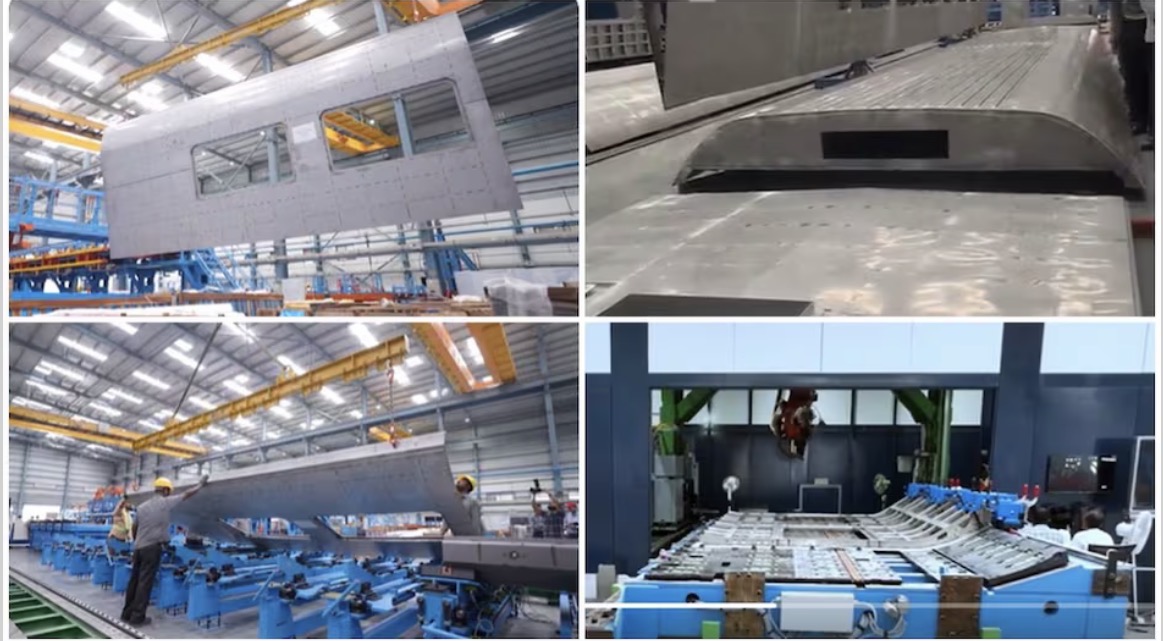 |
Union Railway Minister Ashwini Vaishnaw on Sunday shared a glimpse of India's first indigenously designed bullet train taking shape at BEML's manufacturing facility in Bengaluru.
Vaishnaw inspected the manufacturing unit and witnessed a squeeze test being conducted on the train's structure.
The indigenous B28 trainset, being manufactured by Integral Coach Factory (ICF) and BEML, is designed for a speed of 280 kmph, with track trials expected by mid-2027.
Explaining the different components of the train during his inspection, Vaishnaw said, "The first bullet train we have designed as per international standards. This is the roof wall, this is the side, these are the side walls, and that is the cab. And those are the end walls.
“So, the entire structure is designed as per international standards, and it is undergoing the most rigorous squeeze test because when the train runs at those very high speeds, then around the train, a vacuum gets created,” he added.
Union Commerce and Industry Minister Piyush Goyal also shared a separate video showing the manufacturing of the train's side panels.
B28 to run at 280 kmph, B35 next in line
Earlier in October, Vaishnaw had outlined India's indigenous bullet train manufacturing programme, confirming that the first body frame of the B28 was complete and undergoing structural testing.
“ICF and BEML are manufacturing the indigenous B28 trainset, designed for 280 kmph. The first body frame is complete and is undergoing structural testing. Track trials are expected by mid-2027. A faster B35, designed for 350 kmph, is the next step,” the minister had said.
India is manufacturing bullet train infrastructure too
The government's indigenisation efforts are not limited to train manufacturing.
According to Vaishnaw, major components of the high-speed rail electrification system, including transformers, cross arms mounted on masts, grounding wires, protection wires and feeder wires, are now being manufactured in India.
The J-slab ballastless track system, based on Japanese high-speed rail technology, is also being produced at Indian casting yards by Indian engineers for the first time.
The Union Budget 2026-27 announced seven high-speed rail corridors covering nearly 4,000 km, with expected investments of around Rs 16 lakh crore.
The proposed corridors include Mumbai–Pune, Chennai–Bengaluru, Delhi–Varanasi, Bengaluru–Hyderabad, Chennai–Hyderabad, Pune–Hyderabad and Varanasi–Patna–Siliguri.
The projected travel times include Delhi to Lucknow in 2 hours and 10 minutes, Delhi to Varanasi in 3 hours and 50 minutes, Chennai to Bengaluru in 1 hour and 13 minutes, and Mumbai to Pune in just 48 minutes.
The new corridors are expected to build on the engineering standards, domestic suppliers and technical expertise developed through India's first high-speed rail project.
When will India's first bullet train run?
According to the government's plans, India's first high-speed rail service is scheduled to begin in 2027, with the Surat–Vapi section opening first.
The remaining sections of the Mumbai–Ahmedabad high-speed rail corridor will be commissioned in phases.
The indigenous B28 trainset is expected to begin track trials by mid-2027.


Most read


Recommended
 Economy
Renewing and Elevating ASEAN People-to-People Diplomacy
Popular article
 Economy
Connecting International Resources to Promote Green Development and Climate Change Adaptation
 Economy
Qashier Launches QashierGM, an AI General Manager That Works With the Whole Team
 Economy
India’s farm story: A decade of Transformation
 Economy