
Local External Affairs Must Deliver Tangible Outcomes and Concrete Results
| Integrating Local Cultural Values Into Tourism Activities Da Nang Promotes Connections with Localities and Businesses in Chile |
The conference was chaired by Politburo Member and Minister of Foreign Affairs Le Hoai Trung, with the participation of representatives from central Party committees, ministries and agencies; leaders of local authorities and foreign affairs departments; Vietnamese ambassadors and consuls general abroad; and representatives of functional agencies, associations, and businesses.
Turning external opportunities into development resources
In his keynote address, Minister of Foreign Affairs Le Hoai Trung stated that the global and regional landscape continues to evolve rapidly and profoundly, presenting both opportunities and challenges. Strategic competition, trade rivalry, and the restructuring of international partnerships are intensifying, while advances in science and technology are fundamentally reshaping the global competitive landscape.
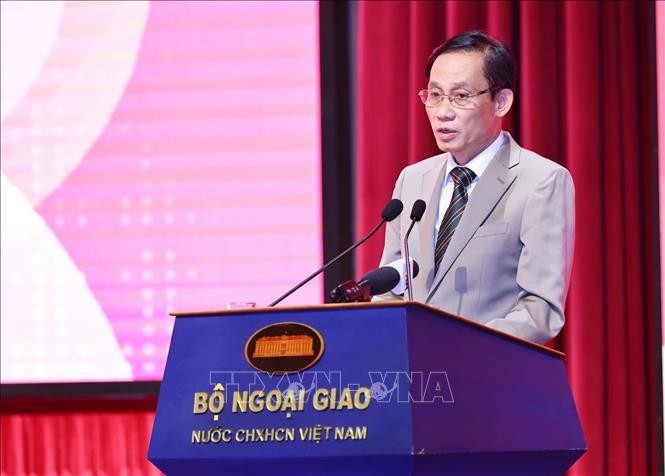 |
| Politburo Member and Minister of Foreign Affairs Le Hoai Trung delivers the keynote address. (Photo: Minh Duc/VNA). |
Against this backdrop, external affairs and international integration must continue to innovate in both mindset and implementation, proactively adapt to changing circumstances, and become more closely aligned with the country's development requirements. The Minister emphasized that, as Vietnam's international standing and reputation continue to grow, the challenge is no longer merely to identify opportunities but, more importantly, to transform them into tangible development outcomes and concrete results.
According to Minister Le Hoai Trung, the country's ambitious growth targets require exceptionally strong efforts from all levels of government, sectors, and localities. In this process, local external affairs play a vital role in expanding development space, connecting with partners, and mobilizing international resources to support socio-economic development.
The Minister stressed that external affairs and international integration are not the sole responsibility of the diplomatic sector but of the entire political system. While the 13th National Party Congress identified external affairs as playing a “pioneering” role, the 14th National Party Congress, for the first time, designated external affairs as a “critical and regular” task, reflecting a new level of awareness of its importance to the cause of national construction and defense.
Assessing the effectiveness of local external affairs, the Minister outlined four key requirements: they must produce concrete outputs, deliver practical value, ensure implementation on schedule, and earn the trust and confidence of the people.
Based on these principles, Minister Le Hoai Trung proposed four strategic priorities for local external affairs in the coming period.
First, localities should renew their thinking and improve the quality of strategic planning by integrating external affairs into socio-economic development strategies, master plans, and action plans. Each locality should proactively review and update its external relations programs, clearly identify priority regions, partners, and areas of cooperation, and translate strategic orientations into feasible programs and projects.
At the same time, diplomacy for development must be fundamentally strengthened, with success measured by its ability to convert external relations into concrete resources and tangible outcomes. Localities should review existing commitments and cooperation agreements, identify areas with untapped implementation potential, address outstanding obstacles, and select opportunities that can be developed into practical programs and projects.
Economic diplomacy, along with science and technology diplomacy, should focus on attracting resources capable of improving growth quality and enhancing the competitiveness of each locality. Cultural diplomacy, people-to-people diplomacy, external communications, and work related to overseas Vietnamese should also be implemented in a coordinated manner to strengthen the country's soft power and mobilize social resources for development.
The Minister also called for continued improvements in leadership, management, and coordination mechanisms to ensure that external affairs activities are implemented consistently and effectively across localities. Coordination between local authorities, the Ministry of Foreign Affairs, other ministries and sectors, and Vietnam's overseas representative missions must be based on practical needs and accompanied by clearly defined responsibilities for each party.
In parallel with developing shared databases and information exchange channels, localities should strengthen their organizational structures by ensuring the presence of a focal agency with sufficient authority, capacity, and standing to provide overall policy advice, coordinate external affairs activities, exercise state management, and monitor the implementation of cooperation commitments.
Foreign affairs officials must possess strong political integrity, sound knowledge of external affairs, foreign language proficiency, and a thorough understanding of local realities. They should also enhance their capabilities in research, forecasting, policy advisory work, project development, and the implementation of international cooperation.
Minister Le Hoai Trung urged Vietnam's overseas representative missions to strengthen their support for localities by facilitating connections with partners and development opportunities. He also called on local authorities to proactively report difficulties and challenges so that the Ministry of Foreign Affairs can promptly coordinate solutions, improve institutional frameworks, and further refine coordination mechanisms.
Local external affairs shift from “participation” to “shaping development”
Presenting the keynote report on local external affairs since the 21st National Conference on External Relations, Deputy Minister of Foreign Affairs Ngo Le Van said that awareness of the role of external affairs in supporting development has steadily improved, the scope of activities has continued to expand, and coordination between central and local authorities has become increasingly effective.
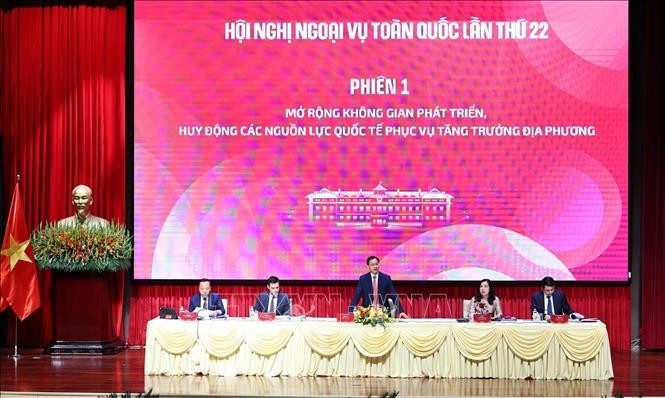 |
| The Presidium chairs the 22nd National Conference on External Relations. (Photo: Minh Duc/VNA). |
Local external affairs have gradually shifted from focusing primarily on expanding international ties to placing greater emphasis on the effectiveness of cooperation; from organizing stand-alone activities to integrating external relations into development planning and socio-economic objectives; and from passively receiving assistance to proactively identifying local needs, proposing initiatives, and mobilizing international resources.
According to Deputy Minister Ngo Le Van, local external affairs have evolved from a position of “participation” to one of “shaping development,” moving beyond merely implementing foreign affairs tasks to proactively creating new opportunities and development space for localities. More than 900 local-level international agreements have been signed, renewed, or remain in force, while over 2,500 international conferences and seminars have been licensed and organized across the country.
The substance of cooperation has also gradually shifted from exchanges and friendship activities toward collaboration for mutual development, with a stronger focus on implementing agreements rather than simply signing cooperation frameworks. Priority areas include trade, investment, high-quality human resources, science and technology, digital transformation, green transition, and infrastructure connectivity.
Despite these achievements, local external affairs still face a number of limitations. Information sharing and coordination have at times been inconsistent, while the processes of identifying needs, preparing proposals, finding partners, implementing cooperation, and evaluating outcomes have in some cases lacked coherence. Responsibility for monitoring the implementation of agreements after signing has also not always been clearly defined.
Drawing on practical experience, Deputy Minister Ngo Le Van stressed that the consistent leadership of Party committees, the unified management of local authorities, and the coordinating role of designated focal agencies have a direct impact on the quality of external affairs. Thorough preparation is also a decisive factor in ensuring effective cooperation. Localities that clearly identify their needs, set appropriate priorities, and develop well-defined proposals are better positioned to establish successful international partnerships.
He also emphasized that the effectiveness of external affairs depends on sustained coordination and consistent follow-up after agreements are signed. Clearly assigning responsibilities, maintaining regular communication, and promptly resolving emerging issues are essential to ensuring continuity and improving the implementation of cooperation agreements.
As part of the conference, delegates participated in two thematic sessions: “Expanding development space and mobilizing international resources to support local growth” and “Strengthening organizational structures and enhancing the capacity of local external affairs in the new context.”
The discussions focused on identifying new opportunities, sharing experiences in international cooperation and resource mobilization, and proposing measures to strengthen organizational structures and build a highly capable local external affairs workforce.
On this occasion, Minister of Foreign Affairs Le Hoai Trung, together with leaders of the Ministry of Foreign Affairs, presented the “For the cause of Vietnam's diplomacy” Medal and the Minister of Foreign Affairs' Certificates of Merit to organizations and individuals in recognition of their outstanding achievements and significant contributions to external affairs during the 2024-2026 period.
 Vietnam-Russia Friendship Association to Consolidate Local Chapters Following Administrative Merger Vietnam-Russia Friendship Association to Consolidate Local Chapters Following Administrative Merger In the second half of 2026, the Vietnam-Russia Friendship Association will focus on consolidating its local chapters following the administrative merger of provinces and cities while implementing the 2025-2030 cooperation agreement signed with the Russia-Vietnam Friendship Association. The Association also identified strengthening youth exchanges as a key priority for its upcoming activities. |
 Viet Nam-Sri Lanka Friendship Association for 2026-2031 Term: Prioritize Connections Among Localities, Businesses, and Universities Viet Nam-Sri Lanka Friendship Association for 2026-2031 Term: Prioritize Connections Among Localities, Businesses, and Universities During the 2026-2031 term, the Viet Nam-Sri Lanka Friendship Association has identified expanding its network of partners and strengthening exchanges in culture, education, Buddhism, and tourism as key priorities. In the coming time, the Association has been encouraged to promote connections among localities, businesses, and universities in the two countries. |



Related Stories
 Handbook
Science and Technology Key to Viet Nam’s Sustainable Growth
 Friendship
Viet Nam’s Key Strength Lies in Its People
 Economy
Viet Nam Sakha Highlight Labor Cooperation and Local Connectivity
 Overseas Vietnamese
Resolution 23: Unlocking Potential of Overseas Vietnamese
Recommended
 National
Hanoi Receives Approximately VND 74 Billion for “For the Poor” Fund in 2026
 National
Key Results of 500-Day Campaign to Search For, Recover and Identify Fallen Soldiers’ Remains
 National
Viet Nam News Today (Oct. 27): Vietnamese, Polish PMs Seek ways to Boost All-round Cooperation
 National
Vietnam, Poland Issue Joint Statement on Establishment of Strategic Partnership
Popular article
 National
Proactively Identifying Development Needs to Expand Cooperation with Foreign NGOs
 National
Viet Nam News Today (Oct. 25): Viet Nam, Mozambique Seek Stronger Agricultural Ties
 National
Viet Nam News Today (Oct. 24): European Media Highlights Substantive Progress in Vietnam-EU Relations
 National