
More Than 150 Coffee Businesses in Son La to Receive Support for Transition to Circular Production
| HCMC: “Morning Coffee with Fishermen” for Prevention and Control of IUU Fishing Enhancing Value and Brand of Vietnamese Coffee in Global Market |
The CAFE-CIRCLE project (Promoting Circular Production and Processing of Arabica Coffee in Son La Province) is being implemented by CARE France and CARE International in Viet Nam, in coordination with the Son La Department of Agriculture and Environment and local partners.
The project aims to support more than 150 micro, small and medium-sized enterprises (MSMEs), cooperatives and coffee processing facilities in Son La in reducing waste and environmental pollution, improving water and energy efficiency, and developing commercially viable solutions using coffee by-products.
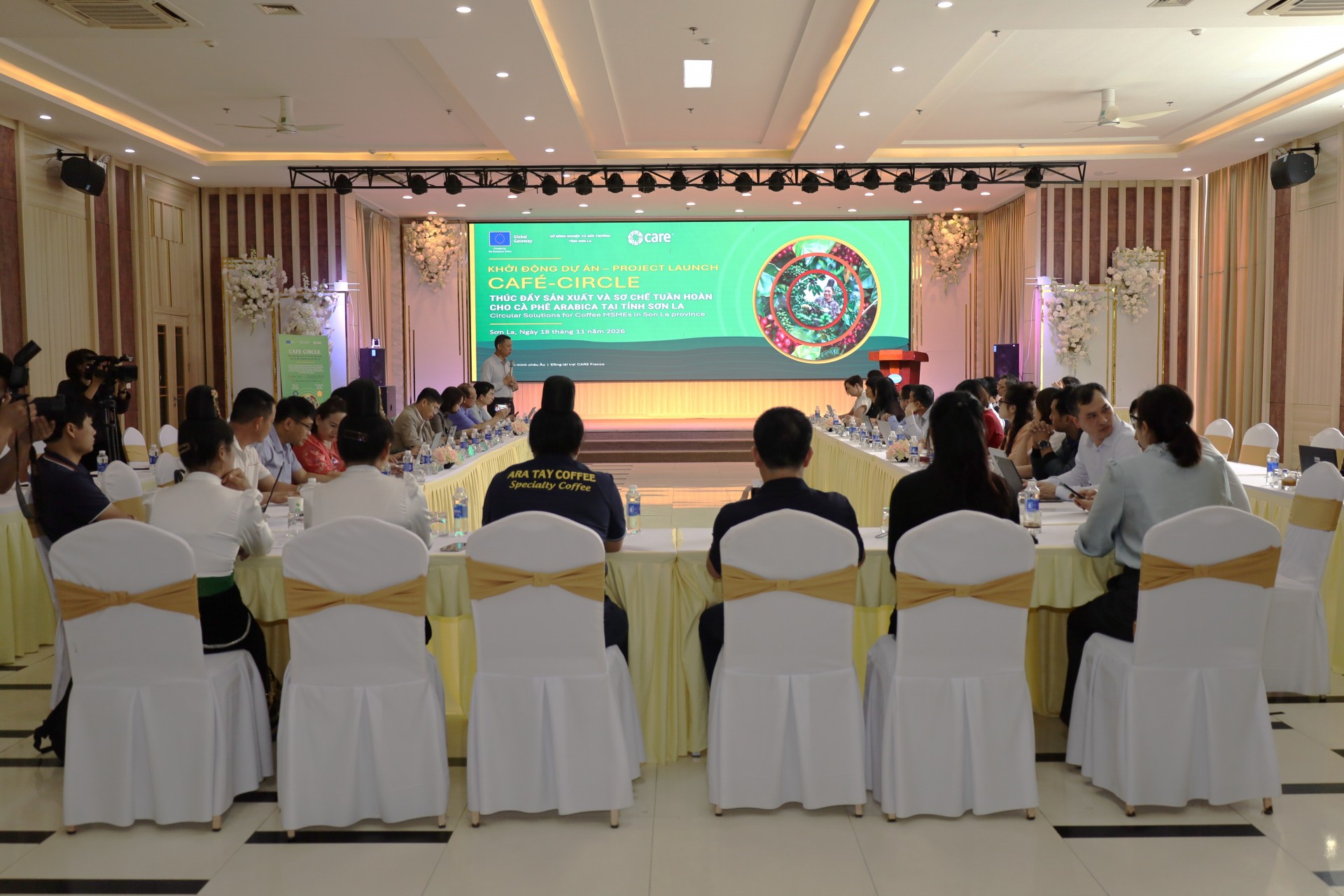 |
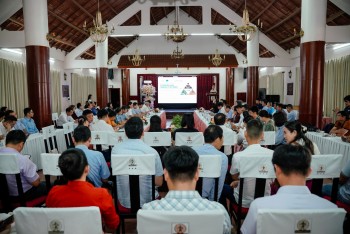
| The launch ceremony of the CAFE-CIRCLE project (Promoting Circular Production and Processing of Arabica Coffee in Son La Province). |
Turning coffee by-products into valuable resources
Viet Nam is one of the world's leading coffee-producing countries, with more than 718,000 hectares under coffee cultivation and output exceeding 1.95 million tonnes in 2024.
According to a 2025 study by the United Nations Development Programme (UNDP) and the Institute of Strategy and Policy on Agriculture and Environment (ISPAE), Viet Nam's coffee industry generates approximately 1.6 million tonnes of dry coffee husks each year. This represents a significant resource with considerable potential for material recovery, organic fertiliser production and the development of new products.
The study shows that circular production solutions, such as composting coffee husks into fertiliser and improving wastewater treatment systems, can help reduce pollution, improve soil quality and lower production costs. However, this potential remains largely untapped, particularly among small-scale processing facilities.
Another assessment by UNDP and the International Water Management Institute (IWMI) of Son La's coffee value chain identified several barriers to adopting a circular economy. These include limited technical knowledge, inadequate wastewater treatment infrastructure, difficulties in collecting and reusing by-products, and a lack of investment capital for new business models.
These challenges are particularly significant in Son La, one of Viet Nam's major Arabica coffee-growing regions. Coffee production and processing provide livelihoods for many local communities, including ethnic minority households. However, the large volumes of organic waste and wastewater generated during processing are placing increasing pressure on the environment, while many small-scale facilities lack the resources to invest in appropriate treatment technologies.
Speaking at the event, Brenda Candries, Attaché and Programme Manager at the EU Delegation to Viet Nam, said that the future competitiveness of Viet Nam's coffee industry would depend not only on product quality but also on resource efficiency and environmental responsibility throughout the production process.
“Through CAFE-CIRCLE, the European Union is supporting practical circular economy solutions that help local businesses reduce their environmental impact, use resources more efficiently and create new economic opportunities. This investment demonstrates our commitment to a greener, more competitive and more inclusive coffee value chain,” Brenda Candries emphasised.
To address these challenges, CAFE-CIRCLE will focus on coffee-growing and processing areas in Son La, particularly the communes of Chieng Mung, Chieng Mai and Muong Chanh, as well as neighbouring coffee production clusters.
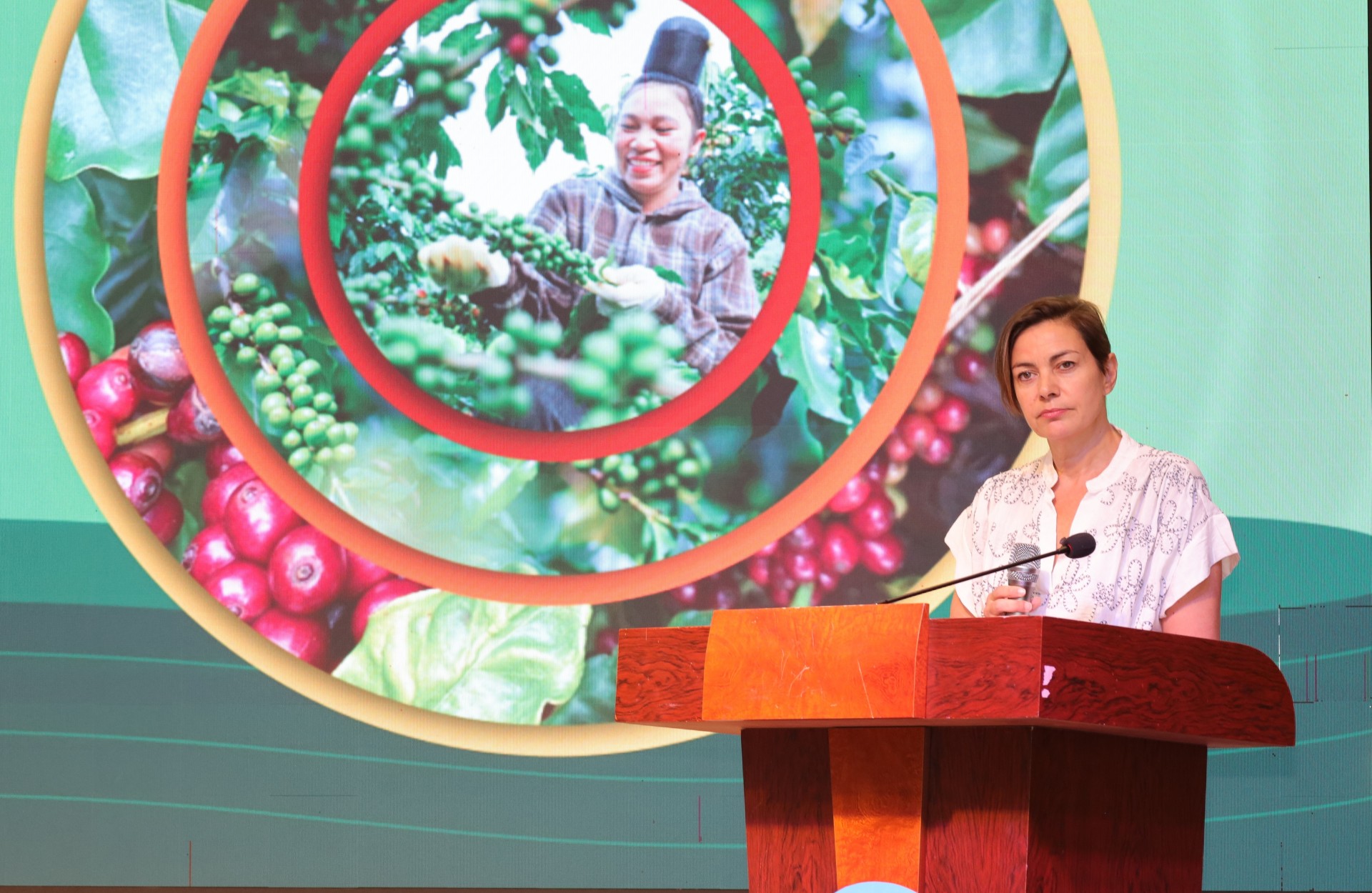 |
| Brenda Candries, Attaché and Programme Manager at the EU Delegation to Viet Nam. |
The project will focus on three main groups of solutions.
First, it will promote water conservation and pollution reduction by supporting the use of water-efficient coffee pulping equipment, combined with affordable biological wastewater treatment systems. These measures are expected to reduce water consumption and improve wastewater management.
Second, it will make use of coffee by-products to create products with economic value. Coffee husks, for example, can be processed into bio-organic fertiliser for reuse in agricultural production. The project will also explore opportunities to develop higher-value products, such as cascara tea made from coffee cherries.
Third, it will improve energy efficiency and product quality by supporting the adoption of solar-powered drying facilities and improved drying systems, thereby helping reduce reliance on conventional energy sources.
Technical solutions will be complemented by training, consultancy and business development support to help local businesses and cooperatives operate and sustain circular production models. The project aims to establish five demonstration models integrating circular solutions and conduct 10 case studies to share experience and encourage wider adoption.
By the end of the project, at least 100 processing facilities and cooperatives are expected to have adopted circular production practices. More than 6,000 farming households are also expected to benefit indirectly through improved environmental management, reduced pollution and stronger linkages across the coffee value chain.
Nguyen Thanh Cong, Vice Chairman of the Son La Provincial People's Committee, said coffee was an important agricultural product and a source of income for many local communities. Alongside the industry's growth, the province needed to address environmental challenges arising from processing activities, particularly wastewater and organic waste.
“CAFE-CIRCLE will help connect technical solutions with the needs of local businesses and cooperatives, contributing to the province's efforts to develop a more sustainable coffee industry that is more environmentally responsible and generates greater value,” Nguyen Thanh Cong said.
Grants of up to EUR 15,000 available to each selected entity
In addition to technology transfer and technical assistance, a key focus of CAFE-CIRCLE is addressing funding constraints, which have been identified as a major barrier preventing small-scale coffee businesses from transitioning to cleaner production methods.
The project will establish a competitive small-grant scheme to support approximately 25 selected micro, small and medium-sized enterprises (MSMEs) and cooperatives in jointly investing in circular technologies. Eligible entities may receive grants of up to EUR 15,000 to invest in equipment and technologies such as water-efficient coffee pulping machines, wastewater treatment systems and solar-powered drying infrastructure.
Grant recipients will be required to provide counterpart funding of at least 30%. This mechanism is designed to encourage business initiative, strengthen investment responsibility and improve the sustainability of the models beyond the support period. The project will also work with financial institutions and relevant partners to improve businesses' access to green financing.
Alongside financial assistance, CAFE-CIRCLE will organise business networking and market linkage activities, while strengthening cooperation among coffee growers, processing facilities, purchasing enterprises and financial service providers. These efforts will create more favourable conditions for promising circular solutions to evolve from pilot models into viable business operations.
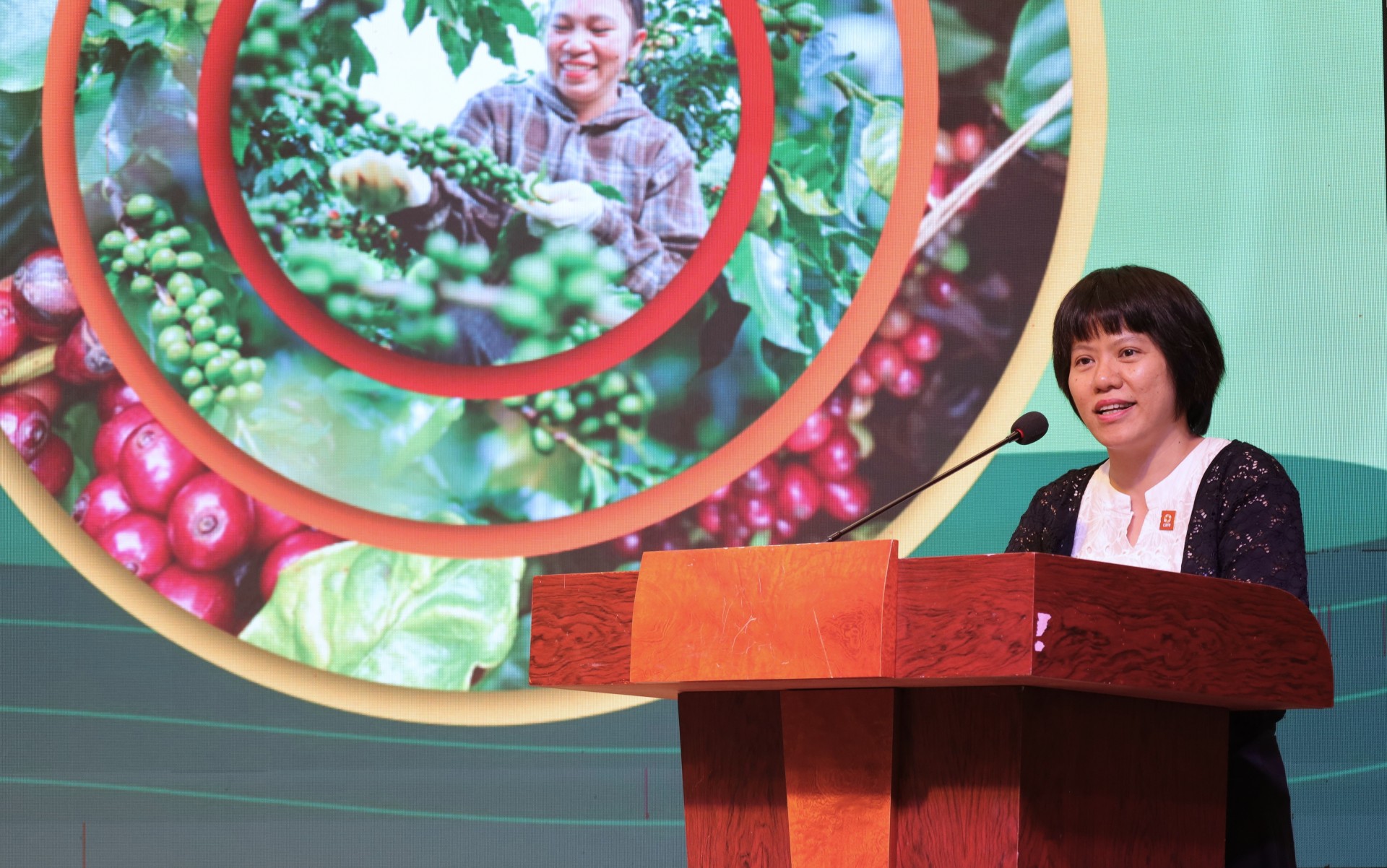 |
| Vuong Thai Nga, Programme Director of CARE International in Viet Nam. |
Vuong Thai Nga, Programme Director of CARE International in Viet Nam, said the circular economy offers economic opportunities for coffee businesses and cooperatives through more efficient resource utilisation, lower operating costs and the creation of new sources of value. She noted that it was essential to ensure that solutions were both technically feasible and financially accessible, particularly for small businesses.
“Through CAFE-CIRCLE, we hope to demonstrate that environmental responsibility and business competitiveness can go hand in hand, while ensuring that women-owned businesses and ethnic minority communities have opportunities to participate in and benefit from this transition,” Vuong Thai Nga said.
To achieve this goal, the project will work with the Son La Department of Agriculture and Environment, provincial specialised agencies, the Son La Coffee Association, research organisations and financial service providers to create an enabling environment for circular coffee production.
During implementation, CAFE-CIRCLE will prioritise the participation of women-owned businesses and ethnic minority communities, aiming for these groups to account for at least 40% of participants across the relevant target groups.
Through demonstration models, knowledge-sharing activities and policy dialogues, the project is expected to contribute practical experience to Son La's green growth priorities while laying the groundwork for scaling up circular production practices across Viet Nam's coffee industry.
CAFE-CIRCLE also builds on CARE's development cooperation activities in Viet Nam. Since 1989, CARE has worked with government agencies, social organisations, communities and businesses to implement more than 400 development projects, focusing on expanding economic opportunities for women, promoting climate-resilient livelihoods, and advancing sustainable and inclusive development.
 Vietnam Seizes Opportunities to Boost Coffee Export |
 SustainCoffee Project Targets Sustainable Growth in Viet Nam’s Coffee Sector |


Most read


Related Stories
 Economy
SustainCoffee Project Targets Sustainable Growth in Viet Nam’s Coffee Sector
 World
Enhancing Value and Brand of Vietnamese Coffee in Global Market
 Vietnamese Culture
Launch of MekongElevate Project “Green and Sustainable Adaptation for Ethnic Minority Communities”
 Vietnamese Culture
Ireland Funds EUR1.4 Million to Support Climate Resilience, Empower Ethnic Minority Women in Three Provinces
Recommended
 Economy
Overcoming Pressure to Start Over: A Young Woman’s Journey of Perseverance
 Economy
India's Economy Amid Energy and Climate Challenges
 Economy
India’s Power Ranking and Regional Influence in 2026
 Economy
XTransfer, VPBank and SmartPay Announce Partnership at Singapore FinTech Festival 2026
Popular article
 Economy
Global Chipmakers Expand Semiconductor Development in India
 Economy
Honoring Young Talent and Expanding Opportunities for Vietnam’s Science and Technology Development
 Economy
JCI and PMI Partner to Empower Young Leaders with Global Project Management Skills and Certifications
 Economy