
Vietnamese Communities Worldwide Bring National Culture to International Friends
In Malaysia, Belgium, the United Kingdom, France, Thailand, South Sudan..., activities marking Viet Nam Culture Day have taken diverse forms of cultural exchange. Tailored to the characteristics of each community and local conditions, the programmes have included food festivals, exhibitions, artistic performances, film screenings, Vietnamese language activities and traditional cultural experiences.
This is also the first year that Viet Nam Culture Day has been observed following the official designation of November 24 each year as a day to honour national culture, marking the 80th anniversary of the first National Cultural Conference (1946-2026).
Vietnamese cuisine and arts connect with international friends
In Malaysia, the Vietnamese Embassy organized Viet Nam Culture Day, attended by ambassadors, diplomatic representatives, international friends and a large number of Vietnamese people living, studying and working in the country. A highlight of the event was the culinary experience, during which international guests had the opportunity to learn how to make traditional Vietnamese spring rolls and try their hand at preparing them. The food stalls also featured Vietnamese pho, banh mi and coffee.
Vietnamese Ambassador to Malaysia Pham Thi Thuy Nga emphasized that Vietnamese culture has taken shape and evolved over thousands of years of history, with distinctive characteristics reflected in the traditions, arts, cuisine and lifestyles of the country's 54 ethnic groups. Within the ASEAN cultural landscape, these values contribute to enriching regional diversity and fostering friendship among nations.
The spring-roll-making activity proved particularly popular with international guests. Austrian Ambassador to Malaysia Gerhard Eisl expressed his delight at making the dish himself and enjoying Vietnamese coffee. Bruneian Ambassador to Malaysia Abdu'r Rahmani also praised the diversity of the programme, from musical and dance performances to culinary experiences.
In Thailand, the Vietnamese community organized a cultural festival at Viet Nam Town in Udon Thani Province as part of activities celebrating the 50th anniversary of diplomatic relations between Viet Nam and Thailand (1976-2026). Viet Nam Town has become a venue for showcasing cultural values and promoting friendship between the peoples of the two countries. A large number of overseas Vietnamese women, dressed in traditional ao dai, gathered to form the number 50, conveying their greetings to delegates, visitors and local residents.
Alongside a photo exhibition on Viet Nam, its people and Viet Nam-Thailand relations, the programme featured performances of Bac Ninh quan ho folk singing, artistic exchanges and the introduction of 21 traditional dishes and beverages. At the culinary competition, Cha Ca La Vong (Hanoi-style grilled fish) won first prize.
Vietnamese Ambassador to Thailand Pham Viet Hung described Viet Nam Town, established in 2023, as a vivid symbol of exchanges and connections between the two countries. Udon Thani Deputy Governor Natthaphong Khamwongpin acknowledged the contributions of the Thai community of Vietnamese origin to local socio-economic development and bilateral friendship.
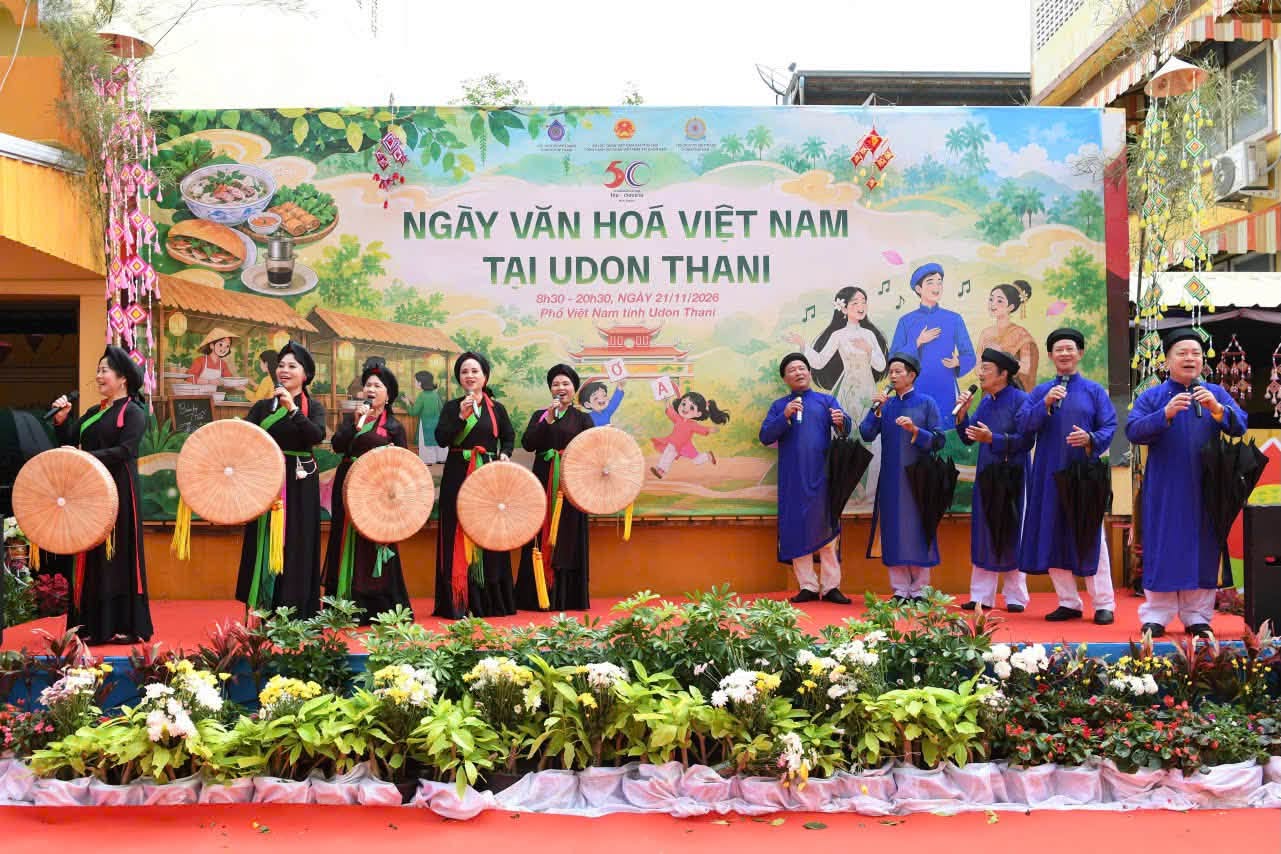 |
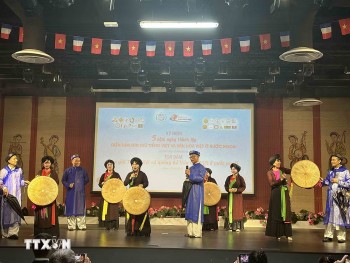
| Bac Ninh quan ho folk singing performed on stage at Viet Nam Culture Day in Udon Thani. |
In Europe, activities marking Viet Nam Culture Day have taken various forms designed to engage local audiences. In Brussels, Belgium, the VieGo organization partnered with the Zoniënzorg Centre to organize a programme entitled “Vietnamese Stories”. Local families and residents took part in making conical hats, painting, watching films, exploring Vietnamese-language books and viewing works by artists of Vietnamese origin.
The exhibition brought together artists from several generations, ranging from those born in 1949 to young people in their twenties. Artist Hoang Thi Ngoc An presented paintings on traditional do paper brought from Viet Nam. Dr. Tran Thanh Thu recreated images of Hoan Kiem Lake, Soc Son and mountainous areas in northern Viet Nam, while younger artists expressed their memories and impressions of their homeland through their own distinctive artistic styles.
According to Tran Thanh Ngoc, founder of VieGo, the programme provides an opportunity for local residents to gain a better understanding of Vietnamese people through the community's real-life stories. It also enables younger generations of Vietnamese descent to share their experiences and strengthen their connection with their roots.
In London, the Vietnamese Embassy organized a community gathering to mark both Viet Nam Culture Day and the National Great Unity Day. A screening of Song Lang, directed by Leon Le, introduced audiences to the world of cai luong, the traditional reformed opera of southern Vietnam.
Vietnamese Ambassador to the United Kingdom Do Minh Hung said the programme aimed to bring the community together, promote national cultural identity and encourage the preservation of cultural traditions. For generations of Vietnamese people in the UK, such cultural activities also provide opportunities to meet and maintain their emotional ties with their homeland.
In South Sudan, personnel from Viet Nam's Level-2 Field Hospital Rotation 8 also organized Viet Nam Culture Day in Bentiu, with the participation of representatives from the United Nations peacekeeping mission and units from Pakistan, Ghana and Mongolia.
Vietnamese military personnel prepared and introduced a variety of traditional dishes, including five-coloured sticky rice, fried spring rolls and iced milk coffee. International guests also had the opportunity to experience Dong Ho folk painting, decorate conical hats and take part in traditional folk games.
In a multinational working environment, these activities provided further opportunities for cultural exchange and mutual understanding, while showcasing the Vietnamese peacekeeping force as friendly, responsible and rich in cultural identity.
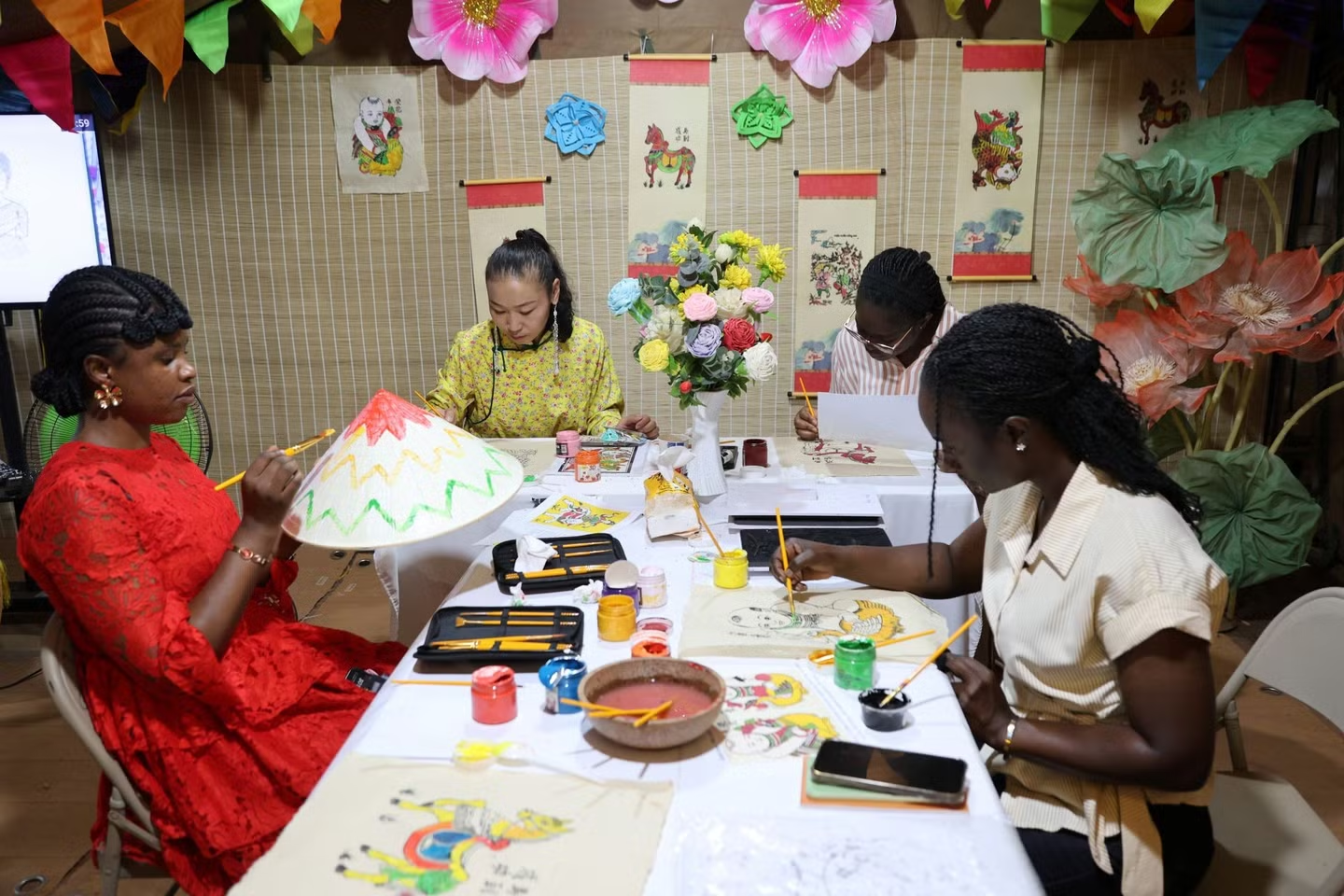 |
| Female military personnel from other countries experience Vietnamese folk art. |
Passing on the Vietnamese language and preserving cultural roots across generations
Alongside promoting the country's image, many activities marking Viet Nam Culture Day have focused on preserving the mother tongue and passing on cultural identity to younger generations born and raised overseas. In Paris, France, the Viet Nam Cultural Centre in France organized a commemorative programme attended by representatives of diplomatic missions, associations, intellectuals, artists and a large number of Vietnamese families.
A highlight of the programme was the “Vietnamese in my heart” (Tiếng Việt trong tim con) competition, organized by the Viet Nam Cultural Centre in France in collaboration with the Association for Vietnamese Culture and Life. The competition received entries from children of Vietnamese origin in France, the Netherlands, Denmark and the Czech Republic. Through videos in their mother tongue, the children shared stories about their grandparents, families, Vietnamese meals and memories associated with their homeland.
Mai Van Thao Vy Émilie, who was born and raised in France and won the Community Choice First Prize, expressed her hope that young people of Vietnamese origin living abroad would all be able to speak and understand Vietnamese and take pride in their homeland.
Her mother, Mai Van Huyen, said that although the family had settled in France 20 years ago, they had maintained a rule of speaking exclusively Vietnamese at home and enrolled their children in online classes. As a result, both children, despite being born in France, speak Vietnamese fluently and can communicate with relatives whenever they return to visit their homeland.
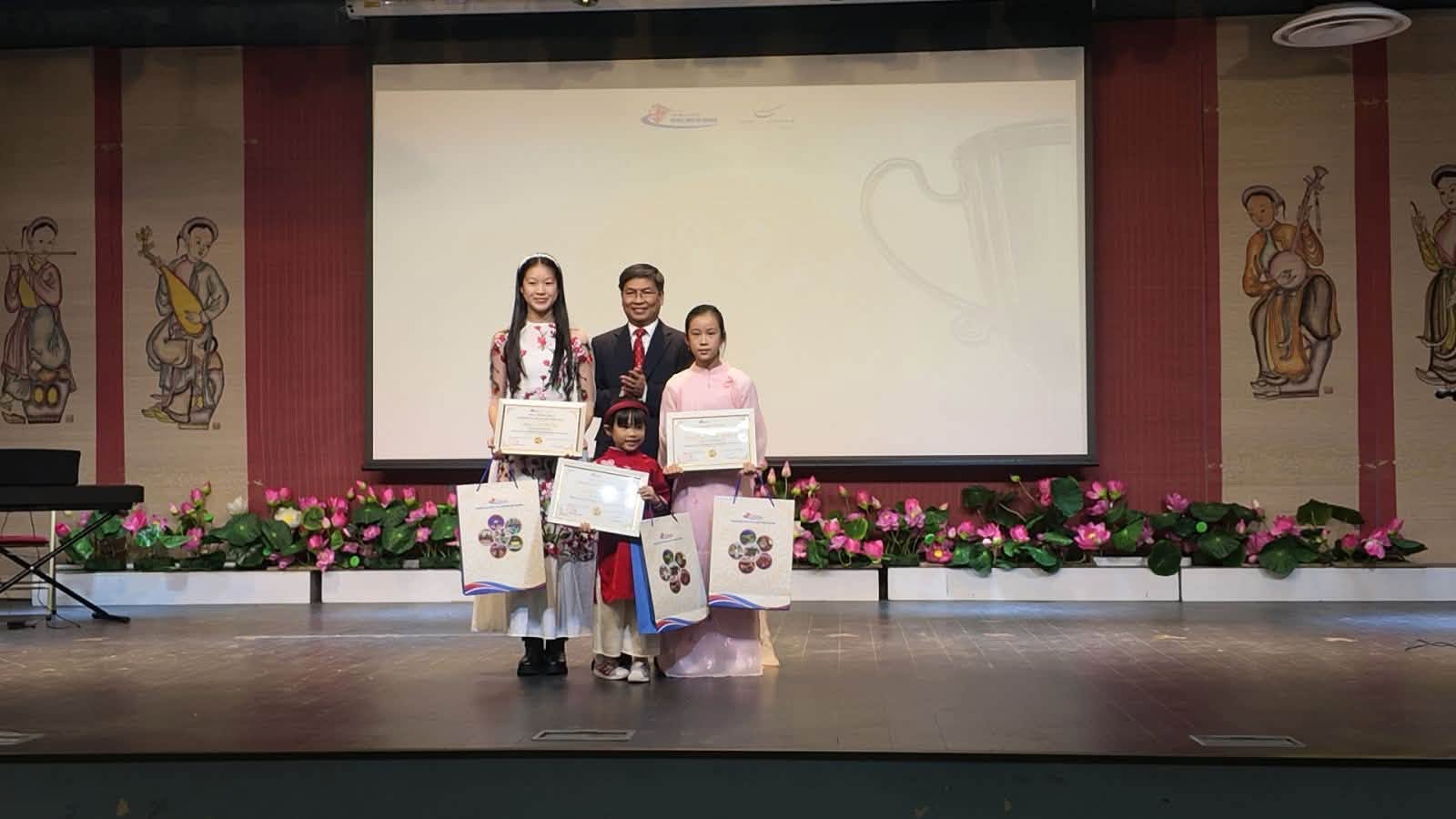 |
| Young contestants receiving awards at the “Vietnamese in My Heart” competition pose for a commemorative photo with representatives of the Organizing Committee. |
According to Vietnamese Ambassador to France Trinh Duc Hai, preserving the Vietnamese language requires the joint efforts of families, associations and the wider community. Every language class and every activity for children helps maintain their connection with the nation's history and culture.
This spirit was also reflected in the performance entitled “Roots of Love” by children from the Vietnamese Language Club in Malaysia, the “Vietnamese in My Heart” writing competition in Thailand, and reading sessions, activities introducing the Vietnamese writing system and cultural programmes for young children in Brussels.
In Israel, home to approximately 900 Vietnamese people, cultural identity is preserved in everyday life through the use of Vietnamese within families, traditional dishes, family gatherings and community activities.
Since the Association of Vietnamese People in Israel was established in March 2025, activities celebrating the traditional Lunar New Year and Mid-Autumn Festival, along with cultural exchanges, have created additional opportunities to bring together Vietnamese people living in different localities. Vietnamese restaurants in Be'er Sheva and Haifa have also helped introduce the flavours of their homeland to local residents.
In particular, in multicultural families, helping children maintain their Vietnamese language skills and learn about national customs and traditions is regarded as a way of ensuring that future generations remain connected to their roots.
 Tran Ba Phuc: “Digital Front” Is Needed to Better Connect Overseas Vietnamese Communities |
 Joining Hands to Preserve the Vietnamese Language and Culture Among Overseas Vietnamese Communities in France |
Most read


Related Stories
 National
Top Leader Calls for Nurturing Culture with Responsibility, Compassion and Spirit of Dedication
 National
Viet Nam News Today (Nov. 17): Viet Nam, Chile Elevate Ties to Strategic Partnership
 Overseas Vietnamese
Vietnamese Cultural Colours in the Heart of Wellington
 Overseas Vietnamese
Vietnamese Language Helps Connect Vietnamese Community in Belarus
Popular article
 Overseas Vietnamese
Expanding Viet Nam - Japan Ties in the Kansai Region
 Overseas Vietnamese
Viet Nam Community in Osaka (Japan) Celebrates the 2026 National Unity Day
 Overseas Vietnamese
Center for Vietnamese Studies Opens in Khon Kaen (Thailand)
 Overseas Vietnamese