BRICS weathers the storm, but has much work ahead
 |
Despite intensive preparations, including the Sherpas’ meeting on 11–13 May, the differences proved unbridgeable. The tense situation did not improve when the foreign ministers took the floor. The outcome: they agreed to disagree. The agreement was not to issue a joint statement, but only ‘Chair’s Statement and Outcome Document’, with two of its paragraphs showing dissent by a member.
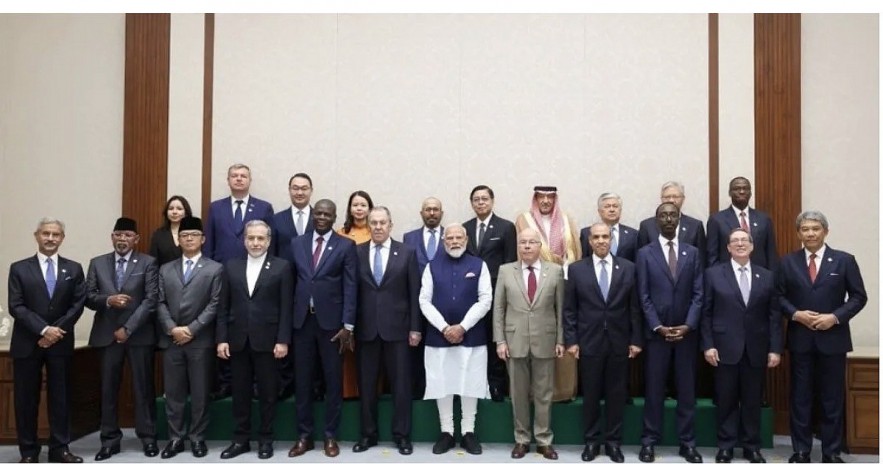
The outcome document, which is also discussed and negotiated among the parties, is the next best thing to a joint statement. As Sudhakar Dalela, India’s Sherpa and Secretary in the Ministry of External Affairs, asserted, it reflected the “common position of members on almost all subjects.” The foreign ministers and heads of delegations from all 11 BRICS member countries and 10 ‘partner’ countries participated in the meeting.
A close reading of the long document, which runs to 63 paragraphs, shows that despite persistent differences over the Gulf War, the central BRICS agenda has advanced, with progress in strengthening the forum and its essential goals. Hence, some observers who rushed to announce the demise or downfall of BRICS may have got it wrong. To paraphrase Mark Twain, reports of BRICS’ death were greatly exaggerated.
It was fully expected that the Delhi meeting would witness an open confrontation between the warring sides. As the BRICS Chair, External Affairs Minister S. Jaishankar noted unhesitatingly, “There were differing views among some members regarding the situation in West Asia/the Middle East.” But most participants spoke about the need for an early resolution of the current conflict, the value of dialogue and diplomacy, respect for sovereignty and territorial integrity, the importance of safe and unimpeded flow of maritime commerce through international waterways, and the protection of civilian infrastructure and civilian lives. So, convergences existed alongside differences.
Two paragraphs (24 and 29) of the Chair’s statement also drew a member’s dissent, addressing the Israeli-Palestinian conflict and the exercise of navigational rights by vessels of all states in the Red Sea and the Bab el-Mandeb Strait, respectively. The dissenting member was reportedly Iran, but its objections have not been explicitly explained.
Beyond the Middle East, BRICS foreign ministers had before them a rich menu of ideas and proposals to address, keeping in mind that their meeting was a bridge between the successful summit held in July 2025 in Rio de Janeiro and the forthcoming summit in Delhi, which is likely to take place in September this year.
At least six issues on which they fully agreed should be spelt out below to illustrate the successful aspects of the Delhi meeting.
One, the representatives of the expanded BRICS family “reaffirmed their commitment” to strengthening the strategic partnership, with three pillars of political and security, economic and financial, and cultural and P-to-P cooperation. They also committed themselves to “the BRICS spirit” of mutual respect, equality, solidarity, inclusiveness, and consensus.
Two, they underlined that multipolarity can expand opportunities for the Emerging Markets and Developing Countries (EMDC), the most accurate description of BRICS’ composition today. They also noted the importance of the Global South as “a driver for positive change.” They identified themselves as playing “a pivotal role in voicing the concerns and priorities of the Global South,” particularly in support of a more inclusive international order.
Three, they did not hesitate to highlight the two shining achievements of BRICS – the New Development Bank (NDB) and the Contingent Reserve Arrangement (CRA) – and how they intended to strengthen them. On the NDB, they were clear that it must mobilise more resources, foster innovation, expand local-currency financing, and support impactful projects. They supported further expansion of the NDB membership, calling it “a crucial BRICS institution.” They also welcomed the idea that new BRICS members should join the CRA and favoured securing further progress in the CRA mechanism.
Four, overcoming the inner schism between those who pressed for faster expansion and those who advocated caution, they now discovered a common ground. They agreed that the expansion of BRICS “reflects its influence, credibility and appeal as an important platform for inclusive global governance.” At the same time, they stressed the significance of enhanced coordination, continuity, and support for long-term institutional development. There was no mention of a proposal to establish a BRICS Secretariat, given the lack of consensus on the matter.
Further, the expansion has brought into sharp relief the question of the order of subsequent chairship rotations. Once India and China have fulfilled their responsibilities, the honour may go to a new member, thereby opening a new phase in the history of BRICS.
Five, they supported the goal of advancing cross-border payments among BRICS countries and other nations in a way that is safe, efficient, and transparent. What impact this may have on the feared de-dollarisation has been left to the critics to decipher.
Six, they reaffirmed the importance of people-to-people exchanges as an instrument for enhancing mutual friendship, robust international exchanges at the people’s level in accordance with the UNGA resolution titled “International Day for Dialogue among Civilisations.”
A less-noticed facet of the outcome document is that it reflects almost all of India’s key priorities, including stronger formulations on UN Security Council reform, disaster management, food security, Digital Public Infrastructure (DPI), and terrorism.
A fair and objective assessment of the Delhi meeting indicates that BRICS has acquitted itself quite well in the face of its biggest crisis. The successful trick was to insulate its mainstream agenda from the fires of the Gulf War. The forum has weathered the storm, but it still faces challenges ahead. Only quiet, smart diplomacy will ensure that the Delhi summit is a greater success.