
India Deepens India–European Union Relations
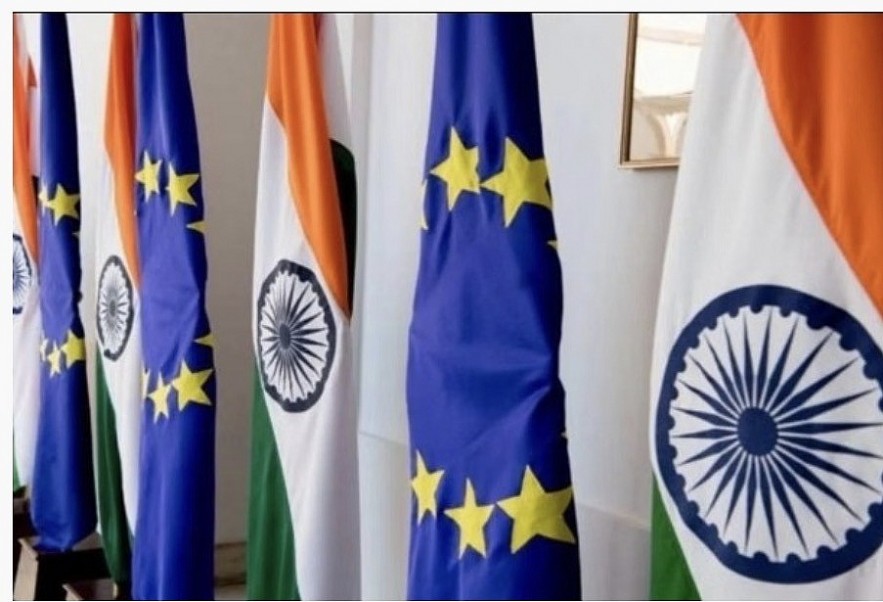 |
Domestically, under PM Narendra Modi’s enabled long-term planning and resilience, the relations with European Union emerged as a key pillar, as both India and Europe confronted economic and geopolitical fragmentation and sought greater strategic coherence.
Strong economic growth, expanding trade, defense modernization, and rising defense exports reinforced India’s global standing.
The text ultimately argues that India’s strategic autonomy and Europe’s need for unity reflect a shared imperative: preserving development and economic sovereignty in an increasingly unpredictable and power-driven international order, making deeper India–EU cooperation not just beneficial but necessary.
Using different means, present-day New Delhi follows a similar logic: it avoids absolute alignments, invests in institutional continuity, and transforms economic resilience and multidimensional diplomacy into tools of development.
This posture carries particular significance for Europe. In 2025, the European Union faces a prolonged inflationary crisis that pressures the euro and exposes the structural weaknesses of European economic governance.
In a world where the economy has become a field of competition, Europe have decided whether it will function as a unified management and monetary power capable of absorbing the euro crisis. In this context, the Indian example is not exotic; it is directly relevant.
India’s foreign policy in 2025 was shaped by a renewed commitment to “strategic autonomy,” engaging with all major powers without full alignment with any. This multi-alignment, long a defining feature of New Delhi’s diplomacy, was tested by new global realities. Rather than remaining passively non-aligned, India expanded its partnerships and took initiatives, seeking to transform strategic autonomy from a posture of detachment into tangible influence over global developments.
Within this framework, at the 17th BRICS Summit held in Rio de Janeiro in July 2025, the bloc’s leaders prioritized strengthening cooperation and cohesion within BRICS, focusing on the representation and interests of developing countries in the Global South. Discussions covered global governance, development financing, technology, and broader structural challenges, reflecting a shared effort to promote more inclusive and sustainable multilateral cooperation amid rising tensions in international trade. Despite internal differences and external pressures, the summit’s joint declaration underscored BRICS’ role as a key platform for emerging economies, while reinforcing India’s position ahead of its assumption of the bloc’s presidency in 2026.
At the same time, India maintained an active and substantive role within the G20, particularly at the 2025 summit in Johannesburg. There, it participated in discussions on critical global issues such as the climate crisis, economic resilience, and development, even amid geopolitical tensions and the absence of certain leaders. The summit’s final declaration reaffirmed commitments to multilateral cooperation and support for developing countries, reflecting priorities advanced by India and other emerging economies. The fact that the 2025 G20 summit was hosted in Africa for the first time highlighted the importance of regional representation and the integration of the Global South into global dialogue.
Domestic governing cohesion provided a decisive foundation for India’s strategic patience and long-term foreign policy planning. Prime Minister Narendra Modi’s government continued implementing reforms aimed at maintaining economic stability and political continuity.
Within this context, relations with Europe emerged in 2025 as a critical pillar of India’s global positioning. New Delhi viewed Europe as a set of like-minded partners capable of helping balance major powers. European states, increasing defense spending and seeking new strategic partnerships showed growing convergence with India’s strategic interests. Europe’s renewed geopolitical seriousness made it, in New Delhi’s view, a credible partner, offering investment capital, advanced technologies, and meaningful cooperation.
Within this broader framework, economic growth remained the foundation of India’s global influence. In 2025, the country sustained one of the highest growth rates among major economies, with GDP expanding by approximately 6.7% and exceeding 8% in one quarter, driven by strong domestic demand and investment. Despite international headwinds, exports and trade demonstrated notable resilience.
Total exports of goods and services were estimated at $73.99 billion in November 2025, up 15.5% year over year, while cumulative exports from April to November reached approximately $562 billion, an increase of 5.4%. The government presented these figures as evidence that its emphasis on manufacturing and skills development was paying dividends, turning trade policy into a flexible instrument of foreign policy.
In 2025, India secured improved access to key markets through free trade agreements with New Zealand, the United Kingdom, and Oman, while strengthening ties with Gulf states and Southeast Asia and laying the groundwork for new agreements, including with the United States in 2026.
In the aftermath, the government approved approximately $4.6 billion in emergency military procurement, accelerated the development of an indigenous stealth fighter, advanced the acquisition of armed drones, and finalized a $7 billion agreement to purchase 26 naval Rafale fighter jets from France. The designation of 2025 as the “Year of Defense Reforms” further reinforced this trajectory, reducing reliance on foreign suppliers and positioning India as an emerging defense exporter, with defense exports rising 12% to reach $2.76 billion.
The strengthening of India and the resilience of the European Union in 2025 are not parallel developments but two sides of the same strategic necessity: safeguarding management and economic sovereignty.
Within this context, deepening India–European Union relations is not merely desirable but imperative. Stronger trade ties, technological convergence, and substantive security cooperation can serve as a counterweight to the arbitrary weaponization of economic power by major actors. For India and Europe, strategic convergence is not an act of confrontation, but a necessary form of security in an international environment where unpredictability has become institutionalized.



Most read

Recommended
 Economy
13 Economic Experts Join Advisory Board of VIFC-HCMC
 Economy
Expanding Opportunities for Vietnamese Businesses in US Market
 Economy
Vietnam, Brazil Review Economic and Trade Cooperation in First Half of 2026
 Economy
CUHK Achieves Top 20 Global Ranking in QS World University Rankings 2027
Popular article
 Economy
World Bank Supports India’s Solar Rooftop Program
 Economy