
India-Indonesia Relations in the BRICS Context
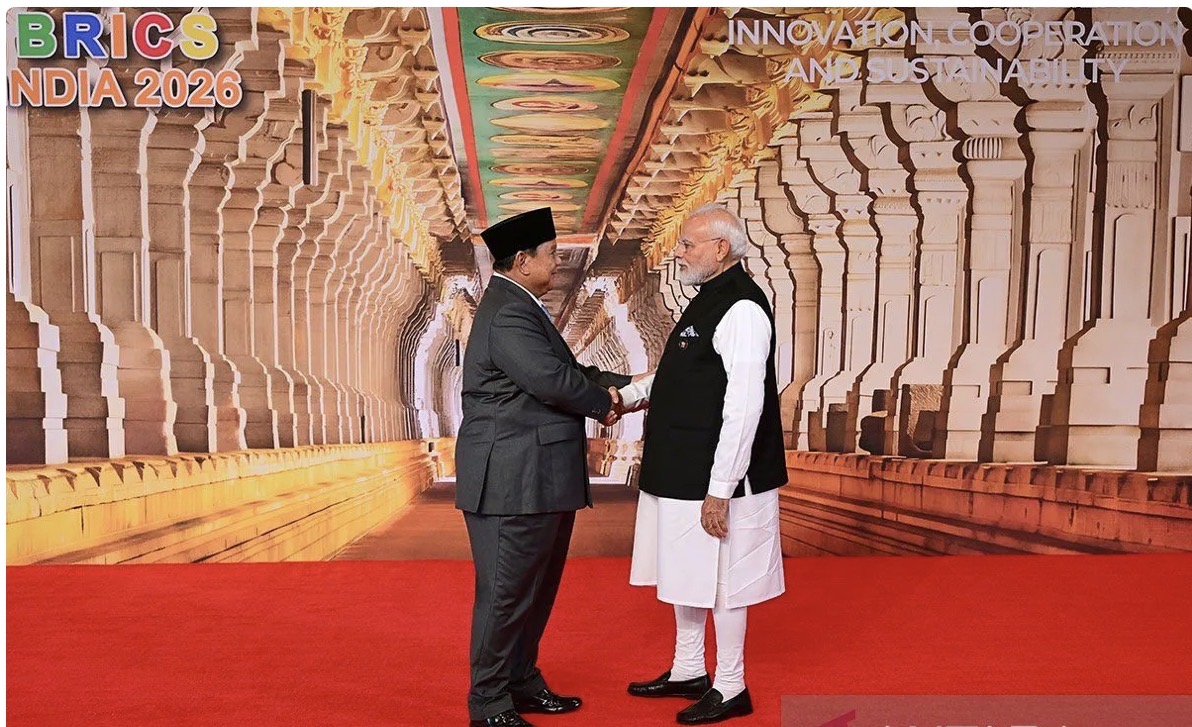 |
Indonesia’s arrival as BRICS’ first full member from Southeast Asia has widened the grouping’s geographical reach, while bringing India and Indonesia closer within the same forum.
Their ties stretch much further back. Centuries of exchange across the Indian Ocean left their imprint on language, literature, religion and architecture across the Indonesian archipelago.
Yet describing this merely as Indian influence misses the more interesting story. Indonesia transformed what reached its shores.
Today, that historical familiarity is accompanied by a much broader strategic agenda. Defence cooperation attracts headlines, but maritime security, digital technologies, critical minerals, healthcare, agriculture, education, investment and supply chains offer equally important possibilities.
Geography makes closer engagement particularly compelling. India’s Andaman and Nicobar Islands lie close to the Indonesian archipelago, while Indonesia occupies a pivotal position between the Indian and Pacific Oceans.
The waters between them are arteries of international commerce, making cooperation on maritime security and connectivity relevant not only to governments but also to businesses and households vulnerable to disruptions in energy and supply chains.
Economics offers another measure of how the relationship has evolved.
Around 2013-14, India-Indonesia bilateral trade stood at roughly US$20 billion. By 2024-25, it had risen to about US$28.4 billion, after touching a record US$38.8 billion in 2022-23.
Indonesia today is India’s second-largest trading partner in ASEAN.
The numbers show progress, but also suggest that the economic relationship still has considerable room to grow.
India’s expanding manufacturing base and demand for critical minerals complement Indonesia’s mineral wealth and downstream industrial ambitions, while India’s experience with population-scale digital systems meets one of Southeast Asia’s most dynamic digital economies.
The next phase should therefore move beyond commodity trade towards investment, technology partnerships, value-added manufacturing and stronger business-to-business links.
BRICS gives these convergences a wider platform. Its expanded membership has raised questions about how countries with different political systems and strategic interests can find common ground.
India and Indonesia offer one possible answer. India has long pursued strategic autonomy, while Jakarta’s tradition of free and active foreign policy, similarly emphasises independence in external affairs.
Both maintain relationships across geopolitical divides while seeking stronger representation for developing economies.
Their approach is based not on agreeing with every partner on every question, but on retaining the space to cooperate where interests meet.
Their domestic ambitions provide another area of convergence.
The more meaningful similarity lies in the challenge confronting both societies: converting national scale into broad-based prosperity across diverse populations and geographies.
This opens room for exchanging experience in infrastructure, skills, food security, healthcare, urbanisation and digital governance.
The significance of the New Delhi meeting, therefore, lies in how many contemporary priorities now intersect.
Maritime security, resilient supply chains, digital transformation, energy transition and reform of global institutions are no longer separate conversations for India and Indonesia. They increasingly form part of the same bilateral agenda.


Most read

Viet Nam, US Strengthen Technological Cooperation and Use of Archival Records to Search for Fallen Soldiers’ Remains

Deputy Minister Ho An Phong Elected President of Viet Nam-Belarus Friendship Association for 2026-2031


Popular article
 World
Poland Inaugurates Memorial Plaque Honouring Architect Who Helped Preserve Hoi An
 World
India enlarged defense cooperation with Tajikistan, Turkmenistan in Central Asia
 World
Viet Nam-Japan Concert Raises Funds for Agent Orange Victims
 World