Indian Invests in Navy’s Aviation Capability
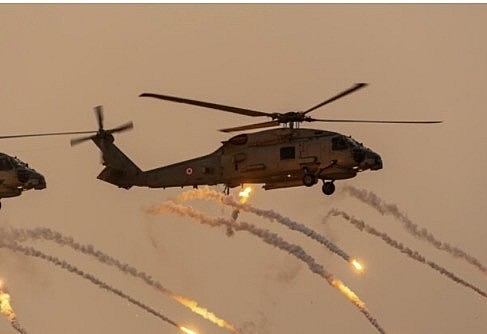 |
A new flotilla of capital warships is being equipped with new multi-role helicopters that are providing combat capabilities far beyond what has been provided for decades by a handful of Seaking 42B/C multirole helicopters (MRHs) that are currently being eased out of its inventory.
Last week, the navy commissioned a second aviation squadron called the “Ospreys” that will operate a new tranche of Sikorsky MH-60R Romeo helicopters. Designated Indian Naval Air Squadron 335 (INAS 335), the new unit was commissioned into the fleet last week at the navy’s premier aviation base, INS Hansa,
Ospreys” are the second naval squadron to be equipped with the MH-60R Romeo. The first squadron, numbered Indian Naval Air Squadron 334 (INAS 334), has been operating from the naval base at Kochi.
This is a major relief for the navy. Since the turn of the century, a succession of Indian Navy chiefs has publicly lamented the shortage of ship-borne multi-role helicopters as one of the navy’s most worrisome operational shortfalls. Over the years, as the navy’s once formidable fleet of Westland Seaking Mark 42B/C MRHs was whittled away by attrition, helicopter hangars on Indian warships progressively emptied, severely reducing their combat capability.
Capital warships – a category that includes larger combat vessels such as aircraft carriers, destroyers, frigates and corvettes – are built with reinforced flight decks and hangars for carrying one or two MRHs when they sail out for operational missions. When fully operational, these MRHs bristle with so many anti-submarine, anti-surface and anti-aircraft weapons and sensors that they are sometimes referred to as “flying frigates.”
Oceanic Surveillance
Part of the surveillance mission will be taken up by launching a dedicated surveillance satellite that all three services – army, navy and air force – can share.
It was also planned to spend another $4 billion to expand the navy’s long-range maritime reconnaissance (LRMR) fleet of 12 Boeing P-8I Poseidon aircraft to 28 aircraft.
In contrast, the Sea Guardian drone can watch for as long as 24-36 hours over a patrol area 1,000 kilometers from its base. Its pilots and weapons operators work in shifts at a ground station ashore, connected with the drone through a two-way data link. With crewmembers relieving each other every 6-8 hours, the Sea Guardian’s endurance is limited only by its fuel capacity.
While the Sea Guardian is not as heavily armed as the P-8I, the UAS being supplied to India carries two small anti-ship missiles to strike any targets of opportunity.
While it is a formidable task to patrol an oceanic expanse as large as the northern Indian Ocean, groupings and partnerships such as the Malabar countries and the AUKUS partnership (Australia, U.K. and the U.S.) have found a solution in partnering with regional powers like India, which takes up a significant share of the cost and operational effort.
India’s Financing
The MH-60R Romeo is widely regarded as the world’s premier all-weather, day and night-capable helicopter, designed for maritime operations. Operating off the flight deck of a corvette, frigate, destroyer, aircraft carrier or amphibious vessel, the Romeo performs roles as diverse as anti-submarine warfare (ASW), anti-surface warfare (ASuW), search and rescue (SAR), medical evacuation (MEDEVAC) and vertical replenishment (VERTREP).
It can also be used on special missions, such as inserting maritime commandos (MARCOS) behind enemy lines, and for VIP transport. These helicopters will significantly augment the Indian Navy’s integral aviation capabilities on the western seaboard.
Sikorsky Helicopters is one of the world’s most highly-regarded helicopter firms, and is a subsidiary of the world’s largest aerospace and defense firm, Lockheed Martin. In 1957, it built the first helicopter to carry a U.S. president, Dwight D Eisenhower. The current U.S. president’s helicopter, designated “Marine One,” is a Sikorsky machine. The helicopters that flew into Abbottabad, Pakistan, to kill Osama bin Laden were stealth variants of Sikorsky’s famed UH-60 Black Hawk.
To help the Indian Navy pilots hone their skills at flying and fighting the versatile MH-60 Romeo, the U.S. Navy is putting them through a 10-month conversion course.
This involves extensive flying from the U.S. Navy’s Helicopter Maritime Strike Squadron – 41. It also requires day and night deck landing qualification on board a U.S. Navy destroyer. The navy expects the MR-60R Romeo to extend India’s maritime reach and to contribute significantly to naval power projection and maritime security in the strategically vital IOR.