
Removing Bottlenecks, Opening Wider Access for Vietnamese Fruit to the Chinese Market
| Vietnamese Lychees Hit Thai Supermarket Shelves Vietnamese Dragon Fruit Exported to Saudi Arabia |
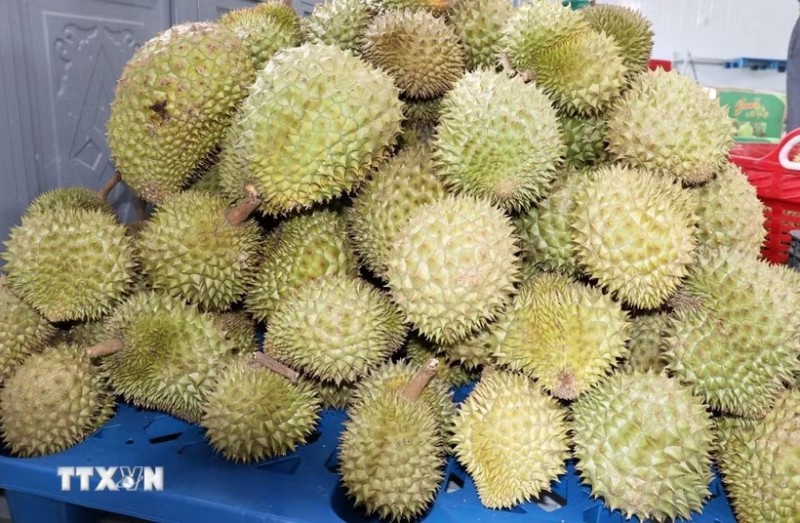 |
| Durian has become a key export commodity, generating high incomes for growers in Dong Thap province. (Photo: VNA) |
To achieve the target of US$74 billion in agricultural, forestry and fishery exports in 2026, the fruit and vegetable sector is expected to remain one of the key drivers of growth. With double-digit growth and substantial untapped market potential, particularly in China, the sector is well positioned for a breakthrough as obstacles related to growing area codes and packing facility codes are gradually being removed.
China is currently the world's largest fruit consumer and also the largest export market for Vietnamese fruit and vegetables. In recent years, the country's fruit import demand has continued to increase, creating significant opportunities for Vietnamese produce. Vietnam has surpassed Chile to become one of China's largest fruit suppliers, ranking second only to Thailand.
Notably, in the durian segment- the highest-value imported fruit in the Chinese market, Vietnam is competing directly with Thailand. In addition to durian, Vietnam is also a major supplier of bananas, fresh coconuts, longan, lychee and several other fruits.
According to Nguyen Thanh Binh, Chairman of the Vietnam Fruit and Vegetable Association, although fruit and vegetable exports to China have already exceeded US$5.5 billion, there remains considerable room for further growth. Vietnamese fruit is still concentrated in only a number of regions and has yet to penetrate many inland localities across China.
Besides fruits already exported through official channels, Vietnam still has many promising products awaiting market access through plant quarantine protocols. Citrus fruits are a typical example. Currently, only pomelos and lemons are eligible for official export to China, while oranges and mandarins have yet to gain access. Custard apples, avocados and several other fruits are also considered to have strong potential in this market.
Among the sector's key export products, durian continues to be regarded as the most important growth driver. According to the Department of Crop Production and Plant Protection, Vietnam currently has around 192,000 hectares of durian cultivation. Output reached approximately 1.8 million tonnes in 2025 and is expected to increase to 2-2.1 million tonnes in 2026. Vietnamese durian is now exported to 28 markets worldwide.
Bananas are also considered to have significant growth potential. In 2025, the global banana trade was valued at approximately US$16.7 billion. Vietnam is currently among the world's top 10 banana exporters, with export turnover reaching around US$418.7 million, while China imports nearly US$1 billion worth of bananas each year.
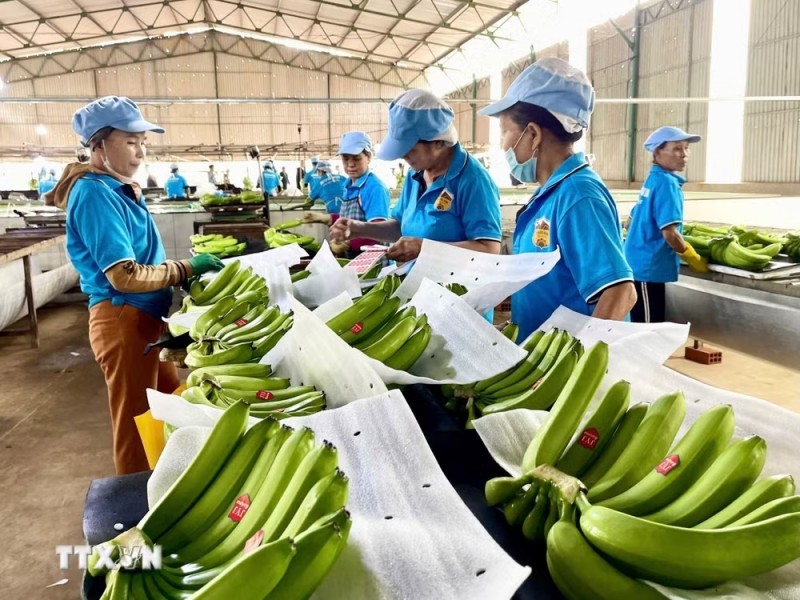 |
| A banana processing facility for export operated by Hoang Anh Gia Lai Agriculture Joint Stock Company (Unifarm) in Lo Pang commune, Gia Lai province. (Photo: VNA) |
According to Nguyen Quoc Manh, Deputy Director of the Department of Crop Production and Plant Protection, China remains the most important market for Vietnamese fruit and vegetables. In recent years, exports to China have maintained annual growth of around 65–70%. Therefore, maintaining and expanding market access to China is crucial to the growth of the entire sector. However, opportunities also come with considerable challenges. Import markets are imposing increasingly stringent requirements on product quality, food safety and traceability.
Meanwhile, rising input costs and stricter production standards are placing growing pressure on producers and businesses. One of the biggest bottlenecks at present is the issuance and management of growing area codes and packing facility codes, which are mandatory requirements for the official export of many fruit products to major markets, including China.
To address these challenges, while awaiting a comprehensive revision of Government Decree No. 38/2026/ND-CP governing the import of plants with soil attached as well as growing area and packing facility codes, the Government has issued Resolution No. 36/2026/NQ-CP, simplifying administrative procedures related to these codes.
The Resolution shortens processing times, reduces compliance costs while strengthening post-clearance inspections, traceability and enforcement against violations. It is expected to provide fresh momentum for exports as the Central Highlands enters the peak durian harvest season.
At the same time, the agricultural sector is promoting the development of a database of growing area codes linked to the national land database while encouraging the establishment of cooperatives and production linkages to develop large-scale concentrated production areas that meet the requirements of importing markets.
Alongside efforts to remove procedural bottlenecks, the Ministry of Agriculture and Environment is actively negotiating with China to expand the list of fruits eligible for official export, while also promoting market access for a wider range of fruits in the United States, Japan, the Republic of Korea, Australia and other high-value markets.
According to Nguyen Quoc Manh, the growth model of Vietnam's fruit and vegetable sector is no longer based primarily on expanding cultivation areas, but is shifting towards improving quality, increasing added value and ensuring sustainable development. The sector is pursuing a comprehensive transformation of its value chain from production, processing and logistics to traceability and digital transformation in order to enhance competitiveness.
As global demand for fruit continues to rise, together with measures to remove bottlenecks related to growing area codes and expand export markets, the fruit and vegetable sector is expected to become one of the strongest growth drivers of Vietnam's agricultural industry. If opportunities in major markets are effectively leveraged, the sector will make a significant contribution to achieving the country's target of US$74 billion in agricultural, forestry and fishery exports in 2026.
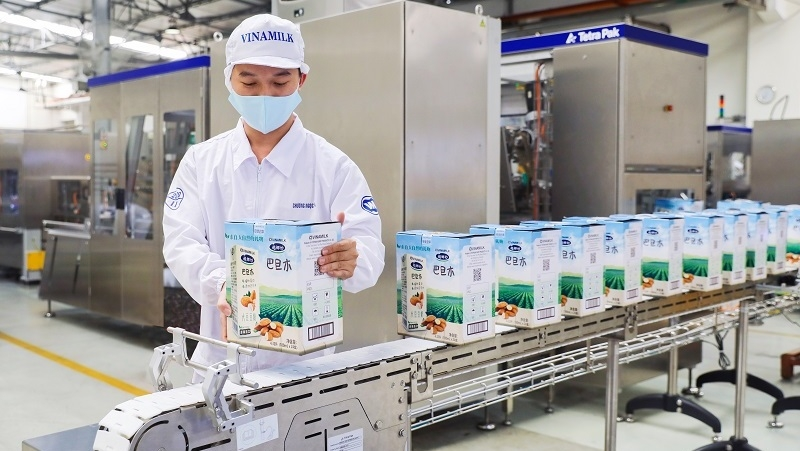 Vinamilk exports large shipments of seed, condensed milk to China Vinamilk exports large shipments of seed, condensed milk to China Vietnamese dairy giant Vinamilk successfully exported large shipments of seed and condensed milk to China during the opening weeks of the year. |
 Vietnam Expects Chinese Market Opening For Agro-fishery Products Vietnam Expects Chinese Market Opening For Agro-fishery Products Deputy Prime Minister Tran Luu Quang wished that the Chinese Government and Yunnan province continue to facilitate trade, speed up market opening for agricultural, aquatic products, and processed foods, and improve customs clearance efficiency. |

Most read


Related Stories
 Economy
New Drivers Promote Vietnam-China People-to-people Exchange
 Economy
Chinese Businesses Value Agricultural Mechanisation Cooperation with Vietnam
 Economy
Vietnamese and Chinese Customs Strengthen Cooperation to Combat Cross-Border Smuggling
 Viets Home
Vietnamese Intellect Showcased at International Economics Olympiad 2026
Recommended
 Economy
India expands its defence exports
 Economy
India’s manufacturing export engine is finally revving up with four driving forces
 Economy
High-Tech Exports Drive Vietnam’s Economic Acceleration
 Economy
Azbil to Present Automation Solutions as a Platinum Partner at Industrial Transformation ASIA-PACIFIC 2026
Popular article
 Economy
New Opportunities for Breakthroughs In Viet Nam - Canada Science and Technology Cooperation
 Women in Business
Mai Kiều Liên: From a dairy engineer to one of Asia's 100 most powerful women
 Economy
HID Enhances FARGO® DTC Printer Line to Help Organizations Issue Faster, More Secure ID Cards
 Economy