
Chinese Businesses Value Agricultural Mechanisation Cooperation with Vietnam
According to several Chinese agricultural equipment manufacturers, Vietnam’s agricultural modernisation, together with its growing need to improve productivity, reduce production costs, and accelerate mechanisation, is opening up substantial cooperation opportunities for Vietnam's and China's enterprises in agricultural machinery.
Speaking to the VNA correspondent in China, company representatives said mechanisation not only replaces manual labour but also improves production efficiency, shortens planting and harvesting times, reduces post-harvest losses and enhances agricultural product quality. For rice-producing countries such as Vietnam, stronger mechanisation is considered an inevitable trend in improving the agricultural sector’s competitiveness.
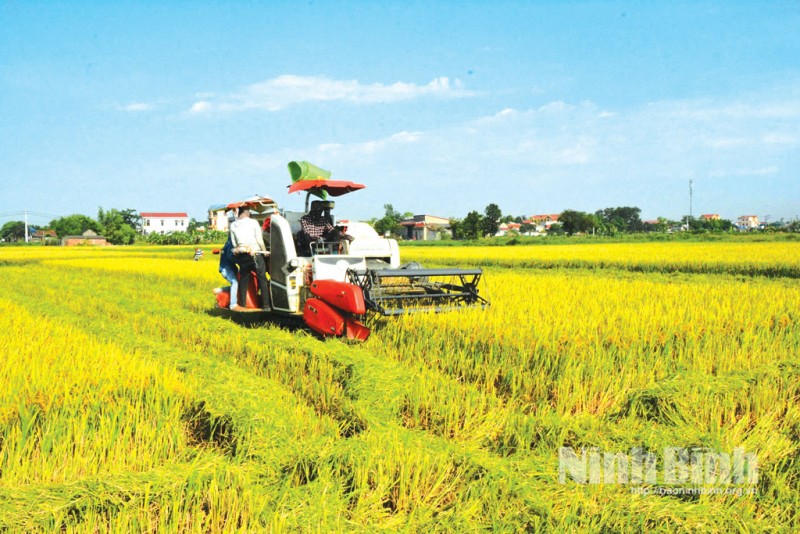 |
| Promoting agricultural mechanisation encourages farmers to embrace science and technology while improving economic efficiency. (Photo: Ninh Binh Newspaper) |
Representative of Shandong Jindafeng Machinery Co., Ltd. Wei Xiaoli said Vietnam is among Southeast Asia’s most promising markets for agricultural machinery, thanks to its extensive farmland, rising demand for mechanisation and farming conditions similar to those of other countries in the region. Small- and medium-sized machinery suited to smaller fields, soft soil and hot, humid conditions is considered particularly capable of meeting the market’s practical needs.
Chinese businesses noted that bilateral cooperation in agricultural mechanisation is no longer confined to commercial transactions but is gradually shifting towards a more comprehensive model covering technology transfer, technical training, maintenance systems, spare-parts supply and after-sales service networks. These factors are regarded as essential to ensuring the efficient use of agricultural machinery and extending equipment lifespans.
The entry into force of the Regional Comprehensive Economic Partnership (RCEP), together with China’s complete agricultural machinery supply chain, is also creating favourable conditions for expanding cooperation with ASEAN countries, including Vietnam. In addition to exporting equipment, many businesses are interested in cooperating with Vietnamese partners in product assembly, distribution network development and the establishment of technical service centres once the market reaches sufficient scale.
Chinese business representatives said Vietnam is promoting modern agriculture, applying science and technology and shifting towards large-scale production, creating room for greater use of machinery in land preparation, sowing, planting, crop care and harvesting. This is considered an important foundation for the two countries to expand cooperation in agricultural mechanisation, improve labour productivity, reduce production costs and promote sustainable agricultural development.
According to businesses, in the coming years, Vietnam-China cooperation in agricultural machinery will expand from equipment trading to long-term partnerships in technology, technical services and human resources training. This cooperation would not only support Vietnam’s agricultural modernisation needs but also generate fresh momentum for bilateral economic ties in the agricultural sector.
 Vietnamese and Chinese Customs Strengthen Cooperation to Combat Cross-Border Smuggling Vietnamese and Chinese Customs Strengthen Cooperation to Combat Cross-Border Smuggling To implement the mutual understandings reached by the senior leaders of the two countries, Vietnam Customs and the General Administration of Customs of China have agreed to strengthen cooperation in investigations and efforts to combat smuggling and trade fraud while enhancing information exchange, coordinated inspections, and law enforcement against cross-border crimes. |
 Removing Bottlenecks, Opening Wider Access for Vietnamese Fruit to the Chinese Market Removing Bottlenecks, Opening Wider Access for Vietnamese Fruit to the Chinese Market Rising demand in China, together with efforts to address bottlenecks related to growing area codes and packing facility codes, is creating new opportunities for Vietnamese fruit to accelerate exports and expand its market share in the billion-consumer market. |

Most read


Related Stories
 Friendship
Events That Bring Partners Together
 Economy
New Drivers Promote Vietnam-China People-to-people Exchange
 Economy
Hanoi Promotes Investment and Tourism Potential to French Business Community
 Economy
Removing Bottlenecks, Opening Wider Access for Vietnamese Fruit to the Chinese Market
Recommended
 Economy
KPLASS Singapore Officially Launches Its Far-Infrared Patches in Vietnam
 Economy
India expands its defence exports
 Economy
India’s manufacturing export engine is finally revving up with four driving forces
 Economy
High-Tech Exports Drive Vietnam’s Economic Acceleration
Popular article
 Economy
Azbil to Present Automation Solutions as a Platinum Partner at Industrial Transformation ASIA-PACIFIC 2026
 Economy
New Opportunities for Breakthroughs In Viet Nam - Canada Science and Technology Cooperation
 Women in Business
Mai Kiều Liên: From a dairy engineer to one of Asia's 100 most powerful women
 Economy