
Transforming Local Resources into Sustainable Livelihoods for Communities
 | Prime Minister: Combating IUU Fishing, Advancing Sustainable Fisheries |
| Oxfam Amplifies Indigenous Knowledge, Paving the Way for Sustainable Livelihoods |
Turning Pineapple Leaves into Fibers for the Textile Industry
Taking the stage in an ao dai made from pineapple fiber, Tran Thi My Hai, Chairwoman of the Board of Directors of Vietfiber Research, Investment and Development Joint Stock Company (Vietfiber), held in her hand a bundle of raw fiber - the input material of the production process currently implemented by the enterprise.
Originally a researcher in the field of spinning, Hai decided in 2023 to establish Vietfiber with the aim of separating bast fibers from agricultural by-products into cottonized fibers - fibers with properties similar to cotton that can be used on existing cotton spinning lines in the textile industry. According to her, cottonization is the core technology of the project, intended to supply natural fibers to Vietnam’s textile industry at a time when the country ranks second globally in yarn exports yet remains heavily dependent on imported cotton fibers.
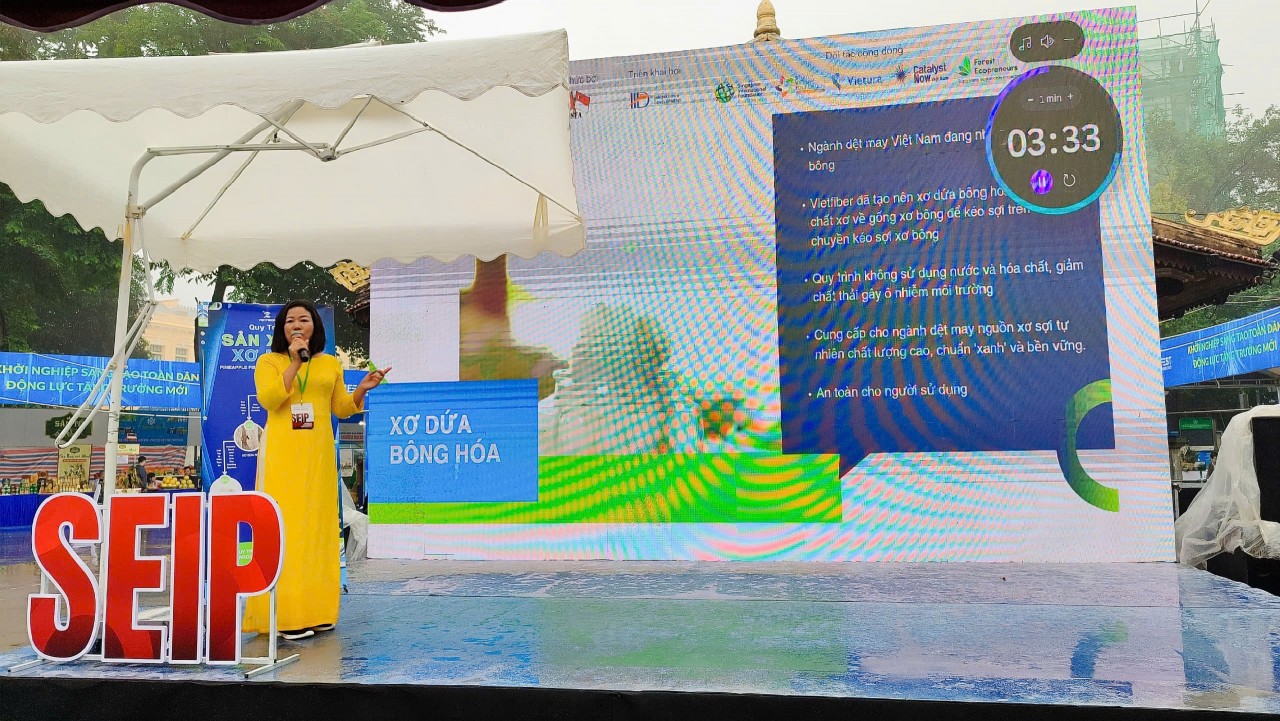 |
| Tran Thi My Hai, Chairwoman of the Board of Directors of Vietfiber Research, Investment and Development Joint Stock Company (Vietfiber), presents the project at Demo Day - SEIP 2025. (Photo: Thanh Luan) |
Tran Thi My Hai noted that in pineapple-growing areas, leaves left after harvest are often burned or treated with herbicides. Collecting pineapple leaves for fiber production helps reduce CO₂ emissions and limit the use of chemicals in cultivation. Instead of becoming agricultural waste, pineapple leaves are incorporated into the production chain, supplying raw materials for the textile industry.
Vietfiber produces cottonized fibers through a process that uses no water, no chemicals, and generates no waste released into the environment. Fibers that meet standards are used for textiles, while by-products are utilized as animal feed.
From this fiber source, Vietfiber has developed several application products, including socks branded “Moc,” made from a blend of pineapple fiber and viscose, without bleaching or dyeing. According to the company, thanks to the properties of pineapple fiber, the products offer natural antibacterial characteristics, breathability, and moisture absorption.
Vietfiber also transfers technology for producing pineapple fiber and banana fiber, provides specialized fiber training, and offers technical consultancy for spinning mills. Based on calculations presented by Ms. Hải, if approximately 5,200 hectares of pineapple cultivation are effectively utilized, the model could create jobs for around 1,650 female workers nationwide. Participating in SEIP 2025, Vietfiber has adjusted its brand identity system, redesigned its logo, and developed a new slogan. At Demo Day, the enterprise called for an investment of USD 500,000 to supplement equipment for extracting raw fiber from pineapple leaves.
“The current capacity of our cottonized fiber factory in Long An is about three tons. However, due to insufficient investment in equipment for extracting fiber from pineapple leaves, the quality of input materials has not yet been stable and output remains limited. Therefore, we are calling for investment in a raw fiber extraction machinery system to secure a stable supply of materials for the factory,” Hai said.
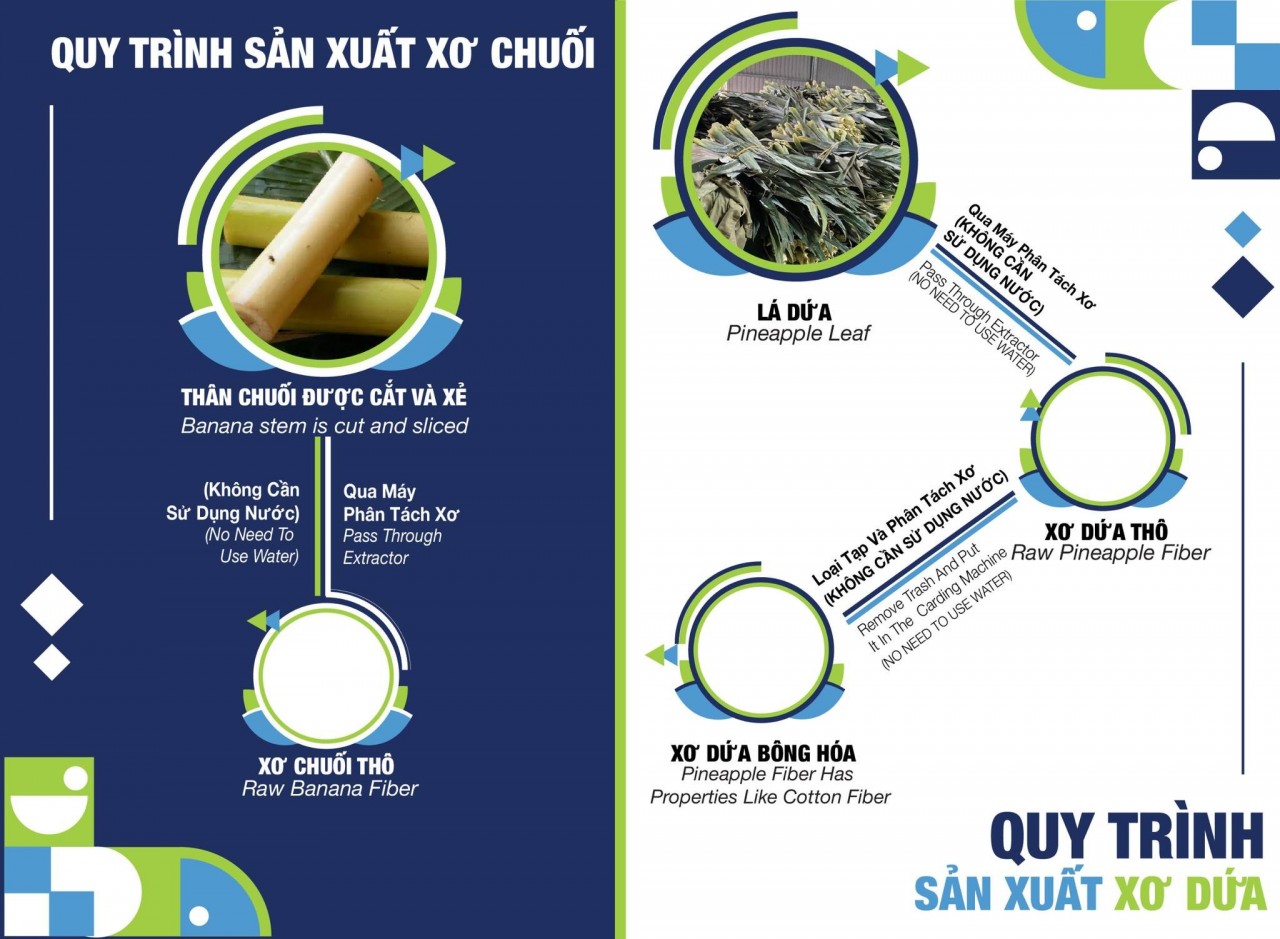 |
| The production process of raw pineapple fiber, cottonized pineapple fiber, and raw banana fiber at Vietfiber. (Photo: Vietfiber) |
Livelihoods Under the Mangrove Canopy
The story of Tai Thinh Phat Farm Cooperative began in the mangrove forests of Ca Mau. According to Mai Thi Thuy Trang, Director of the Cooperative, the organization was established with the goal of developing a sustainable raw-material area that both protects the mangrove ecosystem and increases income for local communities.
After returning to her hometown following many years of working in the corporate sector, Trang directly engaged with the lives of households raising shrimp and crabs naturally under the forest canopy, where livelihoods were largely unstable. From this reality, the Cooperative was formed to restructure production processes and strengthen linkages within the raw-material area.
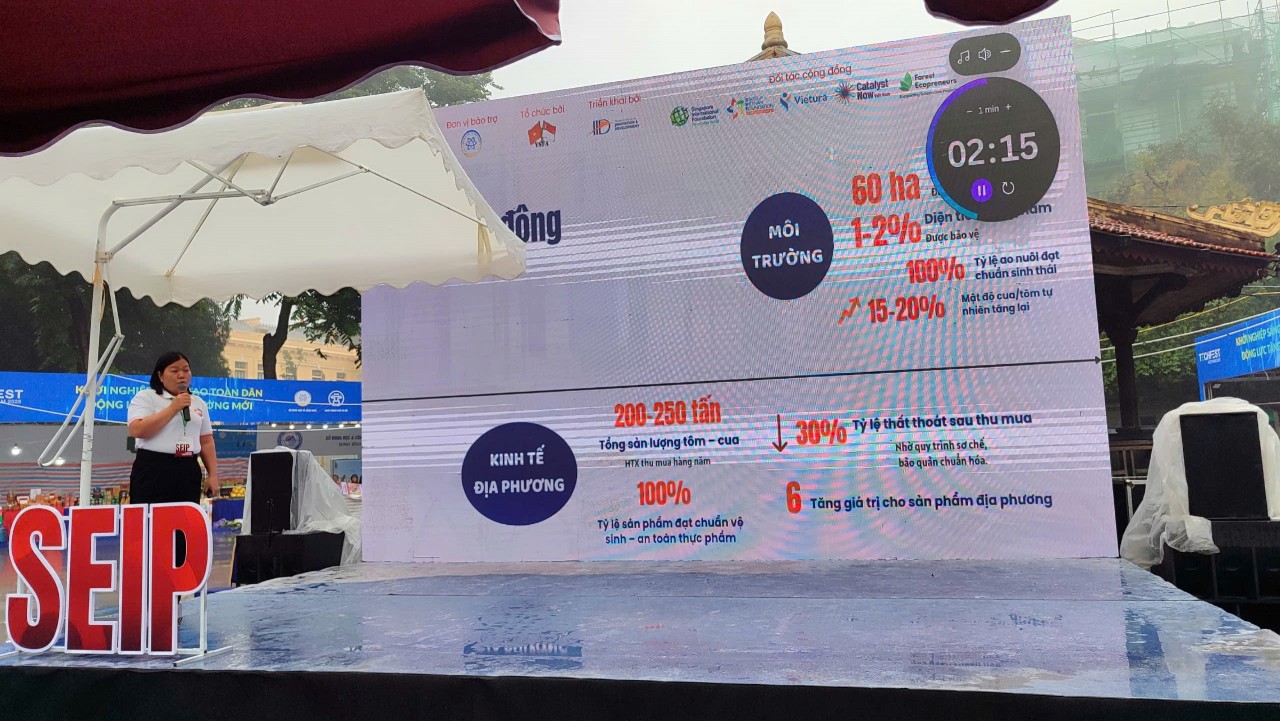 |
| Mai Thi Thuy Trang, Director of Tai Thinh Phat Farm Cooperative, presents the project at Demo Day - SEIP 2025. (Photo: Thanh Luan) |
Currently, Tai Thinh Phat Farm manages and participates in the protection of approximately 60 hectares of mangrove forest, with forest coverage increasing by an average of 1-2% each year. All farming ponds in the area apply a natural shrimp-farming model under the mangrove canopy, with annual input material output reaching around 200-250 tons.
The Cooperative’s products are now supplied to several distribution systems and restaurants such as Aeon Mall, Lotte, and Pizza 4P’s. In particular, Tai Thinh Phat Farm provides raw materials to Pizza 4P’s in accordance with the partner’s specific technical requirements.
Alongside production activities, the Cooperative works with approximately 320 farming households. Women not only participate in farming but also work directly at the processing facility, taking part in training courses on production skills, household financial management, and teamwork.
“After three months of participating in SEIP 2025, the Cooperative was supported in rebuilding its brand identity and completing product packaging. We are more confident in bringing our products to the market with a new brand image. At present, the Cooperative hopes to continue receiving support in terms of investment and funding for local farmers, with a focus on enhancing skills and learning capacity,” Trang said.
Employment Opportunities for People with Disabilities
The April 18 Vocational Training and Rehabilitation Cooperative for People with Disabilities (Thanh Hoa), led by Ngo Van Bieu - a visually impaired individual and the father of two children with disabilities, as Director, was established with the aim of providing charitable vocational training, creating jobs, and supporting sustainable livelihoods for people with disabilities.
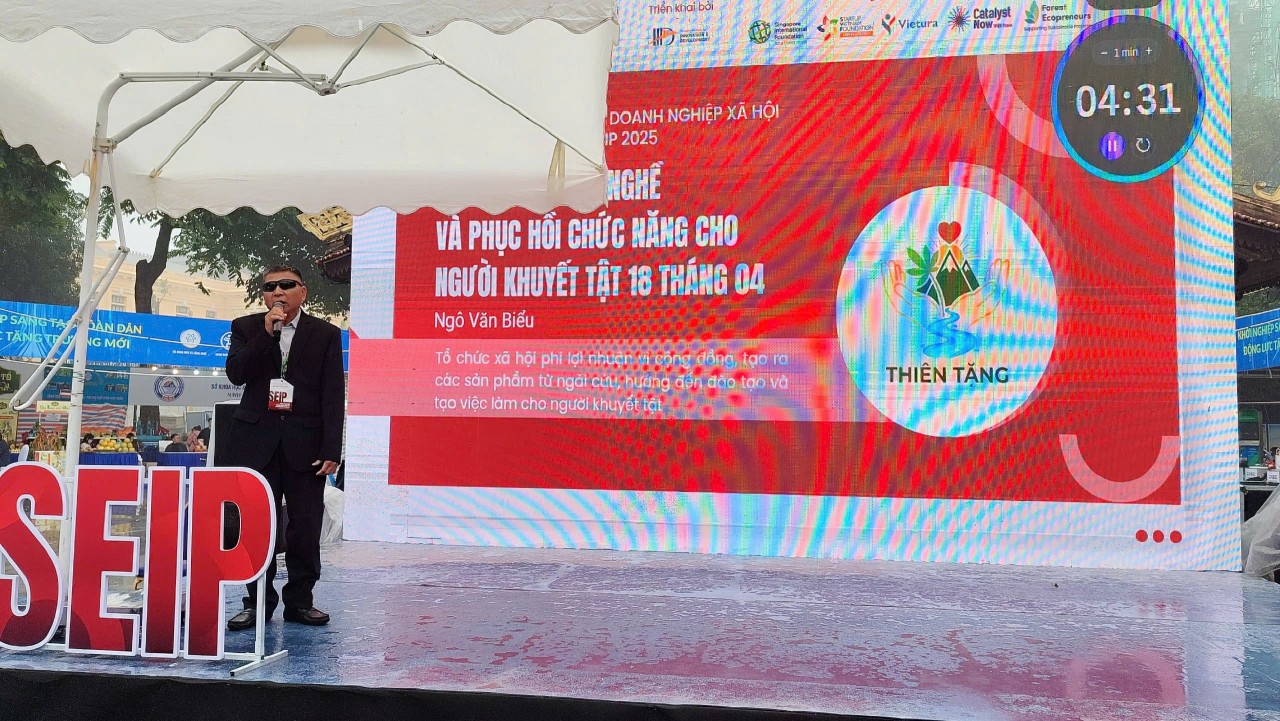 |
| Ngo Van Bieu, Director of the April 18 Vocational Training and Rehabilitation Cooperative for People with Disabilities, hopes to receive support in training skills for medicinal herb cultivation and processing, as well as building traceability systems. (Photo: Thanh Luan) |
The Cooperative currently has 197 members and operates in fields including handicrafts, traditional massage therapy, healthcare services, and the cultivation and processing of medicinal herbs derived from local plants. Among these, mugwort has been selected as the primary raw material for product development.
Through the program, the Cooperative has developed multiple healthcare product lines from mugwort, guided by the principle: “people with disabilities, not defective products.” These products include infrared mugwort mattresses; mugwort extract; mugwort capsules; moxibustion devices; multifunctional mugwort powder used for steaming, foot soaking, applying to the soles of the feet, or filling pillows; as well as various mugwort incense products.
According to Bieu, all of the Cooperative’s products are manufactured through processes that use no chemicals, no preservatives, and no toxic substances, with a strong orientation toward environmental friendliness. Raw materials are fully utilized, from leaves and stems to roots, without generating polluting waste, while microorganisms and insects in the cultivation areas are preserved.
Currently, the Cooperative directly manages and cultivates more than 6,000 square meters of land for medicinal herbs, creating jobs for people with disabilities and their family members, while also contributing to raising community awareness at the local level.
Ngo Van Bieu noted that support from the SEIP program, particularly in building brand identity systems, labels, and packaging, has helped the Cooperative better understand the role of branding in connecting products with consumers. In the coming period, the Cooperative hopes to receive further support in training skills for medicinal herb cultivation and processing, developing systems for traceability and origin identification, and cooperating with investors to produce in accordance with appropriate standards that meet the requirements of both domestic and international markets.
SEIP 2025 was initiated by the Vietnam-Singapore Friendship Association, with strong support and recognition from the Ministry of Science and Technology, and is implemented in coordination with the Institute for Innovation and Development (IID) and a network of Vietnamese, Singaporean, and international partners.
According to information from the Vietnam-Singapore Friendship Association, through six training sessions, SEIP 2025 has supported the top 20 enterprises across a wide range of fields, from regenerative agriculture, conservation and development of indigenous medicinal resources, handicrafts, and community education to sustainable textiles. Many enterprises in remote and disadvantaged areas gained access for the first time to systematic communication and design toolkits, significantly improving brand recognition and positioning in the eyes of customers and investors. Over three months (from October to December 2025), the top six enterprises made clear progress in refining their logos, slogans, color systems, pilot packaging, and brand stories, while also building market-access strategies tailored to specific target customer groups.
Speaking at the event, Vu Viet Ngoan, former Head of the Prime Minister’s Economic Advisory Group and President of the Vietnam-Singapore Friendship Association, stated that SEIP 2025 demonstrates how social and ecological enterprises, when provided with structured support in branding and market connectivity, can generate tangible and sustainable development value for communities. He expressed his hope that partners, investors, and experts will continue to accompany the program so that these exemplary models can be more widely disseminated in the future.
 | Economic Diplomacy: Perspective from Activities of Viet Nam-Singapore Friendship Association In the context of Viet Nam actively implementing its policy of economic diplomacy to serve national development, the activities of the Viet Nam-Singapore Friendship Association ... |
 | SEIP 2025: Launchpad for Innovation among Vietnamese Social Enterprises On December 13 in Hanoi, within the framework of the Vietnam National Innovative Startup Festival 2025 (TECHFEST Vietnam 2025), the Demo Day recap event of ... |
Related Stories
 National
Vietnam News Today (Jun. 24): Vietnam, Cuba Push for Stronger Ties in New Development Period
 Viet's Home
Turning Waste into Resources for Sustainable Development in Tuyen Quang
Recommended
 Economy
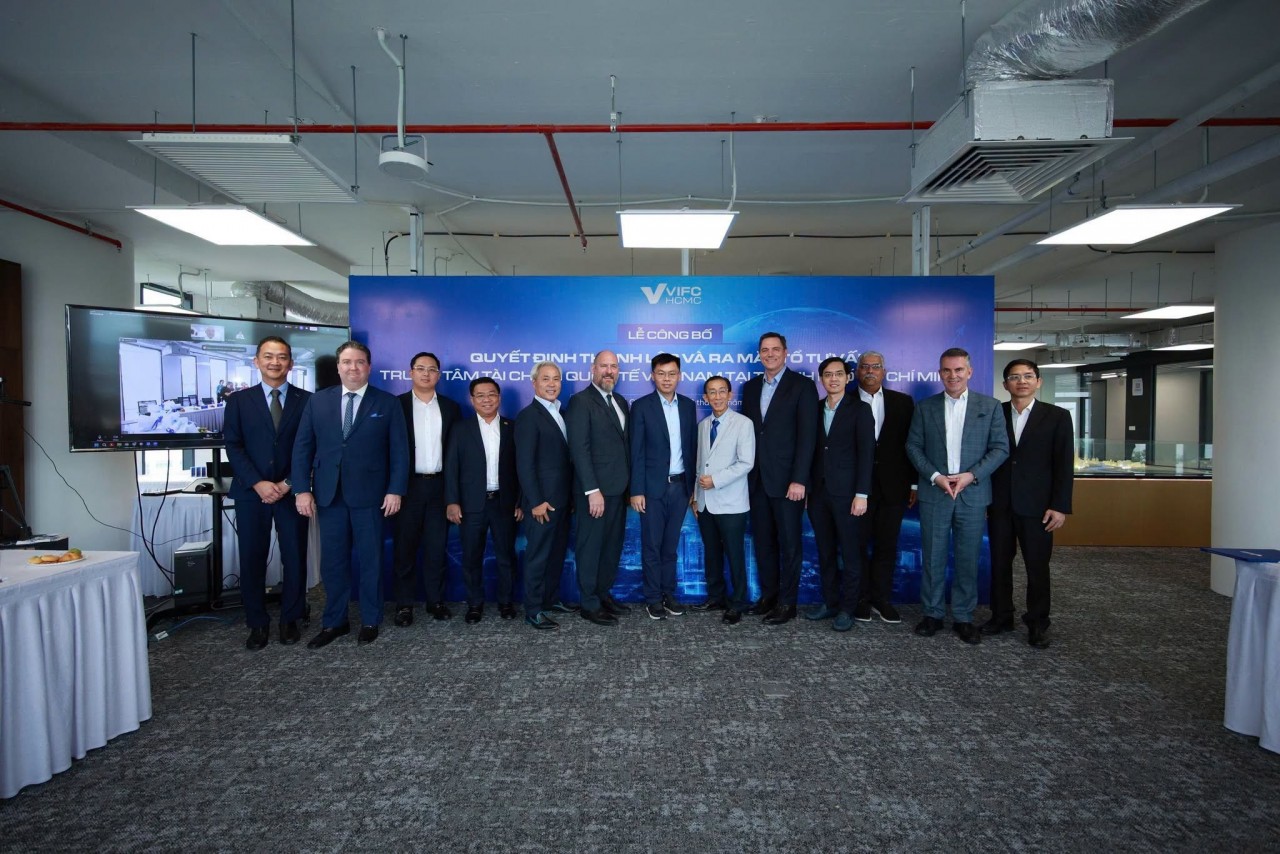
13 Economic Experts Join Advisory Board of VIFC-HCMC
 Economy
Expanding Opportunities for Vietnamese Businesses in US Market
 Economy