
Viet Nam Among Countries Making Significant Progress in Quality Infrastructure
| Infrastructure work on 11 smart industrial cities in India to begin by December 2025 Ministry of Science and Technology Reviews Tech Infrastructure to Combat IUU Fishing in Ho Chi Minh City |
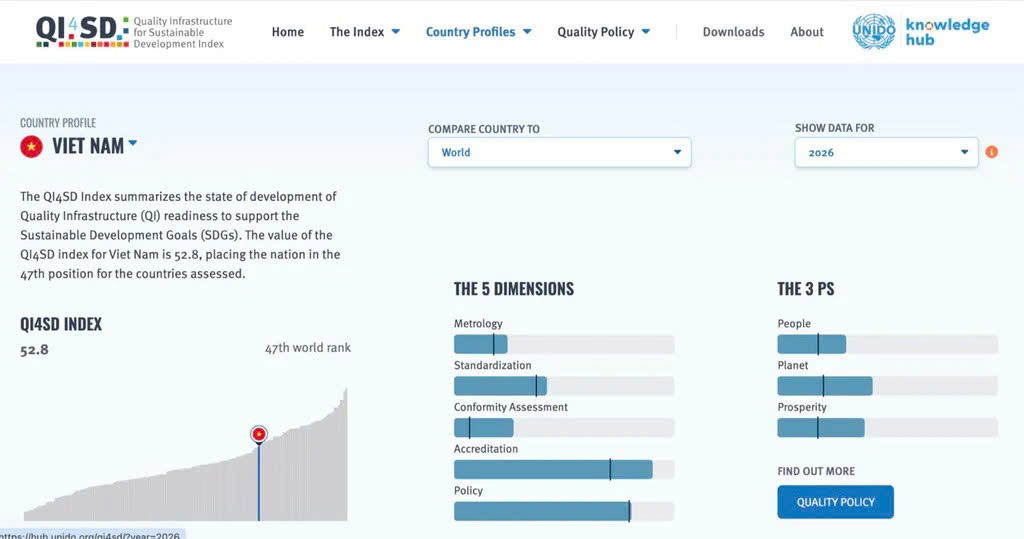 |
| Viet Nam ranks 47th out of 170 countries and territories in the Quality Infrastructure for Sustainable Development Index. |
According to the 2026 Quality Infrastructure for Sustainable Development Index (QI4SD), released by the United Nations Industrial Development Organization (UNIDO) at the 2026 Global Quality Forum, held in Vienna from November 4 to 6, Viet Nam scored 52.8 points, ranking 47th among the 170 countries and territories assessed.
QI4SD is an index developed by UNIDO and first published in 2022 to assess the level of development of a country's quality infrastructure system and its capacity to contribute to the achievement of the United Nations Sustainable Development Goals (SDGs). The QI4SD score is calculated based on 37 indicators across five pillars: standardization, metrology, accreditation, conformity assessment, and quality policy.
In the QI4SD framework, “quality infrastructure” (QI) does not refer to physical infrastructure such as roads, bridges, factories or data centres. Rather, it encompasses a system of organizations, regulations, standards, procedures and technical services designed to ensure that products and services meet quality, safety and environmental requirements. QI enables a country to measure, test, certify and assure the quality of products and services in accordance with common standards.
Compared with the 2024 assessment, Viet Nam's score increased by 1.6 points, from 51.2 to 52.8. Its ranking, however, fell from 42nd to 47th, partly because the number of countries and territories assessed increased from 155 to 170.
This year, UNIDO conducted, for the first time, an analysis of progress between assessment cycles using a set of indicators harmonized in terms of methodology and data, known as the Harmonised QI4SD Index. This approach helps identify substantive improvements across individual components of the quality infrastructure system, rather than relying solely on overall rankings. Due to changes in the scope of countries, indicators and assessment methodology, the composite scores from the two assessment cycles cannot be directly compared as an absolute measure of progress.
In addition to recording an increase in its score, Viet Nam was also selected by UNIDO for inclusion in the group of countries that made significant improvements in quality infrastructure during the 2024-2026 period, alongside Colombia, Iran, Nigeria and Uzbekistan.
According to a representative of the National Committee for Standards, Metrology and Quality, UNIDO's recognition is a “positive signal” regarding the efforts made to develop quality infrastructure in recent years. It highlights the importance of coordinated investment in the capacities for standardization, metrology, accreditation and conformity assessment.
As economies transition towards greener, digital and more sustainable development models, quality infrastructure is becoming an important foundation for improving product quality, ensuring safety, facilitating trade and supporting innovation. The 2026 QI4SD results not only recognise Viet Nam's progress but also underscore the need to translate improvements in quality infrastructure capacity into tangible benefits for businesses, citizens and the economy.
Quality infrastructure is not merely a tool for product control; it also helps boost productivity, improve production efficiency and expand opportunities for participation in global value chains.
For Viet Nam, particularly in export-oriented sectors such as textiles and garments, agricultural products, food and industrial goods, strengthening the adoption of international standards and enhancing capacities in metrology, traceability and conformity assessment are crucial to meeting increasingly stringent market requirements.
As trade becomes increasingly linked to sustainable development, the ability to demonstrate compliance is emerging as a competitive advantage for businesses. Therefore, the coordinated development of quality infrastructure, with standardization, metrology, accreditation and conformity assessment activities aligned with the practical needs of production, will help improve product quality, enhance market access and promote the sustainable participation of Vietnamese businesses in international supply chains.
 Vietnam-Japan Sign ODA Loan Agreements for Climate-Resilient Infrastructure Projects |
 Preparing for APEC 2027: Accelerating Completion of Media Infrastructure to Support International Press |




Popular article
 Handbook
Storytellers of Andersen’s Fairy Tales
 Handbook
“Anna Karenina” Translated Directly from Russian into Vietnamese For the First Time
 Handbook
Viet Nam Unveils Its First Secure Semiconductor Chip and Platform
 Handbook