New bridge inaugurated to boost Laos–Thailand–Vietnam trade connectivity
The fifth Laos–Thailand Friendship Bridge spanning the Mekong River was inaugurated on Thursday, marking an important step in strengthening transport connectivity and promoting trade within the Mekong sub-region, particularly among Vietnam, Laos and Thailand.
The inauguration ceremony was attended by General Secretary of the Lao People’s Revolutionary Party and President of Laos Thongloun Sisoulith and his spouse, and Thailand’s King Maha Vajiralongkorn Phra Vajiraklaochaoyuhua and Queen, and as well as senior leaders of Laos and Thailand, among others.
Addressing the event, Lao Prime Minister Sonexay Siphandone and Thai Prime Minister Anutin Charnvirakul stressed that the project reflects close cooperation between the two governments and the aspirations of their people, particularly those of Bolikhamxay province (Laos) and Buengkan (Thailand). The bridge helps connect Laos to the region along the East–West Economic Corridor, facilitating transport, trade and tourism and delivering tangible benefits to the two countries, VNS reported.
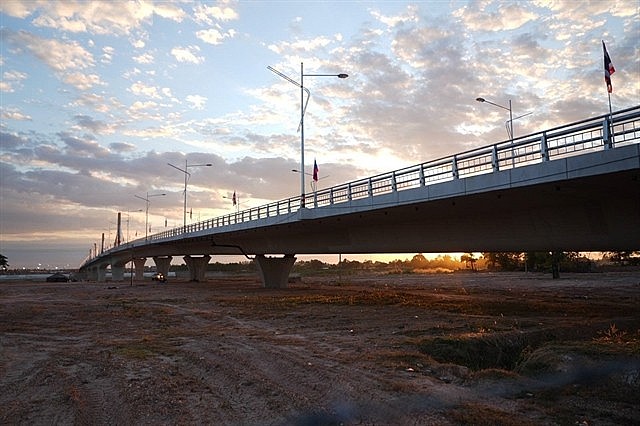 |
| The fifth Laos–Thailand Friendship Bridge spanning the Mekong River was inaugurated on Friday. Photo: VNA/VNS |
The 1,350m bridge significantly shortens the distance from Buengkan in northeastern Thailand, through Bolikhamxay in central Laos, to the Cau Treo border gate in Vietnam’s central province Hà Tĩnh to just over 200km, compared to more than 350 km previously, creating the shortest and most convenient route for transporting goods from Thailand to Vietnam.
The project is expected to open up new opportunities for economic development, trade, investment and tourism for the two border provinces of Bolikhamxay and Buengkan, and the wider Greater Mekong Sub-region (GMS), which includes Vietnam, Cambodia, Myanmar, and China’s Yunnan and Guangxi provinces.
The fifth bridge continues a series of Laos–Thailand transport cooperation projects following four friendship bridges already in operation, and is expected to further deepen traditional friendship and comprehensive cooperation between Laos and Thailand while enhancing connectivity with Vietnam, contributing to a more dynamic and integrated Mekong sub-region.
High standards key for businesses to unlock VEFTA benefits
After more than a decade of negotiations, the Vietnam–EFTA Free Trade Agreement (VEFTA) is expected to open up significant opportunities for Vietnamese businesses to access some of the world’s highest-income markets.
An assessment report on the impacts of the VEFTA on Vietnam was unveiled at a workshop in Hanoi on December 26.
Conducted and produced by the Foreign Trade University in collaboration with experts, the report is part of the sub-project “Promoting Vietnam–EFTA trade relations through a series of training and capacity-building consultancy activities to maximise opportunities from the Vietnam–EFTA free trade agreement.”
Representing the research team of the sub-project, Vu Thi Phuong Mai said that at the macro level, VEFTA helped expand export markets to EFTA, improve the trade structure toward higher quality and value-added products, and enhance the investment environment through commitments on transparency, investment protection, and intellectual property, cited VNA.
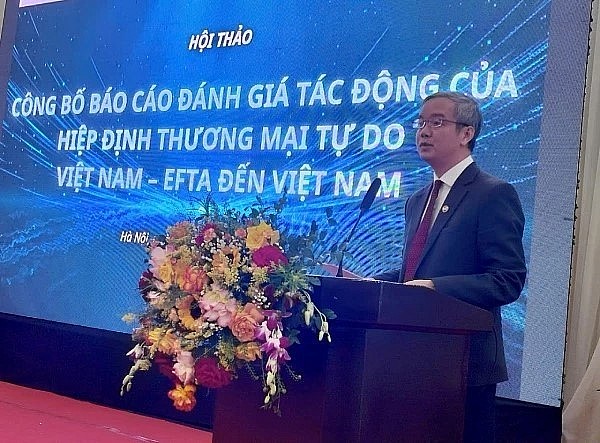 |
| Dao Ngoc Tien, Vice Rector of Foreign Trade University, speaks at the event. (Photo: doanhnghiepvn.vn) |
At the sectoral level, textiles and garments, footwear, agro-forestry-fishery products, food processing, and some services were expected to benefit clearly, while sectors such as transport equipment, steel, chemicals, finance–banking, and communications might face increased competitive pressure due to rising imports, she noted.
VEFTA was not merely a tariff-cutting agreement but a high-standard integration framework that imposed stringent requirements on labor, the environment, food safety, traceability, and sustainable development, Mai said.
For the State and ministries, the research team stressed that the focus must shift decisively from signing to implementation.
This includes continuing institutional reforms toward greater transparency, stability, and alignment with international standards. It also involves enhancing the capacity to implement commitments on investment, intellectual property, labor, and the environment. At the same time, efforts should be made to reduce compliance costs and improve the ability to absorb high-quality investment.
“For businesses, VEFTA requires a shift from price-based competition to standards-based competition. Enterprises need to proactively upgrade technology and governance, invest in cleaner production, traceability, and brand building associated with ESG criteria. Sectors facing competitive pressure need to restructure and improve efficiency to adapt to the new competitive environment,” Mai recommended.
For industry associations and intermediary organisations, VEFTA requires strengthening their role in providing substantive technical support to businesses, especially small and medium-sized enterprises, through information provision, training on rules of origin, SPS/TBT standards, and support in handling trade disputes.
For the education and research system, closer linkage with VEFTA implementation was needed through training human resources that meet international standards, while providing evidence-based analyses, impact assessments, and policy recommendations, she said.
“VEFTA is a major opportunity for Vietnam to penetrate deeper into high-end markets, but it is also a test of institutional reform capacity and value chain upgrading,” Mai stressed.
The effectiveness of VEFTA depended on close coordination among the State, businesses, associations, and education–research institutions to transform integration commitments into sustainable long-term growth, she added.
Speaking at the event, Dao Ngoc Tien, Vice Rector of the Foreign Trade University, said that VEFTA negotiations were launched in May 2012, with the most recent round (the 18th round) taking place in Da Nang last month.
Although negotiations have lasted more than 10 years, the agreement is expected to open up many new opportunities for trade and investment between Vietnam and EFTA countries–economies with high levels of development, stringent market standards, yet stability and transparency.
In this context, early preparation - both at the policy level by state management agencies and at the implementation level by businesses - was critically important, he said.
Highly commending the report, Ngo Chung Khanh, deputy director general of the Multilateral Trade Policy Department under the Ministry of Industry and Trade, said it was an important reference not only for state management agencies and negotiators, but also for businesses, especially those that are operating in or planning to enter the EFTA market.
The government’s current policy prioritised market diversification, he said. Rather than concentrating on a few traditional markets that entailed higher risks, Vietnam needed to diversify not only export markets but also import markets and supply partners, he noted.
Although the EFTA bloc has a relative small population, it enjoys very high income levels and significant untapped potential, he added.
The EFTA bloc, comprising Switzerland, Norway, Iceland, and Liechtenstein, has a combined GDP of about 1.3 trillion EUR (1.5 trillion USD), high living standards, and strong demand for high-quality products.
Sa Dec Flower Festival 2025: Vietnam-shaped floral map sets national record
A Vietnam-shaped map created from the largest number of flower and ornamental plant varieties nationwide was recognized as a national record at the opening ceremony of the second Sa Dec Flower and Ornamental Plant Festival 2025 on the evening of December 27.
At the ceremony, the Vietnam Record Organization – VietKings officially recognized the record for “the Vietnam-shaped map formed from the largest number of flower and ornamental plant varieties in Vietnam,” created for the festival.
In his opening speech, Pham Thanh Ngai, Deputy Secretary of the Dong Thap provincial Party Committee and Chairman of the People’s Committee of Dong Thap province, said the second Sa Dec Flower and Ornamental Plant Festival presents a new look and fresh momentum, featuring a wide range of activities from workshops on high-tech applications to immersive art spaces and floral fashion shows.
He said the festival reflects a strong commitment by the provincial Party organization, local government and people of Dong Thap to continuing efforts to build a modern, green and sustainable agricultural ecosystem, cited VOV.
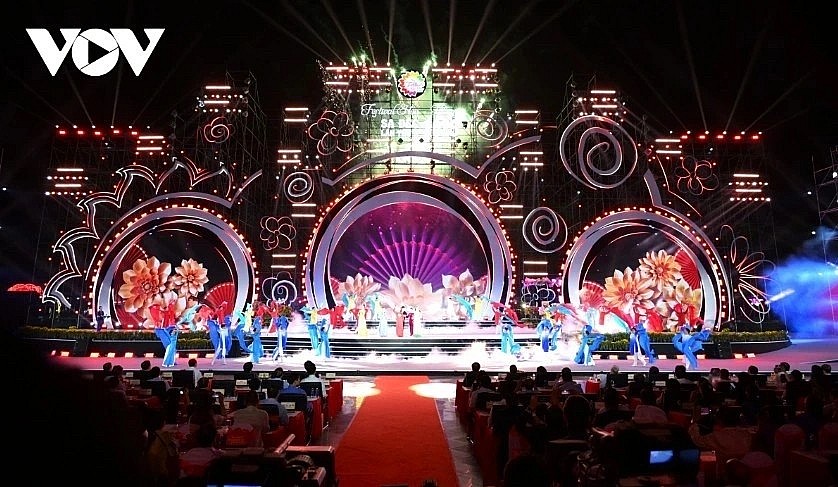 |
| Photo: VOV |
This commitment, he noted, is made even more meaningful as folk knowledge, traditional crafts and the province’s flower and ornamental plant cultivation profession have been officially inscribed on Vietnam’s national list of intangible cultural heritage.
“This is not merely a title, but a recognition of cultural values nurtured and preserved over generations,” Ngai stressed.
The Sa Dec Flower and Ornamental Plant Festival is held to honor the flower and ornamental plant cultivation profession, highlight its economic value, and promote the development of the sector in connection with agricultural tourism and the national One Commune, One Product (OCOP) program.
Through exhibitions, displays, contests, cultural and artistic activities, cuisine and entertainment programs, the festival introduces and promotes Sa Dec Flower Village to domestic and international visitors, while supporting trade, tourism and investment promotion, socio-economic development, and the enhancement of the locality’s image.
Ngai stressed that Sa Dec needs to be elevated, with visitors encouraged to come for experiences and visual impressions, while floral-based tangible and intangible products are developed to reach a wider public and connect with other signature products of the province.
This, he said, would help ensure that when Dong Thap is mentioned, it is immediately associated with fruit, flowers, rice and pangasius, contributing to the development of ecological agriculture, modern rural areas and smart farmers.
He added that every garden owner and resident of Sa Dec is a “tourism ambassador,” helping to spread the values and distinctive identity of the century-old flower village to visitors from near and far.
Also at the opening ceremony, the Ministry of Culture, Sports and Tourism awarded a certificate recognizing the Sa Dec flower and ornamental plant cultivation profession as part of Vietnam’s national list of intangible cultural heritage.
 | Vietnam News Today (Dec. 24): Vietnam - Rising Star in Asia Vietnam News Today (Dec. 24): Vietnam – A rising star in Asia: Indian professor; Valuable artifacts, documents on Vietnam-Indonesia friendship exhibited; Vietnam’s economy surges in ... |
 | Vietnam News Today (Dec. 25): Vietnam, Russia Explore Cooperation Opportunities in Digital Era Vietnam News Today (Dec. 25): Vietnam, Russia explore cooperation opportunities in digital era; Vietnam, Uzbekistan boost cooperation in trade, automobile industry and logistics; Vietnam’s 2025 ... |