
Connecting International Resources to Develop Youth Skills and Sustainable Employment
| Vietnam Summer Camp 2026 Opens to Foster Love and Pride for the Homeland “Encountering the Japanese Language in My Youth Was the Greatest Blessing of My Life” |
On July 31 in Hanoi, the Viet Nam Union of Friendship Organizations held a thematic workshop titled “Promoting cooperation with international partners to develop skills and sustainable employment for Vietnamese youth in the new development era.” The event brought together representatives from government agencies, educational institutions, businesses, social organizations, and foreign non-governmental organizations.
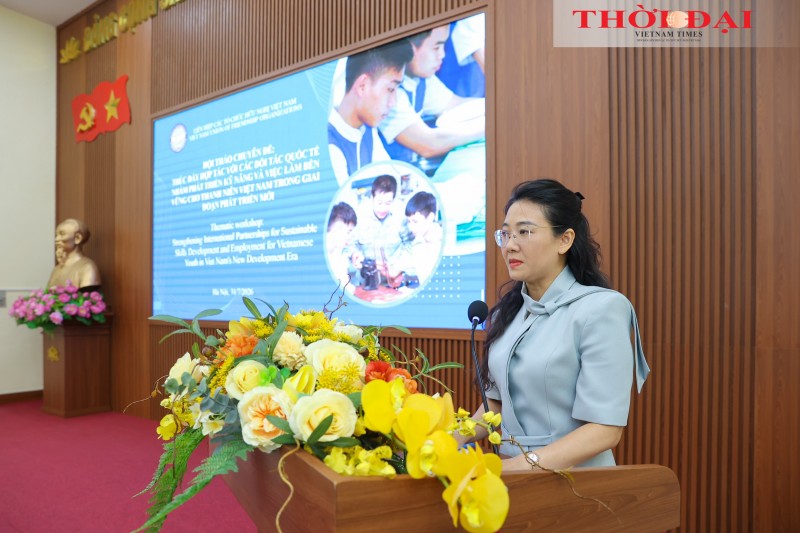 |
| Do Thi Kim Dung, Acting Director of the People's Aid Coordinating Committee (PACCOM) under the Viet Nam Union of Friendship Organizations, delivers the opening remarks at the workshop. (Photo: Dinh Hoa) |
In her opening remarks, Do Thi Kim Dung, Acting Director of the People's Aid Coordinating Committee (PACCOM) under the Viet Nam Union of Friendship Organizations, noted that digital transformation, green transition, advances in science and technology, and international integration are rapidly reshaping the labor market. New occupations are emerging, while skill requirements are evolving continuously, requiring workers to strengthen their adaptability.
She observed that many foreign non-governmental organizations have implemented vocational training models, capacity-building initiatives, employment connection programs, and support activities for disadvantaged youth. However, cooperation in this field remains modest compared with existing needs and potential. The workshop therefore aimed to connect international initiatives, experience, and resources with the practical needs of local authorities, training institutions, and businesses, paving the way for programs that can be implemented effectively in practice.
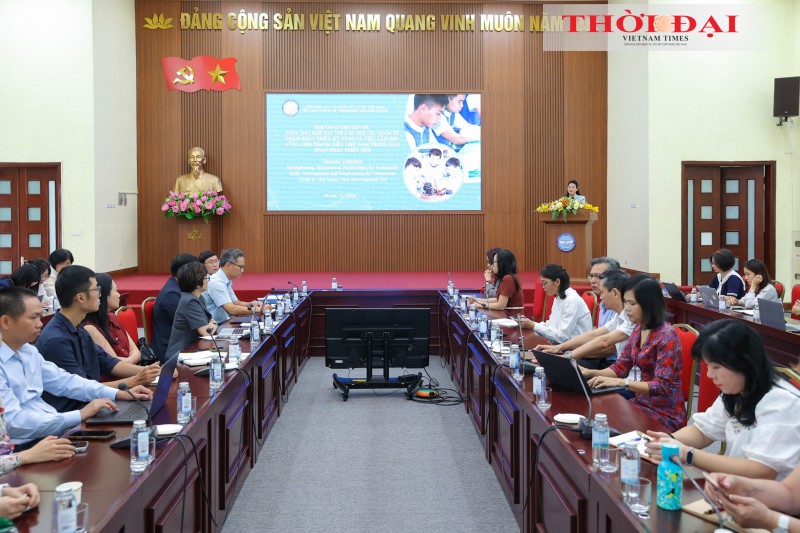 |
| Delegates attend the workshop. (Photo: Dinh Hoa) |
Improving skills and enhancing job quality
Presenting the keynote report, Nguyen Thanh Tuan of the Center for Information, Strategic Analysis and Forecasting, and Public Services under the Institute of State Organization and Labor Sciences (Ministry of Home Affairs), stated that the youth employment rate reached 94.6% in 2024, while the unemployment rate stood at 5.4%. However, the challenge lies not only in the number of jobs available but also in the quality of skills, job stability, and young workers' access to social protection.
Nearly 88% of young workers fall into the no-skills or low-skills category. The skills structure remained virtually unchanged during the 2021–2024 period, creating a significant gap between workforce capabilities and the demands of digital transformation, artificial intelligence, and the green transition.
Job quality also remains a concern. Approximately 57.6% of young workers are employed in the informal sector, while 58% do not participate in social insurance schemes. More than 35% work without written labor contracts or are employed solely under verbal agreements. This situation leaves many young people facing unstable incomes, a higher risk of unemployment, and limited opportunities for long-term training and skills development.
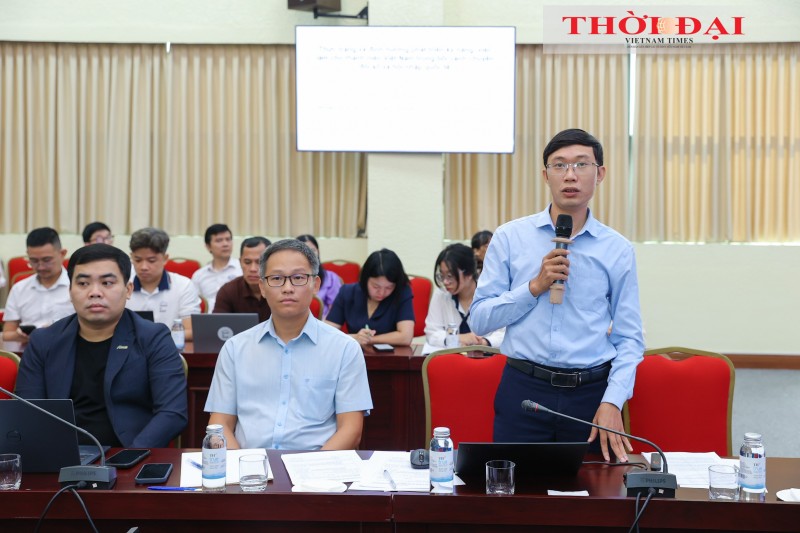 |
| Nguyen Thanh Tuan, Center for Information, Strategic Analysis and Forecasting, and Public Services, Institute of State Organization and Labor Sciences (Ministry of Home Affairs) presents the keynote report at the workshop. (Photo: Dinh Hoa) |
Based on these findings, Nguyen Thanh Tuan proposed shifting from training driven by the supply capacity of educational institutions to training aligned with recruitment demand and labor market trends. Training programs should strengthen collaboration among vocational education institutions, universities, and businesses, while prioritizing digital skills, artificial intelligence, and green skills in sectors employing large numbers of young workers, such as manufacturing, logistics, and services.
He emphasized that skills development must go hand in hand with improving job quality. Policies should expand formal employment, increase the proportion of workers with labor contracts and social insurance coverage, and encourage businesses to provide reskilling and upskilling opportunities. Training resources should also prioritize rural youth, women, ethnic minorities, and other vulnerable groups.
Engaging businesses earlier and aligning resources with local needs
Presentations at the workshop consistently highlighted the need to involve businesses earlier and more substantively in the training process, rather than limiting their role to offering internships or recruiting graduates after they complete their studies.
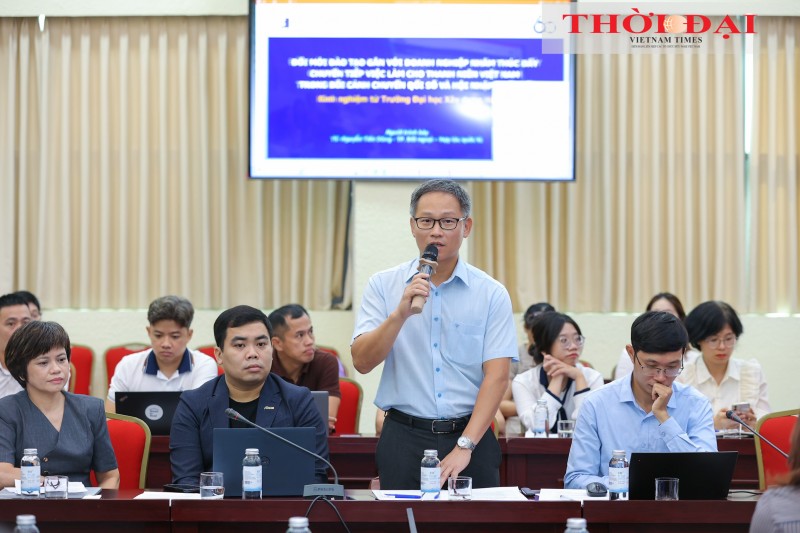 |
| Dr. Nguyen Tien Dung, Head of the Office of External Relations and International Cooperation at Hanoi University of Civil Engineering. (Photo: Dinh Hoa) |
Sharing the experience of Hanoi University of Civil Engineering, Dr. Nguyen Tien Dung, Head of the Office of External Relations and International Cooperation, said businesses can contribute to designing, implementing, and evaluating training programs; facilitate exchanges of experts and lecturers; participate in research and technology transfer; and support internships, recruitment, and entrepreneurship. Such cooperation enables training programs to better reflect practical requirements while expanding career opportunities for students.
One initiative introduced at the workshop was the STEM Scholarship Program, jointly implemented by the university and The Asia Foundation. Since 2011, the program has supported 98 female STEM students from disadvantaged backgrounds. In addition to scholarships, participants receive training in soft skills, professional skills, English proficiency, and labor market knowledge, along with mentoring and connections to experts, businesses, and alumni networks.
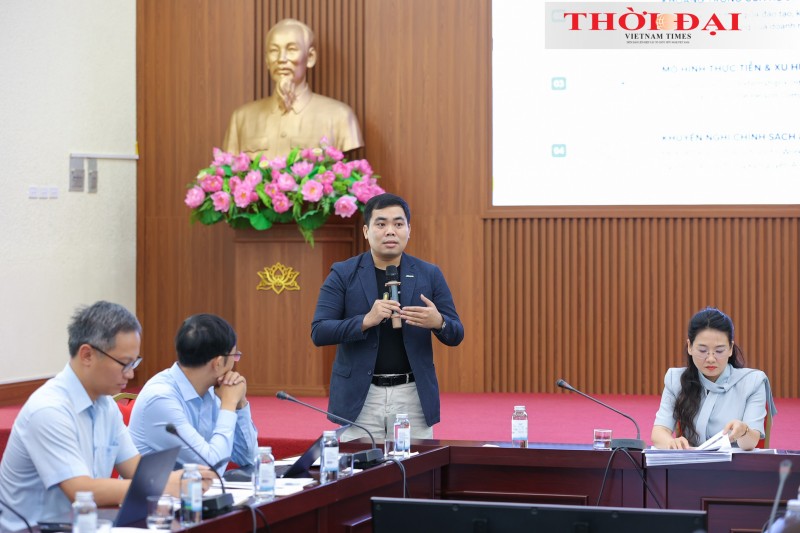 |
| Dao Viet Bach, Co-founder of HR Companion Social Enterprise Joint Stock Company, speaks at the workshop. (Photo: Dinh Hoa) |
From the perspective of a social enterprise, Dao Viet Bach, Co-founder of HR Companion Social Enterprise Joint Stock Company, pointed to a critical bottleneck in the transition from education to employment. Young people often lack practical experience, mentors, professional networks, and job-readiness skills, while training programs have not kept pace with employers' recruitment needs.
To bridge this gap, students should receive career guidance, mentoring, opportunities to participate in real-world projects, and structured internships with clearly defined objectives, responsibilities, feedback mechanisms, and evaluation criteria. Standardized experiential learning and internship models would enable students to build practical experience and demonstrate their competencies more effectively when applying for jobs.
Regarding disadvantaged youth, Dinh Thi Kieu Nhung, Education Program Specialist at The Asia Foundation, stressed that support should not stop at scholarships or one-off training courses. Instead, a comprehensive pathway should be established, covering early career guidance, financial assistance, mentoring, digital and soft skills development, business engagement, job placement, and follow-up support after beneficiaries secure employment.
In vocational education and training, programs need to be closely aligned with actual labor market demand by combining vocational instruction with workplace-based training, soft skills, English language proficiency, and green skills. Businesses should be involved from the program design stage, as today's labor market requires workers to possess not only technical expertise but also a professional work ethic and the ability to adapt.
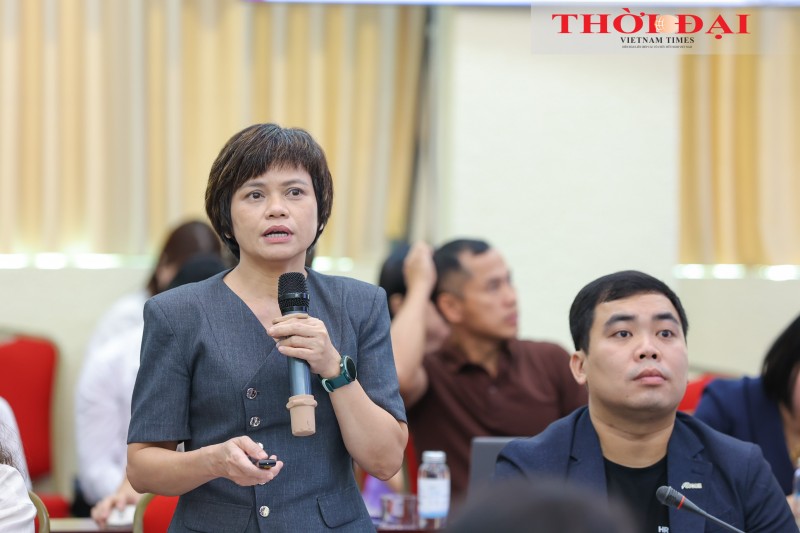 |
| Dinh Thi Kieu Nhung, Education Program Specialist at The Asia Foundation, presents her remarks at the workshop. (Photo: Dinh Hoa) |
Over the past two decades, programs introduced by The Asia Foundation have supported more than 3,000 female students, 392 women studying STEM disciplines, and 652 young people enrolled in vocational training. Employment retention rates have exceeded 80% among vocational training participants and 90% among STEM beneficiaries. Building on these results, Dinh Thi Kieu Nhung proposed piloting a comprehensive support pathway lasting six to twelve months in one or two localities or training institutions, establishing a network of partner businesses, and standardizing short-term skills modules before scaling up the model.
Participants also called for expanded access to training and employment opportunities for young people with disabilities, ethnic minority youth, rural and mountainous youth, and low-skilled workers. Career guidance should begin earlier, starting at the lower secondary school level, while training programs should be linked to local livelihood needs and provide greater opportunities for hands-on learning through STEM education, work-integrated learning models, and community service projects.
Technology companies and foreign-invested enterprises were encouraged to contribute experts, resources, experiential learning opportunities, and mentorship. Representatives from several localities and international organizations also expressed their willingness to serve as focal points, identify suitable pilot locations, and collaborate in developing programs tailored to local needs.
In her closing remarks, Do Thi Kim Dung emphasized that skills development must be a continuous process, training must be more closely aligned with labor market demand, and businesses should play a more substantial role throughout the process.
According to her, international cooperation will be most effective when it is closely aligned with Viet Nam's specific needs and translated into sustainable, implementable programs. In addition to financial support, foreign non-governmental organizations and development partners can contribute knowledge, expertise, technology, networks, and innovative models.
The Viet Nam Union of Friendship Organizations will continue to consolidate the recommendations put forward at the workshop, connect with partners, and facilitate the development of practical cooperation initiatives, with the goal of transforming the workshop's discussions into feasible programs and tangible opportunities for young people.
 YouthSpeak Forum 2017 discusses sustainable employment goal YouthSpeak Forum 2017 discusses sustainable employment goal The YouthSpeak Forum 2017, held in Hanoi on October 22, provided a platform for youngsters to discuss social issues and seek actions towards the goal of sustainable economic growth and employment. |
 Vietnam, ILO sign cooperation pact on sustainable employment Vietnam, ILO sign cooperation pact on sustainable employment A national cooperation programme on sustainable employment for 2017-2021 between Vietnam and the International Labour Organisation (ILO) was signed in Hanoi on December 5. |


Most read


Related Stories
 Focus
Focus
General Secretary and State President To Lam Meets with Viet Nam Union of Friendship Organizations
 Friendship
Expanding Partnerships, Building Substantive and Effective Connections
 Friendship
Six Key Tasks of the Viet Nam Union of Friendship Organizations for 2026-2031 Term
 Focus
Focus
Phan Anh Son Elected President of Viet Nam Union of Friendship Organizations for 2026-2031 Term
Recommended
 Friendship
30 Minutes of “Quintessential Viet Nam” Every Day
 Friendship
Dien Bien Provides Professional Training for 14 Officials from Northern Lao Provinces
 Friendship
Viet Nam and Bulgaria Seek to Expand Sister-City Partnerships
 Friendship
Children’s Drawings Spread Spirit of Viet Nam-Denmark Friendship
Popular article
 Friendship
International Friends and Partners Congratulate Viet Nam Union of Friendship Organizations’ Congress
 Friendship
Viet Nam Union of Friendship Organizations to Hold National Congress
 Friendship
Digital Transformation to Enhance Cooperation with International Organisations
 Friendship