
Peace, Freedom and Justice Unite the Peoples of Viet Nam and Brazil
| From Memory to the Future: Nurturing Peace, Friendship and Cooperation Five Bells for Peace Aboard the Odyssey |
The Brazilian friendship delegation, comprising approximately 70 members, is visiting Viet Nam from November 19 to 28, 2026. The delegation was organized by the Brazilian Center for Solidarity with Peoples and the Struggle for Peace (Cebrapaz), with participants including members of the Communist Party of Brazil, trade unions, social organizations and activists from various fields across Brazil.
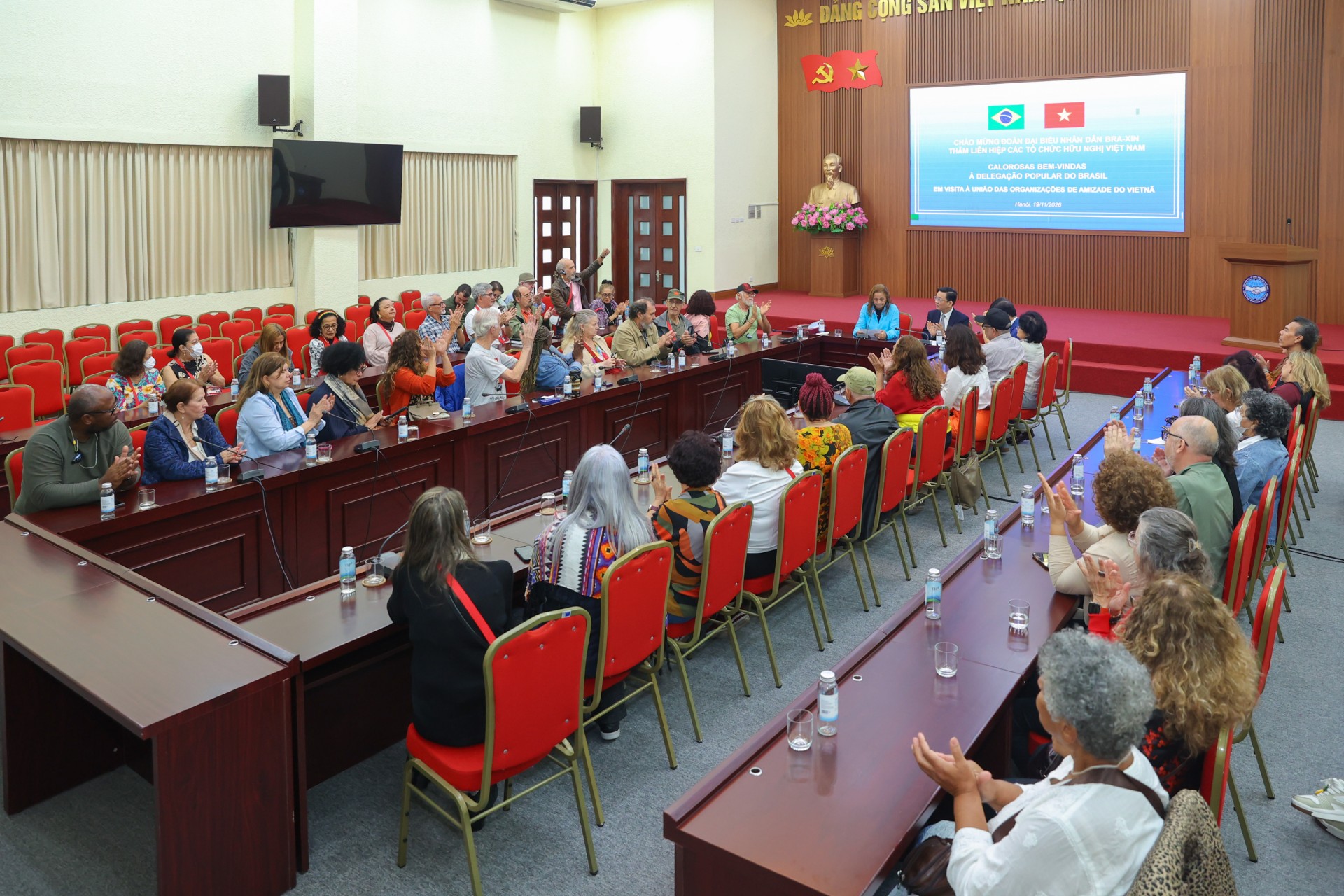 |
| Around 70 members of the Brazilian friendship delegation at a meeting with the Viet Nam Union of Friendship Organizations. (Photo: Dinh Hoa) |
Solidarity across half the world
Speaking at the reception, Maria Ivone Santana Souza, a member of Cebrapaz's National Leadership, expressed her joy and honor at visiting Viet Nam, a country that holds a special place in the history of the global struggle for national independence and social progress.
According to Maria Ivone Santana Souza, for generations of communists and left-wing forces in Brazil, the Vietnamese people's struggle for national independence and reunification has served as a symbol of courage, steadfast determination and the aspiration of nations to self-determination.
During Viet Nam's struggle for national liberation, the solidarity movement in support of Viet Nam attracted the participation of students, workers, intellectuals and numerous progressive organizations in Brazil. These sentiments and historical memories have continued to be preserved and passed down to subsequent generations.
She emphasized that the image of President Ho Chi Minh had transcended Viet Nam's borders, becoming a symbol of the struggle against colonialism and imperialism, the defense of national dignity, and the combination of patriotism with internationalism.
Alongside their interest in learning about Viet Nam's history, delegation members were particularly keen to explore the country's socio-economic development achievements over 40 years of Doi Moi (Renewal), especially in poverty reduction, industrialization, education, science and technology, and international economic integration.
According to Maria Ivone Santana Souza, Viet Nam's experience demonstrates the importance of choosing a development path suited to each country's actual circumstances while combining economic growth with the pursuit of long-term social objectives.
From Brazil's perspective, Viet Nam's experience in industrial development, human resource training and participation in international production chains offers valuable lessons in seeking solutions for reindustrialization and reducing economic and technological dependence.
Assessing the prospects for bilateral relations, she noted that Viet Nam and Brazil have considerable potential for cooperation in trade, investment, agriculture, science and technology, education, innovation and culture. In particular, strengthening mutual understanding among the peoples, universities, social organizations and political organizations of the two countries would help lay the foundation for deeper bilateral relations.
Maria Ivone Santana Souza affirmed that the visit is an opportunity to learn, gain practical insights and exchange experiences. The delegation members hoped to bring the knowledge, impressions and goodwill they had gained during the visit back to Brazil and continue contributing to the cultivation of friendship between the peoples of the two countries.
Sharing the same view, Aladilce Souza, a city councilor in Salvador, Bahia State, said that the Vietnamese people's struggle had become a source of inspiration for generations of activists in Brazil's left-wing movement. She expressed her hope that the visit would open up opportunities to develop concrete exchange programs and projects between organizations and communities in the two countries.
Connecting people through culture and education
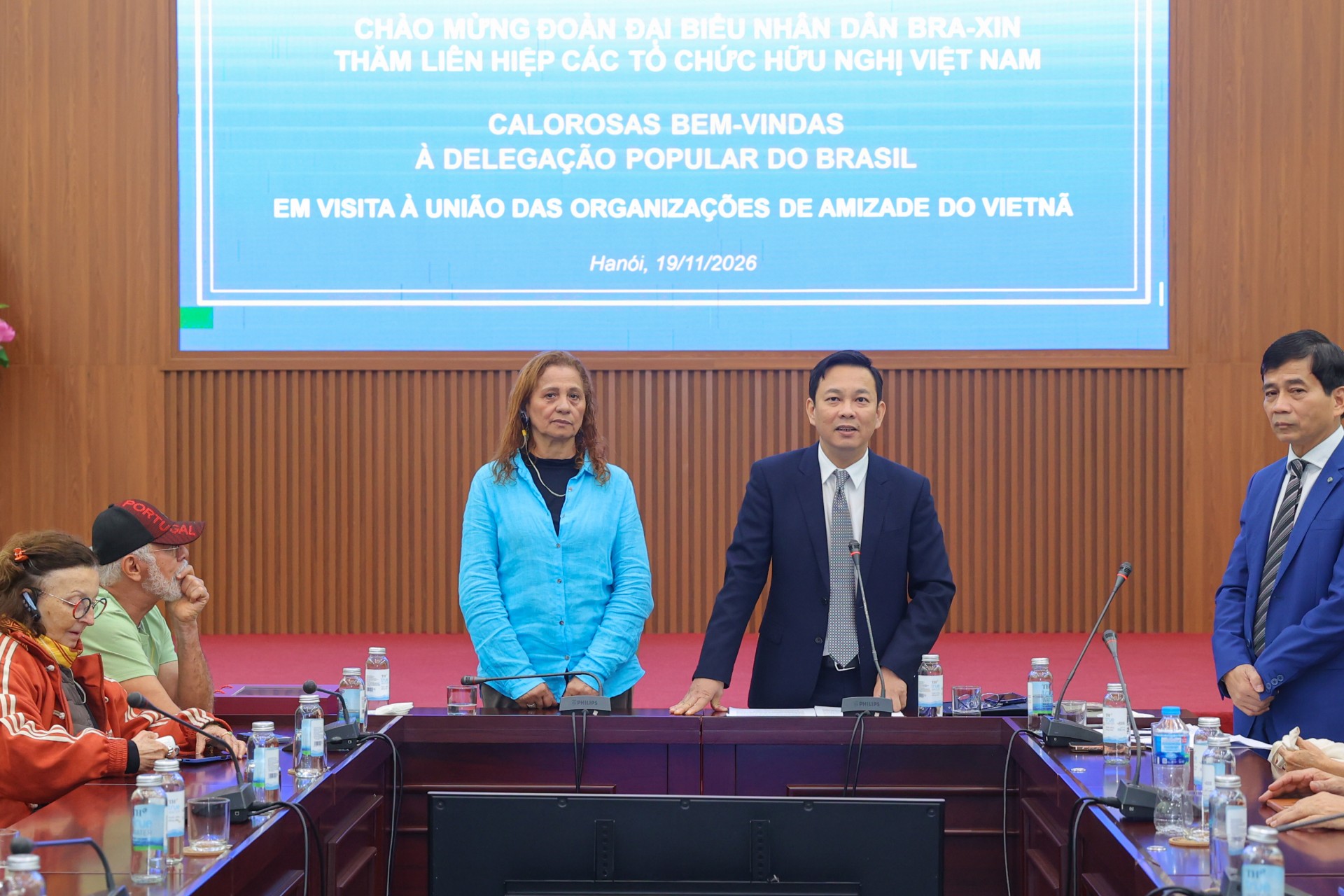 |
| Maria Ivone Santana Souza, a member of Cebrapaz's National Leadership, and Dong Huy Cuong, Vice President of the Viet Nam Union of Friendship Organizations, at the meeting. (Photo: Dinh Hoa) |
Speaking at the reception, Vice President of the Viet Nam Union of Friendship Organizations Dong Huy Cuong expressed his deep appreciation for the warm sentiments that delegation members held towards Vietnam, President Ho Chi Minh and the Vietnamese people.
He acknowledged with gratitude the support extended by the Brazilian people, particularly communist, left-wing and progressive forces, for Viet Nam during its past struggle for national liberation as well as its ongoing efforts to build and develop the country.
According to Dong Huy Cuong, despite the geographical distance, Viet Nam and Brazil share many similarities, foremost among them a love of peace, freedom and justice. These shared values, together with their histories of struggle for independence, sovereignty and the people's rights, have fostered a close bond between the two peoples.
Building on this common ground, Vice President Dong Huy Cuong put forward several ideas to bring the friendship between the peoples of the two countries closer to everyday life.
He said that the Viet Nam Union of Friendship Organizations and the Viet Nam-Brazil Friendship and Cooperation Association were developing an idea to organize an annual Vietnam-Brazil Coffee Festival, given that both countries are among the world's leading coffee producers. Coffee could therefore serve as a focal point for people-to-people exchanges, providing a platform to showcase products, cultures and the distinctive characteristics of each country.
Dong Huy Cuong also mentioned Brazilian cultural features that have become familiar to the Vietnamese public, including the Carnival festival, Samba dance and football. He also introduced Viet Nam's renowned scenic attractions, such as Ha Long Bay and Phong Nha-Ke Bang, highlighting the potential for cultural and tourism connections between the two countries.
The Vice President of the Viet Nam Union of Friendship Organizations expressed his hope that delegation members would continue to serve as bridges, helping establish connections with political organizations, social organizations and partners in Brazil, thereby creating more opportunities for practical people-to-people exchange activities.
In particular, the two sides could focus on exchanging experiences, promoting educational exchanges and building connections between friendship organizations, while bringing Brazilian culture closer to Vietnamese audiences and introducing Vietnamese cultural values more widely to the Brazilian people.
Concluding the meeting, Vice President Dong Huy Cuong expressed his hope that the visit would help delegation members gain a deeper understanding of Viet Nam while fostering further connections among organizations and individuals, thereby contributing to the development of Viet Nam-Brazil friendship and cooperation through concrete activities that directly engage the people of both countries.
 Vietnam Marks 81st National Day in Brazil |
 Viet Nam-Brazil: Turning Cooperation Commitments into Reality |
Most read


Related Stories
 Friendship
Viet Nam and Brazil Strengthen People-to-People Ties and Cooperation
 Friendship
Directive No. 16: “New Impetus” Opens Up Development Opportunities for Lao Cai
 Friendship
Viet Nam and Chile Explore New Avenues for Local Cooperation
 Friendship
Directive No. 16-CT/TW and Strategic Tasks for People-to-People Diplomacy
Popular article
 Friendship
New Disaster-Resilient Homes Handed Over to Residents in Gia Lai
 Friendship
Red Journey in Yunnan (China): Seeking Lessons of Practical Value
 Friendship
Congratulatory Letter Marking the 76th Anniversary of the Traditional Day of the Viet Nam Union of Friendship Organizations
 Friendship