
Village Cultural Centres in Quang Lam: Community Hubs Keeping Highland Traditions Alive
| Young People in Sin Thau Carry Forward Ha Nhi Cultural Heritage More Than 400 Activities Nationwide to Mark Viet Nam Cultural Day 2026 |
More than just meeting places
Village cultural centres are often burdened with the misconception that they are rather lifeless places, opening their doors only when a meeting is called or for brief official gatherings. Yet a visit to Quang Lam today would quickly dispel that notion, revealing a vibrant community life unfolding in every corner.
Imagine arriving at Quang Lam Village Cultural Centre on a November morning and immersing yourself in a space filled with sounds and colours. Beneath its welcoming roof, lively conversations and laughter mingle with the rustling of bamboo being trimmed and the cheerful clicks of split bamboo strips being prepared. In an instant, the cultural centre is transformed into a miniature traditional handicraft workshop, where 20 Kháng ethnic minority participants are engrossed in every weave and fold.
Under the skilful hands of dedicated artisans, whose hands bear the marks of years of hard work, each bamboo strip is carefully shaped, carrying forward techniques passed down from one generation to the next. From selecting bamboo sections and preparing the raw materials to completing simple everyday items such as carrying baskets and winnowing trays, every stage is practised with enthusiasm and meticulous care right here.
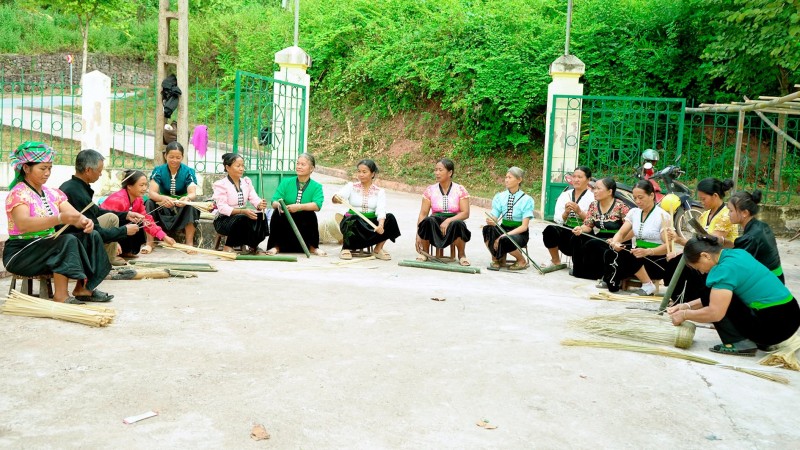 |
| The cultural centre, once simply a gathering place for residents, is transformed into a miniature traditional handicraft workshop. (Photo: Duy Linh) |
At such moments, the cultural centre is far more than four walls of brick and stone. It becomes a bridge connecting the past with the present, a place where “those who know how to keep the flame alive meet those who wish to preserve the craft”, ensuring that the cultural heritage of previous generations never fades with the passage of time.
Bringing policies and guidelines to every village
Beyond being a space filled with laughter and traditional handicrafts, cultural centres in Quang Lam also serve as a vital information bridge between local authorities and highland residents, helping to gradually narrow geographical and knowledge gaps.
At Tram Pung Village Cultural Centre, for example, legal awareness and knowledge-sharing sessions organised by Na Co Sa Border Guard Station in coordination with Quang Lam Commune Police have consistently attracted large numbers of local residents.
Rather than relying on dry, difficult-to-understand official documents, border guard officers and commune police officers make effective use of the welcoming community space by incorporating real-life stories and practical guidance. They help residents identify increasingly sophisticated scams circulating on social media and making their way into remote mountainous areas.
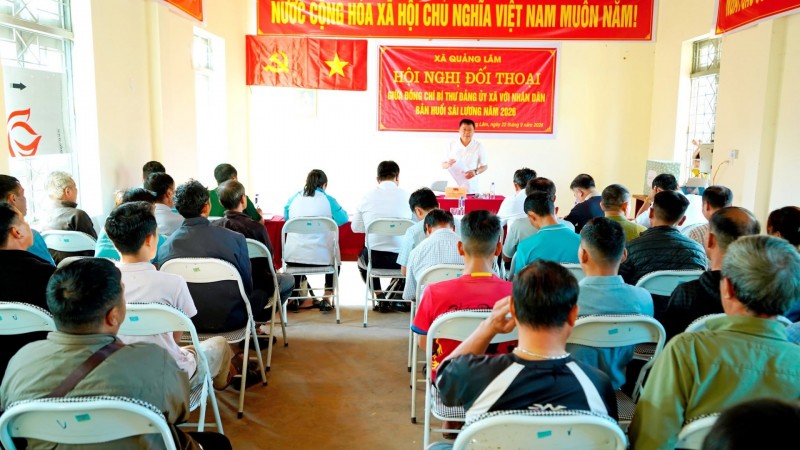 |
| Cultural centres also serve as a vital information bridge between local authorities and residents. (Photo: Duy Linh) |
Thanks to cultural centres with sufficient space, adequate lighting and proper seating arrangements, thematic community sessions, legal education programmes and agricultural production training sessions can now be organised much more effectively.
Residents attending these activities feel more confident about raising questions and seeking clarification on issues they find difficult, receiving thorough and accessible explanations from local officials in return. Having a familiar and accessible venue also enables villages to proactively announce activity schedules and make thoughtful arrangements for sound systems and seating. As a result, each village meeting becomes a useful and practical community activity.
Bright spots and areas still needing attention
Quang Lam currently has 12 village cultural centre facilities, eight of which are regularly maintained and used, making the most of their functions in community life. These figures clearly demonstrate the attention given by local Party committees and authorities to improving the spiritual and cultural lives of ethnic minority communities.
However, the overall picture still contains areas of concern that warrant reflection. The commune has 14 independently operating villages, meaning that six still lack their own cultural centres: Huoi Thung 1, Huoi Thung 2, Na Co Sa 2, Na Co Sa 3, Pac A1 and Nam Cha Noi 2. Nevertheless, construction has already begun on two cultural centres in Pac A1 and Na Co Sa 3 villages.
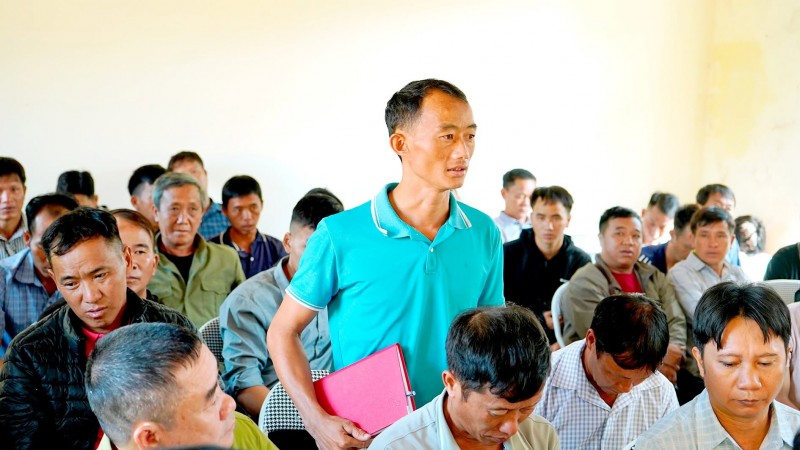 |
| The cultural centre provides residents with a place to gather and a forum to voice their ideas and make recommendations to local authorities. (Photo: Duy Linh) |
A case in point is Huoi Thung 2 Village, home to nearly 200 households. Cha A Chu, a teacher who also serves as the village Party cell secretary, openly shared his concerns. Whenever a community matter arises, whether it is a Party cell meeting requiring a private and formal setting, a public information session on Party guidelines and State policies, or the National Great Unity Day celebration, the village has to find a way to borrow space from local households.
The problem is that private homes are often too small, accommodating only around 20 to 30 people. Even on ordinary occasions, finding a suitable venue is difficult. The challenge becomes even greater during major events involving hundreds of participants, particularly when distinguished guests from the commune and neighbouring villages also attend. Without a cultural centre, the village also lacks sound amplification equipment, loudspeakers and other basic facilities needed to organise a полноцене community cultural event.
A similar account came from Vang A Cua, a resident of Nam Cha Noi 2 Village, who spoke in simple, heartfelt terms about the difficulties local people face. When a family holds a wedding or another major event, residents struggle to find an open plot of land and sometimes even have to borrow recently harvested rice fields to put up marquees and prepare the feast. Seeing neighbouring villages with spacious, well-equipped cultural centres where they can organise cultural performances, weddings and other gatherings, residents of Nam Cha Noi 2 cannot help but feel wistful and wish they had a similar facility.
Listening to these concerns, Tran My Nam, Vice Chairman of the Quang Lam Commune People's Committee, also spoke candidly about the challenges facing the locality. Investment resources remain limited, while many villages lack available land or face significant difficulties in mobilising matching funds. For a poor mountainous commune, encouraging residents to contribute to the construction of major public welfare facilities is a difficult task, given the many financial pressures local households continue to face. In addition, the area's complex, fragmented terrain and challenging transport conditions pose considerable obstacles to the implementation and progress of infrastructure projects.
Keeping faith alive through shared community spaces
Although the road ahead remains challenging and much work is still to be done, the achievements of village cultural centres in Quang Lam provide good reason to look forward to a brighter future for cultural life in the highlands.
Every cultural centre built, every vocational training class opened and every successful legal awareness session plants a seed of faith and solidarity in the borderland communities. In time, when villages still facing difficulties, such as Nam Cha Noi 2, also have a solid, well-equipped shared community space of their own, the picture of development in Quang Lam will be truly complete: a place where the economy continues to grow while traditional cultural heritage is cherished, preserved and passed down through generations.
 Fukuoka to Host “Vietnamese Village” at 2026 Unity Festival |
 Keeping Village Spirit Alive in Muong Luan Commune: Thai People's Aspiration for Cultural Continuity |
Most read


Related Stories
 National
Vietnam News Today (Nov. 15): Vietnamese President Arrives in San Francisco for APEC Summit 2023
 Travel
Best Destinations to Explore in Stunning Thai Nguyen
 World
Petit village in Norway with shortest name in the world
 Travel
Real-life fairytale towns around the world
Popular article
 Vietnamese Culture
Following the Needle, Tracing the Memories of the Dao People in Muong Cha
 Vietnamese Culture
More Than 400 Activities Nationwide to Mark Viet Nam Cultural Day 2026
 Vietnamese Culture
Mountain Flavours and Forest Aromas on the Dining Tables of Thai People in Muong Luan
 Vietnamese Culture