
Mountain Flavours and Forest Aromas on the Dining Tables of Thai People in Muong Luan
| Maintaining National Standards in a Poor Highland Commune of Dien Bien Greeting Sunrise from Thoi Loi Mountain - Unmissable Moment on Ly Son |
Flavours from the rice fields, home gardens and ancient forests
Visiting Muong Luan in the final days of the year, when wisps of kitchen smoke mingle with the early morning mist, we stopped by the home of Lo Van Khanh, where we were invited to gather around a traditional rattan dining tray of the local people. Unlike the fast-paced industrial lifestyle of urban areas, the meals of the Thai people here retain the full essence of nature, drawing on the fruits of their own diligent labour in terraced rice fields and along mountain slopes.
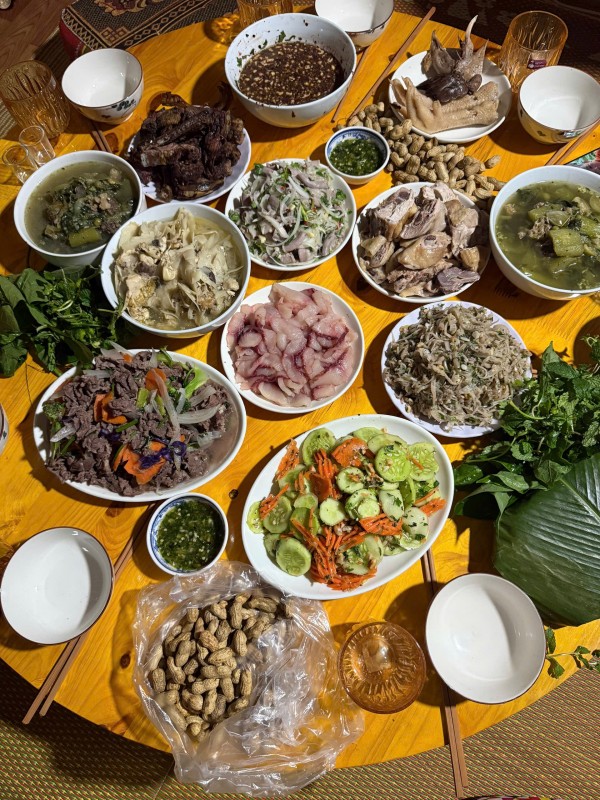 |
| The meals of the Thai people here retain the full essence of nature. (Photo: Duy Linh) |
Meals among the Thai people here always centre on fragrant, sticky upland rice - a precious gift bestowed by nature upon the Muong Luan Valley. The glutinous rice is steamed to perfection in a wooden steamer, with each grain plump and fragrant with the aroma of newly harvested rice. It is accompanied by familiar dishes that nevertheless require considerable care and effort to prepare, such as smoked free-range pork, stream fish grilled over glowing embers (pa minh), bitter bamboo shoot soup cooked with fermented rice, and various forest vegetables, seasoned with the indispensable spices mắc khén and dổi seeds.
“We Thai people eat according to the seasons and in harmony with nature. Each season has its own produce: we go into the forest for bamboo shoots and down to the streams to catch fish and shrimp. The appeal of a delicious meal does not lie in rare and exotic delicacies, but in the freshness of the ingredients and the care and affection that the cook puts into preparing them,” Khanh shared as he savoured a warm cup of fragrant corn wine beside the dining tray.
Culinary secrets passed down through generations
What distinguishes Thai cuisine in Muong Luan lies not only in its ingredients but also in the art of seasoning and cooking, passed down through generations. Each dish reflects the community's own philosophy of balancing yin and yang.
Stream fish grilled over embers (pa minh), for example, may appear simple, but its preparation requires meticulous attention, from selecting and cleaning the fish to marinating it with forest spices and herbs such as lemongrass, lime leaves, grilled chillies and finely ground mắc khén. The fish is secured between fresh bamboo slats and grilled over glowing charcoal until its skin turns golden brown, while its fat sizzles and blends with the pungent, aromatic fragrance of the spices. Then there is a bowl of bitter bamboo shoot soup, a speciality of the Thai people. Its initial bitterness quickly gives way to a lingering sweetness at the back of the throat, much like the lives of mountain communities, whose hard work and perseverance carry them through countless hardships and challenges.
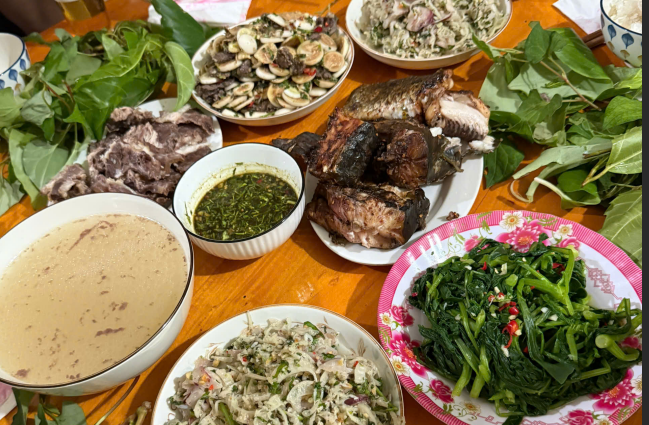 |
| Dishes of the Thai people in Muong Luan and Dien Bien are mainly boiled or grilled, with little use of frying or stir-frying. (Photo: Duy Linh) |
These culinary secrets are not found in books. From the time they are young girls, daughters in the village learn by helping their mothers prepare meals over flickering wood-fired stoves. They learn to identify different medicinal leaves and forest roots, as well as how to adjust the heat to ensure that a pot of soup is cooked just right and a stir-fried dish reaches the perfect level of doneness. In this way, the hands of Thai women continue to keep the family hearth burning through the years.
Gathering around the dining table: Lessons in respect and good manners
In the culture of the Thai people in Muong Luan, the family meal is also a setting for teaching family values, proper conduct and neighbourly solidarity. When honoured guests visit or relatives gather for family occasions, the meal is prepared and served with the utmost care and respect.
Elders are always invited to take the most honoured seats. Before the meal begins, the host offers guests a cup of wine, accompanied by the warmest wishes for good health and abundant harvests. The way rice is served, food is offered to one another and the rattan tray is arranged all follow long-established codes of conduct: showing respect to elders, giving precedence to those older than oneself, and saving the best portions for the elderly and young children.
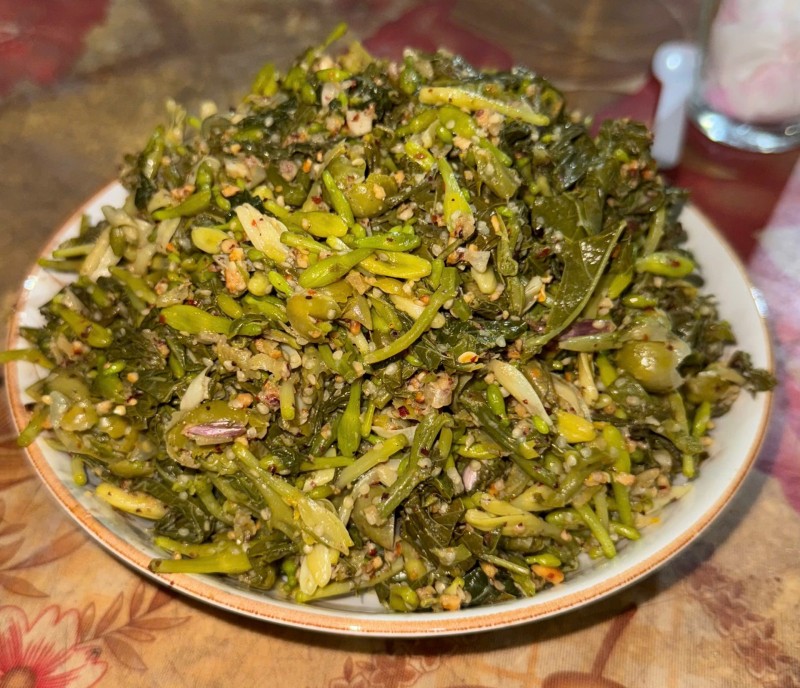 |
| Vegetable salads are a distinctive feature of Thai cuisine. (Photo: Duy Linh) |
“You can tell how well a family upholds its traditions simply by looking at its dining table. From an early age, children are taught to put their hands together and invite their grandparents and parents to eat before picking up their chopsticks. A meal is not just about satisfying hunger; it is also a time when family bonds are strengthened after a day of working in the fields and on the hillsides,” shared Ms. Lo Thi Huong.
Preserving traditional flavours amid a changing way of life
Today, alongside the development of trade and commerce, the lives of the Thai people in Muong Luan have undergone considerable changes. New ingredients have become available, while food services and community-based tourism models are beginning to emerge.
Nevertheless, amid the currents of modern life, local residents remain steadfast in preserving the traditional flavours of their ethnic cuisine. By incorporating local cuisine into community-based tourism, many households have skilfully introduced their traditional dishes to visitors from near and far, turning the flavours of the mountains and forests into an appealing bridge between cultures.
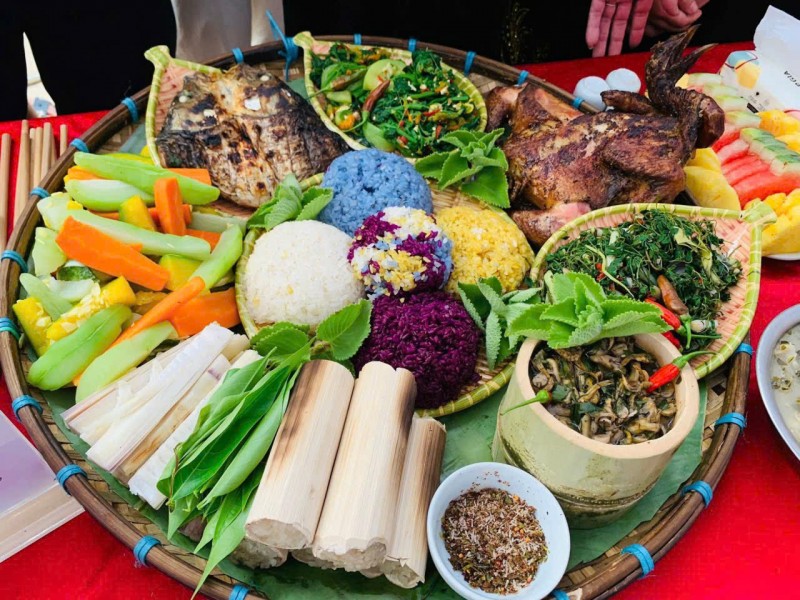 |
| The traditional rattan dining tray of the Thai people in Muong Luan (Dien Bien), featuring fragrant sticky upland rice, grilled stream fish (pa minh), smoked meat and forest vegetables, embodies indigenous knowledge and harmony with nature. (Photo: Duy Linh) |
As dusk settles over the villages of Muong Luan, the fires in household kitchens glow brightly once again, filling the air with the rich aromas of sticky rice and grilled meat. Standing amid this warm and welcoming setting, one comes to understand that the traditional family meal nourishes not only the body but also the spirit. It is a source of inner strength and an invisible bond that has connected generations of the Thai community in this borderland region.
 Conquer The Majestic Putaleng Mountain In Northern Vietnam |
 Discover The Fairytale-Like Beauty Of Sa Mu Mountain Peak |
Most read

Ambassador Jennifer Wicks: People-to-People Exchanges Bring Viet Nam and the United States Closer Together

Karlovy Vary Region (Czech Republic) Considers Proposal to Teach Vietnamese in Schools


Related Stories
 Vietnamese Culture
Si La People of Muong Nhe Preserve Filial Piety Through New Rice Festival
 Vietnamese Culture
Young People in Sin Thau Carry Forward Ha Nhi Cultural Heritage
 Vietnamese Culture
Keeping Village Spirit Alive in Muong Luan Commune: Thai People's Aspiration for Cultural Continuity
 Travel
Viet Nam Cultural Digital Map Officially Launched
Popular article
 Vietnamese Culture
Where Ban Blossoms and Love Stories Bloom
 Vietnamese Culture
Young Vietnamese People Bridge Vietnamese-Japanese Cultures Through Music
 Vietnamese Culture
Documentary on Ho Chi Minh’s Diplomacy Screened in Qatar
 Vietnamese Culture