
Young Vietnamese People Bridge Vietnamese-Japanese Cultures Through Music
| Viet Nam-Japan Concert Raises Funds for Agent Orange Victims Fukuoka to Host “Vietnamese Village” at 2026 Unity Festival |
A Cultural Exchange Channel Between the Peoples of the Two Countries
Even on days when he does not return home from school until 7 p.m., Nguyen Hoang Quan still spends another one or two hours practicing singing and drumming. The sixth-grade student at Tay Son Lower Secondary School in Da Nang only began learning Japanese this summer, yet he chose the song “Hello Viet Nam” to enter the Japanese-language singing contest.
Quan chose the song himself because he could combine singing with drumming to create his own accompaniment. He also wanted to introduce his country to Japanese audiences. “I like singing about Viet Nam so that Japanese audiences can listen and understand more about Viet Nam,” he said.
Through the song, Quan hoped to introduce the beautiful landscapes of his homeland. He particularly liked the lyrics expressing “the wish to visit a sacred place.” Quan said he had translated the lyrics into Japanese himself, using ChatGPT for assistance with difficult passages. After approximately one to two months of preparation, he entered the competition feeling relatively relaxed. “I’m just taking part for the experience. Winning a prize would be even better,” he said.
Quan was among the contestants in the final round of the second Japanese-language singing contest for school and university students, held in Hanoi on October 24. The competition was organized by the Institute for Cultural, Language and Education Research (CLEF) in collaboration with the University of Languages and International Studies and the Vietnam Japan University, both under Viet Nam National University, Hanoi. The organizers selected 19 performances for the final from approximately 100 entries submitted by students nationwide.
Nguyen Minh Duc, a student at FPT Polytechnic College, chose “Suiheisen” (Horizon), one of the first Japanese songs he had ever listened to. Duc was drawn to its message of perseverance in overcoming difficulties and continuing forward in life. The chorus left a particularly strong impression on him, and he had long hoped to perform the song on stage one day.
Duc's mother previously studied in Japan, while his older sister is currently studying there. Although he does not study Japanese at school, he has long been interested in the language. To prepare for the competition, Duc spent more than two months practicing, making use of every spare moment. When he encountered difficult words, he searched for them on YouTube and Google Translate, listened to their pronunciation and practiced accordingly.
Speaking at the contest, Associate Professor and Doctor Ngo Minh Thuy, Director of CLEF, said that the Japanese language and Japanese culture had become familiar to Vietnamese people over many years. Japanese songs were increasingly popular and had become a channel for cultural exchange between the peoples of the two countries.
According to Thuy, CLEF has worked with educational institutions, composers and artists to organize numerous bilingual music programs, folk music exchanges and performances introducing translated songs. First held in December 2023, the Japanese-language singing contest builds on these initiatives, encouraging students to explore Japanese language, music and culture.
Dr. Hoa Ngoc Son, Vice Rector of the University of Languages and International Studies at Vietnam National University, Hanoi, said music makes foreign language learning more accessible and engaging. By practicing Japanese songs, students can improve their pronunciation and intonation while learning how language is used to express emotions. He noted that beyond the prizes, the preparation process, new friendships and stage experience are also valuable rewards for contestants.
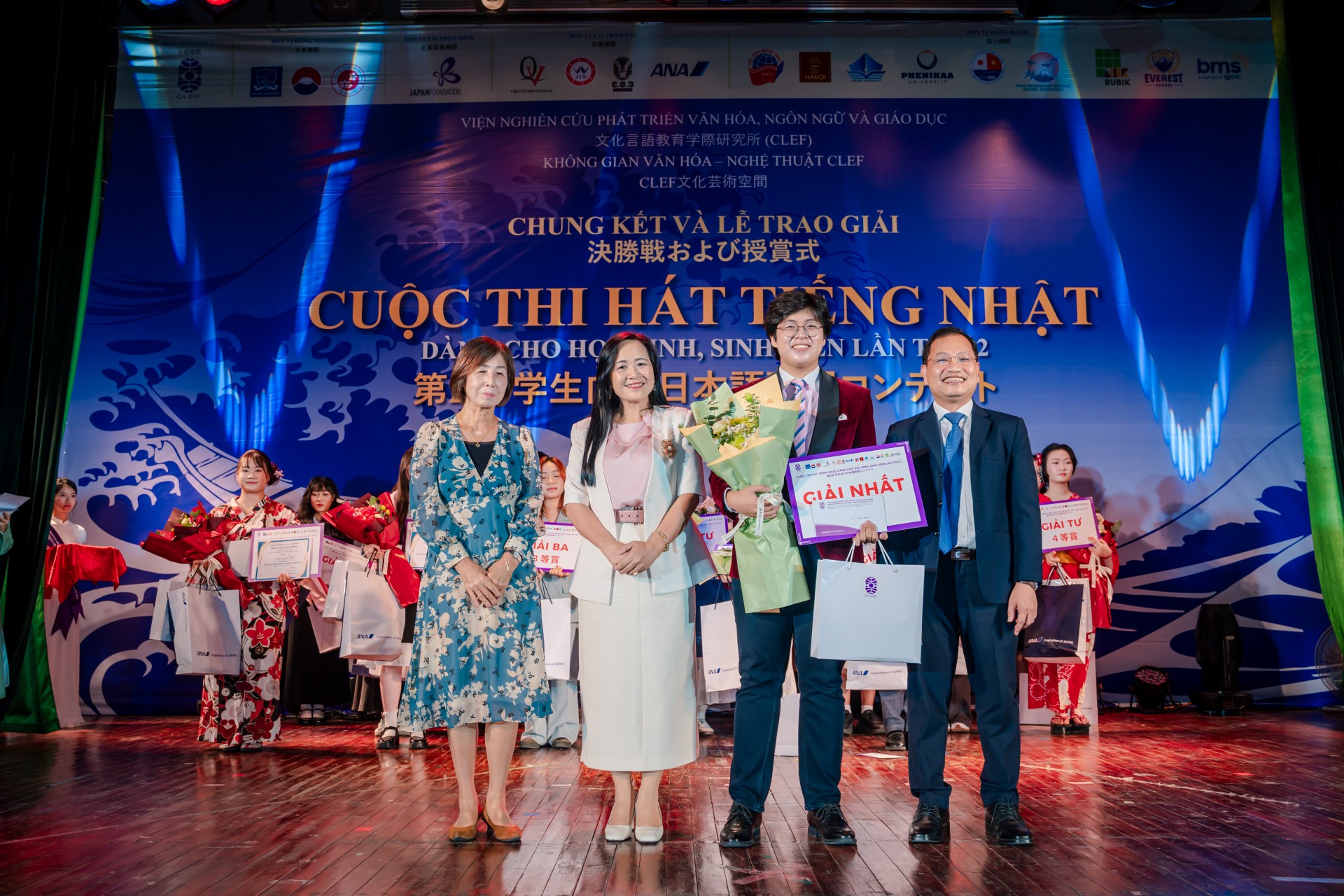 |
| The organizing committee presents the first prize to contestant Tran Gia Hung of Viet Duc High School. |
The organizers presented the first prize to Tran Gia Hung of Viet Duc High School. Two second prizes went to Le Thi Quynh Chi of Hanoi University of Industry and Do Ngoc Ha Chi of the University of Languages and International Studies at Vietnam National University, Hanoi. Three third prizes and 13 fourth prizes were also awarded during the final ceremony. The Most Popular Performance award went to Vu Doan Bao Han and Vu Khanh Linh of the Diplomatic Academy of Viet Nam for their rendition of “Jane Doe.”
Discovering Vietnamese Young People Through Japanese Music
Ogasawara Manabu, Third Secretary at the Embassy of Japan in Viet Nam, said the Japanese-language singing contest for school and university students was one of his favorite cultural programs. In his professional role, he frequently attends cultural and artistic events featuring professional performers. At this competition, however, the performers were Vietnamese school and university students.
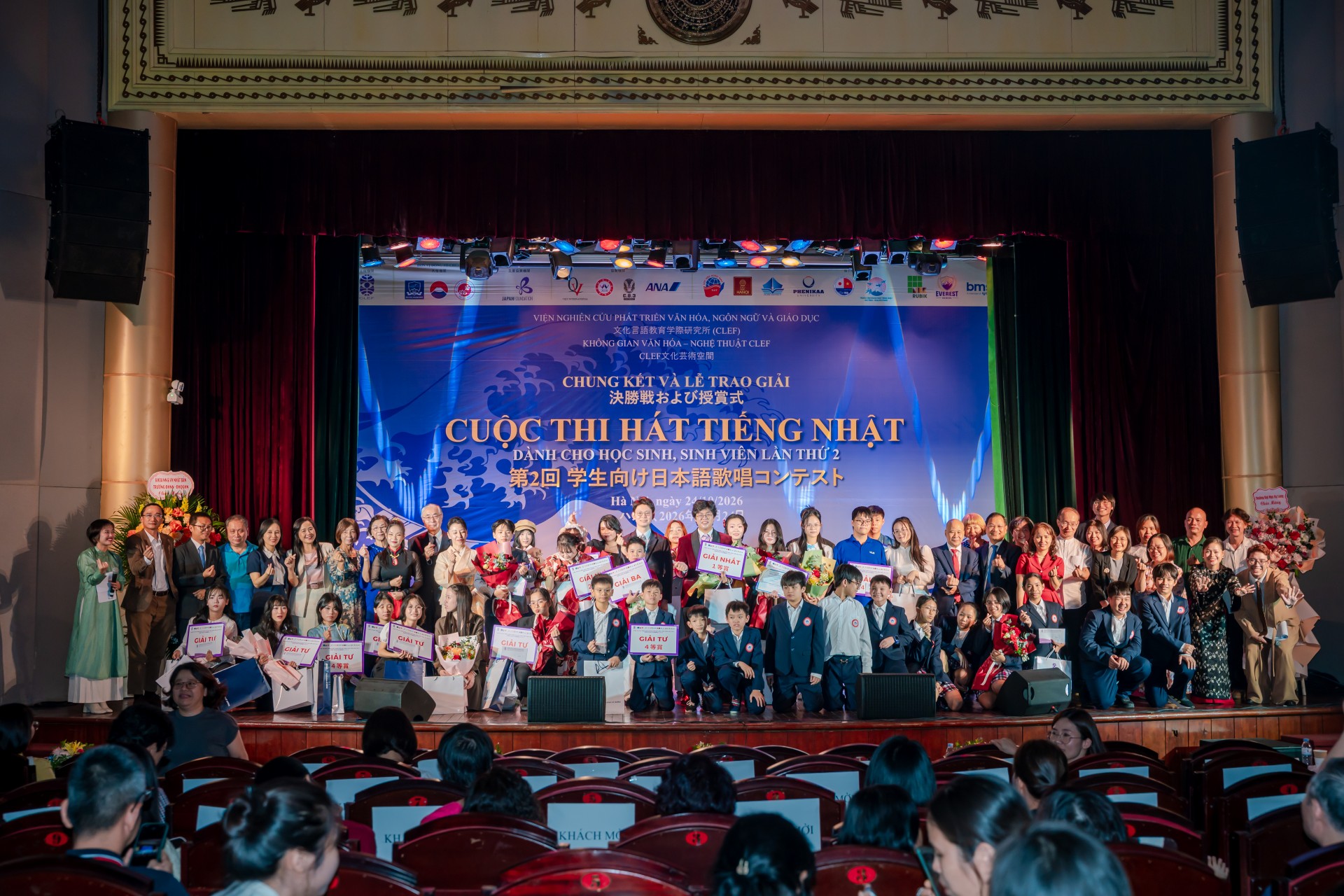 |
| The organizing committee and contestants pose for a commemorative photo. |
What particularly interested Ogasawara was the contestants' song choices. Some were familiar to Japanese audiences, while others were less widely known. He had not even heard some of them before. “There are many excellent Japanese songs that even we Japanese rarely get to hear,” he said.
According to Ogasawara, the competition allowed him to discover more music from his own country while learning which Japanese songs and musical genres appealed to young Vietnamese people. Through their performances, he also gained a better understanding of their interests and how they perceived Japanese culture and the arts.
At the final, he was especially delighted to hear “Tasogare” (Twilight), a song from Japan's City Pop genre. Compared with the previous edition, he observed a clear improvement in performance quality, with many contestants combining singing with choreography, acting and other artistic elements.
Ogasawara also enjoys Vietnamese pop music, including songs by Son Tung M-TP and My Tam. He hopes that more young Vietnamese people will discover and sing Japanese songs, and said he would continue exploring the cultures and arts of both countries.
 Vietnam-Japan Festival 2026 Launched |
 “Encountering the Japanese Language in My Youth Was the Greatest Blessing of My Life” |


Most read


Related Stories
 Overseas Vietnamese
Fukuoka to Host “Vietnamese Village” at 2026 Unity Festival
 Vietnamese Culture
Italian Ambassador to Viet Nam: Culture Brings Peoples of Two Countries Closer Together
 Travel
A Colorful Celebration of South Korea and Vietnam Cultures in Phu Quoc
 Multimedia
Vietnamese and Korean Students Explore Mid-Autumn Traditions Together
Popular article
 Vietnamese Culture
Documentary on Ho Chi Minh’s Diplomacy Screened in Qatar
 Expats in Vietnam
I Chose to Stay Because There Is Still So Much I Don’t Know About Viet Nam
 Vietnamese Culture
Learning to Livestream Agricultural Products
 Vietnamese Culture