
Expanding Market Access to Sustain Vietnam’s Rice Sector
 | Overseas Vietnamese Enterprises Bring Vietnamese Premium Rice to Canadian Market |
| Vietnam, Cuba Enhance Cooperation In Rice Production |
From the beginning of the year to mid-March, Vietnam exported approximately 1.74 million tons of rice, generating a turnover of USD 826.2 million. The average export price reached USD 477.6 per ton, down 10.7% compared to the same period in 2025.
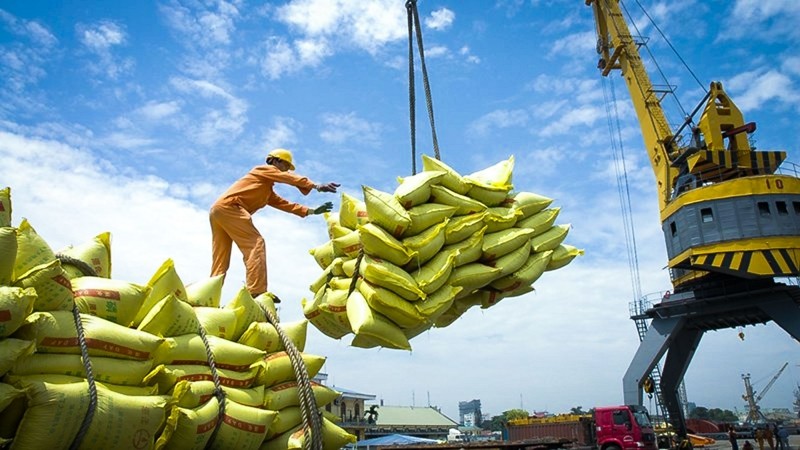 |
| Vietnamese rice exporters need to pay greater attention to origin certification and product quality to enhance competitiveness in FTA markets. |
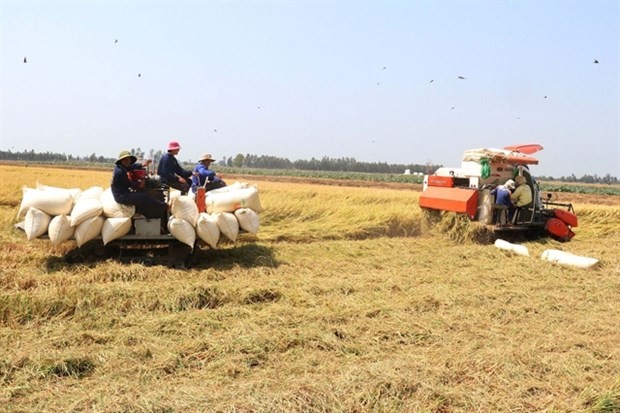
Having just completed harvesting his family’s rice fields, Ho Phuoc Minh (Tam Nong Commune, Dong Thap Province) shared that while paddy sold for over VND 6,000 per kilogram in the previous crop, prices this season hover around VND 5,700-5,800 per kilogram, and at times even lower. Although yields have increased, high agricultural input costs have significantly reduced profits. This situation is also occurring in many rice-growing areas in Can Tho City. Phan Van Chau, Deputy Director of Kien Thanh Agricultural and Service Cooperative (Vi Thanh 1 Commune), noted that while paddy prices in the previous winter-spring crop once peaked at VND 9,100 per kilogram, this year’s drop to below VND 6,000 has “eroded” farmers’ profits.
In addition, rising fuel prices have forced many combine harvester owners to suspend operations, causing delays in harvesting in some areas and posing risks to rice quality. Many farmers are now hesitant to proceed with the upcoming summer-autumn crop due to concerns about potential losses, as this crop typically has lower yield and quality while input costs continue to rise.
According to the Department of Crop Production and Plant Protection (Ministry of Agriculture and Environment), the total rice cultivation area nationwide in 2026 exceeds 7 million hectares, with output estimated at over 43.6 million tons. Of this, commercial paddy for export is projected at about 15.46 million tons, equivalent to 7.73 million tons of commercial rice. Specifically, in the first six months of the year, commercial rice output is expected to exceed 4 million tons, while the second half is projected at over 3.7 million tons. Despite the abundant domestic supply, rice exports are facing numerous difficulties.
Do Ha Nam, Chairman of the Vietnam Food Association (VFA), stated that the price of Vietnam’s 5% broken rice currently stands at just over USD 350 per ton. This is largely because traditional markets such as Indonesia, Malaysia, and the Philippines are tending to limit imports as they strengthen reserves and food security. Indonesia is even considering gradually re-entering the regional rice export market as its domestic production improves. In addition, geopolitical factors are significantly affecting current rice exports, as conflicts in the Middle East have disrupted transportation and increased logistics costs, impacting not only exports to countries in the region but also spilling over into European markets.
In the context of declining global rice prices and rising supply, boosting domestic paddy procurement is considered an urgent solution to stabilize prices and ensure farmers’ profits. The Prime Minister has requested local authorities to direct relevant agencies to coordinate with enterprises and cooperatives to organize timely paddy purchases, avoiding situations where ripe rice goes unsold. The Ministry of Industry and Trade has also required rice exporters to strictly fulfill their responsibilities in purchasing paddy and commercial rice for export; to step up procurement and temporary stockpiling in preparation for signed contracts; and to be ready to supply when import partners resume purchasing.
Pham Thai Binh, Chairman of the Board of Directors of Trung An High-Tech Agriculture Joint Stock Company, emphasized that to promote paddy procurement, especially during peak harvest periods, enterprises need access to capital at reasonable interest rates. In addition, preferential credit mechanisms should be provided for enterprises with storage systems and large procurement capacity, enabling them to increase temporary stockpiling of rice for farmers.
In the long term, according to Nguyen Quoc Manh, Deputy Director of the Department of Crop Production and Plant Protection, enhancing market outlets for rice products requires localities to organize production based on market demand, using high-quality, high-value rice varieties and specialty rice strains. In fact, the structure of rice varieties for the 2025–2026 winter–spring crop continues to shift positively, with high-quality, fragrant, and specialty rice accounting for about 75%. However, the proportion of processed rice remains relatively low and needs further adjustment in the coming period.
From a market perspective, Ngo Chung Khanh, Deputy Director General of the Multilateral Trade Policy Department (Ministry of Industry and Trade), noted that commitments on rice in free trade agreements (FTAs) indicate a high degree of market openness. Under the EU-Vietnam Free Trade Agreement (EVFTA), the EU grants Vietnam an annual quota of 80,000 tons of rice with a 0% tariff. Similarly, the UK-Vietnam Free Trade Agreement (UKVFTA) provides a quota of 13,358 tons with a 0% tariff, allocated by rice categories. Under the Comprehensive and Progressive Agreement for Trans-Pacific Partnership (CPTPP), several markets have also opened significantly, for example, Mexico applies a 0% tariff on rice, while Canada maintains a 0% tariff but imposes specific technical requirements.
However, Vietnam’s rice market share in FTA markets remains low. Specifically, it accounts for only 2.7% in Canada, 1.5% in the EU, 1.3% in the UK, and just 0.2% in Mexico. Meanwhile, Thailand holds 23.9% in Canada, 5.2% in the EU, 4.6% in the UK, and 17% in Mexico. India also maintains high market shares in these markets, particularly 26.7% in the UK. Therefore, Vietnamese rice exporters need to pay greater attention to origin certification and product quality to enhance competitiveness in FTA markets. This will help diversify export outlets, reduce dependence on traditional markets, and build a foundation for stable rice exports amid intense competition.
 | Philippines Seeks Stronger Rice Cooperation with Vietnam Up to 80% of the Philippines’ imported rice comes from Vietnam. The Philippines has considered Vietnam a key partner in ensuring domestic food security. |
 | Rice Production Presents Great Opportunities For Circular Economy Development in Vietnam Vietnam is the 5th largest rice producer in the world with a very large volume of straw, rice husk and other by-products. If rice by-products ... |
Related Stories
 National
Vietnam News Today (Jun. 3): Vietnam Eyes Golden Opportunities For Rice Exports
 Make in Vietnam
Vietnam Becomes Leading Rice Supplier to Singapore in Q1
Recommended
 Economy
13 Economic Experts Join Advisory Board of VIFC-HCMC
 Economy