
India named President of BRICS+ for the 2026 term
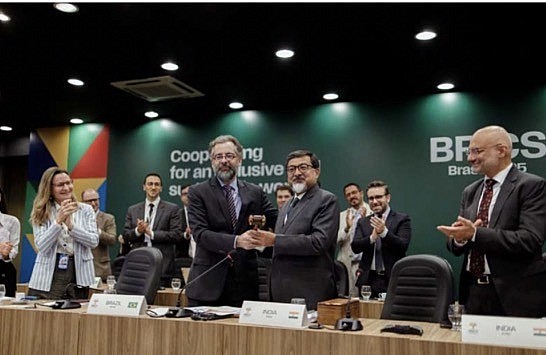 |
| Brasil’s Sherpa, Ambassador Mauricio Lyrio, handed over the gavel symbolizing the BRICS presidency to India’s Sherpa, Ambassador Sudhakar Dalela. Image: Isabela Castilho/Audiovisual BRICS |
By rotational procedures and consensus adopted in Brazil in December, India has taken over the BRICS+ presidency for 2026, underscoring its highly enriching founding membership and gracious opportunity to deepen the intergovernmental association as a leading geopolitical force in the Global South. Brazil took over the BRICS presidency from Russia on January 1, 2025. Following its expansion, BRICS+ currently comprises ten countries: Brazil, China, Egypt, Ethiopia, India, Indonesia, Iran, Russia, South Africa, and the United Arab Emirates.
Historically, its conceptual origins were articulated by Russian Foreign Minister Yevgeny Primakov in 1998 and can be traced to a series of informal forums and dialogue groups such as RIC (Russia, India, and China) and IBSA (India, Brazil, and South Africa). In addition to that significant aspect of its history, BRIC was originally a term coined by British economist Jim O’Neill and later championed by his employer, Goldman Sachs, in 2001, to designate a group of emerging markets.
The bloc’s inaugural summit was held in 2009 (Yekaterinburg summit) and featured the founding countries of Brazil, Russia, India, and China. These four founding members adopted the acronym BRIC and formed an informal diplomatic club where their governments could meet annually at formal summits and coordinate multilateral policies. The following year, South Africa officially became a member after it was formally invited and supported by China and unreservedly backed by India and Russia.
South Africa joined the organization in September 2010, which was then renamed BRICS, and attended the third summit in 2011 as a full member. The biggest expansion witnessed Iran, Egypt, Ethiopia, and the United Arab Emirates attending the first summit as member states in 2024 in Kazan, the autonomous Republic of Tatarstan, part of the Russian Federation. Later on, Indonesia officially joined in early 2025, becoming the first Southeast Asian member. The acronym BRICS+ or BRICS Plus has been informally used to reflect new membership since 2024.
India’s Rotating BRICS Presidency
Leaders’ meetings (or leaders’ summits) are held once a year on a rotating basis. BRICS has neither a permanent seat nor a secretariat. A number of ministerial meetings, for example, between foreign ministers, finance ministers, central bank governors, trade ministers, and energy ministers in the country that is presiding over the BRICS+ association.
Speaking at the BRICS summit back in 2014, Prime Minister Narendra Modi has assertively said that “reform of institutions of global governance … has been on the BRICS agenda since its inception.”
At the Kazan summit, Prime Minister Modi further stated, “We must be careful to ensure that this organization does not acquire the image of one that is trying to replace global institutions.”
At the 17th BRICS Summit held in Rio de Janeiro on 7 July 2025, Prime Minister Modi stated that India would give a “new form” to the BRICS grouping during its presidency in 2026.
Prime Minister Modi proposed redefining BRICS as “Building Resilience and Innovation for Cooperation and Sustainability” and emphasized a people-centric approach, drawing parallels with India’s G-20 presidency, where the Global South was prioritized.
Prime Minister Modi affirmed that India would advance BRICS with a focus on “humanity first,” highlighting the need for joint global efforts to address common challenges such as pandemics and climate change.
Prime Minister Modi also called for urgent reform of global institutions to reflect the realities of the 21st century, emphasizing greater representation for the Global South and criticizing outdated structures like the UN Security Council and World Trade Organization.
BRICS+ Financial Architecture
The financial architecture of BRICS is made of the New Development Bank (NDB) and the Contingent Reserve Arrangement (CRA). These components were signed into a treaty in 2014 and became active in 2015. The New Development Bank (NDB), formally referred to as the BRICS Development Bank, is a multilateral development bank operated by the five BRICS states.
The bank’s primary focus of lending is infrastructure projects with authorized lending of up to $34 billion annually. South Africa hosts the African headquarters of the bank. The bank has a starting capital of $50 billion, with wealth increased to $100 billion over time. Records show Brazil, Russia, India, China, and South Africa initially contributed $10 billion each to bring the total to $50 billion. As of 2020, it had 53 projects underway worth around $15 billion. By 2024 the bank had approved more than $32 billion for 96 projects. In 2021, Bangladesh, Egypt, the United Arab Emirates, and Uruguay joined the NDB.
Future of BRICS+
Last year, several countries began working within the BRICS framework, and many states are planning to join this association. In practical terms, BRICS needs to increase the practical impact of its partnership on the level of qualitative development, not just organizational symbolism and public rhetoric as it has been during the past few years. Time has come to avoid excessive bureaucracy and avoid any undesirable rigid attachment to an organizational structure. BRICS has to enhance its economic potential and develop appropriate mechanisms for financial, trade, and economic cooperation.
With India’s presidency in 2026, which is estimated to be a comprehensive and promising eventful year for BRICS, India has already outlined its framework of priorities, as it did during its G20 presidency several years ago. In close coordination with members and partner states within the BRICS association, India has to ensure the balance of multifaceted interests and ensure or establish mutual trust in the multipolar world system. The goal of transforming into a full-fledged international organization must go beyond addressing current geopolitical challenges and the necessity to develop effective ways of engaging in global development to reflect multipolarity.
Since its inception, BRICS has undergone a transformation and has gone through several stages of qualitative change.There is obvious interest in this consensus-based platform and hundreds of economic and political areas for cooperation and for collaborating, including politics, economic development, education, and scientific research. The New Development Bank finances various projects in member countries: Brazil, Russia, India, China, and South Africa.
Recommended
 World
World
Modi's UAE visit for important energy agreements
 World
World
Indian PM Modi’s UAE visit to advance Strategic Defence Partnership
 World
World
India’s Engagement with ASEAN: Strengthening Mutual Trust
 World
World
Eurasia Review Analysis: India-Vietnam Relations and Their Strategic Significance
 World
World
Vietnam, Austria Promote Practical Cooperation in Cybersecurity
 World
World
Vietnam Makes Its Mark at Paris International Fair 2026
 World
World
Vietnam Promotes Dialogue, Seeks Substantive Solutions at 11th NPT Review Conference
 World
World