
Indonesia Sees Strong Potential for Agricultural Cooperation with Vietnam
| Vietnam-Indonesia Relations: Seven Decades of Strategic Partnership Vietnam’s Growing Economic Influence Highlighted by Indonesian Media |
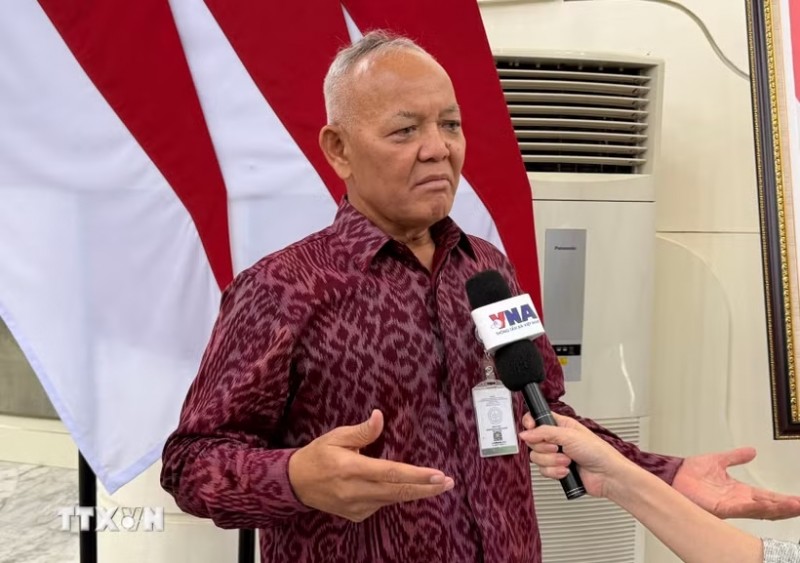 |
| Special Advisor to the Minister of Agriculture of Indonesia, Professor Hasil Sembiring spoke to the Vietnam News Agency in Indonesia. (Photo: VNA) |
Indonesia’s orientation in agricultural development creates many cooperation potentials with Vietnam. This is the assessment of Special Advisor to the Minister of Agriculture of Indonesia, Professor Hasil Sembiring on boosting agricultural production said at an international media discussion in Jakarta on August 10.
According to the VNA correspondent in Jakarta, speaking at the discussion themed “Indonesia’s food security: Autonomy and global supply chain”, Professor Hasil Sembiring said that Vietnam and Indonesia had exchanges on plants and agricultural production experience.
He evaluated that Vietnam had much experience that Indonesia could learn from, particularly the programme on developing 1 million hectares of high-quality and low-emission rice in the Mekong Delta, striving to increase productivity while reducing environmental impacts.
Professor Hasil also noted that the large-scale mechanisation rice production model in the south of Vietnam was a valuable lesson for Indonesia to reduce costs and improve competitiveness.
According to him, Indonesia’s orientation in agricultural development creates many cooperation potentials with Vietnam including mechanisation, short-duration rice, water management, digital agriculture, post-harvest technology, and agricultural processing.
Hasil said that Indonesia is implementing a range of measures to strengthen food security and meet the needs of a large population country, which is growing by around 2.5 million people each year.
He stated that Indonesia is transforming the agriculture industry to 4 main directions, including reforming policies and production inputs, improving productivity and ensuring water security; developing human resources; increasing the added value of agricultural products.
Indonesia introduced a strategy of rapidly increasing domestic production of commodities in which it has comparative advantages and the potential for sustainable development, thereby participating more deeply in global supply chains. At the same time, Indonesia will balance imports of products for which domestic supply remains insufficient.
The import policy is designed to address seasonal shortages, stabilise prices and secure raw material supplies without undermining incentives for domestic production.
According to Professor Hasil, Indonesia also identifies long-term food security as closely linked to stronger climate change resilience.
Measures implemented include improving irrigation water control, making better use of climate information and early warning systems, developing drought-resistant varieties, increasing fertiliser efficiency, reducing post-harvest losses, and expanding precision and smart agriculture.
Beyond rice, Indonesia is seeking to diversify its food sources through corn, cassava, sago, sorghum, fruit and vegetables, livestock, and fisheries to reduce dependence on a single commodity.
With its synchronous food security strategy, Indonesia is calling for international cooperation in five areas, including crop varieties; water and renewable energy management; machinery and technology; preservation, processing, and traceability; and financing and risk-sharing instruments for smallholder farmers and young agribusinesses.
 Indonesian Media Praise General Secretary and State President To Lam’s Message Indonesian Media Praise General Secretary and State President To Lam’s Message Indonesia’s Antara News Agency and Tempo newspaper on May 30 published articles on the keynote address delivered by General Secretary of the Communist Party of Vietnam and State President To Lam at the opening session of the 2026 Shangri-La Dialogue. |
 Strengthen Business Connectivity To Explore Vietnam-Indonesia Trade Potential Strengthen Business Connectivity To Explore Vietnam-Indonesia Trade Potential Strengthening direct business connectivity between Vietnam and Indonesia will create new motivation to expand cooperation, explore free trade agreements effectively to turn opportunities into concrete contracts. |


Related Stories
 Overseas Vietnamese
Cultural Exchange Strengthens Vietnam-Indonesia People-to-People Ties
 Friendship
IESC Supports Vietnam in Modernizing Agriculture and Promoting Digital Transformation
 Economy
Strengthen Business Connectivity To Explore Vietnam-Indonesia Trade Potential
 Overseas Vietnamese
Binh Ngo Spring 2026: Strengthening Community Bonds, Vietnam-Indonesia Cooperation
Recommended
 Economy
India set to rank as world’s fourth-largest economy in 2027: IMF
 Economy
Viet Nam, US Seek Higher-Quality Economic Ties
 Economy
India is powering Nielsen’s AI push from GCC to global innovation engine:
 Economy
Sprite Expands Global Basketball Footprint with NBA’s Nikola Jokić and New "Never Stop Refreshing The Game" Platform
Popular article
 Economy
Media OutReach Newswire Founder & CEO Jennifer Kok Named Top Nominee in the Woman Entrepreneur Category for EY Entrepreneur Of The Year™ 2026 Malaysia
 Economy
India announced steel policy with a target of 604 million tons capacity by 2047
 Economy
KPLASS Singapore Officially Launches Its Far-Infrared Patches in Vietnam
 Economy