
World Vision Supports 1,923 Households in Developing Sustainable Livelihoods in Dien Bien
| WVI and Dien Bien Chart Next Chapter in Support for Children World Vision Provides Recovery Assistance to 260 Flood-Affected Households in Lai Chau |
The project is funded by the ADM Cares Fund, ADM’s social investment program, and implemented in partnership with World Vision International in Viet Nam (World Vision). Its activities focus on ethnic minority communities in the Muong Cha 2 Area Program in Dien Bien Province, with the aim of improving soil health, promoting climate-resilient farming practices, and supporting forest restoration and protection.
The launch ceremony was attended by representatives of local authorities, ADM, World Vision, partners, and residents of the project area. The event provided an opportunity for stakeholders to discuss the current state of agricultural production, challenges in protecting soil and forest resources, and local people's livelihood development needs.
The project adopts an approach that combines improvements to immediate production conditions with the protection of natural resources essential to long-term livelihoods. Rather than focusing solely on providing agricultural inputs, it emphasizes transferring knowledge and skills to help local residents make use of available materials, gradually change their farming practices, and take a more active role in environmental and forest resource protection.
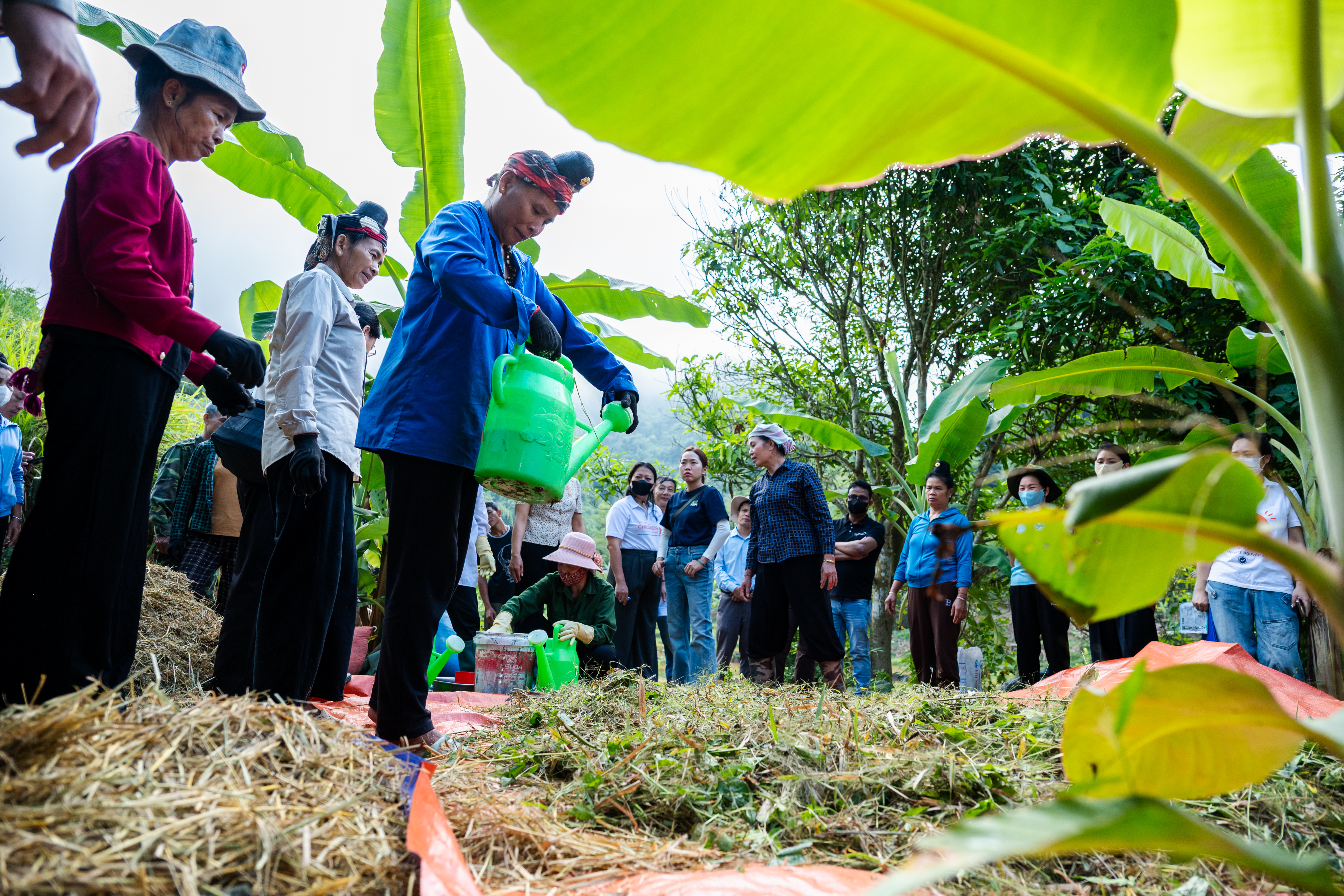 |
| Residents participating in the project in Dien Bien. |
Restoring land to safeguard livelihoods in mountainous communities
Dien Bien is home to 19 ethnic groups and boasts abundant forest resources and considerable potential for agricultural and forestry development. However, agricultural production in many mountainous communities faces challenges arising from declining soil fertility, erosion, extreme weather events, and forest degradation. These factors directly affect crop yields, household food security, and incomes.
According to a report by the People's Committee of Na Sang Commune, Na Sang is a mountainous border commune established through the merger of four former administrative units: Na Sang Commune, Sa Long Commune, Ma Thi Ho Commune, and Muong Cha Township. The commune covers a natural area of more than 36,000 hectares and comprises 25 villages and residential groups. Agriculture, livestock farming, and forestry continue to play important roles in the local economy.
As of the end of October 2026, the commune had 386.77 hectares of coffee, 111.77 hectares of macadamia, and 378 hectares of pineapple. These crops have been identified by local authorities as having the potential to develop into commercial production areas, helping create jobs and increase local incomes. However, the rugged, steep, and deeply dissected mountainous terrain has resulted in fragmented agricultural land, making it difficult to apply scientific and technological advances consistently. Many production areas are located far from residential areas, while limited transport infrastructure increases the costs of transporting agricultural inputs and marketing produce.
Drought and irrigation water shortages during the dry season, heavy rainfall, severe cold spells, and the risk of landslides and soil erosion on steep slopes regularly disrupt agricultural production. Farming remains largely dependent on traditional experience and small-scale production, while linkages among farmers, cooperatives, and businesses in production, processing, and product distribution remain insufficiently robust.
These challenges underscore the need to expand cultivated areas while improving soil quality, using water resources efficiently, limiting resource degradation, and strengthening local people's capacity to sustain production amid climate fluctuations.
Against this backdrop, the project funded by ADM Cares and implemented by World Vision aims to address one of the fundamental issues facing agricultural production: the quality of cultivated land.
Speaking at the launch ceremony, Mai Thi Thanh Huong, Director of External Affairs at ADM, emphasized the importance of protecting natural resources while supporting communities whose livelihoods depend on them.
According to her, agriculture is an essential source of livelihood for many families in the Muong Cha area. Improving soil fertility, preventing land degradation, and maintaining agricultural productivity are directly important to helping local residents achieve greater livelihood stability.
Through activities such as bio-organic fertilizer production, the development of regenerative agroforestry models, and the application of erosion control measures, the project aims to help farmers improve their production practices while protecting the natural resources on which their livelihoods depend.
Equipping local residents with skills and linking agricultural production to forest protection
In its initial phase, the project aims to improve soil quality across 230 hectares of agricultural land and equip 1,923 households with the knowledge and skills needed to produce bio-organic fertilizers by making use of livestock manure and agricultural by-products.
In addition, approximately 2,300 local residents will receive greater awareness of forest protection, biodiversity conservation, and measures to mitigate the impacts of climate change. The project plans to train 23 local partners and community representatives in forest conservation, biodiversity, and climate resilience, while organizing 23 community engagement activities to promote forest protection.
One of the project's key components is to guide local residents in producing bio-organic fertilizers from materials readily available in their communities. By using biological products and applying appropriate technical processes, livestock manure and agricultural by-products can be converted into fertilizers for crop cultivation.
This solution is expected to help replenish organic matter, restore soil fertility, gradually reduce dependence on chemical fertilizers, and curb agricultural land degradation. At the same time, making use of locally available materials will enable residents to become more self-reliant in their production activities.
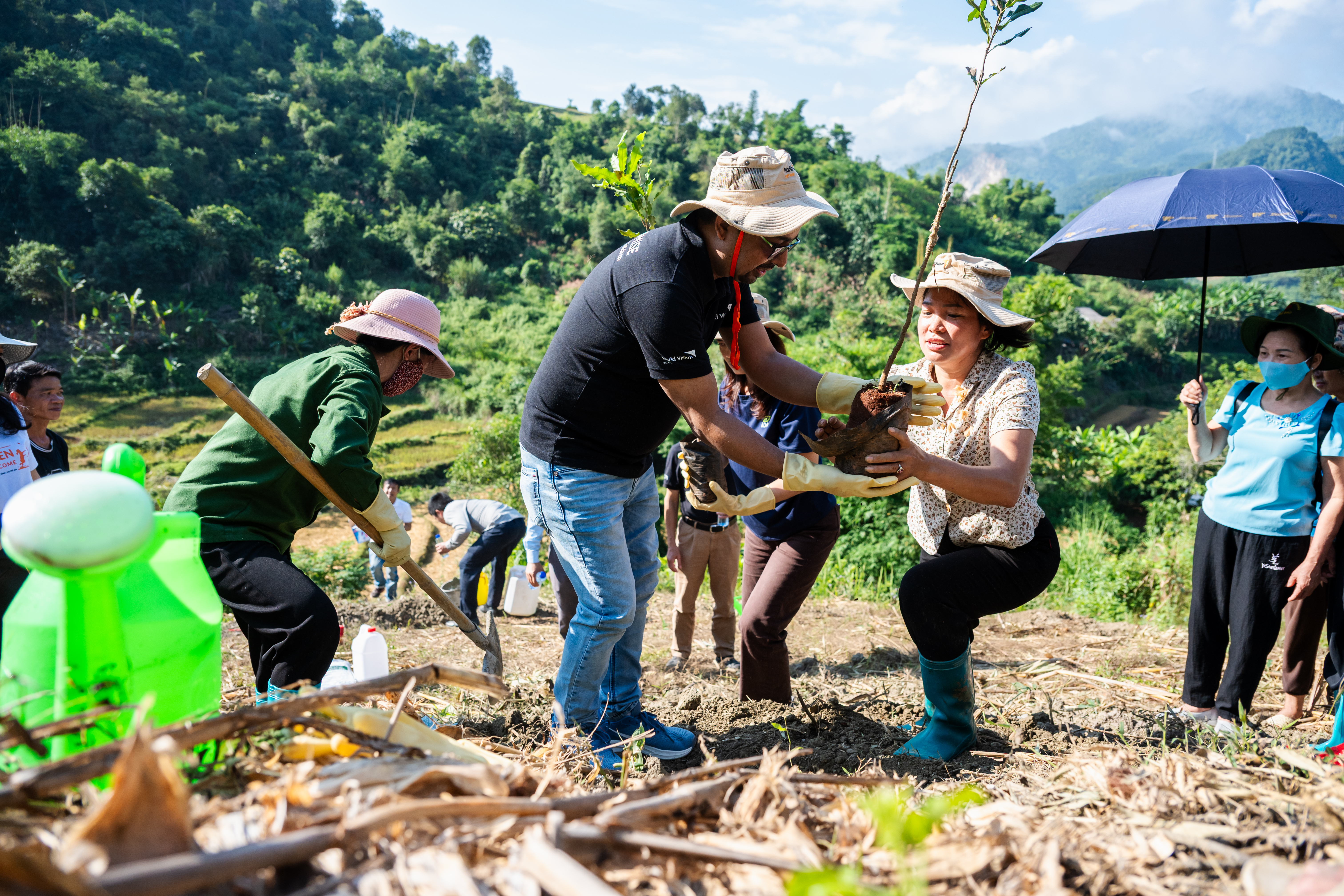 |
| Delegates visit the project site. |
Alongside improving soil quality, the project also focuses on developing regenerative agroforestry models, applying erosion control measures, and supporting forest restoration and protection.
The project also places emphasis on training sessions and hands-on technical guidance to help local residents gradually familiarize themselves with, adopt, and sustain new farming methods. This is an important factor, as long-term effectiveness depends on each household's ability to understand and put these practices into action.
Stanislaus Rozario, Director of Finance and Support Services at World Vision International in Viet Nam, said that developing green, ecological, and climate-resilient agriculture is an important direction for Viet Nam, as reflected in the Strategy for Sustainable Agriculture and Rural Development for the 2021-2030 period, with a vision to 2050.
According to him, for mountainous communities whose livelihoods are closely tied to land and forests, sustainable agricultural development not only helps increase incomes but also plays an important role in environmental protection, strengthening climate resilience, and securing a future for generations to come.
Stanislaus Rozario emphasized: “A better future for children must begin with families that have stable livelihoods and communities with safe and sustainable living environments.” Changes in production practices, improvements in soil quality, and greater community participation in forest protection are expected to lay the foundation for more stable livelihoods, improve family living conditions, and provide children with a better environment in which to grow and develop.
On behalf of the local authorities, Vu Manh Ha, Vice Chairman of the Na Sang Commune People's Committee, called on ADM Cares and World Vision to continue supporting the development of sustainable agricultural livelihood models; prioritize the provision of crop and livestock varieties and essential supplies to poor and near-poor households; and support solutions for water supply, water storage, and water-efficient irrigation for agricultural production.
The local authorities also expressed their desire for strengthened training and the transfer of scientific and technical knowledge, as well as support for linkages in agricultural production, processing, preservation, and distribution. These efforts would help local residents gain better access to markets, increase the value of their products, and improve their incomes.
 WVI and Dien Bien Chart Next Chapter in Support for Children |
 World Vision Provides Recovery Assistance to 260 Flood-Affected Households in Lai Chau |
Most read


Related Stories
 Multimedia
World Vision Provides Recovery Assistance to 260 Flood-Affected Households in Lai Chau
 Multimedia
Women Strengthen Livelihoods for a Better Future
 Vietnamese Culture
WVI and Dien Bien Chart Next Chapter in Support for Children
 Multimedia
Son La Project Strengthens Ethnic Minority Livelihoods
Popular article
 Economy
Japanese Media Express Optimism About Cooperation with Viet Nam in Nuclear Energy and AI
 Economy
Indian Billionaire Mittal Develops Satellite Network as a global communication network
 Economy
SustainCoffee Project Targets Sustainable Growth in Viet Nam’s Coffee Sector
 Economy