
Innovation Drives Next Chapter of Viet Nam-Sweden Health Cooperation
| AVISE DAY 2026 Highlights Growing Network of Vietnamese Scientists and Experts in Sweden Vietnamese Language Teachers’ Club Established in Sweden |
The legacy of Viet Nam-Sweden healthcare cooperation
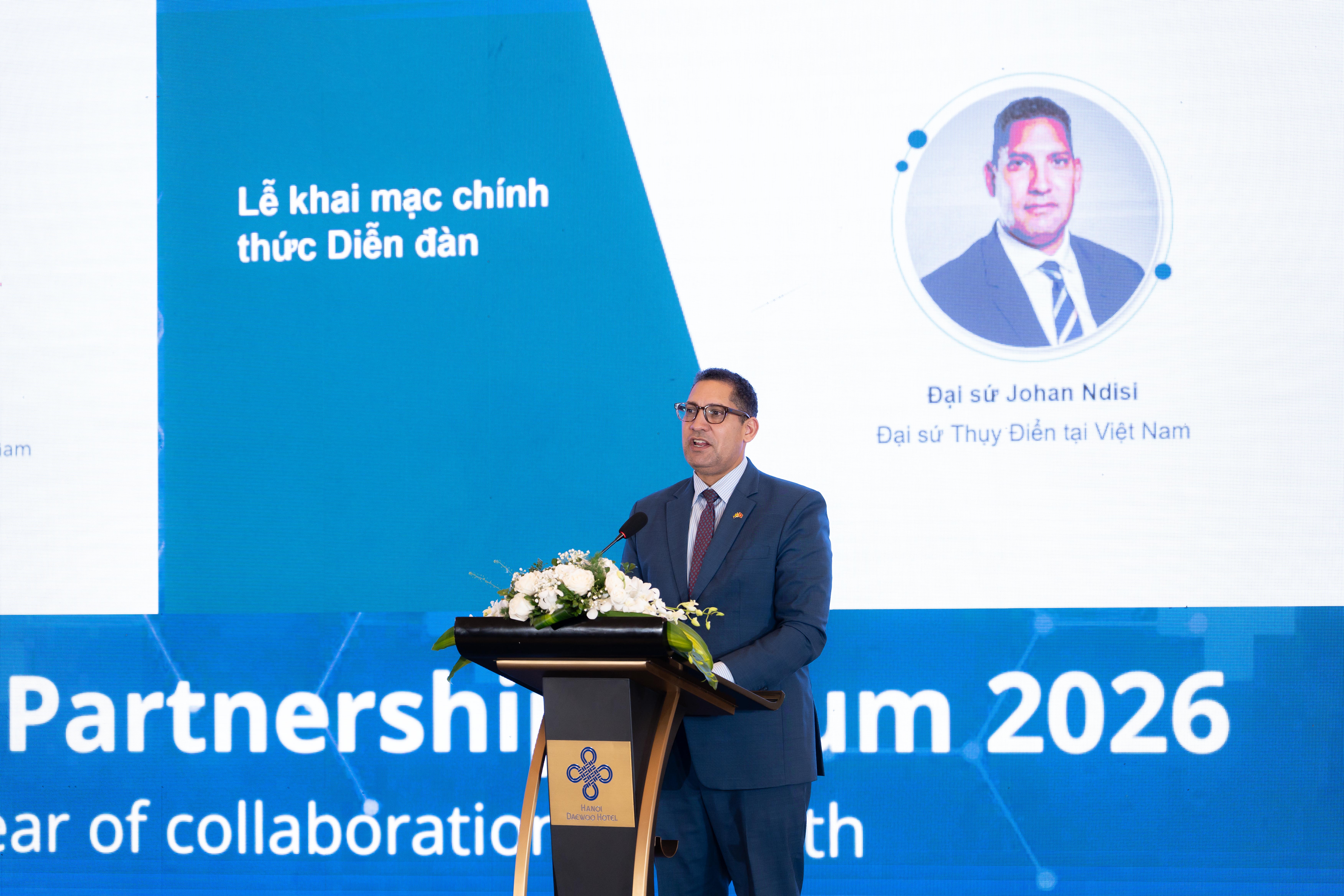 |
| Swedish Ambassador to Viet Nam Johan Ndisi speaks at the forum. (Photo: Embassy of Sweden in Viet Nam) |
Swedish Ambassador to Viet Nam Johan Ndisi emphasized that the 50th anniversary of healthcare cooperation offered an opportunity to reflect on significant milestones in bilateral relations, particularly the establishment of the Viet Nam-Sweden Uong Bi Hospital and the Viet Nam National Children's Hospital in Hanoi. Both hospitals began operating in early 1981 and have since developed into leading medical institutions in Viet Nam, becoming enduring symbols of friendship and partnership between the two countries.
According to Ambassador Johan Ndisi, healthcare cooperation between Viet Nam and Sweden began even before the establishment of diplomatic relations. As early as 1965, the Swedish Red Cross provided Viet Nam with medical supplies and equipment to address urgent healthcare needs during the country's resistance war against the US. In 1969, Sweden became the first Western country to establish diplomatic relations with Viet Nam, with healthcare soon emerging as a key area of cooperation. In 1973, the first Swedish delegation visited Viet Nam to discuss support for the country's healthcare sector. Later that year, a delegation from Viet Nam's Ministry of Health traveled to Sweden to sign the first bilateral agreement on development cooperation in this field. Initially, the two sides agreed to establish a children's hospital in Hanoi before expanding the plan to include a second hospital in Uong Bi, serving mine workers and their families in Quang Ninh Province.
Ambassador Johan Ndisi noted that the most significant legacy of this partnership lies not only in healthcare infrastructure but also in human resource development. Over the decades, more than 40,000 Vietnamese healthcare professionals have participated in Swedish-supported training and capacity-building programs. The two countries have also established strong research cooperation networks and developed joint programs between universities, contributing to the training of successive generations of healthcare leaders.
As Viet Nam pursues its goals of strengthening preventive healthcare, achieving universal healthcare coverage, and advancing digital transformation and innovation in the health sector, both countries face shared challenges, including population aging, the rising prevalence of noncommunicable diseases, increasing healthcare costs, and the need to ensure that advances in healthcare innovation reach those who need them most. According to the Ambassador, addressing these challenges requires strong partnerships not only between countries but also among governments, research institutions, healthcare providers, and the business community.
Towards a long-term strategic cooperation framework
 |
| Deputy Minister of Health Dao Xuan Co speaks at the forum. (Photo: Embassy of Sweden in Viet Nam) |
Speaking at the forum, Deputy Minister of Health Dao Xuan Co affirmed that Sweden is not only a European partner with advanced science, technology, and healthcare systems but also a longstanding friend that has stood alongside the Vietnamese people during some of the most difficult periods in the country's history.
Looking ahead, Deputy Minister Dao Xuan Co proposed that the two countries focus on four key areas of cooperation.
First, strengthening scientific research, innovation, and healthcare technology transfer, including the application of artificial intelligence, advanced diagnostic and treatment technologies, and improvements in the quality of clinical practice.
Second, enhancing cooperation in the prevention, early detection, and management of noncommunicable diseases, as well as healthcare for older people, mothers, newborns, and children. Viet Nam is particularly interested in effective preventive healthcare models that enable people to lead healthier lives while reducing the risk of illness and the need for hospitalization.
Third, developing digital healthcare infrastructure, health data systems, and interoperability across different levels of healthcare. Viet Nam is working towards establishing a unified health data system that ensures safety and security while effectively supporting healthcare management, research, and patient care.
Fourth, exchanging experience in healthcare system governance, hospital management, quality assurance, patient safety, and the efficient use of resources. Viet Nam seeks to learn from advanced governance models and jointly develop solutions suited to practical conditions. In addition, Swedish partners are expected to continue supporting the training of highly qualified healthcare professionals, multicenter research, and cooperation among hospitals, universities, and research institutes in both countries.
According to Deputy Minister Dao Xuan Co, Viet Nam and Sweden have considerable potential to jointly develop future healthcare models, moving from traditional hospitals towards digital healthcare platforms, from technology transfer towards joint research and innovation, and from development assistance towards a partnership focused on co-creating value. To ensure that the legacy of 50 years of healthcare cooperation becomes a genuine driving force for further development, he emphasized the need to move beyond individual cooperation activities towards a strategic, sustained, and accountable cooperation framework.
In the coming period, the two countries should designate coordinating bodies, establish a joint working group involving regulatory authorities, hospitals, universities, and research institutes, and develop a portfolio of priority projects with clearly defined objectives, resources, implementation timelines, and performance indicators. More importantly, the new cooperation framework must enable experts from both countries to jointly identify challenges, design and conduct research, develop solutions, and share the resulting achievements.
Deputy Minister Dao Xuan Co affirmed that Viet Nam aspires not only to acquire technology but also to gradually master and improve it, while contributing knowledge to the international scientific community. Accordingly, transitioning from a historically rooted partnership to a future-oriented cooperation framework, and translating the friendship cultivated over generations into concrete, measurable improvements in people's health, represents a practical way to carry forward the legacy of the past 50 years and elevate Viet Nam-Sweden healthcare cooperation to a new level.
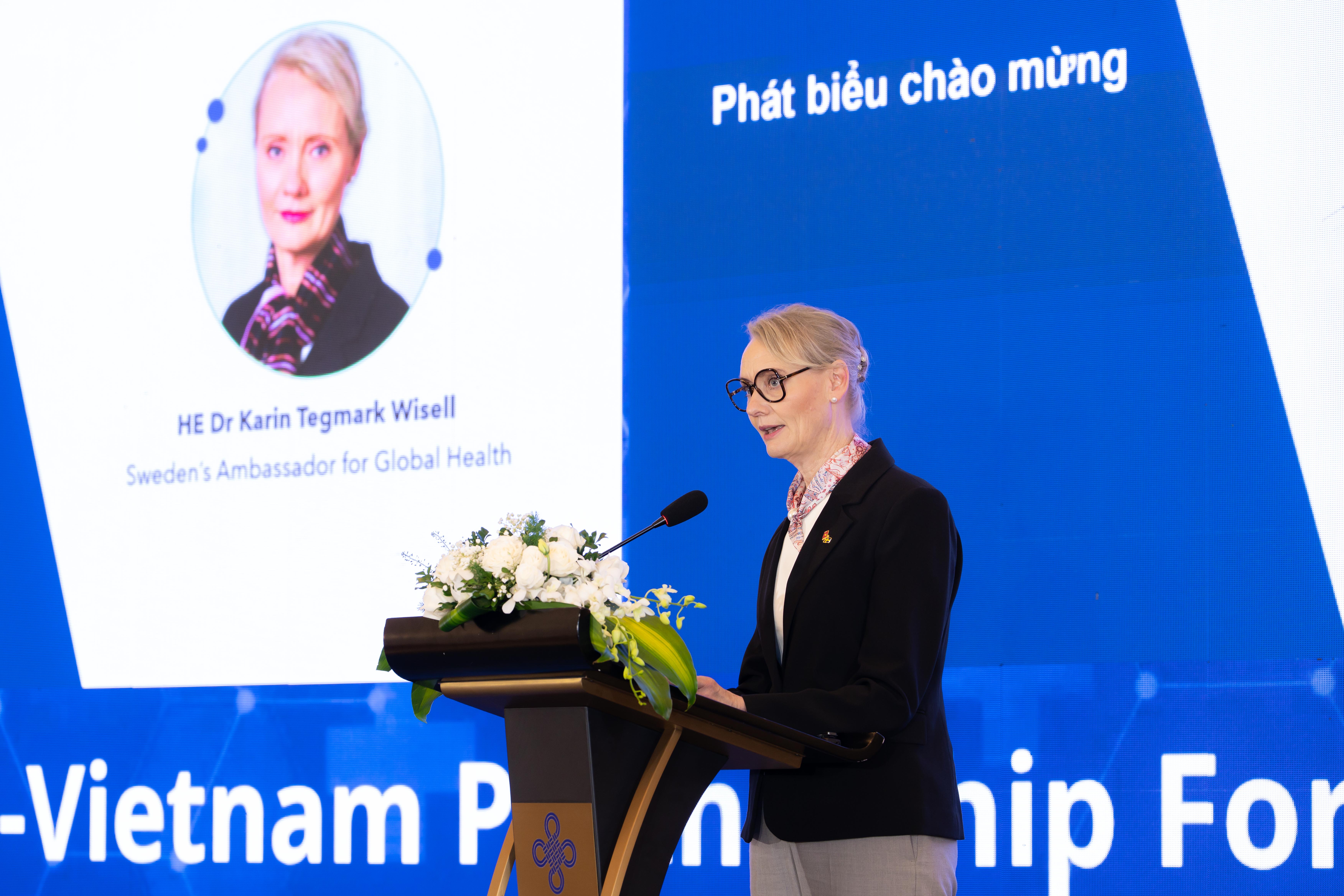
Karin Tegmark Wisell, Swedish Ambassador for Global Health Expanding Sweden-Viet Nam healthcare cooperation through science and innovation
Sweden's healthcare system is built on five core principles: prioritizing disease prevention by addressing health risks before illnesses develop; establishing a strong primary healthcare system; empowering patients by improving their health literacy and enabling access to personal medical records through digital platforms; developing high-quality, internationally accredited, and sustainable hospital systems; and ensuring that healthcare reforms and development decisions are grounded in robust scientific evidence. Today, global health faces numerous challenges. The world has experienced multiple disease outbreaks and continues to confront the need to safeguard shared resources and mechanisms essential to ensuring health security for all countries. Against this backdrop, Sweden and Viet Nam should continue working closely together on global health through multilateral mechanisms, such as the World Health Assembly of the World Health Organization (WHO). Whether at the national or global level, sustainable healthcare development must be built on common foundations: healthy populations, effective healthcare systems, and policy decisions firmly grounded in scientific evidence. |
Professor Tran Minh Dien, MD, PhD, Director of Viet Nam National Children's Hospital From healthcare assistance to joint research and technology transfer
Viet Nam National Children's Hospital stands as a prominent example of the longstanding and effective healthcare cooperation between Viet Nam and Sweden. Over the decades, the hospital has made significant progress in treating childhood diseases, improving survival rates, and reducing mortality from severe infections, diarrhea, and malnutrition. Sweden's cooperation and support have made an important contribution to these achievements. Looking ahead, Viet Nam National Children's Hospital aims to further strengthen its partnerships with Swedish institutions, focusing on academic exchanges, advanced clinical training, medical technology transfer, joint research, multicenter studies, and clinical trials. The hospital is also interested in applying digital transformation and artificial intelligence (AI) to patient care, clinical decision-making, and hospital management. Viet Nam National Children's Hospital hopes that its relationship with Sweden will evolve from development assistance into an equal partnership based on shared knowledge, collaborative research, and innovation. The overarching goal is to improve treatment outcomes, enhance children's health, and provide a better future for children. |

| Professor Tobias Alfvén - Clinical Professor of Global Child Health, Senior Consultant in Pediatrics, and Representative of Karolinska Institutet (Sweden) Prioritizing academic cooperation and scientific researchOne of the significant achievements of Viet Nam-Sweden healthcare cooperation has been the development of education and scientific research programs. At Hanoi Medical University, the collaborative program has trained 65 PhD graduates, including researchers who defended their doctoral dissertations as early as 1991, while other doctoral candidates continue to participate in ongoing joint programs. The connections established across generations of scientists demonstrate the continuity and depth of academic cooperation between the two countries. Research collaboration extends beyond Karolinska Institutet to involve several other Swedish universities. Scientists from both countries have conducted numerous joint studies in public health, infectious diseases, inflammatory conditions, rheumatology, cardiovascular diseases, and nephrology. Viet Nam is undergoing a significant shift in its disease burden. In the early 1990s, infectious diseases and causes related to child health accounted for nearly half of all deaths. Today, noncommunicable diseases have become the leading cause of mortality. This transition highlights the need to maintain a strong focus on maternal and child health while placing greater emphasis on the prevention, early detection, and treatment of noncommunicable diseases. As a result, the healthcare challenges facing Viet Nam and Sweden are becoming increasingly similar, creating opportunities for deeper cooperation in research, education, and healthcare delivery. |
 Deputy Minister of Justice Nguyen Thanh Tu Elected President of Viet Nam-Sweden Friendship Association for 2026-2031 Term |
 Viet Nam-Sweden: A Friendship That Endures |


Most read


Related Stories
 Friendship
Viet Nam-Sweden: A Friendship That Endures
 Focus
Deputy Minister of Justice Nguyen Thanh Tu Elected President of Viet Nam-Sweden Friendship Association for 2026-2031 Term
 World
Vietnamese Culture and Cuisine Shine in Sweden
 Friendship
Swedish Director Bo Öhlén Promotes Vietnamese History and Culture
Popular article
 National
Quang Lam Establishes 14 Digital Transformation Support Teams
 National
Viet Nam News Today (Nov. 17): Viet Nam, Chile Elevate Ties to Strategic Partnership
 National
Vietnam Promotes Cooperation with OIF, Bulgaria, Benin
 National