
Religious Freedom in Vietnam - Numbers That Do Not Lie
 | Vietnam, Indonesia Share Experiences in Handling Ethnic, Religious Issues |
| Vietnam Calls on US to Objectively Assess Religion and Belief Situation |
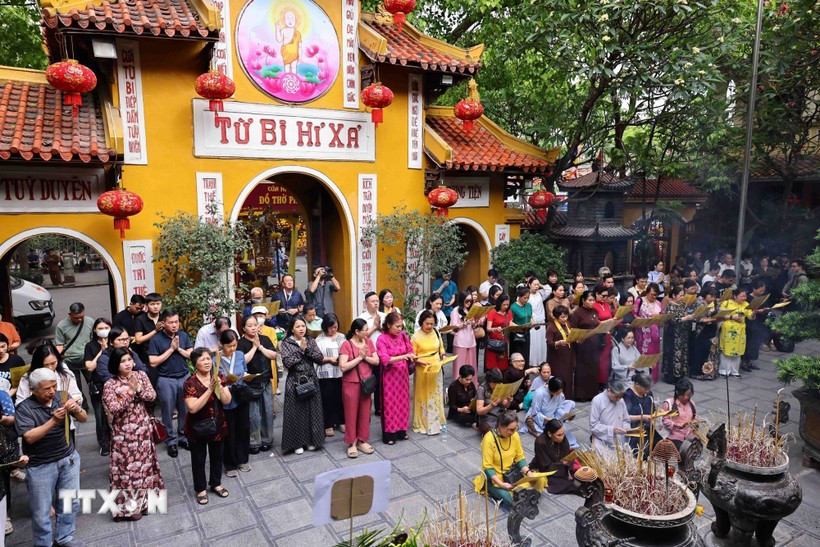 |
| A large number of Buddhist followers attended the Vesak Celebration for the Buddhist calendar year 2569. (Photo: Minh Duc/VNA) |
Religious freedom in Vietnam is clearly reflected from multiple perspectives, including legal documents, citizens’ rights and responsibilities in elections, the growth in the number of followers and places of worship, as well as the richness of spiritual life expressed through annual festivals.
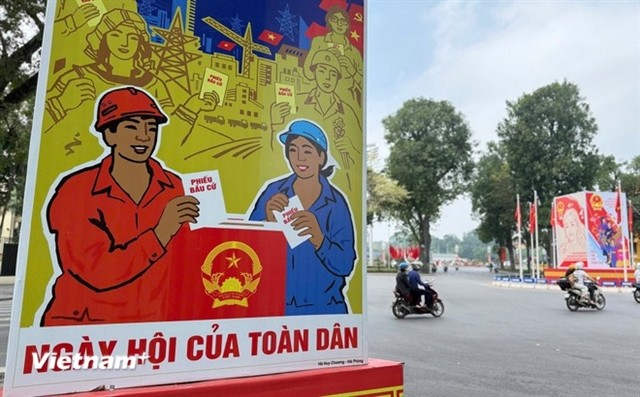
The election of the 16th National Assembly and People’s Councils at all levels for the 2026-2031 term in Vietnam was successfully held, with voter turnout reaching 99.69%, including active participation from religious communities.
Before the election day on March 15, the Ministry of Ethnic and Religious Affairs issued Official Dispatch No. 494/BDTTG-TGCP to the People’s Committees of provinces and cities, requesting local authorities to pay attention to creating the most favorable conditions for religious followers to fully exercise their democratic rights in selecting, nominating, and electing qualified and capable representatives to the National Assembly and People’s Councils at all levels.
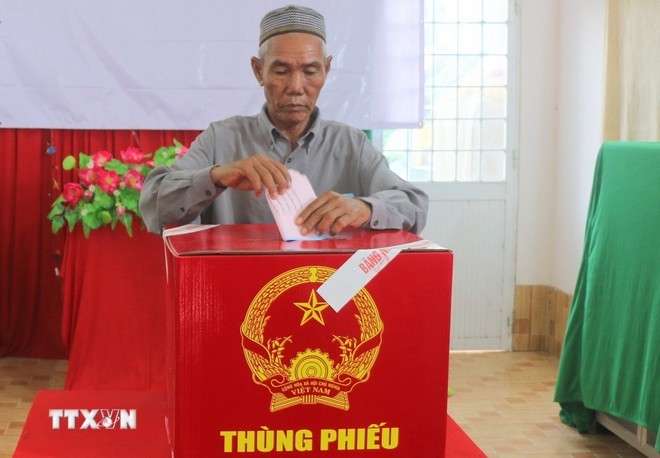 |
| Voters from the Cham ethnic group who follow Islam in Binh Di hamlet, Khanh Binh commune (An Giang province) participate in the election. (Photo: Cong Mao/VNA) |
According to the Law on Election of Deputies to the National Assembly and People’s Councils (2015, amended and supplemented in 2025), as of the announced election day, citizens of the Socialist Republic of Vietnam, regardless of whether they follow a religion or not, have the right to vote at the age of 18 and the right to stand for election to the National Assembly and People’s Councils at all levels at the age of 21.
While the results of the election for the 16th National Assembly are not yet available, the list of deputies of the 15th National Assembly includes five religious dignitaries: Father Nguyen Van Rien (formerly a deputy of the 14th National Assembly); Venerable Thich Bao Nghiem (formerly a deputy of the 13th and 14th National Assemblies); Venerable Thich Thanh Quyet (formerly a deputy of the 13th and 14th National Assemblies); Venerable Ly Minh Duc (formerly a deputy of the 14th National Assembly); and Venerable Thich Duc Thien.
Thanks to the State’s open legal framework and the tolerant nature of society, up to 95% of the population in Vietnam follows either folk beliefs or a religion, and religious followers coexist peacefully, even intermingling with one another.
A survey by the Pew Research Center (USA) indicates that Vietnam is among the 12 countries worldwide and 6 countries in the Asia-Pacific region with a very high level of religious diversity.
According to the White Paper “Religion and Religious Policies in Vietnam” (2023), the country currently has 43 organizations belonging to 16 religions that have been recognized and granted registration certificates by the State, with more than 27.7 million followers, accounting for nearly 28% of the population. There are five major religions with over one million followers each.
Buddhism has approximately 14 million followers, with more than 54,000 dignitaries and officials; 47 religious training institutions; and over 18,500 places of worship. Catholicism has around 7 million followers, organized under 3 archdioceses; 52 bishops; nearly 6,000 priests; 31,000 religious members; over 200 religious orders; 27 dioceses; more than 3,000 parishes; and 9,000 places of worship.
Hoa Hao Buddhism has about 1.5 million followers, with 4,000 officials and 51 pagodas. Protestantism comprises 11 churches with approximately 1.2 million followers, more than 2,300 dignitaries, over 6,800 officials, 4 religious training institutions, and around 600 places of worship.
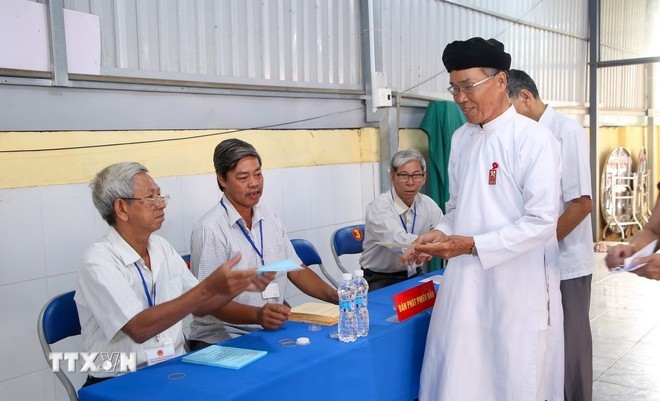 |
| Phan Van Thuoc (born in 1947), head of the parish in Truong Phuoc inter-neighborhood area, Long Hoa ward, cast his vote at Polling Station No. 14. (Photo: Giang Phuong/VNA) |
Cao Dai has more than 1.1 million followers across 10 churches, with approximately 10,000 dignitaries and 30,000 officials; 3 training institutions; and around 1,300 places of worship. Religions in Vietnam are encouraged to actively participate in socio-economic activities.
Data from the Government Committee for Religious Affairs (under the Ministry of Ethnic and Religious Affairs) show that religious organizations are currently managing around 300 kindergartens, 2,000 preschool education facilities, and 12 vocational training institutions; as well as charitable classes; more than 500 healthcare facilities and charity clinics; and 125 social assistance establishments.
The Law on Belief and Religion (2016, amended and supplemented in 2025) stipulates that everyone has the right to freedom of belief and religion, to follow or not follow any religion; to express their beliefs; to practice religious rites; to participate in festivals; to study and practice religious doctrines and laws; to enter religious life at religious establishments; and to study at religious training institutions or training courses organized by religious organizations. Religious dignitaries and officials have the right to conduct religious ceremonies, preach, and proselytize at religious establishments or other lawful locations.
Religious organizations have the right to conduct religious activities in accordance with their charters and regulations; to organize religious gatherings; to renovate, upgrade, and build new religious facilities; and to receive lawful donations of property from domestic and foreign organizations and individuals voluntarily.
The increase of more than 10 million followers of various religions over the past 20 years is clear evidence that the Party and the State not only do not hinder but also create favorable conditions for religious freedom to move beyond legal texts and take root in everyday life.
According to the White Paper “Religion and Religious Policies in Vietnam” (2023), the number of religious followers rose from 17.4 million in 2003 to 27.7 million in 2023; the number of recognized religious organizations increased from 16 to 43; dignitaries from 34,200 to over 54,500; officials from nearly 79,000 to nearly 145,000; and places of worship from 20,900 to 29,890.
Spring is the season of festivals, and these festivals are a distinctive example of freedom of belief as well as the peaceful coexistence among religions in Vietnam.
According to the Department of Grassroots Culture (Ministry of Culture, Sports and Tourism), 544 religious festivals are held annually in Vietnam. This figure refers to purely religious festivals, while in general most festivals contain spiritual elements to some extent.
Religious festivals are organized with structured rituals and ceremonies in accordance with the regulations of each religion. They are conducted by religious dignitaries and organizations, mobilizing followers to participate in order to meet their spiritual and religious needs.
The organization and participation in religious festivals are inherently internal matters of religious institutions and their followers. However, many religious festivals today have extended beyond places of worship and spread widely into society, thanks to the inclusive, non-discriminatory nature of Vietnamese people and the policy of religious freedom of the Party and the State.
Major religious holidays are increasingly organized on a larger scale, attracting many followers and members of the public, accompanied by respectful greetings from leaders of the Party, the State, and the Vietnam Fatherland Front, along with assurances of social order and safety from authorities.
Vesak is a major annual celebration held on the full moon day of the fourth lunar month to commemorate the birth of the Buddha. On this occasion, the Executive Councils of the Vietnam Buddhist Sangha across localities nationwide organize celebrations in a solemn and peaceful atmosphere, with participation not only from Buddhist followers but also from a large number of the public.
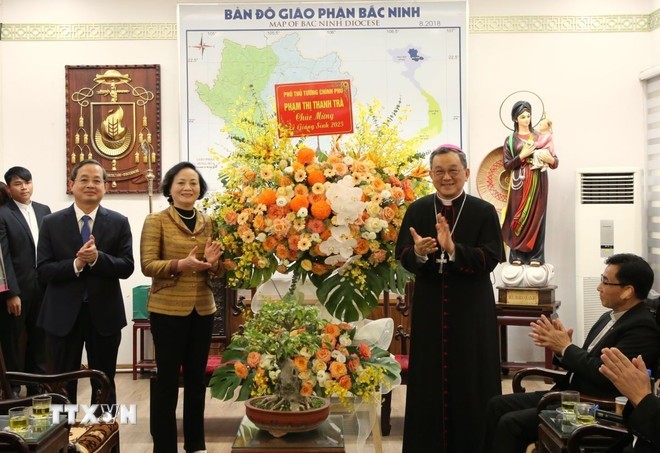 |
| Deputy Prime Minister Pham Thi Thanh Tra (second from right) presents flowers to congratulate the Bac Ninh Bishopric. (Photo: Thai Hung/VNA) |
Christmas (from the evening of December 24 to the end of December 25), originally commemorating the birth of Jesus Christ, is a holiday observed by Christians such as Catholics and Protestants in the West.
In recent years, Christmas has become very popular in Vietnam and is considered a common celebration, including among those who do not follow Christianity.
In Vietnam, although beliefs and religions have different origins and doctrines, there are no severe conflicts; instead, there is interaction and cohesion among them within the broader community, where diverse religious beliefs coexist.
A Catholic, Protestant, or Muslim believer may participate in traditional folk spiritual activities at temples, pagodas, and shrines. No one prevents or judges this practice harshly.
The figures presented above - numbers that do not lie - have completely refuted biased and ill-intentioned external views that claim religious freedom in Vietnam is restricted.
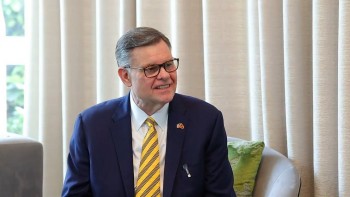 | Pastor Bob Roberts Praises Vibrant Vietnamese Church Growth With over twenty years of connection with Vietnam, Pastor Bob Roberts has observed positive developments in the country’s religious freedom. He aims to build a ... |
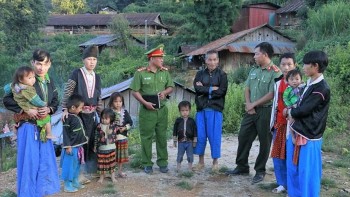 | Ensuring Religious Security in Cyberspace Religious and faith-based activities in cyberspace have long existed in Vietnam and have recently developed strongly, especially during and after the COVID-19 pandemic. These activities ... |
Related Stories
 World
World
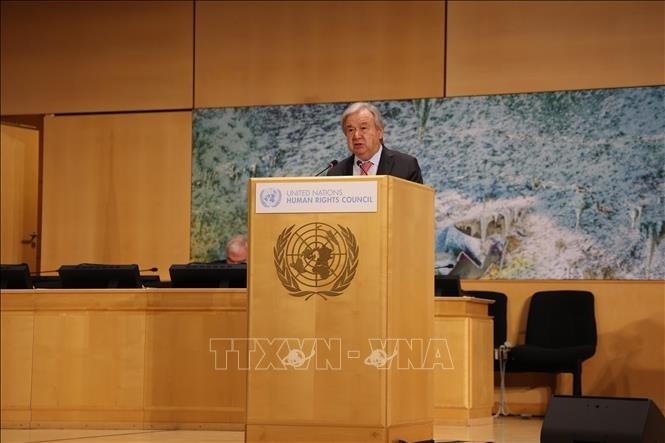
High-Level Segment of 61st Session of the UN Human Rights Council Opens in Geneva
 World
World
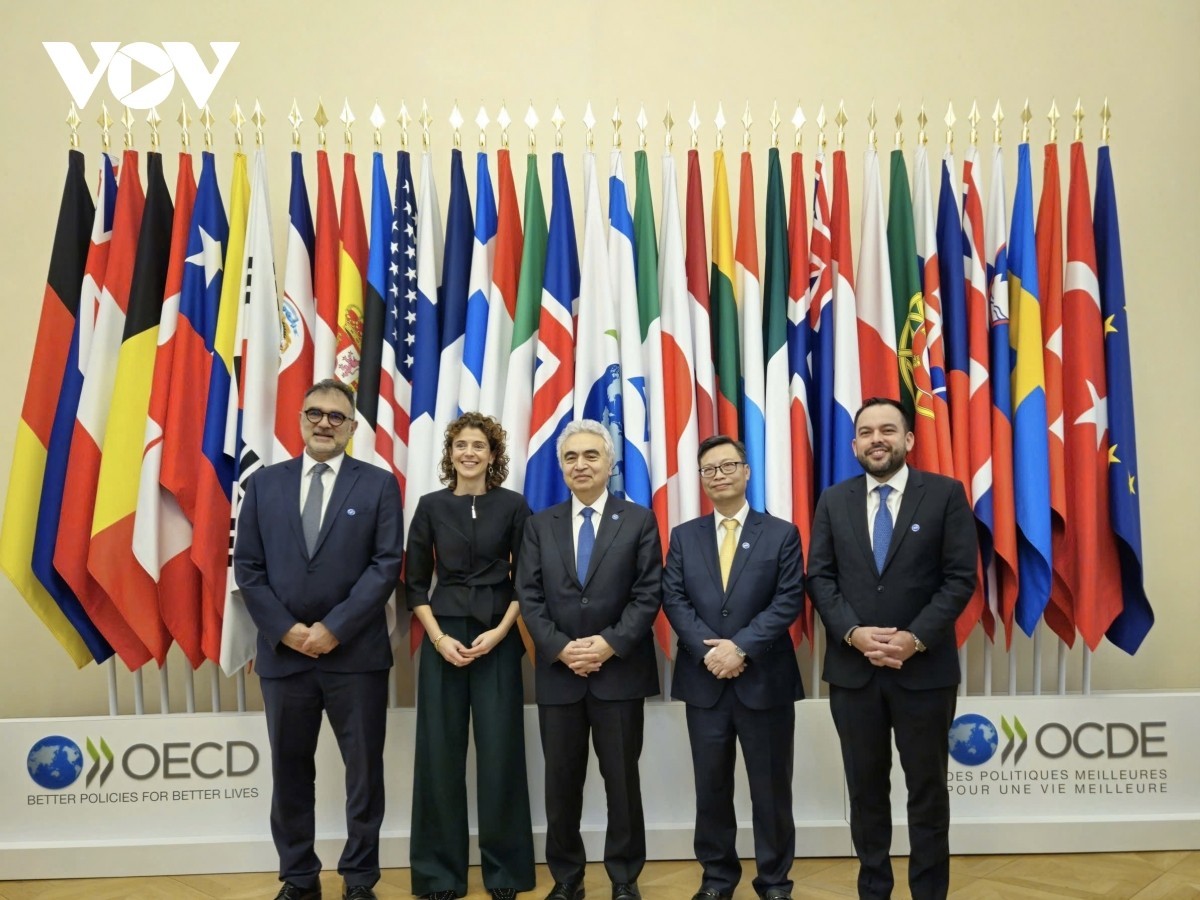
Vietnam Officially Becomes Association Country of International Energy Agency (IEA)
 Friendship
Sharing from Viet Nam
 Friendship
Viet Nam in the Hearts of Friends
Recommended
Viet's Home
Religious Freedom in Vietnam - Numbers That Do Not Lie
Popular article
 Viet's Home
International Scholars: Elections in Vietnam Reinforce Legal Foundation for New Stage of Development
 Viet's Home
Election to National Assembly and People’s Councils: Significant Event Strengthening Power of Vietnamese People
 Viet's Home
Touching Moments as Centenarian Voters in Yen Lang (Ha Noi) Cast Their Ballots
 Viet's Home