
Seeking Solutions to Remove Bottlenecks to Socio-Economic Development
| Côte d’Ivoire Praises Vietnam’ Socio-economic Development Vietnam Strives to Achieve Transport Infrastructure Development Targets: PM |
The seminar, titled “Solutions to remove bottlenecks to Vietnam’s socio-economic development in the coming years, contributing to the achievement of the goals set by the 14th National Party Congress,” was co-chaired by Ambassador Doan Xuan Hung, Vice President of the Vietnam Peace and Development Council, and Associate Professor Dr. Le Bo Linh, President of the Institute for Economic Strategy Studies.
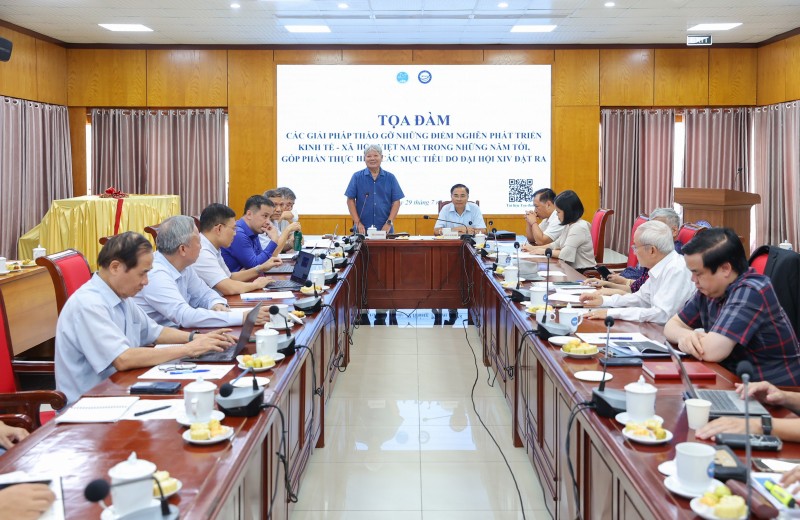 |
| The seminar titled “Solutions to remove bottlenecks to Vietnam’s socio-economic development in the coming years, contributing to the achievement of the goals set by the 14th National Party Congress”. (Photo: Dinh Hoa) |
The program featured three presentations examining the issue from the perspectives of institutions, legal frameworks, growth models, and the business community.
Dr. Nguyen Quoc Hoan, Director General of the Department of Legal Development Affairs under the Ministry of Justice, delivered a presentation identifying institutional and legal bottlenecks and proposing measures to address them.
In his presentation on socio-economic development bottlenecks, Dr. Le Quoc Phuong of the Institute for Economic Strategy Studies noted that Vietnam’s short-term growth drivers are struggling to generate breakthrough momentum.
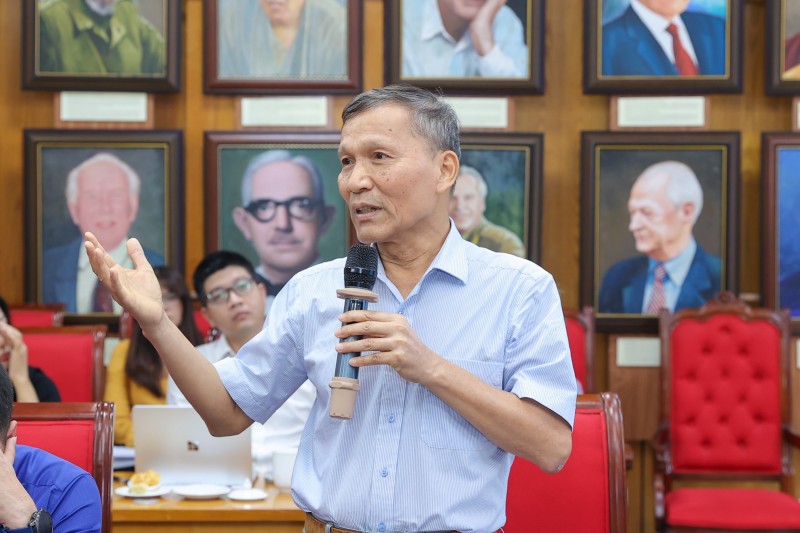 |
| Dr. Le Quoc Phuong, Institute for Economic Strategy Studies, speaks at the seminar. (Photo: Dinh Hoa) |
Analyzing the export sector, he said Vietnam ranks 20th globally in export value. However, the domestic value added of its exports remains low. Among the ASEAN-6 economies, Vietnam ranks fifth, above only Indonesia, in terms of the value-added ratio in exports.
He also pointed out that Vietnam has the highest level of import dependence among the ASEAN-6, as its exports consist largely of processed and assembled products. This model of high export growth but low value addition exposes the economy to significant external risks, including trade protectionism, supply chain disruptions, geopolitical crises, natural disasters, and pandemics.
Against this backdrop, the presentation called for the development of a new growth model centered on science, technology, and innovation, with digital transformation and data serving as foundational infrastructure. This should not be viewed as a solution for a single sector or industry, but rather as an integral part of transforming the growth model and strengthening the resilience of the economy.
According to Dr. Le Quoc Phuong, Vietnam should build an innovation ecosystem that connects infrastructure, finance, data, standards, and markets, with businesses, research institutes, and universities serving as its core actors.
He also stressed the need for the State to play a stronger role through risk-sharing mechanisms with businesses, including seed funding, public-private co-investment, risk management in public investment, and risk guarantee mechanisms.
Another proposed direction is the establishment of a comprehensive legal framework for national data governance, covering data collection, standardization, integration, sharing, valuation, utilization, and oversight. At the same time, artificial intelligence should be more widely applied across industries, agriculture, finance, education, healthcare, logistics, e-commerce, and public administration.
The presentation also highlighted the need to continue improving the business environment and creating favorable conditions for science and technology enterprises. It further recommended designing public finance policies that prioritize a number of strategic sectors capable of generating technological spillover effects and enhancing Vietnam’s position in global value chains.
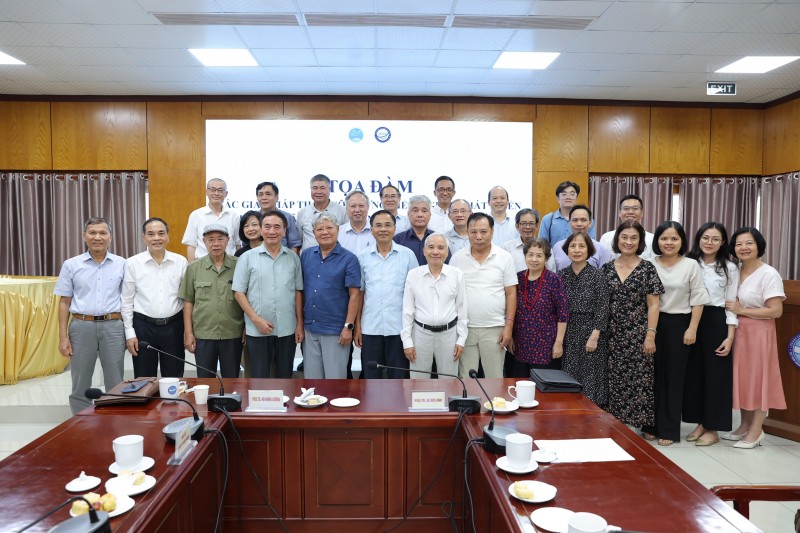 |
| Delegates at the seminar. (Photo: Dinh Hoa) |
Representing the business community, Dr. Dau Anh Tuan, Deputy Secretary General of the Vietnam Chamber of Commerce and Industry (VCCI), discussed institutional bottlenecks, their impact on business and production activities, and potential solutions.
During the seminar, delegates and experts exchanged views and engaged in discussions to clarify policy recommendations and identify priority solutions for the next phase of development.
 Vietnam Grants Visa Exemptions to Certain Special Foreign Nationals Vietnam Grants Visa Exemptions to Certain Special Foreign Nationals The Government has just issued a regulation on temporary visa exemptions for special categories of foreign nationals requiring preferential treatment. |
 Hanoi Seeks Japan’s Experience to Support Its Long-Term Development Vision Hanoi Seeks Japan’s Experience to Support Its Long-Term Development Vision On December 17, as part of activities to strengthen Vietnam-Japan relations, Hanoi Party Secretary Nguyen Duy Ngoc received a delegation from the Embassy of Japan in Vietnam, led by Japanese Ambassador to Hanoi Ito Naoki, to exchange views on strategic cooperation orientations in the new phase and to share experience in long-term development. |

Most read


Related Stories
 Overseas Vietnamese
Building Bridges Connecting Overseas Vietnamese with the Homeland
 National
Ha Noi Unveils 100-Year Master Plan
 Focus
Focus
Viet Nam Peace and Development Council Reviews Work in First Half of 2026
 Overseas Vietnamese
Overseas Vietnamese Entrepreneurs Help Expand Vietnam’s Economic “Soft Power”
Popular article
 Friendship
Vietnam-Austria Friendship Association Connects with Vietnamese Intellectuals and Scientists in Austria
 Friendship
Digital Transformation in Agriculture Requires Strength of Multi-Stakeholder Cooperation
 Friendship
Promoting Vietnam-Romania Educational Cooperation
 Friendship