Viet Nam pledges to advance rule of law at home, uphold law-based global order at UN
Viet Nam remains steadfast in advancing the rule of law at home and working closely with partners to uphold an international order based on international law, said Ambassador Do Hung Viet, Permanent Representative of Viet Nam to the United Nations (UN).
Viet spoke at a meeting of the UN General Assembly’s Legal Committee (Committee 6) during its 81st session in New York on October 7-10, which took up the agenda item “Rule of law at the national and international levels”.
He stressed that international law’s effectiveness and credibility hinge on states interpreting and applying it in good faith, consistently and without selectivity. That applies in particular to the core principles of the UN Charter, including sovereign equality, respect for territorial integrity, non-interference in internal affairs, the ban on the threat or use of force, peaceful settlement of disputes, and good-faith fulfillment of international obligations through concrete action.
Turning to maritime issues, he affirmed that the 1982 UN Convention on the Law of the Sea (UNCLOS) provides the legal framework for all activities at sea. All maritime claims and conduct, as well as the settlement of maritime disputes, including those in the East Sea, must comply with UNCLOS. Until disputes are finally settled, the parties involved should exercise restraint, manage differences responsibly and avoid actions that could escalate or further complicate the situation.
Linking the rule of law at the international and national levels, he outlined Vietnam’s recent drive to overhaul law-making and enforcement. The effort includes reviewing thousands of legal documents for amendment, replacement or repeal to address overlaps and inconsistencies and clear barriers to development; continued improvements to criminal and fisheries legislation, stronger copyright and intellectual property protection, and wider legal outreach to citizens and enterprises, according to VNA.
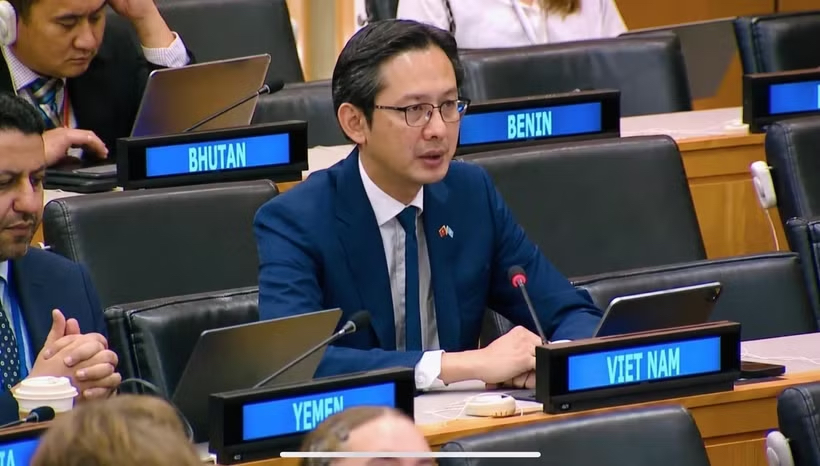 |
| Ambassador Do Hung Viet, Permanent Representative of Viet Nam to the UN (Photo published by VNA) |
As it updates its legal framework, Viet Nam has also put in place rules governing digital technologies, personal data protection, cybersecurity, artificial intelligence and digital transformation. The country upgraded its National Legal Database and expanded digital platforms to broaden access to legal information, education and aid, he said.
On Vietnam’s contributions to the rule of law internationally, he said the country was the third in the world to ratify the UN Convention against Cybercrime (Hanoi Convention). It is also preparing for full and effective implementation of the Agreement on the Conservation and Sustainable Use of Marine Biological Diversity of Areas beyond National Jurisdiction (BBNJ Agreement), and continues to contribute actively to international legal forums and bodies.
Participants affirmed that the rule of law underpins peace, security, international cooperation and sustainable development, and called for peaceful dispute settlement, justice and judicial access. They praised the role of UN bodies in codifying and progressively developing international law, and urged more substantive dialogue and timely exchanges between Committee 6 and member states so that international law reflects the perspectives and legal practices of different regions and legal systems, particularly the contributions of developing countries.
The Legal Committee is one of six main committees of the UN General Assembly, comprising all 193 member states. It considers legal matters and promotes the codification and progressive development of international law. The UN General Assembly has taken up “the rule of law at the national and international levels” item annually since 2006.
Viet Nam-Canada strategic partnership leverages strengths to consolidate positions
Viet Nam-Canada strategic partnership is connecting strengths and capabilities not only in trade and investment, but increasingly deeper into technology, infrastructure, human resources, and energy transition solutions.
Both nations officially established a Comprehensive Partnership in 2017 and upgraded it to a Strategic Partnership in September 2026. As a key ASEAN member and Chair of the Comprehensive and Progressive Agreement for Trans-Pacific Partnership (CPTPP) Commission in 2026, Viet Nam has become a notable partner for Canada with a major regional trade and manufacturing economy.
In this cooperative relationship, Viet Nam has a strong interest in maintaining an open, stable trade environment and preserving room for cooperation with diverse partners. Conversely, Canada offers complementary strengths and relational networks, particularly in Europe and the Indo-Pacific, as well as in energy, critical minerals, finance, and advanced technologies.
Room for investment and energy cooperation
Assessing that the CPTPP has yielded positive results, making Viet Nam one of Canada’s most important economic partners in the Asia-Pacific, Vice President of the Business Council of Canada Trevor Kennedy emphasizes that bilateral trade has grown rapidly in recent years, with Vietnamese goods securing a growing presence in the Canadian market. This shows the manufacturing capacity and global supply chain integration of Vietnamese enterprises.
Kennedy notes strongly expanded bilateral trade, huge potential for cooperation, especially in investment. He adds that Canada possesses key strengths in energy, oil and gas, liquefied petroleum gas (LPG), nuclear power technology, and uranium supply, which can effectively meet Vietnam’s development needs in the coming period.
Highlighting that Canada hosts some of the world's leading pension funds and institutional investors, Kennedy says that Canadian investment capital into Viet Nam is still modest, leaving ample room for both sides to boost cooperation as the investment climate improves and CPTPP commitments are utilized more effectively.
“The challenge today no longer lies in whether a trade agreement exists, but in how the business community effectively leverages commitments, expands investments, and creates new cooperative projects in the next phase of development,” Kennedy expressed confidence.
During a recent working session between Vietnamese Minister of Industry and Trade Le Manh Hung and Canadian Minister of Energy and Natural Resources Tim Hodgson to advance energy and technology cooperation, Minister Hodgson spoke highly of prospects for expanding investment cooperation in LNG, including Vietnamese enterprises researching participation in Canadian LNG projects. Minister Hodgson also expressed a desire to step up cooperation in nuclear technology, including CANDU reactors and Small Modular Reactors (SMRs), while strengthening connections among businesses, technology suppliers, and energy partners from both nations.
Building on the newly established framework, Viet Nam and Canada are well placed to advance concrete programs, boost business participation, and incrementally turn potential into projects, making practical contributions to sustainable energy development and bilateral economic ties.
Expanding new spaces for cooperation
Canada is currently Viet Nam's second-largest trade partner in the Americas, while Viet Nam is Canada's largest trade partner in ASEAN. According to Dr. Tran Thu Quynh, Commercial Counselor and Head of the Viet Nam Trade Office in Canada, the CPTPP acts as a major driver for bilateral trade, opening new spaces for business cooperation.
“Current demand for supply diversification, as Canadian consumers and retail systems actively seek alternative sources, opens opportunities for processed agricultural and aquatic products, wooden furniture, textiles, footwear, and consumer goods from Viet Nam to incrementally expand market share,” Quynh says.
In the industrial sector, the Head of the Viet Nam Trade Office in Canada states that Canada is reshaping its industrial policy while actively diversifying trade beyond the US market. These shifts align closely with Vietnam’s push to enhance industrial autonomy and value-added capabilities, in line with Resolution 57 on breakthroughs in science, technology, innovation, and national digital transformation; Resolution 59 on international integration in the new context; and Resolution 68 on private sector development.
Particularly as Canada actively solidifies foundational industries, restructures manufacturing networks, and seeks deeper linkages with Asia-Pacific trade partners, Viet Nam has emerged as one of the region's dynamic manufacturing, precision engineering, and microelectronics assembly hubs.
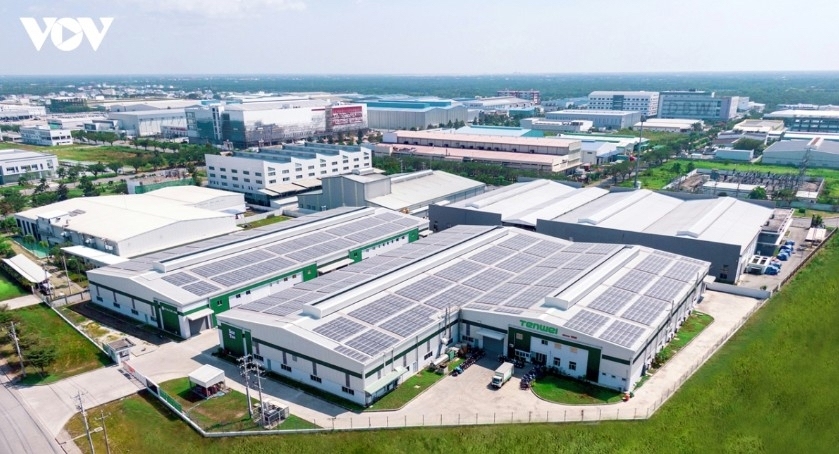 |
| Viet Nam, Canada may establish specialized exchange mechanism on industrial linkages, supply chains under JEC. |
This combination opens vast space for both sides to move beyond trade and subcontracting toward joint investment, product development, and technology transfer, thereby elevating their positions in global value chains, Quynh observes
To realize this potential, Quynh suggests both sides establish a specialized exchange mechanism on industrial linkages and supply chains under the Joint Economic Committee (JEC), reported VOV.
They can launch programs connecting Vietnamese suppliers with Canadian corporations in aerospace, automotive, energy equipment, and SMR sectors. Additionally, they can promote innovation for small and medium-sized enterprises through joint R&D projects on manufacturing automation and new materials, alongside forming production consortia to commercialize research outcomes.
Furthermore, both sides can encourage Canadian financial and credit institutions to participate in green and eco-industrial park projects in Viet Nam, while promoting joint research on deep processing of critical minerals and microchip design between research institutes and universities of both countries.
Canada has provided Viet Nam with nearly 200 development cooperation projects worth approximately US$1.35 billion, many of which have directly contributed to boosting the export capacity and competitiveness of Vietnamese businesses. The North American nation currently ranks as the 14th largest foreign investor in Viet Nam, with 299 projects and over US$4.9 billion in registered capital.
German-Vietnamese friendship association marks 50 years of nurturing people-to-people ties
The Germany-Vietnam Friendship Association celebrated its 50th founding anniversary in Düsseldorf on October 10, marking five decades of efforts to promote solidarity, friendship, mutual understanding and people-to-people exchanges between the two countries.
Addressing the event, Vietnamese Consul General in Frankfurt am Main Luu Xuan Dong praised the association’s contributions over the past five decades. Since its establishment in 1976, the association has sought to bring together organizations and individuals who support Viet Nam, strengthen solidarity and serve as a bridge between the two peoples.
He highlighted its cultural exchange activities to introduce Viet Nam and its people to German audiences. The association has also carried out humanitarian programmes supporting Agent Orange victims, children with hearing impairments and disadvantaged students in remote areas through scholarships, cited VNA.
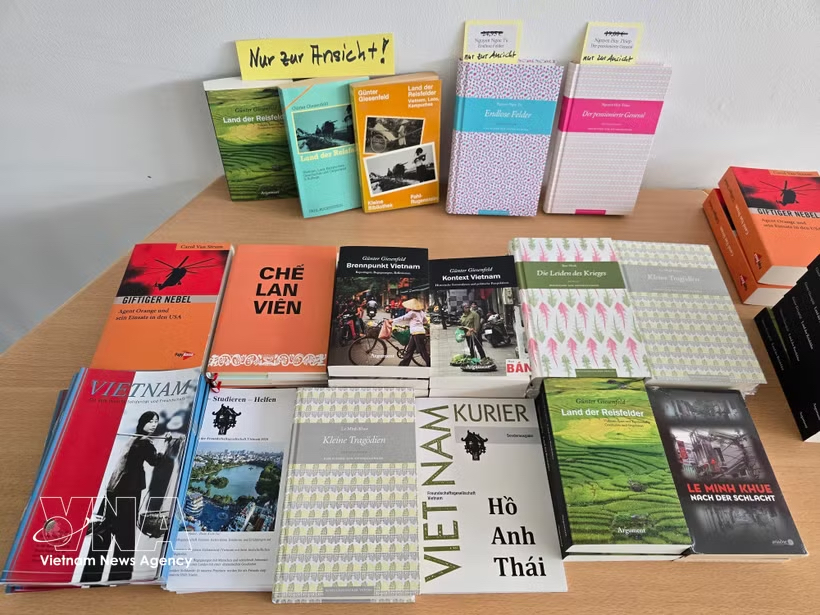 |
| Viet Nam-related works in German translation on display (Photo: VNA) |
These meaningful activities have helped lay a solid foundation for the Viet Nam-Germany Strategic Partnership, he said.
Looking ahead, Dong noted that Viet Nam is entering a new development era and expressed hope that the association would continue to serve as a bridge, not only by maintaining traditional cultural exchanges but also by expanding cooperation into emerging fields such as science, technology, innovation and green transition, while connecting young intellectuals from the two countries.
At the ceremony, head of a delegation from the Viet Nam-Germany Friendship Association Nguyen Bich Ngoc handed over a congratulatory letter from former Deputy Prime Minister Nguyen Chi Dung, President of the Viet Nam-Germany Friendship Association, to President of the German-Vietnam Friendship Association Professor Dr. Günter Giesenfeld, the association’s leadership and members.
The letter recalled the solidarity shown by predecessor organizations in the 1960s and 1970s, when anti-war movements and campaigns supporting peace and Vietnam’s just struggle were active in Germany. Since its official establishment in 1976, the association has made important contributions to friendship and mutual understanding between the two peoples.
Dung praised Giesenfeld and generations of members for their longstanding dedication, expressing hope that the two friendship associations would strengthen coordination in people-to-people exchanges, culture, science and activities targeting young people.
In his speech, Giesenfeld reviewed the association’s history and development over the decades, stressing the need for friendship organizations to renew their methods of operation, shifting from solidarity based on support to equal partnerships that involve exchanging experience, sharing responsibility and seeking solutions to common global challenges.
He praised Vietnam’s development achievements, particularly its efforts to combine economic growth with social progress, equity and people’s interests. He stressed that solidarity today should be based on respect, equality, sharing and partnership, alongside frank and constructive exchanges to strengthen mutual trust.
The ceremony also featured archival photographs and documentary footage compiled by Giesenfeld, tracing key milestones in Germany’s solidarity movement with Viet Nam. The programme also featured readings of Vietnamese poems translated into German by Giesenfeld, helping introduce Vietnamese literary and cultural values to local audiences.
Building an investment ecosystem to attract FDI
As competition to attract investment enters a new phase, Resolution No. 10-NQ/TW, dated June 8, 2026, issued by the Politburo on the development of the foreign-invested economy (Resolution 10), has marked an important shift in the approach and development mindset towards foreign investment cooperation.
Vietnamese enterprises at the center
Resolution 10 identifies the foreign-invested economic sector as an important component of the national economy and calls for a strong shift from attracting investment capital to creating development value. Rather than treating the foreign-invested economy as a separate economic sector, the resolution places it within the broader national development ecosystem, comprising foreign-invested enterprises (FDI), domestic private enterprises, research and development entities, research institutes, universities, and innovation centers.
Dr Phan Huu Thang, Chairman of the Viet Nam Industrial Park Finance Association, said that with the adoption of Resolution 10, for the first time, the development of domestic enterprises had been identified as a central task of foreign investment policy, rather than merely an expected outcome of the investment attraction process. To achieve the set objectives, Thang proposed implementing a selective FDI model linked to technology transfer and domestic spillovers through a policy shift from an incentive-based mindset to conditional requirements.
High-tech, large-scale FDI projects should be required to meet three mandatory conditions: having a substantive technology transfer roadmap with specific verification mechanisms; establishing joint ventures and co-investing with Vietnamese enterprises; and maintaining close links with the domestic innovation ecosystem. Such institutional requirements are becoming increasingly urgent given the significant gap between FDI enterprises and domestic businesses.
Specifically, FDI enterprises account for 80.7% of the country's total merchandise exports, while newly registered FDI capital has exceeded 50 billion USD, up 76.4% year on year. Disbursed capital has reached more than 21 billion USD, up 12.1%, marking the highest level for the first nine months of the year in the past five years.
Improving FDI attraction policies
According to Prof. Dr Nguyen Trong Hoai, senior lecturer at the University of Economics Ho Chi Minh City, to narrow the gap between the FDI sector and the domestic economy, policy priorities should shift from simply attracting FDI to improving the quality of linkages between FDI enterprises and domestic businesses through a legal framework established by the Government. FDI attraction should be linked to creating opportunities for domestic small and medium-sized enterprises to participate in supply chains and access technology transfers.
Hoai noted that the World Bank had emphasised the need to connect global enterprises with domestic suppliers, improve the business environment, and develop supply chain finance solutions. These measures would enable domestic businesses to gradually meet requirements for quality, technology, cost, and delivery times, thereby qualifying to become suppliers to multinational corporations. In this process, human resource training should be more closely aligned with business needs and global value chains to address the shortage of highly skilled workers, NDO reported.
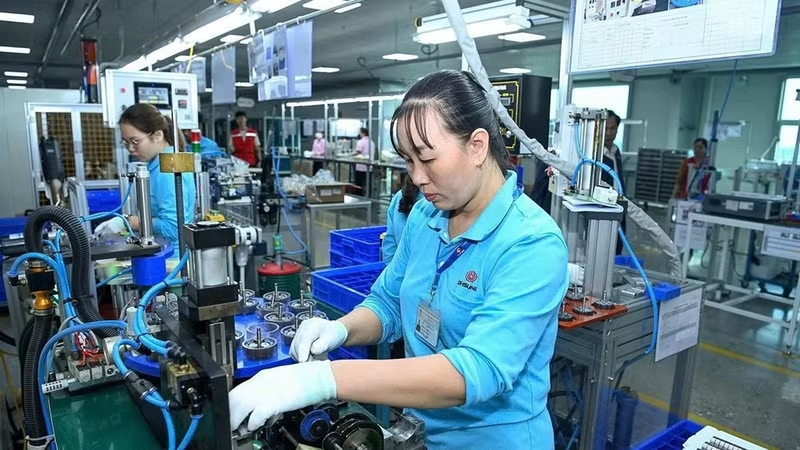 |
| Ohsung Vina Co., Ltd., an FDI enterprise specialising in manufacturing electronic components and accessories, screens, and electrical equipment, at Lien Ha Thai Industrial Park, Hung Yen Province (Photo: DANG ANH) |
This provides a basis for boosting productivity, increasing domestic value added in exports, and strengthening the economy's long-term competitiveness. Resolution 10 also sets out tasks to improve institutions and the investment and business environment, with a view to bringing about a breakthrough in cooperation with and the development of the foreign-invested economic sector.
Sharing the policy direction for incorporating Resolution 10 into the Law on Investment, Bui Thu Thuy, Deputy Head of the Foreign Investment Agency under the Ministry of Finance, said that future FDI attraction policies would not offer uniform, broad-based incentives or pursue projects based on scale and quantity alone.
Instead, incentives must be tied to investors' fulfilment of commitments on technology transfer, domestic supplier development, workforce training, and environmental protection. Projects delivering high socio-economic benefits will receive commensurate support, while unfulfilled commitments will be assessed and may lead to adjustments or the withdrawal of incentives. Policy priorities will also shift from investment management towards creating a favourable environment and establishing a unified national coordination mechanism, replacing competition among localities to attract investment.
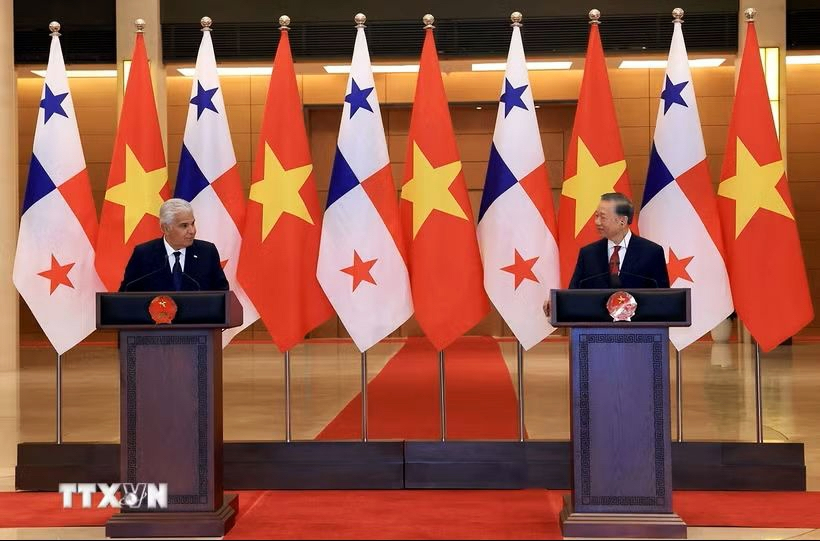 Viet Nam News Today (Oct. 7): Viet Nam, Panama Highlight New Opportunities for Trade and Investment Viet Nam News Today (Oct. 7): Viet Nam, Panama Highlight New Opportunities for Trade and Investment |
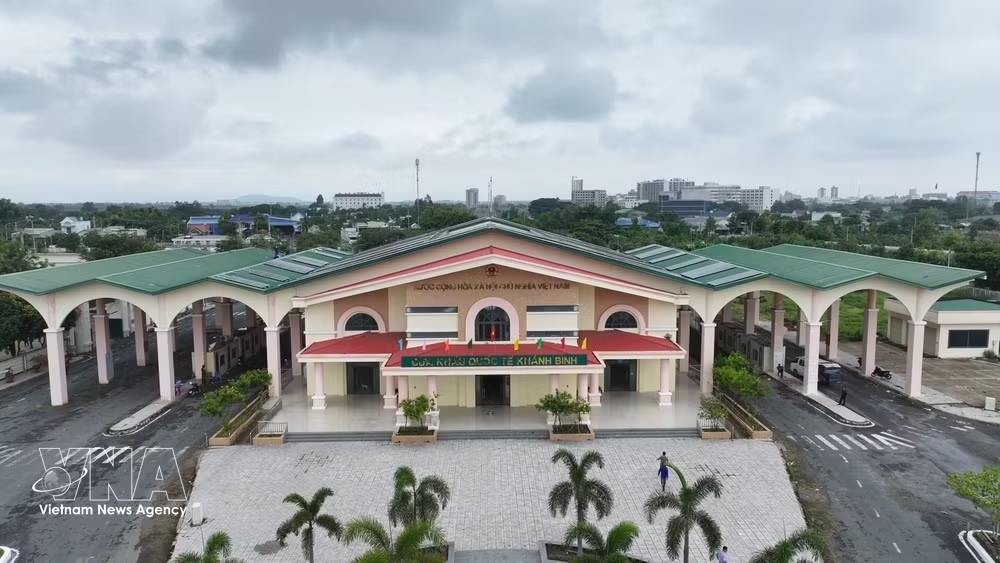 Viet Nam News Today (Oct. 8): Viet Nam Sees Panama as Key Partner in Latin America Viet Nam News Today (Oct. 8): Viet Nam Sees Panama as Key Partner in Latin America |