| Viet Nam News Today (Oct. 7) notable headlines Viet Nam, Panama highlight new opportunities for trade and investment Lao Ambassador highlights four areas to realize strategic cohesion in Laos-Vietnam relations Viet Nam, Cambodia strengthen connectivity, create new momentum for growth World Bank raises Vietnam’s 2026 growth outlook as high-tech exports surge Central Viet Nam braces for torrential rain, with over 600mm forecast in places Vietnam–Laos strategic cohesion set for deeper, more practical development From APEC to Michelin: New opportunities for Phu Quoc to extend stays, boost spending People-to-people exchanges forge stronger Viet Nam-Panama ties Five Vietnamese films selected for 31st Busan International Film Festival |
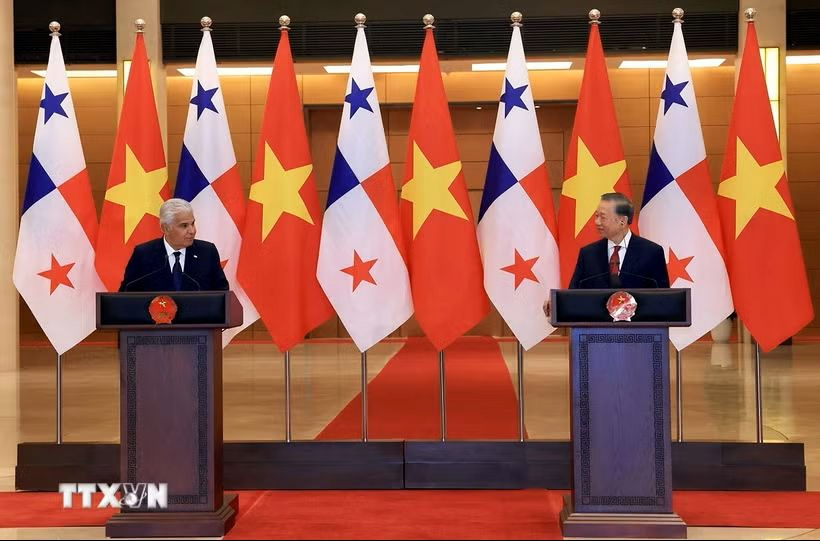 |
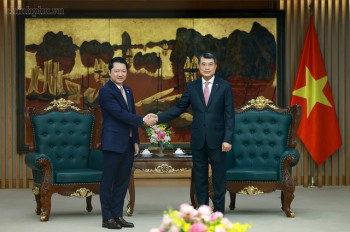
| General Secretary of the Communist Party of Viet Nam Central Committee and President of Viet Nam To Lam (R) and President of the Republic of Panama José Raúl Mulino at the press briefing following their talks in Hanoi on October 6. (Photo: VNA) |
Viet Nam, Panama highlight new opportunities for trade and investment
Viet Nam and Panama will tap their respective economic and geographic advantages to expand trade, investment, connectivity and supply-chain links between Southeast Asia and Latin America, their leaders said at a press briefing in Hanoi on October 6.
General Secretary of the Communist Party of Viet Nam Central Committee and President of Viet Nam To Lam and President of the Republic of Panama José Raúl Mulino met the press, following their talks during President Mulino’s official visit to Viet Nam.
General Secretary and President To Lam welcomed President Mulino, his spouse and the Panamanian high-level delegation to Viet Nam, saying the visit provided an important opportunity to discuss ways to strengthen bilateral friendship and cooperation in a more substantive and effective manner.
He said the talks were held in a friendly, open and trusting atmosphere, with the two sides exchanging views on bilateral relations as well as regional and international issues of shared concern.
Viet Nam and Panama seek to expand trade and connectivity
The two sides assessed that Viet Nam-Panama relations have continued to develop positively, with high-level visits and contacts as well as bilateral cooperation mechanisms maintained. Two-way trade reached nearly US$500 million in 2025.
The leaders agreed that there remains considerable room for cooperation, particularly in trade, investment and services. They will therefore promote cooperation in the economy, trade, investment, agriculture, port logistics, finance, banking, tourism and transport, as well as other areas where the two countries have strengths.
They also agreed to continue negotiations on agreements covering investment protection, aviation and other areas, with a view to creating a favorable framework for expanding bilateral cooperation.
The Vietnamese leader highlighted the importance of leveraging the two countries’ geoeconomic advantages and strengthening connectivity in transport, logistics, financial flows and supply chains between East Asia and Latin America, thereby creating more opportunities for businesses from both sides.
On multilateral cooperation, the two sides agreed to continue coordinating and supporting each other at international organizations and multilateral forums, while exchanging views on regional and international issues of shared concern.
They reaffirmed the importance of international law and the United Nations Charter, and supported maintaining freedom and safety of navigation and overflight, as well as settling disputes by peaceful means in accordance with international law, particularly the UN Charter and the 1982 United Nations Convention on the Law of the Sea.
An important outcome of the visit was the adoption of a joint statement setting out orientations, objectives, principles and key areas of cooperation for Viet Nam-Panama relations in the coming period.
The two sides also agreed to strengthen exchanges through diplomatic channels, promote parliamentary cooperation and people-to-people diplomacy, and facilitate businesses’ access to each other’s markets and deeper participation in regional and global supply chains, cited VOV.
General Secretary and President To Lam expressed his belief that President Mulino’s visit would provide important fresh momentum for implementing the agreements reached, making better use of the two countries’ potential and strengths, and bringing bilateral relations to more substantive and effective results.
Viet Nam stands ready to work with Panama to effectively implement the outcomes of the visit for the benefit of the two peoples, while contributing to peace, cooperation and development in the two regions and around the world, he told his guest.
Panama looks to deepen economic links with Viet Nam
For his part, President José Raúl Mulino said that although Panama and Viet Nam are geographically distant, their peoples have maintained a relationship of friendship and solidarity built over more than 50 years.
For Panama, expanding and diversifying its international relations is important, and Viet Nam is an important partner in Southeast Asia, he affirmed.
President Mulino said a significant part of the talks focused on economic relations, noting that Viet Nam has developed impressive industrial and export capacity.
Panama wants to serve as a gateway for Vietnamese industry to reach Latin American and Caribbean markets, he said, expressing the hope that Vietnamese businesses would take advantage of Panama’s strengths to establish a presence there and expand into regional markets.
The two sides also discussed agriculture, connectivity, tourism, maritime cooperation and other areas where their capabilities are complementary, President Mulino said.
He hoped that better conditions could be created for businesses and producers to seek new markets, helping to reduce the impact of the considerable geographical distance between the two countries.
During the visit, the two sides signed agreements on security, maritime transport and agriculture, which President Mulino described as important steps. The task now is to turn those agreements into concrete projects and results for the people of both countries, he said.
President Mulino stressed that Panama wants to move closer to Viet Nam, expand its presence in Asia and create new opportunities for trade, investment and cooperation between the two peoples.
Lao Ambassador highlights four areas to realize strategic cohesion in Laos-Vietnam relations
Lao Ambassador to Viet Nam Khamphao Ernthavanh has highlighted four areas to realize the strategic cohesion between the two countries while granting an interview to the Viet Nam News Agency ahead of Prime Minister Le Minh Hung’s upcoming official visit to the neighbouring country.
The ambassador highly valued the visit, made at the invitation of PM Saleumxay Kommasith from October 8-9, describing it as an important event for the great friendship, special solidarity, comprehensive cooperation and strategic cohesion between Laos and Viet Nam.
The trip, the first to Laos by PM Hung since he assumed office, will reaffirm the determination of the two countries’ leaders to implement their reached agreements and common perceptions; and also contribute to putting into practice cooperation plans and programs, particularly those agreed at the 48th meeting of the Viet Nam-Laos Intergovernmental Committee, the diplomat said.
Khamphao said the two countries are making efforts to ensure that economic ties develop in line with their strong political relations. Bilateral trade reached nearly 3 billion USD in 2025 and approximately 1.65 billion USD in the first eight months of 2026.
Viet Nam remains one of the leading investors in Laos, with investment increasingly focusing on quality projects in energy, mining, agriculture and services. She expressed her hope that PM Hung’s visit will provide fresh impetus for economic cooperation and mutual development.
She said cooperation would be further expanded in the time ahead, especially in the digital economy, e-commerce, innovation, energy, agriculture and high-quality human resources. The ambassador also suggested the two countries create favorable conditions for their businesses to study each other’s markets and capabilities and implement agreements reached by their leaders.
Regarding the “strategic cohesion”, the diplomat said the concept reflected the leaders’ shared view that all agreed projects and agreements should be implemented and translated into concrete results. To realize it, she identified four priority areas.
First, economic and infrastructure connectivity should be strengthened. With a shared border of more than 2,000 km, the development of transport, logistics, energy, border gates and digital infrastructure is essential to bringing the two countries closer and meeting new development requirements.
Second, the two sides should step up human resources development. Khamphao said education cooperation has been intensified, with more than 1,300 scholarships provided annually for Lao students to study in Viet Nam, alongside regular exchanges and specialized research programs for Lao officials. The two countries have also agreed to establish a Lao-Vietnam Friendship University in Laos, which is currently being implemented.
Third, science, technology and digital transformation should become a stronger focus. Against the backdrop of rapid digital economic development, Laos and Viet Nam should step up the sharing of experience and collaboration in data, e-commerce, innovation, cybersecurity and digital infrastructure in service of their people and businesses, according to VNA.
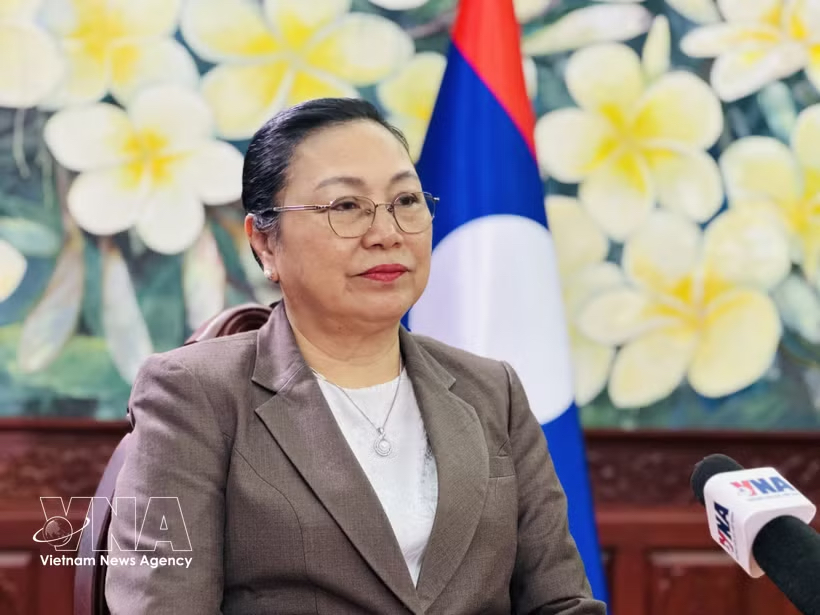 |
| Lao Ambassador to Viet Nam Khamphao Ernthavanh grants an interview to the Viet Nam News Agency ahead of Prime Minister Le Minh Hung’s official visit to Laos. (Photo: VNA) |
Fourth, connectivity between localities and people of the two countries should be enhanced. The ambassador stressed that bilateral ties should not be confined to the central level but should extend to localities and communities. Greater exchanges among provinces and cities, particularly among young people, will help strengthen their understanding of the special relationship and carry forward the legacy built by previous generations.
She emphasised that strategic cohesion should mean turning words into action and ensuring substantive and effective implementation rather than stopping at declarations.
For infrastructure connectivity, Khamphao described transport and logistics as the most important link in Laos’ current development as the country is aims boost connectivity with the region and the world.
The two sides have discussed and prioritized major connectivity projects, including the Hanoi-Vientiane expressway and the Viet Nam-Laos railway. According to the ambassador, these projects will provide valuable support for Laos in improving access to maritime transport through Viet Nam.
If the projects, particularly transport routes expected to be completed by 2030, are implemented effectively, the movement of Lao goods to the sea and regional markets will become faster and more efficient, reducing transport costs and delivery times while ensuring product quality, she assessed.
Energy cooperation is another important area, Khamphao said, noting Laos’ potential in hydropower, wind and solar energy, and expressing her hope that Viet Nam will continue to invest in the power sector, particularly large-scale wind power projects.
The two countries share more than 2,000 km of border, with numerous adjoining localities, which facilitates border trade, thus benefiting border residents, the ambassador stressed.
She also showed her wish that Laos and Viet Nam will continue working together to develop connecting routes and accelerate projects already agreed upon. Successful connectivity in transport, energy, trade and digital transformation will provide an important foundation for deeper strategic cohesion and bring greater benefits to the two peoples.
The diplomat affirmed that the great friendship, special solidarity, comprehensive cooperation and strategic cohesion between Laos and Viet Nam constitute the most important foundation for bilateral ties, particularly political and economic cooperation. She stressed that the younger generation has a responsibility to inherit, preserve and further develop the relationship for generations to come.
Viet Nam, Cambodia strengthen connectivity, create new momentum for growth
Vietnamese Prime Minister Le Minh Hung’s official visit to Cambodia is seen as a significant step in strengthening Cambodia-Vietnam relations, moving from “political trust” to “development momentum” and from “historical proximity” to “strategic closeness,” according to Uch Leang, Acting Director of the Department of Asia, Africa and Middle East Studies at the Royal Academy of Cambodia’s Institute of International Relations.
Uch Leang, who is also President of the Association of Cambodian Alumni who studied in Viet Nam, held that the visit’s focus is expected to be on translating high-level agreements into economic and infrastructure connectivity projects and practical cooperation that benefit people and businesses.
According to the scholar, the visit should be viewed from a long-term and regional perspective, as Cambodia-Vietnam relations are important not only to the two countries but also to peace, stability, connectivity and cooperation within ASEAN. High-level contacts in 2026 have demonstrated a solid foundation of political trust, while cooperation in the economy, defense and security, border affairs and people-to-people exchanges has continued to expand.
He said the most important breakthrough in the coming period would be to shift from expanding cooperation to improving its quality and substance. The two sides should first prioritise connectivity between their economies, particularly in transport infrastructure, border gates, logistics, trade and investment, and economic zones, creating conditions for closer links among goods, businesses and production chains.
Connectivity projects such as the Ho Chi Minh City-Moc Bai-Bavet-Phnom Penh expressway could become important growth drivers if implemented effectively, he said.
Alongside economic connectivity, defense and security cooperation and border management should also be deepened, particularly in combating transnational crime, addressing non-traditional security challenges and building a border of peace, stability, cooperation and development, he said.
Another driver highlighted by Uch Leang was people-to-people exchanges, education, culture and youth engagement. He described these as the social foundation for strengthening long-term understanding and trust between the two peoples, particularly as the two countries prepare to celebrate the 60th anniversary of their diplomatic relations in 2027.
Elaborating on people-to-people exchanges, the Cambodian scholar said such exchanges, particularly among young people, are not merely a complementary aspect of Cambodia-Vietnam relations but one of the most important social foundations determining the long-term vitality of bilateral ties.
For young people, he said this area is particularly important because today’s youth will become the leaders, diplomats, entrepreneurs, scholars and others who directly shape Cambodia-Vietnam relations in the decades ahead. Investing in youth exchanges is therefore effectively an investment in the future of bilateral ties.
Uch Leang placed particular emphasis on the role of Cambodian alumni who studied in Viet Nam, describing them as a unique resource.
However, he said people-to-people exchanges in the new period also need to renew their content and methods. They should move beyond ceremonial or traditional exchanges towards programs that are substantive, interactive and capable of producing lasting results. Digital platforms and social media should also be leveraged to enable young people from the two countries to communicate regularly and share knowledge and understanding.
As the two countries prepare to mark the 60th anniversary of diplomatic relations in 2027, he said the time is right to develop a long-term people-to-people exchange program in which young people, students, scholars and alumni networks become active participants, helping take bilateral ties from “historical closeness” to “future-oriented connectivity”.
Regarding Prime Minister Le Minh Hung’s visit to Cambodia, Uch Leang said the official visit would not only consolidate and deepen the foundation of political trust between the two countries, but also create momentum for turning high-level consensus into concrete results, VNA reported.
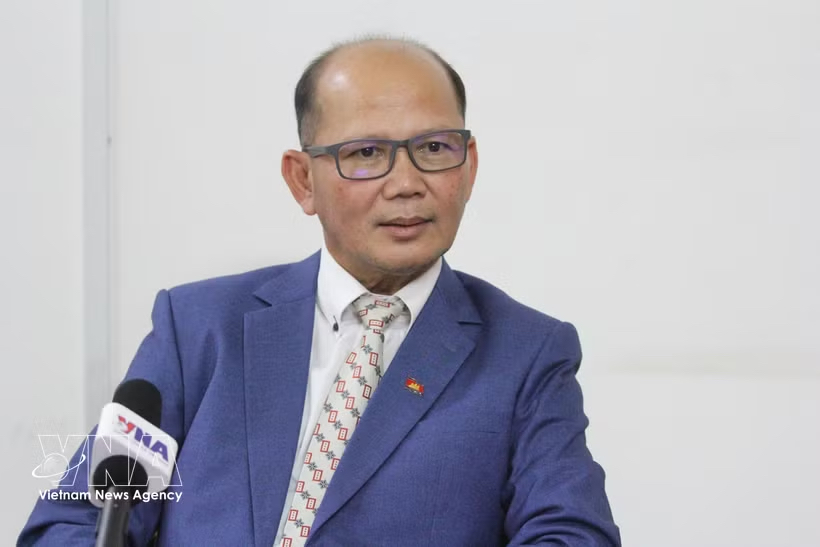 |
| Uch Leang, Acting Director of the Department of Asia, Africa and Middle East Studies at the Royal Academy of Cambodia’s Institute of International Relations speaks to Viet Nam News Agency correspondents in Phnom Penh (Photo: VNA) |
Against a backdrop of rapid regional changes and intertwined interests, maintaining regular, frank and constructive high-level dialogue is particularly important for both Cambodia and Viet Nam, he said.
The Cambodian scholar expects the visit to generate momentum in three key areas.
First, it should strengthen mechanisms for dialogue and strategic coordination. The two sides should continue regular exchanges between senior leaders and relevant agencies, covering not only bilateral relations but also regional and international issues of shared concern. This would help them better understand each other’s priorities, address differences, and maintain an environment of trust and stability.
Second, political relations should be translated into more substantive cooperation programs. Political trust can only remain sustainable when reflected in tangible benefits, he said. The visit should therefore provide fresh impetus to economic, trade and investment cooperation, infrastructure connectivity, border-area development, defense and security, and people-to-people exchanges.
Particular attention should be paid to projects capable of linking the two economies, facilitating business activities, promoting trade and bringing practical benefits to people, he added.
Third, the visit should establish an appropriate framework for addressing issues that require continued coordination. For matters relating to the border, security, transnational crime, water-resource management and non-traditional challenges, it is important to maintain professional-level exchanges and dialogue mechanisms at various levels.
World Bank raises Vietnam’s 2026 growth outlook as high-tech exports surge
The World Bank has raised its 2026 growth forecast for Viet Nam to 7.4%, the largest upward revision in East Asia and the Pacific, as high-tech manufacturing and exports benefit from the global AI investment boom, but the country also faces greater exposure to external supply-chain shocks.
AI-driven trade lifts Vietnam’s growth outlook
The World Bank’s latest East Asia and Pacific Economic Update, released on October 6, raised its forecast for Vietnam’s 2026 growth by 1.1 percentage points to 7.4%, putting the country at the top of the regional growth outlook. Malaysia’s forecast was raised by 0.7 percentage point to 5.1%, while Thailand’s was lifted by 0.7 percentage point to 2.0%.
The stronger outlook reflects Vietnam’s deep integration into global value chains and the growing role of high-tech manufacturing and exports in supporting economic activity.
Vietnam’s economy grew 8.02% in 2025 and accelerated to 8.3% in the first half of 2026, according to the figures cited in the report. Manufacturing, exports and public investment have provided important support for the expansion.
Goods exports rose 22% year on year in the first eight months of 2026, with electronics and machinery continuing to play a major role. The increase was particularly strong in August, when goods exports were up 26% from a year earlier.
The technology boom is becoming an increasingly important part of that export story.
The World Bank’s regional analysis shows that economies across East Asia and the Pacific are benefiting from the global surge in AI-related investment through the manufacture and export of high-tech goods. Viet Nam is among the economies where this effect has been particularly visible, helping explain the size of the upward revision to its 2026 export outlook.
The regional AI supply chain covers both intermediate goods and equipment. Semiconductors and other intermediate inputs remain important, while exports of equipment such as data-centre hardware have also increased. The World Bank’s earlier analysis identified Viet Nam as particularly notable for the rapid growth of AI-related equipment exports, pointing to its emergence as a significant hub for AI-related hardware assembly. This gives Viet Nam an opportunity to benefit from a global investment cycle that is reshaping technology supply chains.
The scale of the opportunity is significant. China, Indonesia, Malaysia, the Philippines, Thailand and Viet Nam together exported around US$1.4 trillion worth of AI-related goods in the 12 months to April 2026, according to the World Bank, cited VOV.
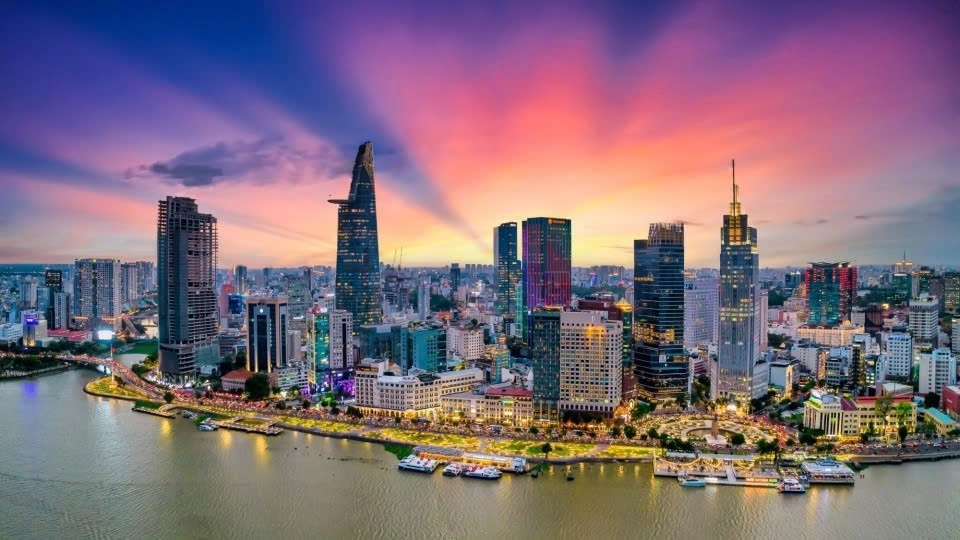 |
| The World Bank has raised its 2026 growth forecast for Viet Nam by 1.1 percentage points to 7.4%, the highest among economies covered in its latest East Asia and Pacific Economic Update, as high-tech exports and AI-related production bolster growth. (Illustrative image) |
For Viet Nam, computers, servers and routers account for around 60% of AI-related goods exports, with a substantial share ultimately serving demand in the US.
Public investment provides another pillar of the growth outlook. Infrastructure spending under the 2026–2030 public investment plan is set to increase further, with a focus on energy, transport and logistics. The World Bank sees continued infrastructure investment as an important complement to export-led growth.
The current pace, however, is not expected to continue indefinitely. The World Bank projects Vietnam’s growth to ease to 7.3% in both 2027 and 2028.
The adjustment nevertheless leaves Viet Nam with the strongest 2026 growth forecast in the region among the economies covered by the latest revisions.
Stronger exports bring greater external exposure
The same integration that is helping Viet Nam benefit from the AI investment boom also creates new vulnerabilities.
One concern is inflation. Consumer price pressures increased from 2.53% in January to 4.89% in August, driven mainly by higher fuel, housing and utility costs. The World Bank projects average inflation of 4.2% for 2026.
Imports are also growing faster than exports, partly reflecting the accumulation of electronic inventories by businesses and higher chip and fuel prices.
The increase in energy import costs is putting additional pressure on the external balance. Higher oil import bills, together with efforts to stabilise domestic fuel prices, have contributed to a decline in foreign-exchange reserves. The World Bank expects Vietnam’s reserves in 2026 to cover less than two months of imports.
These pressures matter because Vietnam’s growth model is highly exposed to international trade and global production networks.
The AI boom provides a clear example. As global demand for AI-related equipment and technology expands, Vietnamese manufacturers can gain from their position in regional supply chains. But a slowdown in global technology investment could have the opposite effect.
Franziska Ohnsorge, World Bank Chief Economist for Asia, linked the outlook for Vietnam’s two-digit growth ambitions to the broader global environment, noting that the country’s high degree of economic openness leaves it closely tied to international value chains and AI-related activity.
If the global expansion driven by AI continues, Viet Nam is well placed to benefit from rising demand for technology-related goods. If global economic activity weakens or the AI investment cycle reverses, however, the same supply-chain integration could amplify the impact on Vietnam’s exports and manufacturing sector.
The issue is therefore not whether Viet Nam can benefit from the AI boom. It is how the country can turn the current export opportunity into a more resilient source of long-term growth. That will depend partly on the ability to strengthen domestic capabilities alongside foreign investment and export manufacturing, improve the resilience of supply chains and broaden the sources of growth beyond a single global technology cycle.
The World Bank’s latest regional assessment points in that direction. The report argues that East Asia and the Pacific’s deep integration into global value chains has positioned the region to benefit from the AI surge, but the next challenge is to translate production strengths into wider productivity gains, AI adoption, skills and better jobs.
For Viet Nam, the message is particularly relevant. The country is gaining from its role in high-tech manufacturing and AI-related exports, but sustaining that advantage will require continued investment in infrastructure, skills, technology adoption and the domestic business environment.
The stronger 2026 growth forecast therefore reflects both an opportunity and a challenge. Viet Nam is benefiting from the global AI investment boom, but the deeper its integration into technology supply chains becomes, the more important it will be to strengthen resilience against external shocks.
Central Viet Nam braces for torrential rain, with over 600mm forecast in places
Central Viet Nam is facing days of torrential rain, with some areas forecast to receive more than 600mm and authorities warning of flooding, flash floods and landslides.
A strengthening cold air mass moving south, combined with the intertropical convergence zone and upper-level easterly disturbances, is bringing widespread heavy rain to central Viet Nam, according to the National Center for Hydro-Meteorological Forecasting.
From 7pm on Oct. 5 to 8am on Oct. 6, rainfall exceeded 200mm in several locations. Ky Anh in Ha Tinh recorded 297mm, Sen Thuy in Quang Tri 427.6mm and Phong Dien in Hue 203.4mm.
The heaviest rain is now shifting southward, with areas from southern Quang Tri to Hue, Da Nang and eastern Quang Ngai expected to bear the brunt of the downpours.
During Oct. 6 and the following night, areas from southern Ha Tinh to Da Nang and eastern Quang Ngai are forecast to receive 50-100mm of rain, with localized totals exceeding 200mm.
Heavy rain will continue on Oct. 7, concentrating from southern Quang Tri to Da Nang and eastern Quang Ngai. Rainfall of 50-100mm is forecast, with some places receiving more than 200mm.
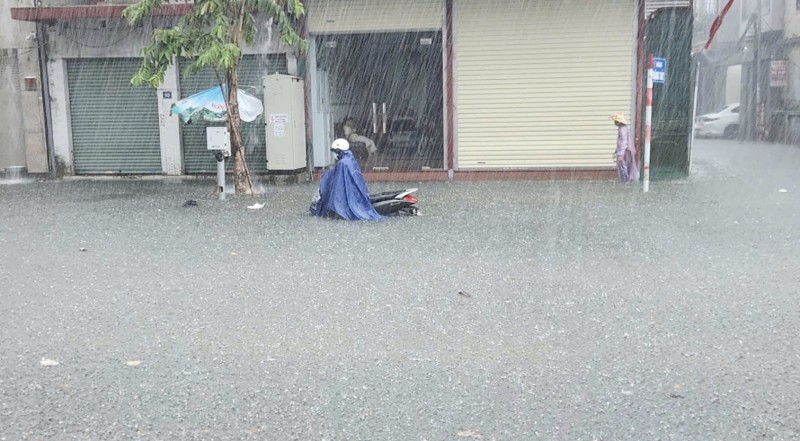 |
| Central Viet Nam is experiencing a period of very heavy rainfall. Photo: Tran Tuyen |
Meteorologists have also warned of intense downpours exceeding 100mm within three hours.
During Oct. 8 and the following night, heavy rain and thunderstorms are expected to persist from southern Ha Tinh to Da Nang, with rainfall of 50-100mm and localized totals above 200mm.
Total rainfall from Oct. 6 through the end of Oct. 8 is forecast at 100-250mm across southern Ha Tinh, Da Nang and eastern Quang Ngai, with some locations receiving more than 400mm.
Particularly heavy rainfall is expected from southern Quang Tri to Hue, where totals could reach 300-400mm and exceed 600mm in some places.
Hue and Da Nang are among the areas facing particularly severe rainfall, prompting meteorological authorities to issue a Level 2 natural disaster risk warning for heavy rain.
Heavy rain could persist until Oct. 11
From the night of Oct. 8, rainfall from Hue to eastern Quang Ngai is expected to gradually ease. However, the rain zone is forecast to shift back northward and expand toward Thanh Hoa.
The widespread heavy rain across central Viet Nam could persist until around Oct. 10-11.
Several days of continuous rainfall will increase the risk of flooding in low-lying areas and cities, while mountainous areas face heightened threats of flash floods and landslides.
Residents in affected areas are advised to closely monitor weather forecasts and warnings and take precautions to protect lives and property.
Cold air reaches Quang Ngai as northern Viet Nam turns cooler
The cold air mass is continuing to spread southward and is expected to affect other parts of eastern Quang Ngai.
On land, northeasterly winds are forecast at Level 2-3, strengthening to Level 3-4 in coastal areas.
Northern Viet Nam and Thanh Hoa will experience cooler conditions at night and in the early morning, with cold weather in some high mountainous areas.
The lowest temperatures during this cold spell are forecast at 18-21 degrees Celsius across much of the north and 14-17 degrees in high mountainous areas.
Hanoi is expected to be sunny during the day and dry at night, with cooler conditions overnight and in the early morning.
At sea, the Gulf of Tonkin is forecast to experience Level 6 northeasterly winds with gusts reaching Level 7-8. Waves could reach 2-3 meters, producing rough seas.
The northern East Sea, including the Hoang Sa special zone, is forecast to experience Level 6-7 northeasterly winds, gusting to Level 8-9, with waves of 2-4 meters and very rough seas.
Ho Chi Minh City and southern Viet Nam face flooding risk
Heavy rain is also forecast across parts of southern Viet Nam.
On the afternoon and night of Oct. 6, eastern Gia Lai, the Central Highlands and southern Viet Nam are expected to see scattered showers and thunderstorms, with rainfall of 10-30mm and localized totals exceeding 70mm.
The Southern Regional Hydro-Meteorological Center said the intertropical convergence zone, combined with cold air extending farther south, is increasing rainfall.
From Oct. 6-8, southern Viet Nam is expected to experience frequent rain, including scattered moderate rain and localized heavy to very heavy downpours, mainly around midday, in the afternoon, evening and at night.
Urban areas including Ho Chi Minh City, Can Tho and Lam Dong should be particularly alert to heavy rain and possible flooding on the afternoon and evening of Oct. 6.
Residents are advised to watch for flooding in low-lying areas and places with poor drainage. Thunderstorms may also bring tornadoes, lightning and strong wind gusts.