
Vietnam-India Promote Cooperation in Human Resource Development, Science, Technology, and Digital Transformation
 | AI and High Tech Open New Cooperation Opportunities for Vietnam, India |
| Planting Friendship Trees in Can Tho |
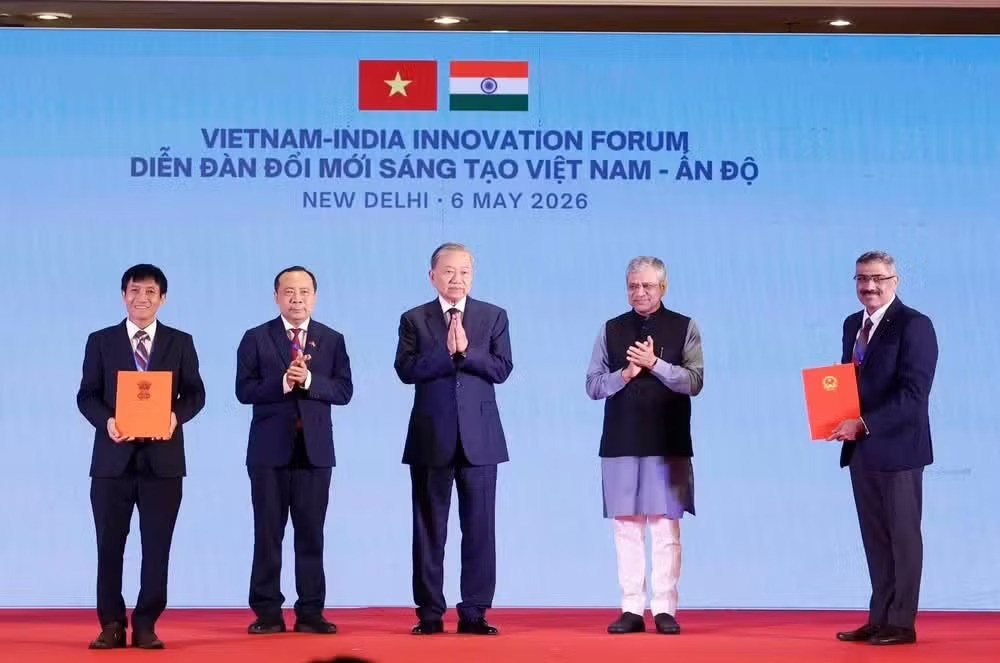 |
| General Secretary of the Communist Party of Vietnam Central Committee and State President To Lam witnessed the exchange of cooperation documents and agreements between the two countries. (Photo: Thong Nhat/VNA) |
The forum was held under the theme: Cooperation in human resource development, science, technology, innovation, and digital transformation.
General Secretary and State President To Lam attended and delivered remarks at the forum.
General Secretary and State President To Lam highly appreciated the relevant agencies of both countries for jointly organizing the forum with a timely and appropriate theme, reflecting the development trends of the era and the increasingly profound cooperation needs between Vietnam and India. Rapid breakthroughs in artificial intelligence, semiconductors, big data, biotechnology, quantum technology, and clean energy are fundamentally transforming production methods, growth models, and the structure of the global economy.
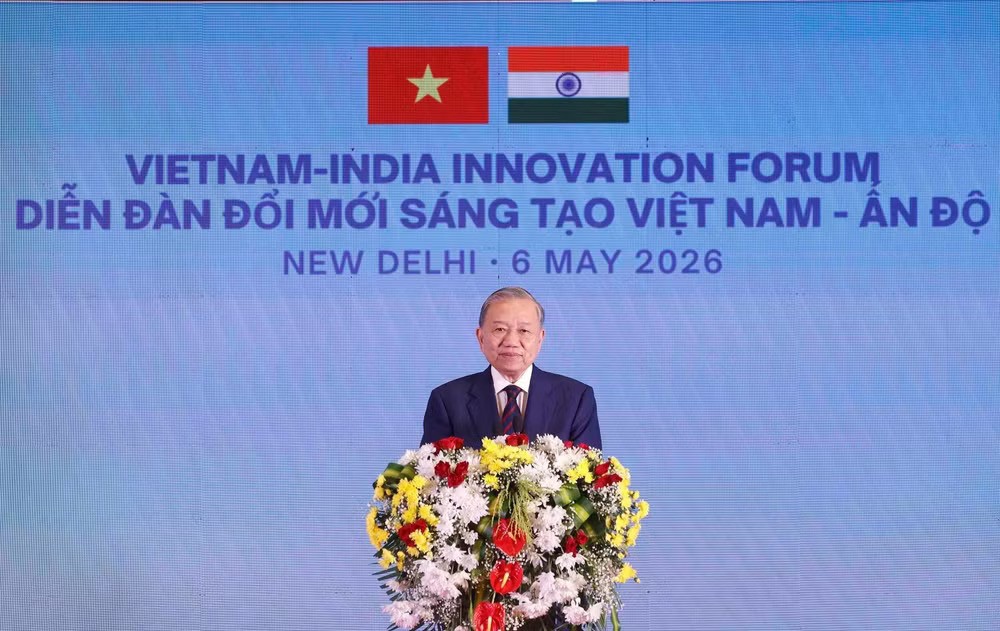 |
| General Secretary and State President To Lam delivers remarks at the Vietnam–India Innovation Forum. (Photo: Thong Nhat/VNA) |
Digital economy, green economy, and circular economy trends, together with the need to ensure technology security, data security, and supply chain stability, are shaping a new era of development - the era of innovation. In this context, nations that master knowledge, science and technology, and innovation will make breakthroughs to generate strength for development.
General Secretary and State President To Lam emphasized that Vietnam has issued Resolution No. 57-NQ/TW on breakthroughs in science and technology development, innovation, and digital transformation, along with the National Strategy on Innovative Startups. Under these policies, Vietnam identifies science, technology, innovation, and digital transformation as central drivers for developing modern productive forces, renewing the growth model, and enhancing strategic self-reliance. Vietnam is focusing on improving institutions in an open and flexible direction to unlock resources; encouraging the development of science, technology, innovation, and national digital transformation; developing high-quality human resources; building an open innovation ecosystem centered on enterprises; and prioritizing the development of strategic technologies such as artificial intelligence, semiconductors, biotechnology, digital technology, and clean energy, with the goal of building a data-driven economy.
Expressing his impression of India’s major achievements in information technology development, General Secretary and State President To Lam stated that India is not only a great civilization but has also become a center of knowledge, technology, and innovation with an increasingly important role in the world.
Vietnam and India are two nations with a long-standing traditional friendship, forged through historical and cultural depth, a spirit of independence and self-reliance, and aspirations for development.
The strong foundation of political trust serves as an important basis for the two countries to advance further in cooperation, especially in high technology and strategic technology sectors.
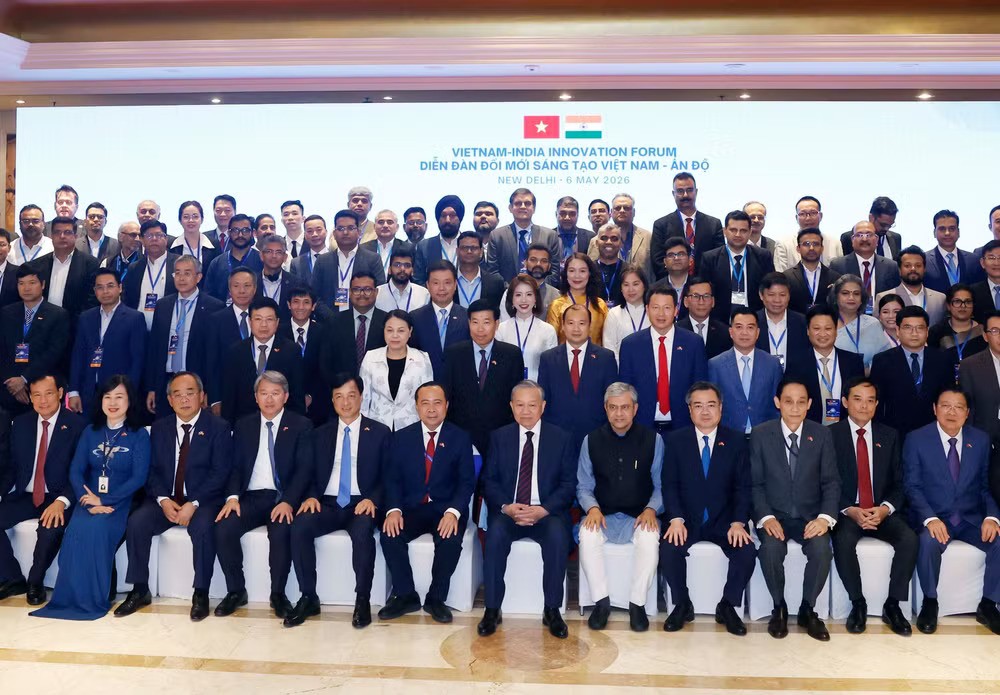 |
| General Secretary and State President To Lam and delegates. (Photo: Thong Nhat/VNA) |
General Secretary and State President To Lam stated clearly that the two countries share many similarities in their long-term development visions. Vietnam aims to become a developed, high-income country by 2045, while India is implementing the Viksit Bharat 2047 vision to become a developed nation. These orientations create strong momentum for the two countries to strengthen cooperation in the new phase.
India is one of the world’s major economies, with outstanding strengths in technology, software, artificial intelligence, and digital services. Vietnam is a dynamic economy with an important geostrategic position, a rapid pace of digital transformation, and a fast-growing startup ecosystem. The two economies are highly complementary.
Affirming that bilateral relations are entering a new stage of development, General Secretary and State President To Lam proposed that the forum focus discussions on clearly identifying priority areas for cooperation, particularly strategic technologies shaping the 21st century, including artificial intelligence, semiconductor microchips, digital technology, biotechnology, clean energy, and smart manufacturing. The two sides should build new spaces for cooperation in science and technology through large-scale projects and long-term cooperation mechanisms, including promoting the formation of a Vietnam-India Digital Partnership; advancing the model of “co-research, co-development, and co-production” toward creating jointly branded technology products capable of participating deeply in global value chains.
Both sides should improve coordination mechanisms among stakeholders within the innovation ecosystem, particularly the “three-party model” involving the State, scientists, and enterprises. At the same time, they should promote public-private cooperation, establish risk-sharing mechanisms, encourage businesses to increase investment in research and development, and move toward establishing bilateral co-investment innovation funds.
Businesses from both countries should play a pioneering role, boldly investing in new technology sectors, strengthening cooperation in research and development, and participating in the construction of symbolic cooperative projects. This would help deepen Vietnam-India relations through production linkages, technology transfer, and participation in global value chains.
General Secretary and State President To Lam proposed promoting substantive connections among research institutes, universities, and enterprises of the two countries, aiming to establish a Vietnam-India technology human resources corridor. The focus should be on building linked R&D centers, joint laboratories, and implementing high-quality human resource training programs in areas such as artificial intelligence, semiconductors, data science, and cybersecurity.
Scientific and technological cooperation should be associated with the goals of sustainable, inclusive, and people-centered development, ensuring that the achievements of innovation are widely shared, contributing to improving people’s quality of life, narrowing development gaps, and strengthening the capacity to respond to global challenges.
General Secretary and State President To Lam affirmed that, with a foundation of political trust, the complementarity of the two economies, and the tremendous potential of human resources, cooperation in science, technology, innovation, and digital transformation will become an important pillar, directly contributing to economic growth, enhancing competitiveness, and strengthening the strategic self-reliance of each country.
On this occasion, General Secretary and State President To Lam, together with the Vietnamese Minister of Science and Technology and the Indian Minister of Electronics and Information Technology, witnessed the exchange of cooperation agreements and documents between Vietnam and India.
 | Elevating Traditional Vietnam-India Friendship At the invitation of Indian Prime Minister Narendra Modi, General Secretary of the Communist Party of Vietnam Central Committee and President of the Socialist Republic ... |
 | People-to-People Exchanges, Culture and Tourism Drive Vietnam-India Ties Forward Vietnam and India share many similarities and intersections in culture and history, particularly through Buddhism and cultural heritage, creating favorable conditions for promoting academic exchanges, ... |
Related Stories
 National
Top Leader Receives Newly Accredited Ambassadors from Portugal, Iran, Mongolia, the US, Myanmar
 National
Top Leader’s Letter Honours Vietnamese Family Values
Recommended
 Economy
Vietnam, Brazil Review Economic and Trade Cooperation in First Half of 2026
 Economy
World Bank Supports India’s Solar Rooftop Program
 Economy
Vietnam, Armenia Promote Air Connectivity to Expand Access to New Markets
 Economy
Quang Ngai Expands Cooperation with France on Green Industry and Clean Energy
 Economy
Legal Reforms Facilitate Corporate Securities Issuance
 Economy