The completion and commissioning of the National Data Center No.1 have laid an important foundation for the country’s data infrastructure and will make a significant contribution to accelerating national digital transformation in the coming period, Party General Secretary To Lam said during a working visit to the facility at Hanoi's Hoa Lac Hi-Tech Park on December 29.
As reported at the event, the center – the first specialised unit directly under the Ministry of Public Security tasked with state management and coordination of data – was officially launched on February 25, and inaugurated on August 18. It has been positioned as a core and pivotal facility, serving as the “brain” and “heart” of the national digital transformation process.
In terms of national data creation and integration, the center has synchronously consolidated a large volume of data into an integrated repository, including 157 million datasets from 16 national and sectoral databases.
It has coordinated with the Government Office to restructure procedures for 82 groups of administrative services. It has also deployed a modern ten-layer physical security system and a 24/7 cyber security monitoring system (SOC/SIEM) to safeguard national digital data sovereignty. In addition, an innovation center for data exploitation and research into strategic platforms has been launched, with readiness to roll out in 2026 initiatives such as the national data exchange, blockchain technology and a national virtual assistant.
Addressing the meeting, the Party General Secretary noted that in order to realise the country’s two centennial development goals, there is no alternative but to accelerate, achieve strong breakthroughs and pursue sustainable development, driven primarily by science, technology, innovation and digital transformation.
“In this new development model, data has become a strategic resource and a new type of asset, of particularly important significance to national governance capacity, the competitiveness of the economy and the quality of life of the people,” he stressed.
He further underlined that building infrastructure and collecting and storing data are only necessary conditions. More importantly, data must be utilised, analysed and transformed into value – turning data into knowledge, into sound policy decisions, and into concrete products and services that bring practical benefits to society and the people.
The Party leader also pointed to three major difficulties that must be overcome: data quality has yet to meet requirements; a data-driven innovation ecosystem has not been developed in a comprehensive manner; and autonomy in core technologies as well as the availability of high-quality human resources remain limited, according to VNA.
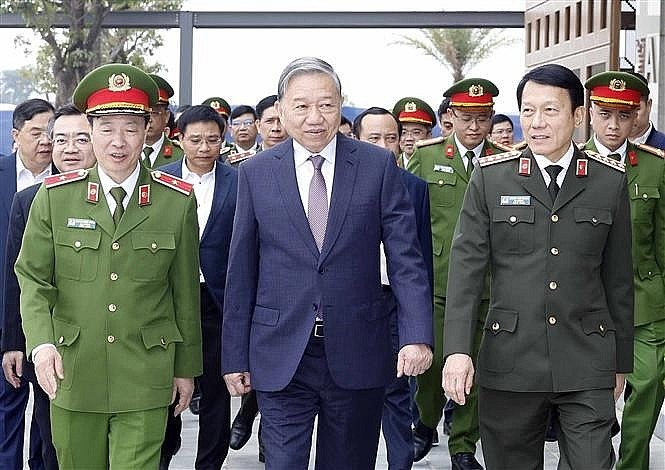 |
| Party General Secretary To Lam (center) during a working visit to the National Data Center No.1 at Hanoi's Hoa Lac Hi-Tech Park on December 29. (Photo: VNA) |
Building on the results achieved with the center, he called for the continued implementation of subsequent ones as planned, in order to complete the national trusted data infrastructure network.
Emphasizing that this is a task of national importance, General Secretary Lam said it is a shared responsibility of the entire political system, rather than that of any single agency or force. The Ministry of Public Security has been assigned responsibility for state management of data and for assisting the Government in managing and operating the center.
He directed that the national integrated database be established in the first quarter of 2026, connecting relevant data repositories. Alongside data creation, efforts must be accelerated to utilise data and generate value from it. He also stressed the need to ensure that 100% of eligible fully online public services are implemented, maximising convenience for citizens and businesses.
In addition, the national data exchange must be urgently put into operation in the second quarter of next year. Meanwhile, priority should be given to mastering core and strategic technologies, particularly cloud computing, artificial intelligence, blockchain and shared data platforms, thereby gradually enhancing technological self-reliance, reducing dependence on foreign providers and safeguarding national digital sovereignty.
The leader also underscored that data security and safety must be ensured at the highest level. He called for particular attention to be paid to human factors, with special mechanisms and policies to attract and retain high-quality personnel, especially those in key and core operational roles such as chief engineers and chief architects.
General Secretary Lam also urged stronger international cooperation and collaboration with major corporations to facilitate the transfer of core technologies and the development of comprehensive personnel training plans.
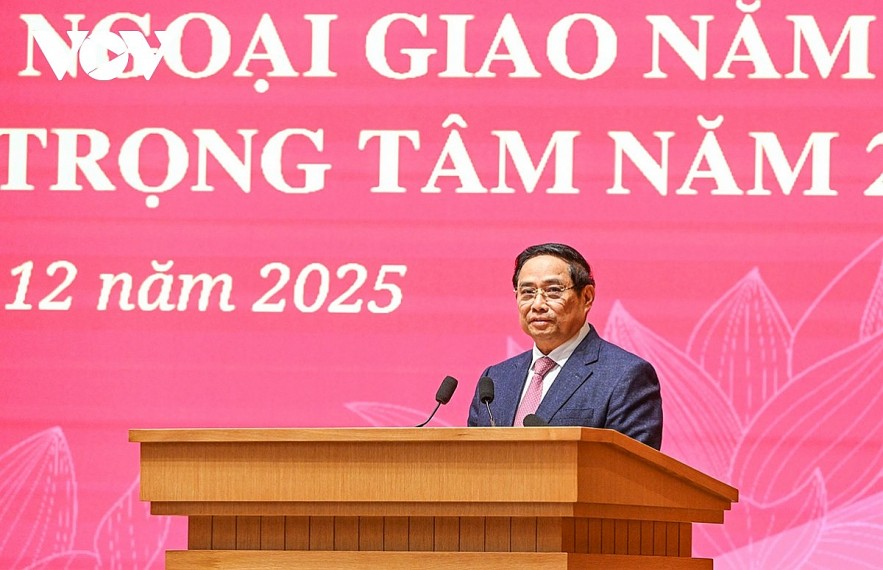 |
| Prime Minister Pham Minh Chinh says the diplomacy sector should bring into full play its soft power to enhance Vietnam’s role globally in 2026 and beyond. |
PM urges proactive diplomacy to enhance Vietnam’s role globally in 2026
Prime Minister Pham Minh Chinh has called on Vietnam’s diplomatic sector to enhance the country’s international standing and actively shape its role in global affairs, highlighting the importance of soft power in reflecting Vietnam’s growing stature and capabilities.
Speaking at the 2025 year-end review and 2026 orientation conference for the Ministry of Foreign Affairs (MOFA) in Hanoi on December 29, the Prime Minister praised the ministry for achieving significant results despite a volatile global environment influenced by lingering COVID-19 effects, the Russia-Ukraine conflict, and other uncertainties.
Vietnam has so far established diplomatic ties with 194 countries and territories worldwide. In 2025 alone, it upgraded diplomatic relations with 17 additional countries, bringing the total number of partners with comprehensive or higher-level ties to 42. High-ranking Vietnamese leaders conducted 75 diplomatic activities, nearly 1.5 times the previous year, strengthening strategic partnerships and fostering trust with international counterparts.
The PM highlighted the role of diplomacy in supporting national development and economic growth. The MOFA implemented economic diplomacy guided by the principle of putting citizens, localities, and businesses at the center, producing tangible socio-economic benefits. Key milestones included hosting major multilateral forums such as the ASEAN Future Forum and the Partnering for Green Growth and the Global Goals 2030 (P4G) Summit, as well as facilitating the signing of the UN Convention against Cybercrime, thus reinforcing Vietnam’s engagement in multilateral cooperation.
The Prime Minister stressed that Vietnam’s diplomacy must remain flexible and responsive to rapidly evolving international policies and regional dynamics, including developments in the East Sea, and continue to assert Vietnam’s central role in ASEAN. He urged consolidation of the nation’s security-development belt to maintain strategic initiative amid complex or unforeseen global developments, cited VOV.
The Government leader also noted that the Party and State place high expectations on foreign affairs and international integration, regarding them as “pioneering, essential, and continuous” and as tools to advance a comprehensive foreign strategy at a higher level. Diplomacy, he said, remains a critical pillar in Vietnam’s efforts to build and safeguard the nation, consistent with the spirit of the Political Bureau’s Resolution 59 on international integration.
Looking ahead in 2026, the Government leader outlined a vision for comprehensive, modern, and professional diplomacy, fully leveraging the three pillars of Party, state, and people-to-people diplomacy. He urged the sector to deepen ties with strategic partners, neighbouring countries, major powers, traditional allies, and other key international partners, while actively exploring opportunities for development and harnessing external resources to promote rapid and sustainable growth.
The Prime Minister emphasized the human dimension in diplomacy, encouraging Vietnamese diplomats to embody the guiding principles of loyalty and dedication, confidence and creativity, resilience and flexibility, persuasive negotiation, top-level effectiveness, and putting the country first. Recognising the challenges inherent in foreign affairs work, he expressed confidence that the diplomatic sector would enhance Vietnam’s global influence, foster peace, advance multilateral cooperation, and contribute to the country’s socio-economic progress.
Concluding his speech, the Prime Minister highlighted Vietnam’s ambition to make positive contributions to international peace, development, and multilateralism, while creating breakthrough growth opportunities and promoting a fair, rules-based international order grounded in international law. He expected that Vietnam’s diplomatic sector would continue to achieve even greater successes, contributing to the country’s growing prosperity, modernity, development, and wealth, and ensuring that the well-being and happiness of the Vietnamese people continue to improve.
Russia remains reliable partner of Vietnam in new development era: Ambassador
Vietnam is entering a new phase of development with significant achievements, and Russia remains a reliable partner ready to support Vietnam in high-technology areas such as digital transformation, cybersecurity and nuclear energy for peaceful purposes, stated Russian Ambassador to Vietnam Gennady Stepanovich Bezdetko.
The diplomat made the statement at a press briefing in Hanoi on December 29 to review the development of the Vietnam–Russia Comprehensive Strategic Partnership in 2025 and outline key cooperation priorities for the coming period.
Bezdetko said that 2025 has been a particularly eventful year at multiple levels, marked by major historical milestones, including the 75th anniversary of diplomatic relations between Vietnam and Russia, the 50th anniversary of the liberation of southern Vietnam and national reunification, and the 80th anniversary of Victory in the Great Patriotic War.
He noted that Vietnam-Russia relations continue to be consolidated based on strong political trust and substantive dialogue at all levels. According to the ambassador, regular and effective exchanges, including at the highest level, have served as a key driving force for the expansion of multifaceted cooperation between the two countries.
A highlight of the year was Party General Secretary To Lam’s visit to Russia in May 2025, which resulted in the signing of a package of 20 important agreements covering economy, science and human resource training, creating a solid legal framework for a new phase of cooperation. The participation of Vietnam People’s Army soldiers in the Victory Day parade on Red Square was described as a vivid symbol of shared historical perspectives and mutual respect between the two nations.
Bezdetko also recalled Russia’s timely support for Vietnam during difficult times, citing the provision of 30 tonnes of humanitarian aid to central Vietnam following natural disasters in October.
Reviewing economic cooperation, the ambassador highlighted the success of the GAZ automobile assembly plant in Da Nang, which has supplied 3,000 vehicles to the market, as well as the strong presence of TH True Milk Group in Russia, as effective models of cooperation. Tourism cooperation recorded remarkable growth, with 590,000 Russian visitors to Vietnam in the first 11 months of the year, and the figure is expected to surpass the pre-pandemic record of 650,000 arrivals by year-end following the resumption of direct flights to destinations such as Hanoi, Nha Trang and Phu Quoc.
Head of the Russian Trade Mission in Vietnam Vyacheslav Kharinov said the two sides are implementing the Comprehensive Cooperation Development Plan to 2030. Russia is prioritizing structural projects in energy, industry and particularly pharmaceuticals, he said, stressing that localisation of production, especially in pharmaceuticals and high technology, along with improvements to local-currency payment mechanisms, will help expand Russia’s presence and create new growth momentum for Vietnam’s economy, cited VNA.
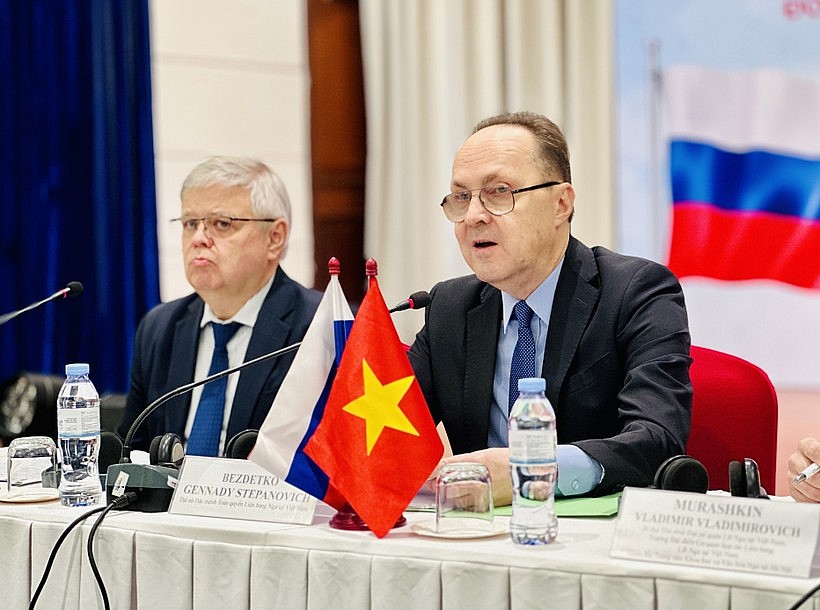 |
| Russian Ambassador to Vietnam Gennady Stepanovich Bezdetko (R) speaks at the press briefing in Hanoi on December 29 (Photo: VNA) |
In education, science and people-to-people exchanges, Bezdetko and Director of the Russian Center of Science and Culture (RNCC) in Hanoi Vladimir Murashkin underscored positive outcomes in maintaining and developing high-quality human resources.
Russia continues to offer 1,000 scholarships annually to Vietnamese students and is promoting the transformation of the Pushkin Russian Language Institute branch in Hanoi into a regional Russian language center. Cultural exchanges in 2025 were vibrant, featuring Moscow Days in Hanoi, Vietnam Culture Days in Russia, and performances by leading Russian ballet and symphony orchestras at Ho Guom Theater.
Murashkin emphasized the RNCC’s priority of connecting young generations of the two countries through joint training and research programs, expressing confidence that Vietnam-Russia relations will continue to thrive on a foundation of knowledge and mutual understanding.
Both officials highlighted new bright spots in scientific cooperation, including the handover of the research vessel Professor Gagarinsky to the Vietnam-Russia Tropical Center for East Sea surveys, and positive progress on the Vietnam-Russia Nuclear Science and Technology Center project in Dong Nai province.
At the press briefing, Russian representatives also answered questions on plans for 2026, including preparations for high-level visits and prospects for supplying Russia’s new cancer vaccines to the Vietnamese market.
Concluding the briefing, the ambassador thanked Vietnamese ministries and agencies for their support in organising exchange activities over the past year, pledging to deepen the comprehensive strategic partnership for the benefit of the two countries' people and regional peace.
Speaking to a Vietnam News Agency (VNA) reporter at the press briefing regarding cooperation between the Russian Federation and Vietnam in the development of the nuclear power industry, the Russian ambassador said that the Ninh Thuan 1 nuclear power project and the project to build a nuclear science and technology research center in Dong Nai province are two major projects within the framework of the Vietnam - Russia comprehensive strategic partnership.
He noted that before 2016, the Russian side had implemented a wide range of concrete activities, and the two countries had signed intergovernmental agreements on cooperation in the peaceful use of nuclear energy. Russia’s State Atomic Energy Corporation Rosatom and Vietnam Electricity (EVN) are in discussions over the drafting of a new intergovernmental document.
“The most recent round of negotiations on this document took place just over a week ago, and around 98% of the content has already been agreed upon by both sides,” the ambassador said. He added that if the remaining issues are resolved in the first months of 2026, the two sides could plan to sign the document in conjunction with upcoming high-level or top-level exchanges.
Vietnam boosts cooperation with Inter-Parliamentary Union
National Assembly Vice Chairman Tran Quang Phuong received Inter-Parliamentary Union (IPU) Secretary General Martin Chungong in Hanoi on December 29, reaffirming Vietnam’s commitment to multilateral parliamentary diplomacy.
During the meeting, Phuong expressed appreciation for Chungong’s longstanding support and close relationship with the National Assembly of Vietnam, noting that his engagement had been instrumental in the success of major IPU events hosted by Vietnam. These include the 132nd IPU Assembly in Hanoi in 2015, the Asia-Pacific Regional Conference on Climate Change and Sustainable Development Goals in Ho Chi Minh City in 2017, the Conference on Sustainable Development Goals in Da Nang in 2018, and the 9th Global Conference on Young Parliamentarians in Hanoi in 2023.
These events not only hold significance for the IPU, but also mark milestones in Vietnam’s international integration and parliamentary diplomacy, Phuong said.
He stressed that Vietnam views active and responsible participation in IPU activities as a core priority, and expressed the National Assembly’s desire to continue receiving support and cooperation from Secretary General Chungong and the IPU Secretariat to further strengthen mutual trust and effectiveness in joint initiatives.
Highlighting Chungong’s personal contributions, Phuong noted his strategic vision and experience have enhanced the role and voice of parliaments and parliamentarians globally, particularly young and women legislators, advancing IPU’s objectives of peace, democracy, and sustainable prosperity worldwide, reported VOV.
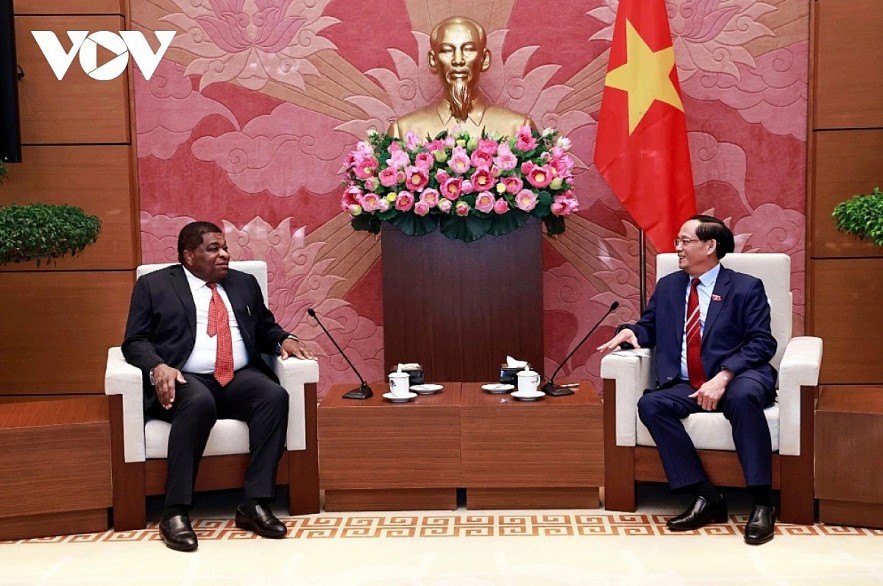 |
| National Assembly Vice Chairman Tran Quang Phuong (R) and Inter-Parliamentary Union (IPU) Secretary General Martin Chungong during their meering in Hanoi on December 29. |
In response, Secretary General Chungong expressed deep appreciation for Vietnam and its legislature, pledging continued support for Vietnam in multilateral parliamentary diplomacy, the application of science and technology in parliamentary work, and a more active role in IPU initiatives.
Both leaders agreed on the importance of closer coordination to promote even more effective cooperation between Vietnam and the IPU in the future.
Cold air likely to return to the North at the start of 2026
Northern Vietnam is forecast to enjoy two or three warm days before welcoming a fresh cold front right at the start of 2026. The upcoming northeast monsoon is expected to arrive with moderate to strong intensity.
According to the Southern Hydrometeorological Center, the current cold air mass is weakening and shifting eastward. However, it is likely to strengthen again around January 1–2, 2026, and once more around January 5. These waves will bring with them brisk northeast winds and a noticeable drop in temperature.
The National Center for Hydro-Meteorological Forecasting (NCHMF) predicts that from the night of December 28 to December 30, light rain will fall in parts of northern and north-central Vietnam, with fog in the early mornings. The weather will remain cold, especially in mountainous areas where severe cold or even frost is possible.
Cold drizzle likely around New Year’s Day
From December 30 to January 7, light rain is forecast across the North, Thanh Hoa, and Nghe An provinces, especially on the nights of December 31 and January 1. These areas may experience widespread drizzle, with early morning fog and persistent cold. In higher elevations, conditions could turn severely cold.
In central Vietnam, light showers are expected from Quang Tri to Da Nang and from Quang Ngai to Dak Lak until December 30. Temperatures will remain cool in the northern parts of this region.
From December 30 to January 7, areas from Ha Tinh to Da Nang, eastern Quang Ngai to Dak Lak, and Khanh Hoa will continue to see occasional showers. Between January 2–4, moderate rain and thunderstorms may occur, with isolated heavy downpours possible. Northern portions will remain chilly.
In the Central Highlands and Southern Vietnam, the weather pattern will stay mostly stable: sunny days followed by scattered evening and overnight thunderstorms.
Hanoi: Cloudy skies, drizzle, and fog to ring in the new year
The Northern Weather Station notes that due to the weakening and eastward-shifting cold air, Hanoi will see mostly cloudy skies with light drizzle and patchy fog from December 30 to January 1. On January 1 specifically, light scattered rain is expected, along with southeastern winds at level 2. Temperatures will remain low at night and in the early morning, cited VNN.
 |
| Northern Vietnam may greet 2026 with a new wave of cold air. Temperatures could dip to a high of just 22°C. Photo: Hoang Minh |
Another wave of cold air is forecast to strengthen around January 2 and again on January 5. During these days, Hanoi will experience overcast mornings with light rain, but sunshine may return by the afternoon. Northeast winds will reach level 2–3, and the weather will stay cold.
New Year’s Holiday Weather Forecast (December 31, 2025 – January 4, 2026)
Northern Vietnam: From December 31 to January 1, scattered rain and morning fog are expected, especially in the northeast, where light rain may persist. Daytime highs will range from 20–24°C (up to 24°C in some areas), with the northeast peaking at just 19–22°C. Nighttime temperatures will drop to 14–18°C, with some mountainous areas falling below 13°C.
From January 2–4, scattered rain continues, with severe cold likely in the mountains. Daytime temperatures will hover around 18–22°C (some areas above 22°C), with lows of 12–16°C and under 11°C in higher terrain.
From Thanh Hoa to Hue: From December 31 to January 1, light rain and morning fog are expected. On January 1, light drizzle is forecast in northern parts of the region. Northern areas will be cold, while southern areas remain cool. Highs will range from 21–24°C (some above 24°C), with lows from 16–20°C.
From January 2–4, the north will see light rain, while the south may experience heavier showers and isolated thunderstorms. Temperatures will range from 19–23°C during the day, and drop to 13–16°C in the north and 17–20°C in the south.
South-Central Coast: From December 31 to January 1, expect sunny days and occasional showers at night. Highs will reach 23–27°C in the north and 27–31°C in the south, with lows of 20–24°C.
From January 2–4, scattered showers and thunderstorms are forecast, with heavy rain possible in some areas. Northern parts will turn cooler. Highs range from 23–26°C in the north and 27–30°C in the south, with lows of 19–22°C and 22–24°C respectively.
Central Highlands: From December 31 to January 4, expect sunny days with isolated thunderstorms in the evening and at night. Daytime temperatures will range from 24–28°C, with some areas exceeding 28°C. Nighttime lows will be 15–19°C, and could drop below 15°C in some places.
Southern Vietnam: From December 31 to January 4, the region will remain sunny during the day with a few scattered evening showers or storms. Daytime highs will range from 29–33°C, with some areas topping 33°C. Overnight lows will sit between 21–25°C, with some inland eastern regions dipping below 21°C.
 | Vietnam News Today (Dec. 26): Vietnamese, Lao Provinces Enhance Youth Cooperation Vietnam News Today (Dec. 26): Vietnam and Azerbaijan boost defense industry cooperation; Vietnamese, Lao provinces enhance youth cooperation; Exhibition highlights vitality of Vietnamese cultural heritage; ... |
 | Vietnam News Today (Dec. 27): E-commerce Charts New Runway for Vietnam’s Digital Exports Vietnam News Today (Dec. 27): Youth festival reinforces solidarity among Vietnam, Cambodia and Laos; New publication highlights Germany – Vietnam partnership; E-commerce charts new runway ... |