
Vietnam Seeks Continued WTO and WEF Support to Strengthen Integration Capacity
| Vietnam Affirms Global Role And Responsibility Through WTO Agreement on Fisheries Subsidies WTO Director General Praise Vietnam's Practical Contributions |
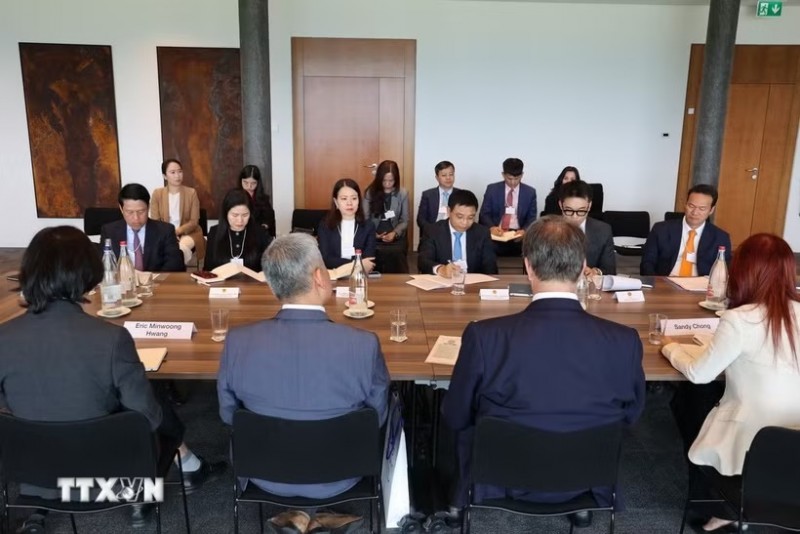 |
| Deputy Prime Minister Nguyen Van Thang and the Vietnamese delegation meet with representatives of the World Economic Forum (WEF) in Geneva. (Photo: Anh Hien/VNA) |
As part of his working visit to Switzerland, Deputy Prime Minister Nguyen Van Thang met with World Trade Organization (WTO) Deputy Director-General Jennifer DJ Nordquist on July 27.
At the meeting, Deputy Prime Minister Nguyen Van Thang reaffirmed Vietnam's support for an open, transparent, fair, inclusive, and rules-based multilateral trading system, with the WTO playing a central role.
As an active member, Vietnam has been proactively contributing to the organization's agenda, including ratifying Phase 1 of the Agreement on Fisheries Subsidies, negotiating participation in the Information Technology Agreement Expansion (ITA2), and preparing for its Trade Policy Review scheduled for late 2026.
In light of current challenges, the Deputy Prime Minister proposed that the WTO prioritize three key directions.
First, to continue advancing WTO reform by updating its rules to adapt to emerging trends in international trade while fully reflecting differences in development levels and implementation capacities among developing countries.
Second, to promptly restore the full dispute settlement mechanism to ensure the predictability, transparency, and enforceability of the multilateral trading system.
Third, to expand the WTO's agenda to cover new areas such as digital trade, artificial intelligence, green transition, climate change, and supply chain resilience, while strengthening support for developing countries to enhance their capacity to take full advantage of these emerging trends.
Sharing Vietnam's development orientation, Deputy Prime Minister Nguyen Van Thang said the country is entering a crucial stage of development with the goal of becoming a developed, high-income nation by 2045. Vietnam also aims to achieve GDP growth of at least 10% annually during the 2026–2030 period and beyond.
To realize these goals, Vietnam is focusing on breakthroughs in institutions, infrastructure, science and technology, and mobilizing comprehensive and diversified resources, including the establishment of an International Financial Centre under a “one centre–two locations” model in Ho Chi Minh City and Da Nang, combined with free trade zones, regulatory sandbox mechanisms, and a favorable legal framework.
Against this backdrop, the Deputy Prime Minister expressed hope that the WTO would continue supporting Vietnam in capacity building, particularly through advanced training in trade policy, legal advisory services on international dispute settlement, and trade facilitation. Such support would enable Vietnam to make more effective use of international agreements and commitments, promote exports, attract high-quality investment, and enhance its global competitiveness.
For her part, Jennifer DJ Nordquist commended Vietnam's socio-economic achievements and acknowledged the country's strong reform efforts to improve institutions, enhance the investment and business environment, and deepen international economic integration.
The WTO Deputy Director-General emphasized the importance of ensuring transparency in policy formulation and implementation, recommending that Vietnam continue providing timely updates to the WTO Secretariat on revisions to its legal framework and trade- and investment-related policies to facilitate business activities.
She also noted that although global trade continues to face numerous uncertainties and challenges, the volume of global merchandise trade is still projected to increase by 4.6% in 2025, with the overall outlook remaining positive.
Jennifer DJ Nordquist reaffirmed the WTO's commitment to accompanying Vietnam by sharing experience and providing support throughout its international economic integration process.
In the immediate future, this includes coordinating the successful organization of Vietnam's Trade Policy Review at the WTO this November and implementing technical assistance programs, including activities related to the Information Technology Agreement Expansion (ITA2). She also encouraged Vietnam to consider joining the Investment Facilitation for Development (IFD) Agreement.
On this occasion, Deputy Prime Minister Nguyen Van Thang invited WTO leaders to visit Vietnam to further discuss future cooperation orientations.
On the same day, the Deputy Prime Minister also met with Andre Hoffmann, Co-Chair of the Board of Trustees of the World Economic Forum (WEF), and visited the Embassy of Vietnam in Switzerland.
During the meeting at WEF headquarters, Deputy Prime Minister Nguyen Van Thang shared information on Vietnam's efforts and positive results in institutional reform, improving the investment and business environment, and promoting economic growth, including achieving GDP growth of more than 8.2% in the first six months of 2026.
Given the country's substantial capital demand for the next stage of development with around 80% expected to come from domestic and foreign enterprises and investors, the Deputy Prime Minister called on the WEF to continue promoting public-private cooperation and strengthening connections between the Vietnamese government and leading global businesses and investors.
Building on the positive outcomes of Vietnam-WEF cooperation, notably support for the establishment of the Centre for the Fourth Industrial Revolution (C4IR) in Ho Chi Minh City and the successful organization of the 2025 Autumn Economic Forum, the Deputy Prime Minister proposed further expanding and elevating cooperation between Vietnam and the WEF.
He suggested that both sides develop a Vietnam-WEF cooperation program for 2026–2030, focusing on priority areas such as science and technology, innovation, and the development of a modern financial ecosystem. He also proposed that the WEF consider making the Vietnam Autumn Economic Forum an annual event within its conference ecosystem, while strengthening connections between Vietnam and global business networks, investors, and international financial institutions, and mobilizing business participation in activities related to APEC 2027.
For his part, Andre Hoffmann praised Vietnam's economic achievements, particularly its ability to maintain strong growth despite global economic headwinds, as well as its robust institutional reforms and improvements to the investment environment.
He noted that Vietnam is emerging as one of the region's most dynamic economies, with significant potential in digital transformation, innovation, and the development of international financial centers.
The WEF leader observed that global competition in artificial intelligence and emerging technologies is no longer solely about technology but also about the ability to mobilize resources, ensure energy security, and promote sustainable development.
In this context, he said investors are increasingly prioritizing countries with transparent, stable, and predictable policy environments, viewing these as essential conditions for making long-term investment decisions, particularly in technology and finance.
Andre Hoffmann reaffirmed the WEF's commitment to supporting Vietnam by strengthening connections with leading global enterprises, corporations, and financial institutions, while sharing experience in developing international financial centers, regulatory sandbox mechanisms, public-private partnerships, innovation ecosystems, artificial intelligence applications, and high-quality human resources.
The WEF also stands ready to act as a bridge to introduce international investors, experts, and business leaders to opportunities for cooperation, investment, and knowledge sharing with Vietnam.
Recognizing Vietnam's growing role and standing in the region and globally, Andre Hoffmann expressed confidence that the country would successfully host APEC 2027 and said the WEF looks forward to welcoming Vietnam's senior leaders to the World Economic Forum Annual Meeting in Davos in 2027.
 Vietnam to Promote Its Dynamism at WEF Meeting in China Vietnam to Promote Its Dynamism at WEF Meeting in China Prime Minister Pham Minh Chinh arrived in Dalian city in China's Liaoning province for the 15th World Economic Forum (WEF) Annual Meeting of the New Champions and working sessions in the country from June 24 to 27. |
 Vietnam Deepens Cooperation with WEF and European Partner Countries Vietnam Deepens Cooperation with WEF and European Partner Countries At the invitation of the Prime Minister of the Republic of Poland Donald Tusk, Prime Minister of the Czech Republic Petr Fiala, Founder and Executive Chairman of the World Economic Forum (WEF) Klaus Schwab, Prime Minister Pham Minh Chinh, accompanied by his spouse, led a high-level delegation of Vietnam on a working trip to Europe. |

Most read


Related Stories
 National
Foreign Affairs Should Better Serve National Development: Top Leader
 Focus
Focus
Enhancing the Role of Youth in People-to-People Diplomacy and International Integration
 National
Vietnam News Today (Jan. 8): Vietnam Races Ahead in GDP Growth, Closing Gap with Southeast Asia’s Giants
 Seas and islands
Vietnam Affirms Global Role And Responsibility Through WTO Agreement on Fisheries Subsidies
Popular article
 World
World
Countries cooperate for strengthening of maritime security in the Indian Ocean region
 World
World
China Ready to Strengthen Cooperation with ASEAN: Chinese Foreign Minister Wang Yi
 World
World
ASEAN, India reaffirm commitment to strengthening longstanding partnership
 World
World