
World population to reach 9.8 billion in 2050: UN
(VNF) - The world's current population of 7.6 billion will balloon to 9.8 billion in 2050, with India's numbers to surpass China's in just seven years, a United Nations report said on Wednesday (June 21st).
With roughly 83 million people being added to the world's population every year, the upward trend in population size is expected to continue, even assuming that fertility levels will continue to decline, according to the figures by the U.N. Department of Economic and Social Affairs.
At that rate, the global population will reach 8.6 billion in 2030, 9.8 billion in 2050 and 11.2 billion in 2100, it said.
The U.N. agency forecasts that from now through 2050 half the world’s population growth will be concentrated in just nine countries — India, Nigeria, Congo, Pakistan, Ethiopia, Tanzania, United States, Uganda and Indonesia. Those nations are listed in the order of their “expected contribution to total growth,” the report said.
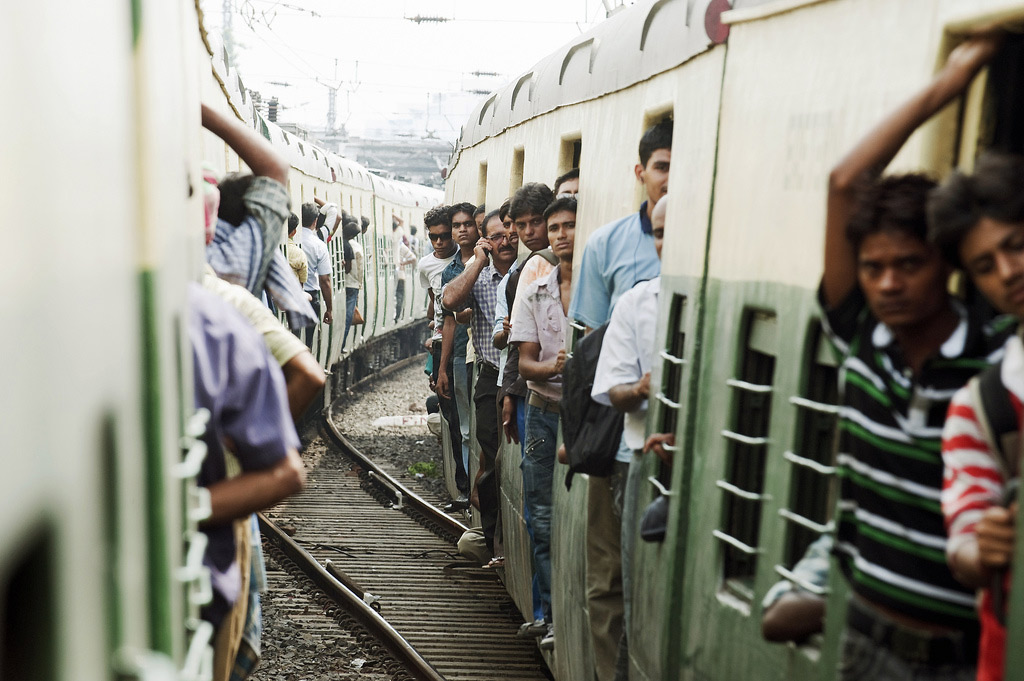 |
A view of passengers aboard trains connecting the suburbs of Kolkata, India. (UN Photo/Kibae Park)
Nigeria, currently the world’s seventh largest country, has the fastest growing population of the 10 most populous countries worldwide, and the report projects it will surpass the U.S. shortly before mid-century.
The new projections also forecast that China, which currently has 1.4 billion inhabitants, will be replaced as the world’s most populous country around 2024 by India, which now has 1.3 billion inhabitants.
John Wilmoth, Director of the Population Division, said at a news conference that the report includes information on the populations of 233 countries or areas of the world.
“The population in Africa is notable for its rapid rate of growth, and it is anticipated that over half of global population growth between now and 2050 will take place in that region,” he said. “At the other extreme, it is expected that the population of Europe will, in fact, decline somewhat in the coming decades.”
The number of persons aged 60 or above is expected to more than double by 2050 and more than triple by 2100.
The aging population is projected to rise from 962 million globally in 2017 to 2.1 billion in 2050 and 3.1 billion in 2100, said the report.
The report, titled “The World Population Prospects: The 2017 Revision,” said fertility has been declining in nearly all regions in recent years.
Between 2010 and 2015, Wilmoth said, “the world’s women had 2 1/2 births per woman over a lifetime — but this number varies widely around the world.”
“Europe has the lowest fertility level, estimated at 1.6 births per woman in the most recent period, while Africa has the highest fertility, with around 4.7 births per woman,” he said.
The report said birth rates in the 47 least developed countries remain relatively high, with population growth around 2.4 per cent a year. While this rate is expected to slow significantly in the coming decades, the U.N. said the combined population of the 47 countries is projected to increase by 33 per cent from roughly 1 billion now to 1.9 billion in 2050.
More and more countries now have fertility rates below the level of roughly 2.1 births per woman needed to replace the current generation, the report said. During the 2010-2015 period, fertility was below the replacement level in 83 countries comprising 46 per cent of the world’s population, it said.
The 10 most populous countries with low fertility levels are China, United States, Brazil, Russia, Japan, Vietnam, Germany, Iran, Thailand and United Kingdom, the report said.
In addition to slowing population growth, low fertility levels lead to an older population, the report noted. It forecasts that the number of people aged 60 or above will more than double from the current 962 million to 2.1 billion in 2050 and more than triple to 3.1 billion in 2100.
A quarter of Europe’s population is already aged 60 or over, and that share is projected to reach 35 per cent in 2050 then remain around that level for the rest of the century, the report said./.
VNF



Recommended
 World
World
PM Modi’s Sweden Visit Marks Milestone In Deepening Ties
 World
World
India and Caricom promote friendship
 World
World
US and India emphasize strategic cooperation at event in New Delhi
 World
World
Modi's UAE visit for important energy agreements
Popular article
 World
World
Indian PM Modi’s UAE visit to advance Strategic Defence Partnership
 World
World
India’s Engagement with ASEAN: Strengthening Mutual Trust
 World
World
Eurasia Review Analysis: India-Vietnam Relations and Their Strategic Significance
 World
World