
India–Brazil–South Africa (IBSA) Dialogue Forum: An Assessment – Analysis
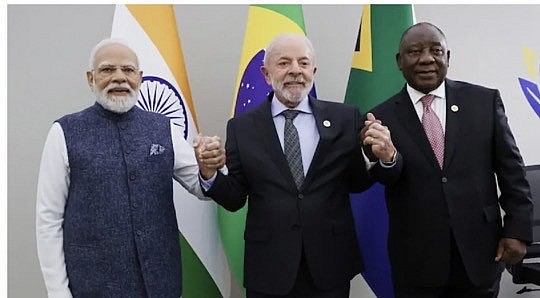 |
| India's PM Narendra Modi attends the India-Brazil-South Africa (IBSA) Leaders’ Meeting on the sidelines of the 20th G20 Leaders’ Summit in Johannesburg, South Africa on November 23, 2025, with Brazil's President Luiz Inácio Lula da Silva and South Africa's President Cyril Ramaphosa. Photo Credit: India Prime Minister Office |
In 2003, when IBSA was established, the global political-security and economic landscape was different. Today, both these countries are on different footing. Their concerns are no longer aligned with those of the IBSA countries.
Nonetheless, in its first decade, IBSA emerged as one of the most ambitious attempts to institutionalise South–South cooperation among three major democracies of the Global South. It brought together India, Brazil, and South Africa—regional leaders with shared interests in global multilateral reforms, inclusive development, and equitable global governance.
IBSA’s momentum stalled after 2011 due to the rise of BRICS, domestic political changes in member states, and their shifting regional and global strategies. However, its underlying rationale remains compelling even today. The evolving global order makes the revival of IBSA not only timely but necessary. The forum’s identity, development partnership model, and multilateral reform agenda offer distinct value that is unmatched by other groupings in the Global South.
At its core, IBSA, the only minilateral grouping with countries representing three different continents, is an unique ‘non-Western’, ‘minilateral’ institution. It is built on three pillars: political dialogue, sectoral cooperation, and development partnerships.
This identity gives the forum moral authority in advocating for a more inclusive and participatory global governance architecture. India, Brazil, and South Africa have all sought greater representation in institutions such as the UN Security Council (UNSC), the World Bank, and the IMF. IBSA acts as a vehicle for harmonising its reform proposals and amplifying its collective voice in global arenas.
Second, IBSA’s South–South cooperation model is development-centric and demand-driven. Its flagship initiative, the IBSA Fund for Poverty and Hunger Alleviation, launched in 2004, is widely regarded as one of the most effective South–South development funds. The fund has supported projects in Africa, Asia, Latin America, and the Middle East. Its emphasis on capacity-building, local empowerment, and sustainability demonstrates an alternative to traditional donor-recipient dynamics. Thus, IBSA operationalises solidarity in development and highlights how emerging powers can contribute responsibly to global welfare.
Third, sectoral cooperation within IBSA spans over a dozen working groups—from trade facilitation and agriculture to health, education, and science and technology. These exchanges allow the three countries to share best practices, pool knowledge, and jointly address challenges they face as developing, industrialising economies. Their collaboration on renewable energy, public health, and e-governance demonstrates how IBSA members can co-create solutions adaptable across the Global South.
India, Brazil, and South Africa continue to aspire to permanent membership of the UNSC. But their reform agendas have weakened due to fragmented advocacy. A revived IBSA can articulate a united, coherent, and persuasive position on UNSC reform, Bretton Woods reform, and the restructuring of global trade governance. As middle powers with shared interests, they can coordinate strategies and mobilise broader coalitions in the Global South.
The IBSA Fund has demonstrated high impact at low cost. In a world facing widening development gaps, economic inequality, and climate vulnerability, enhancing the fund’s resources and expanding its reach would reaffirm IBSA’s moral leadership. The three countries can pioneer innovative development finance tools, technology-sharing models, and climate resilience initiatives tailored for low-income countries.
India, Brazil, and South Africa share similar geopolitical orientations: strategic autonomy, issue-based multipolarity, and emphasis on multilateral diplomacy. They are not aligned with any single power bloc, enabling flexible coalition-building. Reviving IBSA would allow them to act as stabilising actors in the evolving international system and shape the emerging multipolar order from the perspective of developing democracies.
IBSA economies have potential synergies in energy transition, digital economy, pharmaceuticals, agriculture, space technology, and defence production. Joint initiatives in these sectors can enhance resilience, reduce dependence on external suppliers, and create new South–South value chains. Sectoral working groups, if revitalised, can deliver high-impact cross-regional cooperation.
The India–Brazil–South Africa (IBSA) Dialogue Forum retains enduring relevance as a platform for collaboration, South–South solidarity, and global governance reform. Its distinct identity—rooted in shared political values, development-focused cooperation, and a commitment to multilateralism—offers something no other forum in the Global South provides. By reinvigorating political dialogue, expanding the IBSA Fund, strengthening sectoral cooperation, and articulating a unified position on global governance reform, India, Brazil, and South Africa can reaffirm their role in the world.
Recommended
 World
World
Modi's UAE visit for important energy agreements
 World
World
Indian PM Modi’s UAE visit to advance Strategic Defence Partnership
 World
World
India’s Engagement with ASEAN: Strengthening Mutual Trust
 World
World
Eurasia Review Analysis: India-Vietnam Relations and Their Strategic Significance
 World
World
Vietnam, Austria Promote Practical Cooperation in Cybersecurity
 World
World
Vietnam Makes Its Mark at Paris International Fair 2026
 World
World
Vietnam Promotes Dialogue, Seeks Substantive Solutions at 11th NPT Review Conference
 World
World