
India, EU ramp up push for free-trade deal
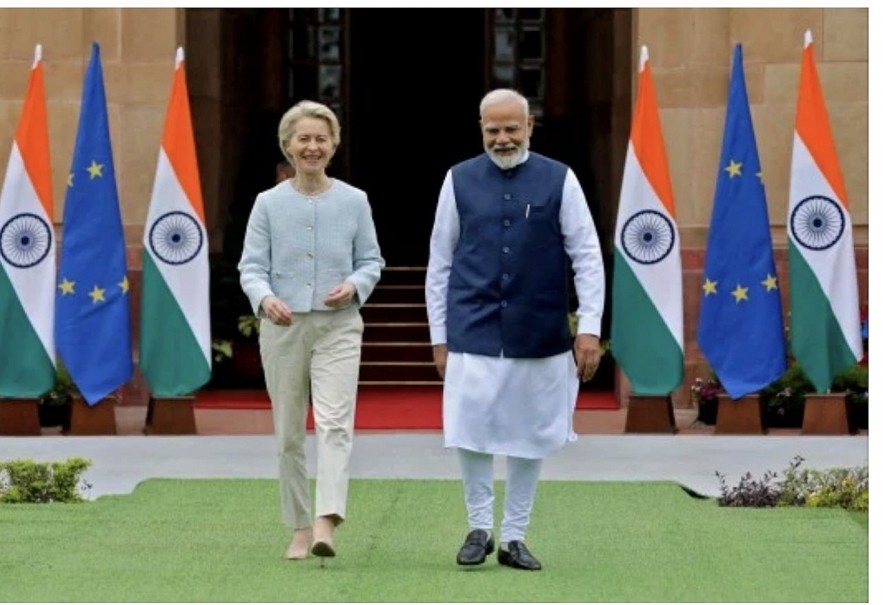 |
European Commission President Ursula von der Leyen, in a speech at the World Economic Forum on Tuesday, said she would be travelling to India after the conference, adding that the two sides were “on the cusp of a historic trade agreement”.
Both von der Leyen and European Council President Antonio Costa will attend India’s Republic Day celebrations on January 26, followed by an EU-India summit the next day where they will hold talks with Indian Prime Minister Narendra Modi, Foreign Minister Subrahmanyam Jaishankar and other top officials.
“The political signalling from both sides has been unusually strong, with leaders openly calling it ‘historic’ and timing the summit with Republic Day for maximum impact,” said Srinivaasan Balakrishnan, director of strategic engagements and partnerships at Delhi-based think tank Indic Researchers.
Negotiations between the two sides have dragged on since 2007 due to differences over issues such as market access and mobility of workers, but have acquired urgency in a fraught global environment.
European leaders strongly emphasised the need for achieving greater economic independence and reducing reliance on other country at the World Economic Forum this week.
“Midldle powers must act together because if you are not at the table, you are on the menu,” he said.
Analysts note that a trade pact between India and the EU would be representative of how the world order is realigning to becoming multipolar.
Both India and the EU have been pushing to close a broad trade deal after von der Leyen and Modi agreed to fast-track negotiations in 2025. Delhi has also been looking to diversify trade partnerships.
Sanjay Iyer, a former military diplomat for India who previously served in Europe, said a trade pact with the EU would significantly benefit Indian industries such as textiles, footwear and pharmaceuticals by eliminating the EU’s import tariffs of between 12 and 16 percent.
Brussels signed deals with Mexico and Indonesia and stepped up talks with India, while Delhi sealed agreements with the United Kingdom, Oman and New Zealand.
The EU-India summit date of January 27 created a “deadline effect” to conclude a deal, he said.
“Leaders will want at least a headline deliverable or an agreement in principle even if the actual free-trade agreement takes a bit longer to sign off on,” Chandra said.
“Both sides are signalling that they are pushing to close remaining gaps quickly, even if some technical issues remain.”
The EU has been seeking significant reductions in India’s high import duties on automobiles, which can exceed 100 per cent for fully built cars.
While the EU has been pushing for better market access for its luxury carmakers, India has been hesitant because a surge of European imports could hurt the domestic industry.
The Indian industry is also concerned about Europe’s Carbon Border Adjustment mechanism – a charge on carbon-intensive imports such as steel and cement – which the EU says is needed for harmonising environmental standards with European industries.
India is also unlikely to ease import curbs on sectors such as agriculture and dairy, which have generally been a red line for Delhi with all countries, including its largest trading partner the US, according to Chandra.
“According to Chandra, trade facilitation of industrial goods and services is likely to dominate an agreement between the two sides. This could become the anchor for a wider package between the two sides encompassing joint security coordination, defence supply chains and industrial collaboration, he added.
While an EU-India partnership would hold value in terms of trade, defence collaborations were likely to be more niche, Iyer said, noting that Europe lacked a unified military command with individual states maintaining armed forces’ sovereignty.
European nations including France and Germany would continue collaborations with India for programmes such as Rafale fighter jets and submarines respectively, but chronic coordination challenges cast doubt on the EU’s ability to deliver substantive industrial partnerships, Iyer noted.
Recommended
 World
World
Modi's UAE visit for important energy agreements
 World
World
Indian PM Modi’s UAE visit to advance Strategic Defence Partnership
 World
World
India’s Engagement with ASEAN: Strengthening Mutual Trust
 World
World
Eurasia Review Analysis: India-Vietnam Relations and Their Strategic Significance
 World
World
Vietnam, Austria Promote Practical Cooperation in Cybersecurity
 World
World
Vietnam Makes Its Mark at Paris International Fair 2026
 World
World
Vietnam Promotes Dialogue, Seeks Substantive Solutions at 11th NPT Review Conference
 World
World