
Japan Proposes Industrial Hub in Bangladesh with Supply Chains to India
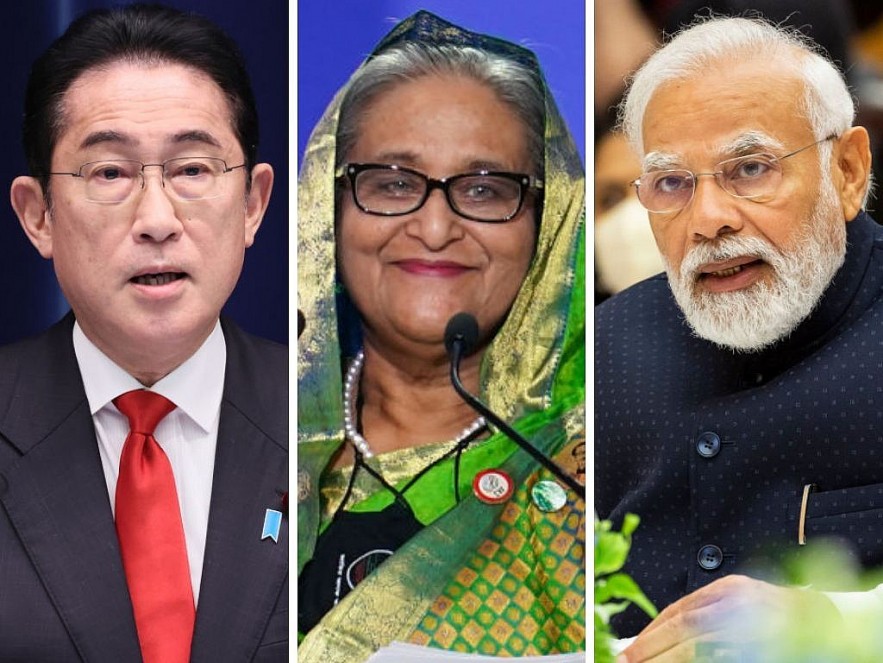 |
| (L-R) Japanese prime minister Fumio Kishida (Photo by Yoshikazu Tsuno – Pool/Getty Images), Bangladeshi prime minister Sheikh Hasina (Photo by Ian Forsyth/Getty Images) and Indian prime minister Narendra Modi (Photo by Yuichi Yamazaki/Getty Images) |
It comes after Japanese Prime Minister Fumio Kishida's visit to India last month in which he touted the idea of a new industrial hub for the Bay of Bengal and northeast India that could bolster development in the impoverished region of 300 million people.
After Kishida's visit, his government approved $1.27 billion in funding to Bangladesh for three infrastructure projects - including a new commercial port in the Matarbari area with links to adjacent landlocked Indian states, including Tripura, and wider international markets.
"It can be a win-win plan for India and Bangladesh," Hiroshi Suzuki, Japan's ambassador to India, said on Tuesday, citing the industrial hub proposal at a meeting of Indian, Bangladeshi and Japanese officials in Agartala, the Tripura state capital.
He said the deep seaport was likely to become operational by 2027 and would be a key to building an industrial hub connecting the Bangladeshui capital Dhaka to landlocked areas of India.
Ministers in both Indian and Bangladeshi governments were happy with the move.
While G Kishan Reddy, India’ minister for development of its northeast region, welcomed the Japanese initiative, Bangladeshi minister of state for foreign affairs Shahriar Alam said it would boost trade between India and Bangladesh and help bring in investment from Japan and other countries.
The Matarbari project would be Bangladesh’s first deep-sea port capable of hosting large vessels.
Tripura is located about 100 kilometres (62 miles) from the proposed seaport, and could prove a gateway for regional exporters, Sabyasachi Dutta, head of Asian Confluence, a think-tank which organised the meeting on Tuesday (11) and Wednesday (12), said.
India and Japan have together developed infrastructure projects across South Asian nations such as Bangladesh and Sri Lanka and Africa as an alternative to China’s multibillion-dollar Belt and Road Initiative to counter Beijing’s growing influence.
According to the Reuters report, more than 300 Japanese companies were already in operation in Bangladesh and both the countries are likely to sign an economic partnership agreement soon that could further boost manufacturing and attract more foreign companies, he said.
Bangladeshi prime minister Sheikh Hasina will visit Japan from April 25-28 at Kishida’s invitation, according to a statement from Dhaka.
Recommended
 World
World
Vietnam Reaffirms Support for Effective Implementation of ASEAN's Five-Point Consensus
 World
World
Algeria Shares Healthcare Expertise to Advance Africa's Pharmaceutical Self-Reliance
 World
World
Modi's Asia-Pacific tour highlights India's regional engagement
 World
World
Australia-India Partnership on Cyber, Critical Technologies and Supply Chains
 World
World
Venezuela Declares Seven Days of National Mourning for Earthquake Victims
 World
World
Europe Faces Historic Heatwave, More Than 1,000 Deaths Reported
 World
World
Myanmar Destroys Over 50 Tons of Drugs on International Anti-Drug Day
 World
World