
QUAD: Changes in the balances in the Indo-Pacific Ocean Bring changes to global balances
 |
| image source: X @SecBlinken |
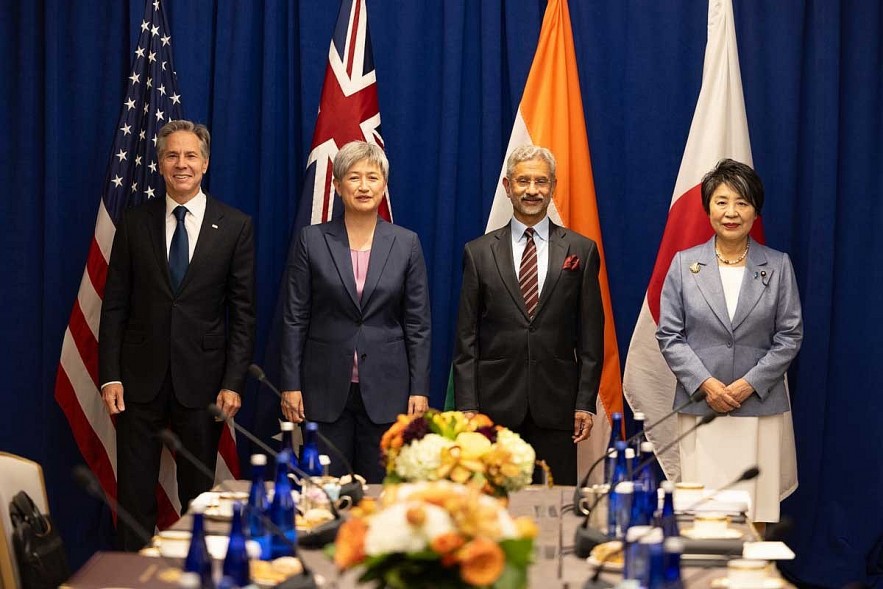
Starting the analysis, we will talk about the QUAD, which includes America, India, Japan, and Australia. It is a coalition of states that are trying to promote free navigation in the Indo-Pacific Ocean and open trade, respecting the rules of international law and maritime law. The joint activity of the four, although it started with military actions, now has a much broader scope, including efforts to address climate change and ensure health frameworks for developing countries by providing vaccinations to them. Additionally, the countries are also striving to ensure cybersecurity amidst the rapid advancement of technology, as well as taking care of the environment, aiming to cover all these areas to ensure a stable global economy for the states. The importance of their cooperation was particularly evident during the Covid-19 period, especially regarding the supply chain of products.
QUAD started in 2004 by providing humanitarian aid to the tsunami-affected areas. Other countries in the Indo-Pacific often act as fire extinguishers in the tense chess match that has been played for years between India and China. It is not new that the two countries economically compete with each other in technological development and trade; the issue is how each of them defines what development means and how they are willing to achieve it.
The world watches as the two nations compete to become the dominant superpower and representative of the global south. India is rapidly advancing with its economic dynamism, military buildup, and diplomatic offensive. India has also launched its own lending program called the Neighborhood First Policy to compete with China’s Belt and Road Initiative. (BRI).
In the post-Cold War era, the absence of strategic competition in the Indian Ocean allowed New Delhi not only to play a prominent role but also to secure a favorable and safe Indian Ocean for its strategic interests. The emergence of China as an additional and alternative security provider forced India to reassess its foreign policy options under the government of Prime Minister Narendra Modi. If Beijing manages to make progress in the immediate neighborhood, India continues to increase its global collaborations and has much friendlier relations with America compared to China.
Over the past ten years, China has proceeded to surround India’s southern coast with ports. These ports form a “string of pearls” restricting India’s access to the world. India, on the other hand, is creating alliances to encircle China. India has created a “diamond chain” to choke China’s access to the Indian Ocean, the East China Sea, and the South China Sea.
Regarding diplomatic relations, India has surpassed China as the most populous country in the world with 1.43 billion consumers. It has emerged as the fifth-largest global economy and continues to grow at a rate of six to seven percent annually. Today, India ranks fourth in the global military strength and nuclear power index, 11th in diplomatic strength, fourth in innovation and technology, seventh in the number of filed technological patents, and is the eighth largest recipient of foreign direct investment. Prime Minister Narendra Modi has launched a diplomatic campaign to reach out to countries with similar views. Since 2014, he has made 84 trips abroad covering 71 countries.
Recommended
 World
World
UNESCO Adopts Busan Declaration for Global Heritage Preservation
 World
World
India expands technology partnerships through foreign engagement
 World
World
UNESCO to Examine 30 New Nominations for World Heritage List
 World
World
Australia and India expand civil nuclear energy cooperation
 World
World
ASEAN and the RoK Aim to Upgrade Bilateral FTA
 World
World
WHO Urges Financial Support for Ebola Response
 World
World
Vietnam Calls for Accelerated Global Cooperation to Achieve Sustainable Development Goals
 World
World