
Vietnam Among Top 5 Countries Leading New Economic Growth Cycle in ASEAN
 | Commemorating 47th Anniversary of Triumph of Sandinista People's Revolution: Expanding Vietnam-Nicaragua People-to-People Exchanges |
| Vietnam, Algeria Strengthen Traditional Ties |
The next economic growth cycle in Southeast Asia will no longer depend on a single economy or commodity cycle, but will be shaped by a group of five regional countries, including Vietnam, Malaysia, Indonesia, Thailand, and the Philippines, according toVietnamPlus.
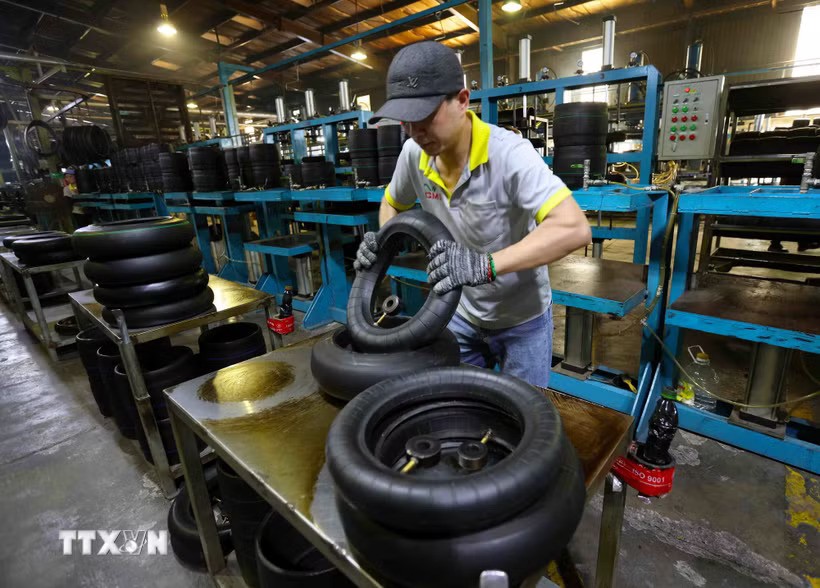 |
| Motorcycle tire production at the factory of CAMEL Vietnam Rubber Co., Ltd., a wholly Thai-owned enterprise located in the Lao Bao International Border Gate Economic Zone, Quang Tri Province. (Photo: VNA) |
Shan Saeed, global chief economist at Juwai IQI, emphasized that the combination of demographic size, industrial depth, external buffer zones, and policy discipline of these five economies is reshaping ASEAN's development.
According to The World & Vietnam Report, with a total population of over 610 million people, accounting for nearly 9/10 of the entire region's population, this group possesses a structural advantage of scale, from Indonesia's enormous domestic market with 287 million people to Vietnam's strong export-oriented manufacturing capacity with over 100 million people.
Vietnam recorded the fastest growth rate at 7.83% year-on-year, followed by Indonesia at 5.61% and Malaysia at 5.4%, driven by private consumption and manufacturing.
Meanwhile, Thailand and the Philippines both recorded growth of 2.8%, reflecting their unique challenges ranging from slow budget implementation to the recovery of the tourism and export sectors.
Shan Saeed noted that the solid macroeconomic foundation, bolstered by abundant international reserves, helps these countries withstand global interest rate fluctuations and geopolitical risks.
 |
| Foreign tourists in HCMC (Photo: Le Vu). |
This diversification does not weaken ASEAN's narrative; on the contrary, it enhances the region's attractiveness to international capital flows, which prioritize economies that combine growth with institutional credibility and external stability.
Growth data for the first quarter of 2026 shows a clear divergence, which is the factor that current investment flows are focusing on, rather than just looking at the overall growth rate.
"The solid macroeconomic foundation is bolstered by abundant international reserves, helping these countries withstand global interest rate fluctuations and geopolitical risks. As of the first half of 2026, Thailand's foreign exchange reserves led with approximately US $280.5 billion, followed by Indonesia with US $148.2 billion and Malaysia with US $130.5 billion,” Shan Saeed commented.
These reserves not only ensure the ability to pay for imports but also enhance investor confidence in the currency's recovery and national liquidity.
Also, key resources such as palm oil in Malaysia and Indonesia, or key agricultural exports of Vietnam and Thailand, continue to act as real economic anchors, supporting foreign exchange earnings and national balance sheets.
Digital transformation and data infrastructure are projected to be key drivers for the next phase of capital allocation in the region. Thailand and Malaysia are emerging as the most dynamic data center markets in ASEAN. Vietnam is also attracting infrastructure commitments related to AI and semiconductors, while Indonesia remains the largest digital consumer market.
If implemented effectively, the ASEAN Digital Economy Framework could nearly double the size of the bloc's digital economy, reaching US $2 trillion by 2030. However, according to economist Shan Saeed, countries still face structural challenges such as household debt in Thailand or the need to maintain reform momentum and attract talent in Malaysia to sustain long-term competitive advantage.
 | PM Departs for ASEAN – Russia Commemorative Summit PM Hung’s participation in this summit once again reflects Vietnam’s consistent foreign policy of independence, self-reliance, resilience, peace, friendship, cooperation and development, as well as ... |
 | Vietnam Is “Key” to Maintaining Balance of the ASEAN Region In an interview with a Vietnam News Agency (VNA) correspondent in Moscow, Russian expert on international relations Grigory Trofimchuk stated that, in the current international ... |


Most read

Related Stories
 World
World
Vietnam Reaffirms Support for Effective Implementation of ASEAN's Five-Point Consensus
 Economy
Legal Reforms Facilitate Corporate Securities Issuance
 National
Vietnam News Today (July 7): Vietnam, United States Seek to Deepen Comprehensive Strategic Partnership
 National
Vietnam News Today (Jun. 29): Vietnam Joins World's Top 30 Most Competitive Economies
Recommended
 Economy
European Businesses' Confidence Index in Vietnam Rises Sharply
 Economy
Vietnam Among Top 5 Countries Leading New Economic Growth Cycle in ASEAN
Popular article
 Economy