Vietnam-Thailand ties: 50 years of friendship, growing cooperation
The Thai Embassy in Vietnam teamed up with the Vietnam-Thailand Friendship Association (VTFA) and Nghe An provincial authorities on August 10 to host a ceremony marking the 50th anniversary of the two countries' diplomatic relations.
Chairman of the Nghe An provincial People's Committee Vo Trong Hai said cooperation between the province and Thailand has delivered concrete results since the two countries elevated ties to a Comprehensive Strategic Partnership in 2025, with two-way trade now standing at roughly 100 million USD.
Thai businesses are operating nine foreign direct investment (FDI) projects in Nghe An, with a total registered capital topping 241 million USD. The projects target industrial park infrastructure, supporting industries, food processing, electronic component manufacturing, and other high-value-added sectors.
Cultural, educational, tourism, and people-to-people exchanges are increasingly vibrant. About 5,000 Nghe An natives live in Thailand, maintaining close ties with their homeland and contributing to its development.
Nghe An has committed to keeping a transparent business environment and expanding cooperation with Thailand in areas like industry, high-tech agriculture, energy, logistics, trade, tourism, and science and technology, helping to strengthen the friendship between the two sides, he said.
VTFA Chairman Sen. Lieut. Gen. Nguyen Van Thanh said Vietnam and Thailand have made strides across multiple fields over the past five decades. The two sides have sustained high-level exchanges, fostered political trust, and coordinated effectively at global and regional mechanisms. Thailand remains one of Vietnam’s top trade and investment partners in ASEAN, and cooperation among localities, businesses, schools, social organizations and communities has expanded markedly.
Amid the fourth industrial revolution, the two sides should widen links among provinces, enterprises, scientists, universities, and social organizations while driving cooperation in sci-tech, digital transformation, green economy, innovation, and sustainable development, Thanh said.
The immediate goal, he added, is to deepen the Comprehensive Strategic Partnership, strengthen people-to-people connectivity, economic collaboration, and sustainable development, thus making real contributions to a united, resilient, and prosperous ASEAN Community as well as to peace and stability in the region and the world.
Thai Ambassador to Vietnam Urawadee Sriphiromya declared that after 50 years, the Thailand-Vietnam relationship has bloomed. The year 2026 has already delivered a series of major diplomatic activities, including high-level visits, injecting new momentum into bilateral ties.
Those ties have been cultivated not only at the government level but also through people-to-people exchanges, the Thai-Vietnamese community, cultural cooperation, and business activities, she said.
The association will expand connectivity and advance ties, reinforcing local economic links and opening more opportunities for small and medium-sized and community-based enterprises to connect, expand market access, and grow together.
The VFTA will also push digital transformation and artificial intelligence, treating technology as a critical tool to boost the capacity of people, enterprises, and grassroots economies and help both countries adapt to rapid changes in the global economy, she added.
President of the Thailand-Vietnam Friendship Association Sanan Angubolkul said the “Growing Together” motto aims to lift the relationship from a trade partnership to deep, broad cooperation and people-centered sustainable development, contributing to peace, security and prosperity in the Mekong subregion, ASEAN and beyond.
During the ceremony, the VTFA and the Vietnamese embassy jointly released a book chronicling 50 years of Vietnam-Thailand cooperation for shared development.
Hai also presented certificates of merit to one organization and two individuals for their outstanding contributions to people-to-people diplomacy.
Da Nang nurtures Vietnam-Thailand friendship over five decades
The same day, the Da Nang Union of Friendship Organizations and the municipal Department of Culture, Sports and Tourism, in coordination with relevant agencies and the Thai Consulate General in Ho Chi Minh City, celebrated the occasion.
Vice Chairwoman of the municipal People’s Committee Nguyen Thi Anh Thi said the elevation of bilateral ties to a Comprehensive Strategic Partnership in 2025 has laid a solid foundation for stronger cooperation across politics, economy, trade, investment, and people-to-people exchanges.
For Da Nang, Thailand has always been one of its important regional partners. The city hopes that the anniversary activities will unlock new cooperation among localities, strengthen solidarity and friendship, and deliver practical benefits to their people, she said.
Thai Consul General in Ho Chi Minh City Wiraka Moodhitaporn affirmed that Vietnam is not just a close friend and a vital partner of Thailand in ASEAN, but also a country of striking similarities and complementary strengths, according to VNA.
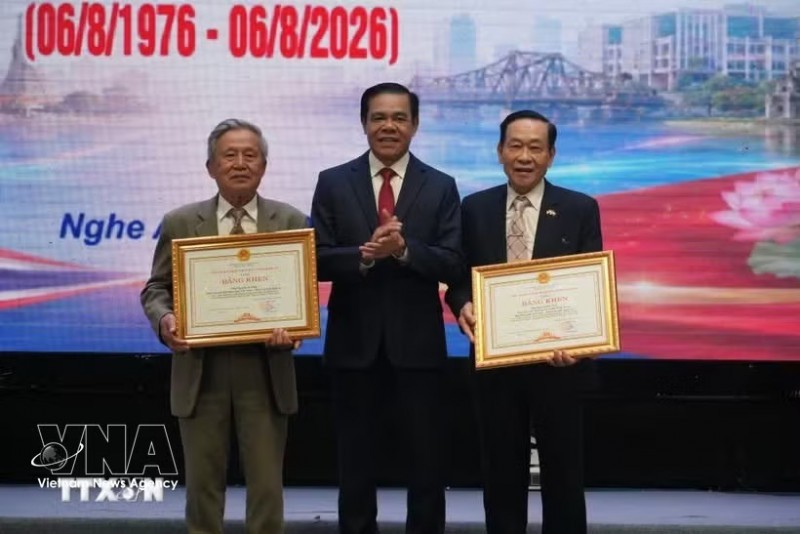 |
| Chairman of the Nghe An provincial People's Committee Vo Trong Hai (center) presents certificates of merit to contributors to Vietnam - Thailand ties. (Photo: VNA) |
Cooperation between the two countries has expanded across the full spectrum of politics, security, trade, investment, tourism, education, culture, and people-to-people exchanges, she said.
Moodhitaporn expressed thanks to the authorities and people of Da Nang for consistently facilitating cultural exchanges and economic cooperation between the two sides.
The anniversary provides an opportunity for the two countries to review achievements over the past five decades while looking ahead to the next 50 years with new expectations. The Vietnam-Thailand partnership in the coming time will continue to be nurtured not only by the two governments but also by localities, businesses, universities, and ordinary citizens, she said.
Delegates enjoyed a music show that put the distinctive flavours of Vietnamese and Thai culture center stage. The lineup featured performances that highlighted Thailand’s rich cultural heritage, alongside traditional Vietnamese and Da Nang arts, including the Khon masked dance drama “Hanuman captures Benyakai,” the graceful Apsara dance, and the soulful Bai Choi folk art. They were brought to life by Thai artists and performers from Da Nang’s Trung Vuong Theater.
Da Nang now maintains formal friendship and cooperation ties with Thailand’s Khon Kaen and Ubon Ratchathani provinces.
As of late July 2026, Thailand had 16 investment projects in Da Nang with a total registered capital exceeding 112 million USD. In 2025, Da Nang’s exports to Thailand neared $129 million USD.
In the first half of this year, Da Nang welcomed roughly 204,000 Thai visitors, or 3.92% of the city’s total foreign arrivals.
Joint work in education, training, and people-to-people exchanges between Da Nang and Thailand has become increasingly active and effective, contributing to a stronger traditional friendship between their people.
More Vietnamese officers appointed to UN peacekeeping missions in South Sudan, Abyei
The Ministry of National Defense (MND) on August 10 held a ceremony to hand over the President’s decisions appointing two officers of the Vietnam People’s Army (VPA) to serve in United Nations peacekeeping missions in South Sudan and Abyei.
The two officers are Captain Nguyen Ngoc Anh, a logistics assistant at the Logistics and Technical Division of the Vietnam Department of Peacekeeping Operations (VDPO), who will serve as a logistics staff officer at the UN Interim Security Force for Abyei (UNISFA), and Captain Nguyen Van Nam from the Chemical Warfare Officers Training School under the Chemistry Corps, who will serve as a military observer at the UN Mission in South Sudan (UNMISS).
Addressing the ceremony, Deputy Chief of the General Staff of the VPA Senior Lieutenant General Phung Si Tan hailed the achievements of Vietnamese military personnel in UN peacekeeping over the past more than 12 years.
He highlighted their efforts to overcome difficulties and successfully fulfill assigned tasks, contributing to enhancing the image and reputation of Vietnam, the VPA and Vietnamese peacekeeping forces in the international arena, VNA reported.
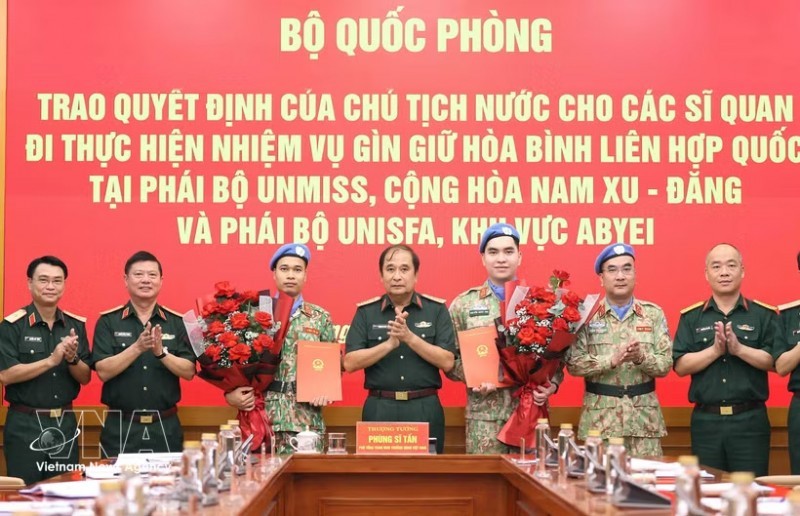 |
| Deputy Chief of the General Staff of the VPA Senior Lieutenant General Phung Si Tan (center) hands over the President’s decisions to the officers undertaking UN peacekeeping missions at the ceremony. (Photo: VNA) |
Congratulating the two officers, Tan, who is also deputy head of the MND's steering committee for participation in the UN peacekeeping operations, showed his belief that they will uphold the traditions of the VPA and Vietnamese peacekeeping forces and successfully fulfill their missions. He also commended the VDPO and relevant agencies and units for their thorough preparations.
According to VDPO Deputy Director Colonel Pham Tan Phong, the two officers were selected based on their political and moral qualities, professional competence, military expertise, foreign-language proficiency, health, and ability to work in an international environment.
They have completed pre-deployment training and professional UN peacekeeping courses at home and abroad, covering peacekeeping operations, military expertise, work in multinational environments, security and safety, and handling situations in mission areas.
Anh previously served as an administrative officer with Vietnam’s Level-2 Field Hospital Rotation 4 at UNMISS from 2022-2023, while Nam has received specialised training relevant to his upcoming role as a military observer.
Da Nang enhances trade links and investment ties with Thailand
An international workshop titled “Da Nang - A Bridge for Tourism, Trade, and Investment Cooperation and Development between Vietnam and Thailand” took place in the central city of Da Nang, opening up further opportunities for business connectivity and boosting ties between Da Nang, the Central and Central Highlands regions of Vietnam, and Thailand.
The workshop comprised four sessions with 10 presentations from managers, experts, and businesses of both countries, with a focus on tapping the Vietnam-Thailand tourism market, air connectivity, transport infrastructure, trade, and investment.
For Da Nang, Thailand is identified as one of its top foreign partners in the ASEAN region. Cooperation between the city and Thai partners has expanded across a variety of fields, including trade, investment, tourism, education and training, and people-to-people exchanges, with many Thai enterprises choosing Da Nang as a long-term investment destination, reported VOV.
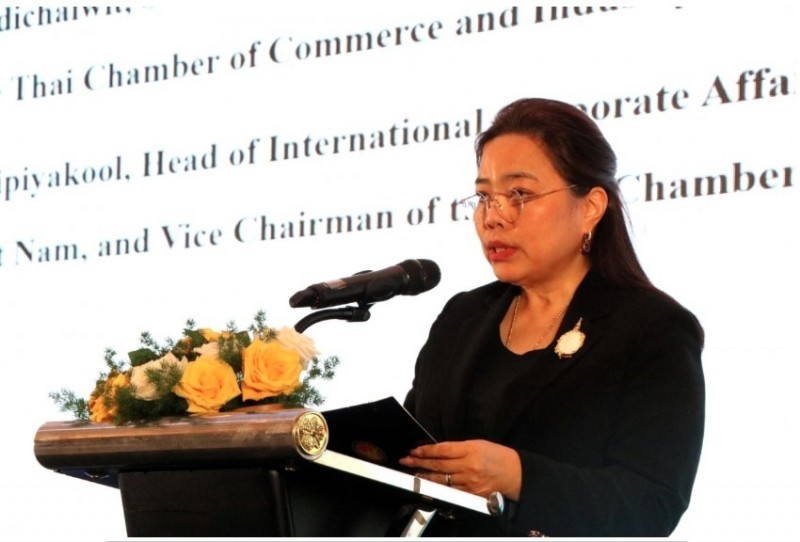 |
| Thai Consul General in Ho Chi Minh City Wiraka Moodhitaporn delivers her speech at the workshop. (Photo: Da Nang Portal) |
At the workshop, delegates exchanged ideas and contributed initiatives aimed at forming new cooperative programs and connectivity projects, particularly in tourism, trade, investment, logistics, and people-to-people exchanges.
Nguyen Thi Anh Thi, Vice Chairwoman of the Da Nang People's Committee, emphasized that over the past 50 years, Vietnam - Thailand relations have developed into one of the most dynamic and effective partnerships within ASEAN. The elevation of bilateral ties to a Comprehensive Strategic Partnership in 2025 opens a new chapter of cooperation.
She stated that Da Nang is focusing on establishing an International Financial Center and a Free Trade Zone. These serve as new platforms and development spaces to attract major Thai corporations in areas such as retail trade, high-tech manufacturing, smart logistics, the digital economy, clean energy, and high-end tourism services.
The city leader suggested that the municipal Union of Friendship Organizations continue leveraging its role as a bridge for people-to-people diplomacy, actively and effectively connecting with strategic partners, investors, business associations, and highly experienced experts from both countries.
"She called for cooperation in key sectors of interest to the city, including IT, artificial intelligence, semiconductors, biotechnology, new materials, clean energy, and trade-services, to contribute to local development while nurturing and propelling the traditional friendship and Comprehensive Strategic Partnership between Vietnam and Thailand forward.
Vietnam needs to create global trade gateways via ocean economy
The world has determined that the 21st century will witness a very strong shift of development drivers to the ocean.
In the second part of the interview, Economist Tran Dinh Thien said that to move beyond nearshore mindsets, Vietnam needs to leverage its premier geoeconomic location, build high-quality global gateways, and transition toward a technology-driven, sustainable blue ocean economy for future generations, VNN reported.
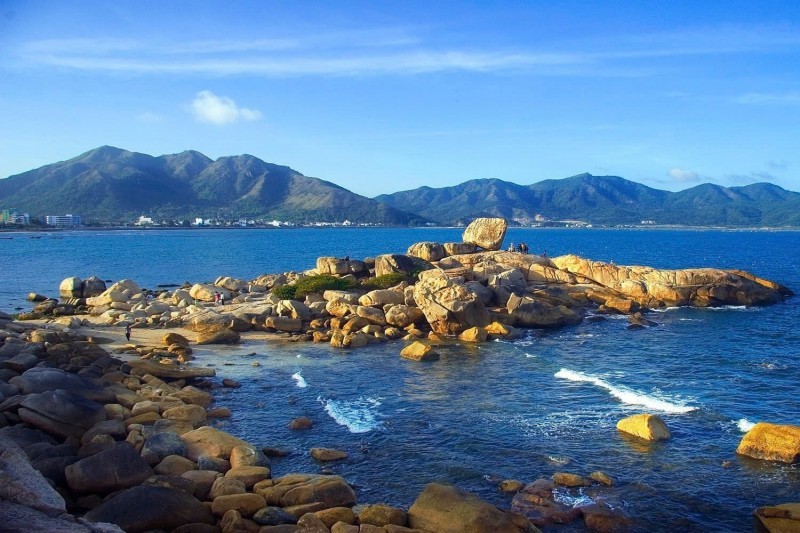 |
| Photo: VNN |
If we continue to view the sea only as a place to exploit resources, we will narrow our own opportunities, he said. But if we view the sea as a new development space, we will see there not only resources but also logistics, international transportation, renewable energy, marine technology, ocean data, marine skies, finance, services, and innovation, he added.
The world has determined that the 21st century will witness a very strong shift of development drivers to the ocean, and whichever nation builds an ocean mindset early will have a long-term competitive advantage. Vietnam cannot stand outside that trend.
Vietnam has more than 3,260 km of coastline and lies on important international maritime routes. Where does Vietnam's greatest advantage truly lie: marine resources or geoeconomic location?
In my opinion, Vietnam's greatest advantage does not lie in resources, but in its geo-economic location.
Vietnam opens up to the Pacific Ocean and sits at the gateway connecting the Pacific and Indian Oceans, on the world's busiest maritime routes, and at the center of the most dynamically developing region globally. That is an advantage not many nations possess.
We often say Vietnam owns a very beautiful “frontage.” But having a beautiful frontage does not mean one will automatically be rich. The deciding factor is what we do with that frontage.
If we only build a few more industrial parks or a few local ports, we have only exploited a small part of the geographical value. What we need to aim for is building “Global Gates” with logistics, finance, and maritime service centers, free trade zones, and marine cities directly connected to the global economic network, turning Vietnam's marine “frontage” into a high-class development convergence coordinate for the whole world.
That is the way to transform geographical advantages, which are essentially still just “comparative advantages,” into true competitive advantages and development advantages.
The 21st century will no longer be a competition between nations with abundant resources, but between nations that know how to organize global flows of goods, capital, technology, data, and cultures. The sea is the place where those flows converge.
Therefore, in my opinion, the big question is not how much sea Vietnam has or what position it holds in the East Sea, but rather what role Vietnam will play in the ocean. When we can answer that question, we will not limit ourselves to a “nearshore fishing” mindset, but will determine our position in the world economy for many decades to come.
Resolution 36 prioritizes the development of marine tourism and services, the maritime economy, offshore renewable energy, and new marine economic sectors, instead of just focusing on resource exploitation. In your opinion, what does this change reflect?
In my opinion, this is a very fundamental transformation in the development model, from a development method relying on physical resource exploitation to creating an economy based on services, high technology, and creative intelligence.
For many decades, we mainly exploited what the sea had readily available. If there was oil, we extracted oil; if there was fish, we caught fish; if there was a beautiful beach, we did tourism. That is a development model relying on natural resources.
But resources always have limits. The deciding factor for the strength of a modern economy is no longer how many resources it can extract from nature, but how much value it can generate from knowledge, technology, and organizational capability.
That is also the spirit of Resolution 36.
What needs to be exploited is no longer just oil and gas or fisheries, but the entire marine economic space, inside the sea, under the seabed, on the sea surface, including the marine sky, and in the economic activities taking place in connection with the sea.
An international transshipment port can create much more long-term value than a mine that will eventually run dry. A logistics center, a free trade zone, an offshore energy industrial cluster, or an ocean research center are all assets capable of generating profits for many generations.
The world today no longer talks much about “marine economy” in the sense of exploiting the sea. People talk much more about “ocean economy” or “blue economy,” meaning an ocean economy based on technology, innovation, green economy, and sustainable development.
 Vietnam News Today (Aug. 6): Vietnam, Thailand Parliaments Back Comprehensive Strategic Partnership Vietnam News Today (Aug. 6): Vietnam, Thailand Parliaments Back Comprehensive Strategic Partnership |
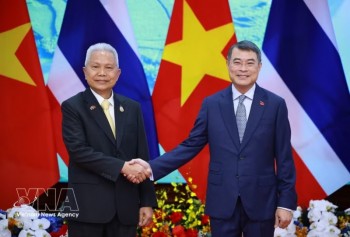 Vietnam News Today (Aug. 7): Vietnam, Thailand Agree to Advance “Three Connects” Strategy Vietnam News Today (Aug. 7): Vietnam, Thailand Agree to Advance “Three Connects” Strategy |