Vietnam, India step up cooperation in research, training, policy advice
A delegation from the Vietnam Academy of Social Sciences (VASS), led by its Vice President Assoc. Prof. Dr. Ta Minh Tuan, held working sessions with leading Indian research institutes, policy think tanks and the Vietnamese Embassy in India during a working visit to India on August 6-7.
The meetings focused on promoting cooperation in research, training, policy advice and academic exchanges, contributing to deeper cooperation under the Vietnam-India Comprehensive Strategic Partnership.
VASS and its Indian partners agreed to strengthen links between research institutions, develop joint research programs, co-publish research, organize international workshops, exchange scholars and share research findings.
Such cooperation is expected to provide more scientific evidence for policymaking and support development cooperation between the two countries.
At a meeting with researchers from the Institute for Studies in Industrial Development (ISID), the two sides highlighted strong potential for cooperation in economic policy, industrial development, innovation and technology transfer, according to VNA.
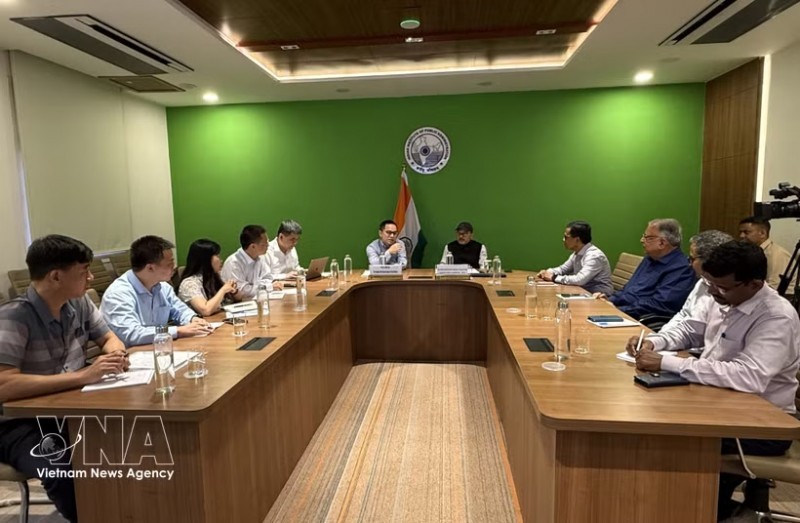 |
| The VASS delegation meets with researchers from the Institute for Studies in Industrial Development (ISID). (Photo: VNA) |
Tuan proposed that VASS and ISID develop a specific cooperation roadmap, including setting up joint research groups, organizing workshops on trade, investment and technological cooperation between Vietnam and India, and establishing regular exchanges between the two institutes.
VASS also expressed its readiness to host ISID researchers for short-term research programs in Vietnam.
At the meeting with the Indian Institute of Public Administration (IIPA), the two sides discussed cooperation in public governance, human resource training and policy advice.
IIPA Director Professor Surendrakumar Bagde said the institute is ready to strengthen cooperation with VASS through jointly organized workshops, co-publications and scholar exchanges, and to support VASS researchers in publishing in IIPA's academic journals.
The two sides also discussed the possibility of developing training programs suited to Vietnam's needs under the Indian Technical and Economic Cooperation (ITEC) program. They agreed to establish contact points to gradually implement the proposed areas of cooperation.
In strategic research and policy dialogue, the delegation met with the Observer Research Foundation (ORF), one of India's leading policy think tanks. The two sides saw strong potential for cooperation in research on Vietnam-India relations, the Indo-Pacific region, economic connectivity, trade, investment, technology and innovation, as well as regional and international issues.
VASS proposed jointly organizing workshops, roundtables and policy dialogues, while promoting joint research, co-publications and exchanges of experts and scholars. Both sides also expressed readiness to host each other's scholars for short-term research to strengthen professional exchanges and develop joint research ideas.
Vietnam – one of most attractive destinations for leading US semiconductor companies: expert
Vietnam has emerged one of the most attractive destinations for leading US semiconductor companies, thanks to its competitive labor costs, political stability, favourable geographic location and extensive network of free trade agreements (FTAs), according to Dr. Tran Doan Huan, Senior Research Scientist at Georgia Institute of Technology in Atlanta.
Speaking to Vietnam News Agency correspondents in the US, Huan, who is also Head of Research Innovation at Matmerize, Inc., noted several factors behind the US decision to include Vietnam in the International Technology Security and Innovation (ITSI) program under the 2022 CHIPS and Science Act.
According to him, Vietnam has built a solid semiconductor and electronics industry before joining ITSI, attracting major US semiconductor companies. Intel Products Vietnam is one of Intel's largest assembly and testing facilities worldwide, while chip design companies such as Synopsys, Cadence, Marvell and Qualcomm have established engineering and research centers in the Southeast Asian country, providing a foundation for Vietnam to gradually move into higher value-added segments of the semiconductor value chain.
Vietnam's participation supports the US goal of diversifying and strengthening the resilience of semiconductor supply chains. Following the COVID-19 pandemic and amid geopolitical tensions, the US has sought to reduce excessive dependence on a small number of countries. Rather than bringing all semiconductor production back to the US, the country aims to build a network of trustworthy partners that share commitments to transparency, supply-chain security and technological cooperation.
In this context, Vietnam is well positioned to develop semiconductor assembly, testing, packaging and chip design activities, helping reduce concentration in global supply chains, cited VNA.
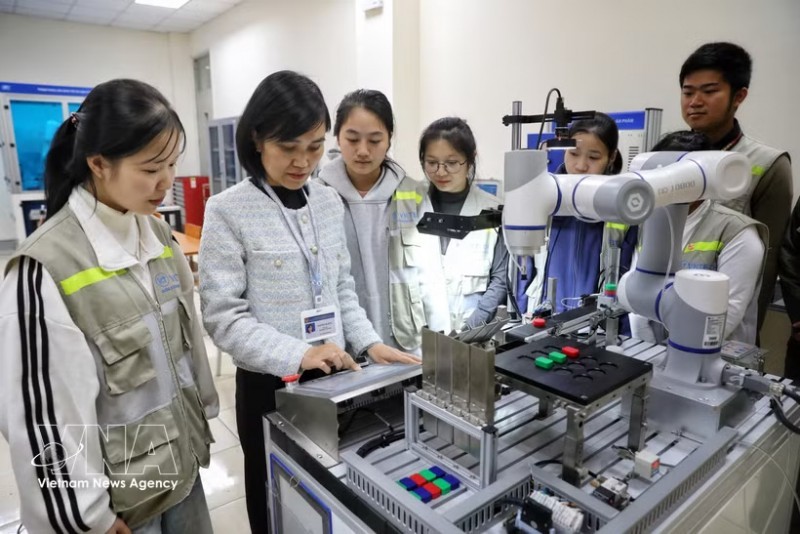 |
| Students practice microcontroller programming at the Vietnam-Korea College of Technology in Bac Ninh province (Photo: VNA) |
Huan also highlighted Vietnam's large electronics manufacturing ecosystem, with major companies such as Samsung, Foxconn and LG operating in the country. The ecosystem, together with a young workforce, strong mathematics and software skills and competitive labor costs, provides favourable conditions for semiconductor development.
Human resources remain a key strength, he said, noting that Vietnam trains tens of thousands of engineers in electronics, information technology and engineering every year. Although the number of specialised semiconductor engineers remains limited, ITSI can help support training engineers, developing curricula, establishing laboratories, and strengthening university - business collaboration.
Geopolitically, Vietnam's strategic location and its independent and balanced foreign policy also make the country an important partner for the US in building more secure technology supply chains. The elevation of Vietnam-US relations to a Comprehensive Strategic Partnership in 2023 reflects Vietnam's growing importance in the US’s regional strategy, with semiconductor cooperation among the key areas.
Huan noted that the Vietnamese Government's strong commitment to developing semiconductors is another important factor. Vietnam has identified semiconductors as a strategic technology sector, with plans to train tens of thousands of engineers, develop chip design centers, attract foreign investment and build domestic semiconductor companies.
ITSI is designed to support countries with strong political commitment and a willingness to improve their investment environment and technological capabilities. Vietnam meets these criteria well, creating favourable conditions for US support programs to deliver long-term results, he said.
According to the expert, besides Vietnam, many other countries have also been selected to participate in the ITSI program. However, very few of them possess all the conditions that Vietnam currently has: a large-scale electronics industry, the presence of major US semiconductor companies, an abundant pool of skilled technical workers, a stable political environment, strong government commitment, and the ability to integrate deeply into global supply chains.
The combination of these factors makes Vietnam one of the most important strategic partners for the US in the ITSI program, he said, adding the US decision to include Vietnam in the ITSI program reflects a long-term cooperation strategy based on the complementary interests of the two countries.
For the US, cooperation with Vietnam can help diversify semiconductor supply chains, reduce geopolitical risks and expand its network of trustworthy technology partners. For Vietnam, ITSI offers opportunities to access resources, knowledge, technology and global business networks, laying the groundwork for a stronger position in the global semiconductor value chain.
The 2022 CHIPS and Science Act represents a major shift in US semiconductor policy. It seeks not only to restore domestic chip manufacturing but also to build a comprehensive ecosystem capable of maintaining US technological leadership.
International cooperation is a key pillar of the strategy. Through ITSI, the US works with strategic partners including Vietnam, Costa Rica, Mexico, the Philippines and Indonesia, to develop human resources, strengthen assembly, testing and packaging capacity, and build more diversified and secure semiconductor supply chains.
Vietnam shifts FDI strategy from quantity to quality
Resolution 10 marks a shift from attracting foreign capital at scale to building a high-quality FDI ecosystem, with stronger links to Vietnamese businesses and global value chains, experts say.
From attracting capital to building an FDI ecosystem
After more than four decades of attracting foreign investment, Vietnam is changing the way it approaches foreign direct investment, placing greater emphasis on quality, technology transfer, spillover effects and the ability of domestic businesses to participate in global value chains.
Speaking at a seminar titled “Resolution 10: Developing a high-quality FDI ecosystem,” organized by the Government Information and Communication Department on August 7, Bui Thu Thuy, deputy director of the Foreign Investment Agency under the Ministry of Finance, said Politburo Resolution No. 10-NQ/TW on developing the foreign-invested economic sector sets out six major shifts in development thinking.
The first is a move from “attracting foreign investment” to “developing the foreign-invested economy,” recognising the foreign-invested sector as an integral part of the national economy.
The resolution also marks a shift away from prioritising the scale and volume of investment toward quality, efficiency and added value.
At the same time, Vietnam plans to move from investment incentives based largely on industries, sectors or locations toward incentives linked to outcomes, spillover effects, technology transfer and the tangible contribution that foreign capital makes to the economy.
Rather than attracting individual FDI projects in isolation, Vietnam will seek to develop an integrated ecosystem connected to international capital flows, Thuy said.
The country also intends to move from an “investment management” mindset toward creating a more enabling business and investment environment, with infrastructure, human resources and institutions prepared to improve the economy’s capacity to absorb high-quality capital.
To translate these objectives into practice, the Ministry of Finance is coordinating with relevant agencies to study how the new approach can be incorporated into the Investment Law and related legislation, VNN reported.
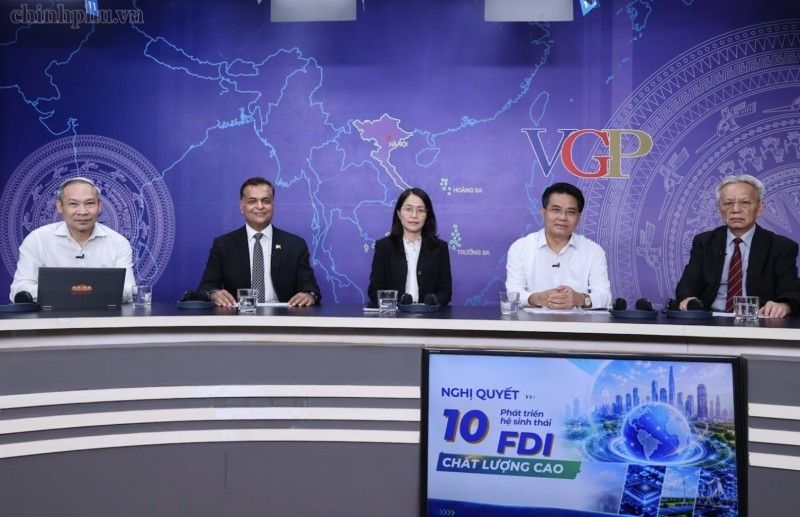 |
| Experts discuss Resolution 10 and the development of a high-quality FDI ecosystem at a seminar on August 7. Photo: VGP |
The government is expected to design stronger incentives for FDI companies, including tax measures, support for research and development costs, assistance with the cost of training Vietnamese businesses to participate in supply chains, and new approaches to supporting domestic companies.
Building Vietnam’s capacity to benefit from FDI
Phan Duc Hieu, a full-time member of the National Assembly’s Economic Committee, said the most important feature of Resolution 10 is a fundamental change in approach.
He described its new direction through four characteristics: more methodical, more systematic, more in-depth and more practical.
The key difference, Hieu said, is that Vietnam is no longer focusing solely on incentives designed to attract FDI. Instead, it is seeking to create an ecosystem that supports the entire lifecycle of foreign investment, from promotion and attraction to the operation of projects.
That ecosystem encompasses not only conventional investment policies but also the living and working environment, human resources and infrastructure.
For Vietnam to improve the quality of FDI, Hieu argued, the critical issue is strengthening the economy’s capacity to absorb investment and translate it into broader domestic gains.
“High-quality FDI will not automatically generate spillover effects if we lack the capacity to absorb them,” he said.
Resolution 10 therefore introduces a range of measures intended to strengthen the host economy’s absorptive capacity, particularly by improving the quality of the domestic business sector and upgrading infrastructure for production and business activities.
Hieu stressed that stronger absorptive capacity would do more than make Vietnam a more attractive destination for high-quality FDI. It would also strengthen the economy’s self-reliance and autonomy.
The longer-term ambition, he said, is to develop global value chains in which Vietnamese businesses themselves take leading roles.
To implement Resolution 10 effectively, Hieu said policies covering FDI, the private economy and state-owned enterprises need to be implemented simultaneously and in a coordinated manner.
He also called for a comprehensive review of the Investment Law, the Law on Support for Small and Medium Enterprises and policies governing supporting industries to eliminate overlaps and deliver more substantive results.
Support policies, he added, need to be sufficiently strong and precisely targeted rather than spread too thinly. Additional mechanisms should also encourage FDI companies to deepen their links with Vietnamese businesses.
Domestic companies still face barriers
From a provincial perspective, Le Quang Hoa, vice chairman of the Hung Yen Provincial People’s Committee, said Vietnamese companies continue to face significant challenges in human resources, technology and access to capital when trying to join the value chains of major corporations.
Hung Yen will therefore focus on encouraging FDI businesses to provide workforce training and transfer technology, while helping domestic companies strengthen management capabilities, upgrade technology and forge closer connections with foreign-invested businesses.
Hoa also called for investment promotion activities to be reformed under a unified national focal point, alongside stronger regional links and expanded trials of breakthrough mechanisms.
These efforts reflect the broader goal of ensuring that foreign investment creates benefits extending beyond individual projects and contributes to the development of Vietnamese businesses themselves.
Global investors look beyond tax incentives
Binu Jacob, CEO of Nestlé Vietnam, said that amid the global minimum tax, traditional investment incentives are no longer the decisive factor for multinational corporations.
Instead, global companies are paying closer attention to the government’s strategic direction, transparent and predictable policies, a highly skilled workforce and a sufficiently strong business ecosystem that gives investors confidence to make long-term commitments.
Jacob also proposed moving away from the term “foreign investor” and instead using expressions such as “investment partner” or “FDI partner.”
Such a change in terminology and approach, he argued, could serve as a form of strategic commitment, more accurately reflecting a long-term relationship in which Vietnam and the FDI business community share both responsibilities and benefits.
The broader shift outlined in Resolution 10 signals that Vietnam’s next phase of foreign investment policy will be measured less by how much capital enters the country and more by what that capital leaves behind.
Greater technology transfer, stronger Vietnamese companies, deeper domestic participation in supply chains and ultimately Vietnamese-led global value chains are emerging as central measures of success in the country’s new FDI strategy.
Vietnam takes smart tourism to new heights
Yet, many smart apps for tourism statistics, customer research and forecasting remain on the shelf. Putting them to work would sharpen tourism management, crisis response and policymaking for sustainable growth.
Robots go mainstream
At the Vietnam National Fine Arts Museum on Nguyen Thai Hoc Street, Hanoi, a robot receptionist has been greeting visitors on the ground floor since mid-June. It fields questions on virtually any artwork or artefact, taps an extensive knowledge base, and even designs an optimal tour based on the visitor’s available time.
Hanoi has been an early mover. Automated audio guides and e-ticketing arrived at the Temple of Literature and Hoa Lo Prison relic, while destinations began promotions on Facebook and YouTube.
As technology advanced, smart tourism took off. Virtual reality and digital tourism maps now feature at Hanoi Old Quarter, Bat Trang Ancient Village and Phu Dong Temple. 3D mapping projection powers nighttime products like “Decoding the Thang Long Imperial Citadel” and the “Essence of Confucian Learning” tours at the Temple of Literature, creating fresh pull.
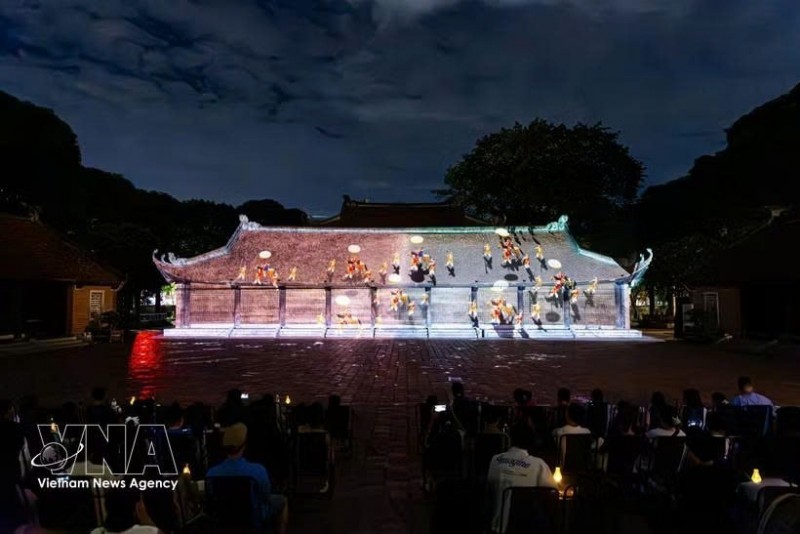 |
| A modern 3D mapping projection on the ancient architecture of the Temple of Literature vividly recreates the journey of Vietnam's scholarly tradition before a large audience. (Photo: VNA) |
Meanwhile, a suite of digital services lets tourists book rooms, order meals and arrange transport from their seats.
Smart tourism apps deliver for managers, agents and travellers alike. Nguyen Huu Viet, Deputy Director of the Hanoi Tourism Information and Support Center, said the city aims to complete its digital platform by 2030 and make tourism a pillar of its creative economy.
Digital transformation is seeping into every corner of tourism, from trip planning and research to on-the-ground experiences, accommodation, and smart tools that help firms welcome, guide and delight visitors.
Moving toward “high-level” apps
Chu Duc Quy, general director of RevPilot (On Hotel Rooms), said Hanoi’s roughly 7,000 lodging facilities lean on international platforms such as Booking.com and Agoda, and pay steep commissions. Dr Nguyen Anh Tuan, Director of the Institute of Tourism Economics, urged Hanoi to build a tourism data center to standardise information on destinations, events, businesses, visitor behaviour and feedback.
The city should stitch together a seamless smart tourism journey, from search and booking through payment, experience and feedback, while injecting AI into management via data aggregation, predictive charts, multilingual chatbots, automated marketing and customer care, alongside growing digital talent and public-private partnerships, he said.
The data center will serve as a shared analytics and AI platform, forecasting visitor flows, segmenting markets, reading sentiment and flagging overcrowding. Hanoi could also roll out a multilingual virtual assistant capable of answering questions around the clock.
Nguyen Tran Quang, deputy director of the municipal Department of Tourism, said Hanoi is accelerating smart tourism to align with its “Safe – Friendly – Quality – Attractive – Smart” destination brand.
The city will focus on building out a tourism database to link data sharing for state management and development; digitising destinations, heritage sites, craft villages and signature products; and refreshing promotion on digital platforms. It will also set up coordination among state agencies, tech and tourism companies to build a full digital tourism ecosystem.