| Vietnam News Today (Feb. 13) notable headlines Vietnam–Canada ties gain fresh momentum after ministerial meeting Spring Fair 2026 elevates trade promotion in tandem with market development: official FDI disbursement hits five-year high in January Foreigners dive into Vietnam’s Tet traditions, embrace festive flavors, family rituals Spring returns to northern frontier, where people stand guard Vietnam considers linking HCMC–Moc Bai with Phnom Penh expressway Coast Guard vessels set sail to safeguard seas during Lunar New Year Vietnam Airlines operates free Tet flights for disadvantaged workers Happy Tet contest celebrates a peaceful and heartwarming Vietnam |
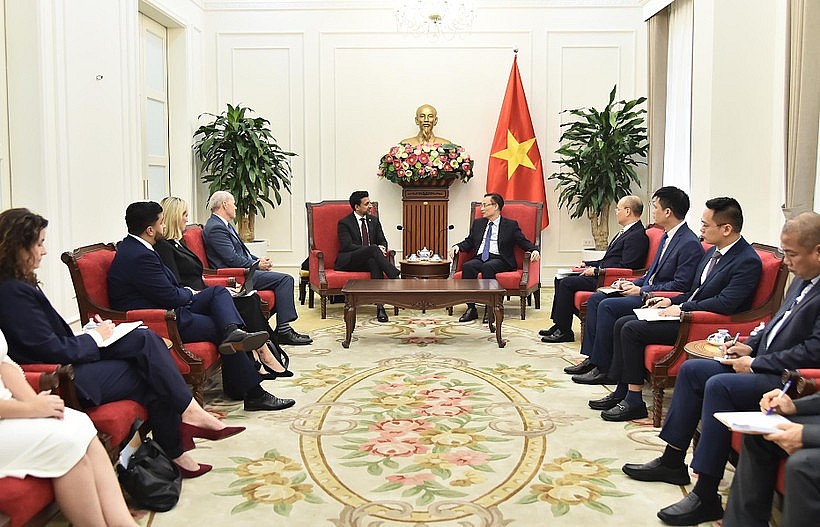 |
| Minister of Foreign Affairs Le Hoai Trung meets with Canada's Minister of International Trade Maninder Sidhu on February 12, 2026. (Photo: Ministry of Foreign Affairs) |
Vietnam–Canada ties gain fresh momentum after ministerial meeting
Vietnam attaches great importance to strengthening its Comprehensive Partnership with Canada, Minister of Foreign Affairs Le Hoai Trung said, noting that Canada’s active engagement with the world and the Asia-Pacific, together with shared strategic interests, offers a solid foundation for expanding cooperation, addressing common challenges and lifting bilateral relations to a higher level.
At a reception for Minister of International Trade Maninder Sidhu on February 12, Trung highlighted the significance of the Canadian official’s first visit to Vietnam in further deepening bilateral ties.
He asked Sidhu to convey Party General Secretary To Lam’s thanks and New Year greetings to Governor General Mary May Simon, and expressed appreciation for her congratulatory letter following his re-election as General Secretary of the Communist Party of Vietnam.
The Vietnamese minister welcomed positive developments in the Comprehensive Partnership, especially in trade and investment, with two-way trade surpassing 8.5 billion USD in 2025. He also thanked Canada for supporting ASEAN’s and Vietnam’s stance on resolving disputes peacefully in line with international law, including the 1982 United Nations Convention on the Law of the Sea (UNCLOS).
For his part, Sidhu said he was pleased to make his first visit to Vietnam and attend the inauguration of the new Canadian Embassy premises. He congratulated Vietnam on the success of the 14th National Party Congress and voiced confidence in the country’s advancement in a new development phase.
He described Vietnam as Canada’s top priority partner in ASEAN and highlighted significant room for expanded cooperation in trade and investment, science and technology, education and training, environmental protection and climate change response, cited VNA.
Sidhu added that regular high-level exchanges and effective implementation of bilateral and multilateral mechanisms, particularly leveraging both countries’ membership of the Comprehensive and Progressive Agreement for Trans-Pacific Partnership (CPTPP), with Vietnam serving as rotating chair in 2026, will generate new momentum for cooperation and contribute to regional and global peace, stability and development.
The two ministers agreed on measures to advance the Comprehensive Partnership, pledging to facilitate cooperation in trade and investment, defense and security, official development assistance, tourism and people-to-people exchanges, while expanding collaboration in emerging areas such as supply chains, AI, semiconductors, quantum technology, clean energy transition, renewable energy, green agriculture, environmental protection and climate change response.
They also consented to coordinate and support each other as Vietnam prepares to host APEC Year 2027 and to further strengthen Canada–ASEAN relations.
Spring Fair 2026 elevates trade promotion in tandem with market development: official
As the domestic market remains a key pillar of the economy, the first Glorious Spring Fair 2026 has highlighted the success of updating trade promotion methods in a more meaningful way, closely tying product promotion, distribution connections, and consumer demand stimulation.
In an interview with the Vietnam News Agency (VNA), Vu Ba Phu, Director of the Vietnam Trade Promotion Agency (Vietrade) under the Ministry of Industry and Trade (MoIT), said that this model should be replicated to enhance the competitiveness of Vietnamese goods and foster a stable, sustainable domestic market.
Assessing the overall outcomes, Phu noted that the event successfully created a vibrant Tet (Lunar New Year) and Spring festive space that went beyond conventional buying and selling activities. It combined business and production showcases with performances of both traditional and contemporary folk arts, thereby promoting product brands, regional identities and national pride in Vietnamese goods.
In 10 days, the fair attracted around 500,000 visitors, including international delegations from India, the Philippines, Belgium, the Republic of Korea, Japan and China seeking partnership opportunities. Participating businesses shared promising daily revenues, ranging from a few million to hundreds of millions of Vietnamese dong, with about 75% seeing strong growth during busy weekend peaks. Notably, these localities included Hanoi, Ca Mau, and Lao Cai, according to VNA.
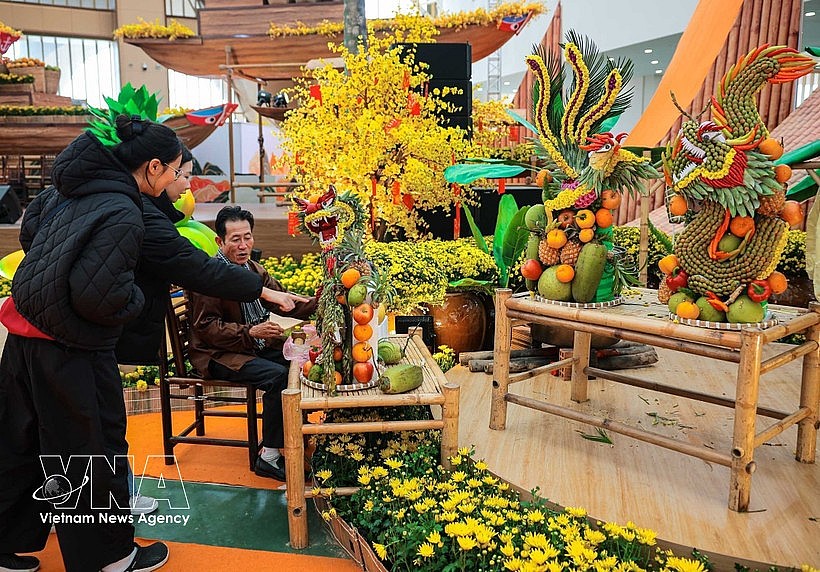 |
| Many visitors explore artistic fruit creations crafted by artisan Nguyen Van Tuyen from Ho Chi Minh City. (Photo: VNA) |
In addition, communications efforts amplifying outreach also achieved strong results, thanks to the coordinated engagement of press agencies and digital media platforms. Information about the fair was featured in thousands of news articles and hundreds of posts on social media platforms such as Facebook and TikTok, generating hundreds of thousands of views each day, said Phu.
The official highlighted that the quality of supply–demand connectivity has improved significantly, as the fair evolved into a substantive trade platform linking producers, distributors and consumers. Through exhibition zones and thematic forums, enterprises, particularly small and medium-sized firms, were able to expand retail networks and directly access target markets.
The integration of cultural experiences was described as creating a distinctive “touchpoint” that stimulated consumer interest.
Building on the success of the first Spring Fair, Phu shared that the MoIT has learned four key lessons: aligning fairs with the national trade promotion strategy instead of isolated sales events, prioritising consumer trust through quality standards, boosting supply–demand connections into lasting contracts, and weaving in cultural elements to create a unique identity for Vietnamese trade fairs.
The lessons are an important foundation for the ministry to refine the organisation of national trade fairs and exhibitions more professionally, enhancing national trade promotion capacity and supporting the business community in achieving stable development in both domestic and international markets, the official added.
FDI disbursement hits five-year high in January
According to the Statistics Office under the Ministry of Finance, realized foreign direct investment in Vietnam in January 2026 was estimated at 1.68 billion USD.
This represents an 11.3% increase compared with the same period last year. It is also the highest January disbursement recorded over the past five years.
Of the 1.68 billion USD in realized FDI, the processing and manufacturing sector accounted for 1.39 billion USD, representing 82.5% of the total.
Real estate business activities attracted 110.2 million USD, equivalent to 6.6%. Electricity, gas, steam and air conditioning supply drew 66.6 million USD, or 4.0%.
The continued growth in FDI disbursement indicates that Vietnam’s investment environment remains conducive for foreign investors to promptly implement projects.
However, total registered FDI as of January 31, 2026 - including newly registered capital, adjusted capital and capital contributions or share purchases by foreign investors - reached 2.58 billion USD. This marked a decline of 40.6% year-on-year.
In terms of newly registered capital, 349 projects were licensed with total registered capital of 1.49 billion USD.
This was up 23.8% in the number of projects and 15.7% in registered capital compared with the same period last year.
Processing and manufacturing again led newly licensed projects with 1.05 billion USD, accounting for 70.8% of total newly registered capital. Real estate business followed with 243.2 million USD, representing 16.3%. The remaining sectors accounted for 191.4 million USD, or 12.9%.
Among 35 countries and territories with newly licensed investment projects in Vietnam in January 2026, Singapore was the largest investor with 906.1 million USD, accounting for 60.9% of total newly registered capital.
China ranked second with 169.6 million USD, or 11.4%.
Japan followed with 140.8 million USD, representing 9.5%.
The US contributed 85.5 million USD, or 5.7%.
Hong Kong (China) registered 66.1 million USD, accounting for 4.4%.
South Korea invested 48.3 million USD, equivalent to 3.2%.
The Netherlands contributed 32.3 million USD, or 2.2%.
Regarding adjusted capital, 91 previously licensed projects registered additional capital totaling 888.5 million USD.
This figure declined 67.4% year-on-year. If combining newly registered and adjusted capital of previously licensed projects, total registered FDI in processing and manufacturing reached 1.88 billion USD, accounting for 79.2% of the combined total, VNN reported.
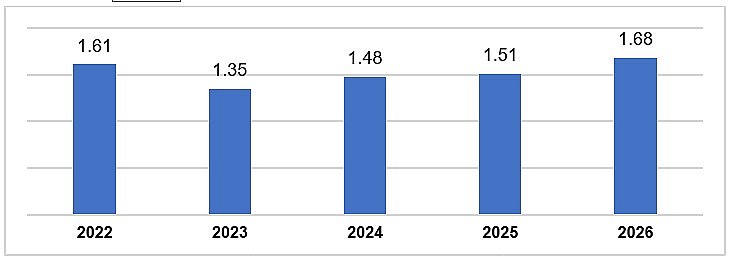 |
| FDI disbursement in January from 2022 to 2025 (billion USD). Source: Statistics Office, Ministry of Finance. |
Real estate business recorded 245.5 million USD, representing 10.3%. Other sectors attracted 248.3 million USD, or 10.5%.
Capital contributions and share purchases by foreign investors totaled 198.4 million USD across 265 transactions, down 38.6% year-on-year.
Of these, 78 transactions increased charter capital with a value of 67.0 million USD.
Meanwhile, 187 transactions involved foreign investors acquiring domestic shares without increasing charter capital, amounting to 131.4 million USD.
In terms of sectoral distribution for capital contributions and share purchases, processing and manufacturing attracted 81.2 million USD, accounting for 40.9% of the total value.
Professional, scientific and technological activities received 45.7 million USD, or 23.1%. The remaining sectors accounted for 71.4 million USD, equivalent to 36.0%.
Foreigners dive into Vietnam’s Tet traditions, embrace festive flavors, family rituals
Foreign visitors are stepping beyond sightseeing to immerse themselves in the cultural traditions of Vietnam’s Mekong Delta, taking part in hands-on Lunar New Year (Tet) preparations ahead of the Year of the Horse 2026.
Through a cultural experience tour titled “Foreigners Celebrate Tet in the Mekong Delta,” organised by Vietluxtour, a group of Polish travelers traveled from Ho Chi Minh City to rural areas in Dong Thap province to experience the authentic atmosphere of southern Vietnam’s traditional Lunar New Year.
Instead of visiting high-rise buildings or famous landmarks, the group found themselves in modest riverside homes, where life flows at a slower pace along the waterways. In kitchens filled with the scent of fresh banana leaves, newly harvested sticky rice and wood smoke, they learned to wrap bánh tét (cylindrical sticky rice cakes), cook candied coconut, practice Vietnamese calligraphy, arrange the five-fruit tray and light incense on ancestral altars – the customs deeply familiar to Vietnamese families but entirely new and captivating to them.
Adriana, a Polish traveler, said that although she had previously learned about Vietnamese culture through books and earlier trips, this was her first time directly engaging in ancestral worship rituals during Tet.
“I was impressed by the way Vietnamese families burn incense to connect with their ancestors,” she said. “In Poland, we also have traditional rituals, so I felt an interesting sense of connection. Vietnamese calligraphy left the deepest impression on me — it is delicate yet full of cultural depth. Bringing home a calligraphy artwork as a Tet gift is something I truly value.”
Another traveler, Wojtek Pawelec, said joining local families in preparing bánh tét helped him better understand the importance of reunion during the holiday.
“Watching family members gather and prepare for Tet together helped me appreciate the value of family reunion in Vietnamese culture,” he said. “Through this experience, I could genuinely feel the Tet atmosphere and emotions. I hope to learn even more about Vietnam’s culture and people.”
A highlight of the journey was a traditional Tet meal, where guests not only enjoyed festive dishes but also heard the stories behind them, from the symbolism of bánh tét and the sweetness of candied coconut to the custom of giving red envelopes for good luck. The exchange of red lucky envelopes and New Year wishes brought visible delight to the European visitors, cited VOV.
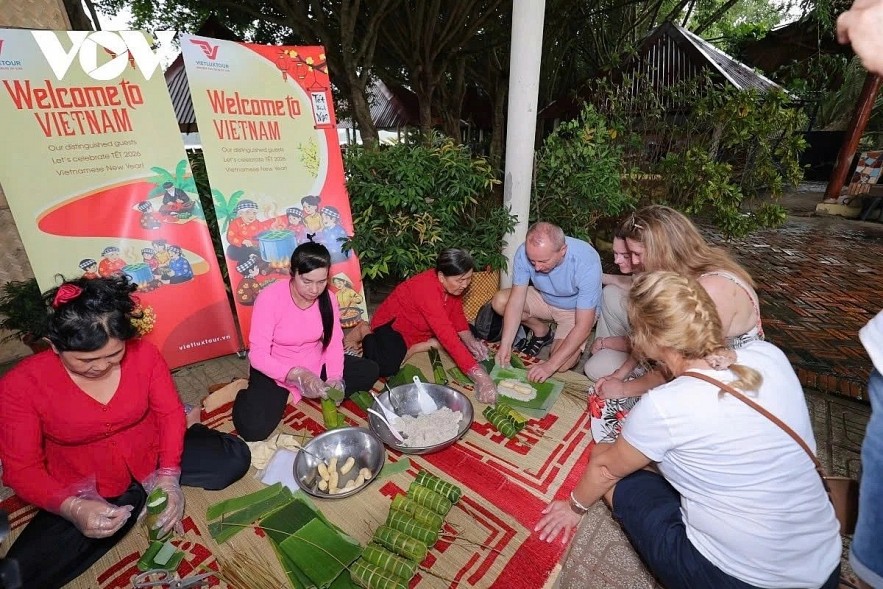 |
| Foreign visitors enthusiastically join locals in making bánh tét for the Tet holiday |
Tran The Dung, general director of Vietluxtour, said European travelers are increasingly seeking immersive, locally rooted experiences.
“When participating in Vietnam’s traditional Tet celebrations, visitors are not simply attending a festival,” he said. “They are introduced to family stories, community bonds and the rich cultural heritage of the Vietnamese people. That is why we invest in developing Tet-themed cultural products tailored for international visitors. When cultural experiences are thoughtfully designed and professionally organized, they hold strong appeal for global travelers.”
As tourism shifts beyond passive sightseeing toward meaningful cultural engagement, experiential programmes such as “Foreigners Celebrate Tet in the Mekong Delta” reflect a broader move toward sustainable tourism development – the one that preserves and promotes Vietnam’s cultural identity while creating authentic connections between visitors and local communities.
Spring returns to northern frontier, where people stand guard
As the Lunar New Year (Tet) approaches, red national flags flutter in villages along Lai Chau’s border, where ethnic communities and border guards quietly safeguard peace on Vietnam’s northern frontier.
In Thu Lum commune, home to Ha Nhi and La Hu ethnic groups in Lai Chau’s far northwestern highlands, daily life continues steadily in the crisp mountain air. Some residents repair rooftops, others clear fields, while many hang bright red flags in front of their homes in preparation for Tet.
Here at the country’s frontier, peace is not an abstract concept. It is reflected in each household, each flag raised on a hillside, and in the enduring commitment of people who have long chosen to stay rooted to their land.
Under Resolution 33 of the Politburo on the Strategy for Safeguarding National Borders, citizens are identified as key stakeholders directly involved in protecting national sovereignty. In Lai Chau’s border areas, that principle is visible not just in policy documents, but in everyday life.
Each resident, in their own way, serves as a “living border marker,” affirming sovereignty through their enduring presence.
Si Hu Pha, head of Lo Na village in Thu Lum commune, said border guard units and local authorities visit disadvantaged households every Tet with gifts and well wishes.
“These gifts are meaningful to us,” he said. “They help families celebrate a warmer, happier Lunar New Year. People feel cared for and supported.”
The Tet presents and national flags distributed to villagers carry not only material value but also symbolise solidarity between the military and civilians along the country’s frontier.
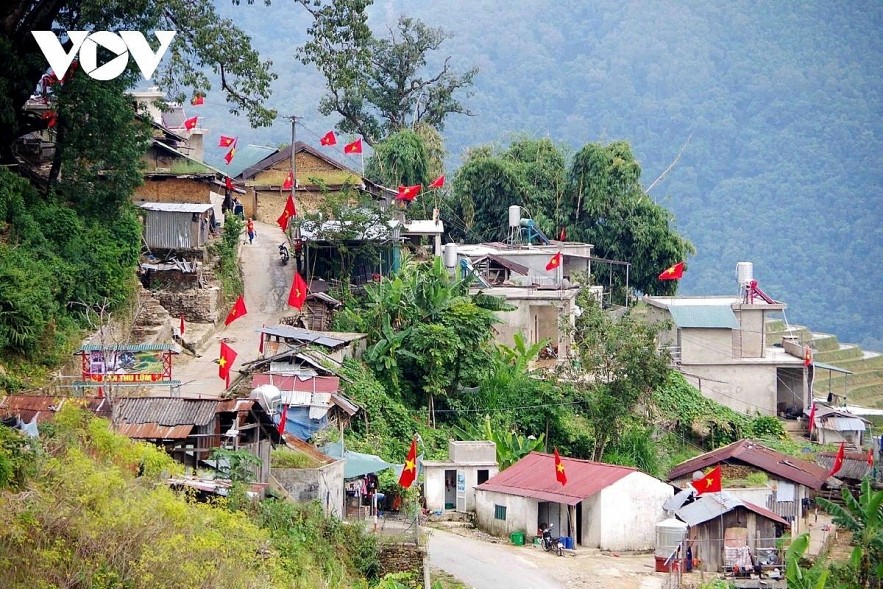 |
| Spring 2026 arrives in Thu Lum commune’s border villages, adorned with national flags. |
In Thu Lum, Chu Xe Lu’s story illustrates what Vietnamese officials describe as the “people’s hearts and minds posture” in border protection. For more than two decades, he has traversed over 50 kilometers of rugged border terrain, serving as both a local official and a trusted guide for border guards during surveys, boundary demarcation and patrol route maintenance.
“Safeguarding border security is the responsibility of all citizens,” Lu said. “Living here, we must be even more responsible. I have encouraged villagers to clear pathways so soldiers can patrol and maintain border markers more easily.”
The quiet determination of border residents is echoed by a younger generation who have chosen to wear the green uniform of the border guard force. Captain Chu Ha Pha of Ka Lang Border Guard Station grew up listening to his father’s stories about patrol missions along the frontier. Inspired by those accounts, he decided to follow the same path.
“I dreamed of becoming a border guard to contribute, even in a small way, to protecting our territorial sovereignty and border security,” he said.
According to leaders of the Lai Chau Border Guard Command, the strength of border protection lies in public unity, particularly among ethnic minority groups who make up much of the population in these remote areas.
Colonel Le Cong Thanh, Deputy Political Commissar of the Lai Chau Border Guard Command, said ethnic minority communities in border areas demonstrate strong patriotism and close ties with the Party, the State and the border guard force.
“This is a crucial foundation for building a solid national defence and security posture, as well as strong public support,” he said.
Over the years, border guard units have implemented various socio-economic development initiatives, including poverty reduction and livelihood support programmes, to help improve living standards and encourage residents to remain in their villages.
As Tet draws near, the villages of Lai Chau glow with red flags against the mountain landscape. Along winding patrol paths, the footprints of soldiers and civilians intertwine - a quiet testament to shared responsibility.
In this frontier region, the border is safeguarded not only by stone markers, but by trust, unity and the enduring presence of its people, with each one a “living border marker” standing firm to keep spring peaceful at the edge of the nation.
 | Vietnam News Today (Feb. 7): Vietnam, Laos, Cambodia leaders outline new cooperation orientations Vietnam News Today (Feb. 7): Vietnam, Laos, Cambodia leaders outline new cooperation orientations; Vietnam highlights legal cooperation at Cuba international justice forum; Vietnamese Embassy in ... |
 | Vietnam News Today (Feb. 9): Vietnam’s GDP Ranks 32nd Globally, Per Capita Income Rises Sharply Vietnam News Today (Feb. 9): Vietnam Fatherland Front cherishes OV contributions; U.S. vows to work closely with Vietnam for successful APEC Year 2027; Vietnam’s GDP ... |