| Vietnam News Today (Jan. 3) notable headlines Enhancing resilience key to Vietnam's stable growth: Argentine politician Vietnamese economy at crossroads as 2026 opens new growth cycle Quy Nhon among best cities to visit in 2026: Lonely Planet Citizen protection measures rolled out following bar fire in Switzerland Cold air intensifies, mountain temperatures fall below 7°C Vietnam ranks among top performers in WB’s Business Ready 2025 report Ambassador highlights 2025 as remarkable year for Vietnam–US relations Hue tourism set for further breakthrough in 2026 Experts praise inclusion of overseas Vietnamese in policy consultation |
 |
| Marcelo Rodriguez, head of the Commission for Foreign Affairs of the Communist Party of Argentina Central Committee (Photo: VNA) |
Enhancing resilience key to Vietnam's stable growth: Argentine politician
Vietnam’s continued socio-economic stability and positive development outcomes demonstrate the effective governance capacity and strong adaptability of its political system, according to Marcelo Rodriguez, head of the Commission for Foreign Affairs of the Communist Party of Argentina Central Committee.
In an interview with the Vietnam News Agency's correspondent in Buenos Aires, Rodriguez noted that Vietnam’s target of around 8% economic growth in 2025 is highly ambitious, particularly amid global uncertainties ranging from prolonged armed conflicts to trade tensions and strategic competition among major powers.
However, he highlighted Vietnam’s ability to mobilise endogenous drivers as a defining strength, reflected in deep reforms to the organisation and operation of its political system.
According to Rodriguez, who also serves as Director of the Center for Marxist Studies (CEFMA) under the Communist Party of Argentina, reforms to streamline organisational structures, re-organise administrative units and address overlaps among Party and State agencies have laid an important foundation for more effective national governance. These reforms, he said, carry long-term strategic significance and will continue to yield results in the years ahead.
He praised Vietnam’s foreign policy of independence, self-reliance, multilateralization and diversification of international relations, noting that it has enabled the country to strengthen its internal capacity for development across economic, social and industrial pillars while remaining flexible in responding to global fluctuations and firmly upholding its principles, identity and strategic priorities.
Political and social stability, he stressed, remains a decisive factor underpinning Vietnam’s consistent development trajectory - an achievement not shared by many countries, cited VNA.
Regarding Vietnam’s goal of achieving double-digit growth of over 10% in 2026, Rodriguez described it as challenging yet realistic. Based on Vietnam’s performance in 2025, during which most development targets were met, he said the prospects for high growth in the coming period are achievable, despite expected impacts from the global political, economic and trade environment.
He noted that Vietnam is entering a new development phase as it prepares to review the implementation of the 13th National Party Congress Resolution and formulate the next five-year socio-economic development strategy, with the aim of becoming an upper-middle-income country. If Vietnam continues to consolidate a growth model centered on modern industry, science and technology, digital transformation, artificial intelligence and high-quality human resources, he said the country’s development potential remains substantial.
He also underscored the importance of cooperation between the Communist Party of Vietnam and the Communist Party of Argentina. Over the past year, the CEFMA has initiated in-depth research into Vietnam’s revolutionary experience and Party-building practices, viewing them as highly relevant to the theoretical and practical work of the Communist Party of Argentina.
Rodriguez said that, driven by deep respect for Vietnam’s national heroes and the historic role of the Communist Party of Vietnam, the CEFMA has coordinated with the Vietnamese Embassy in Argentina to organise a thematic seminar and publish a special volume compiling papers on Argentina–Vietnam relations, along with contributions from a commemorative event honoring President Ho Chi Minh. This marked one of the first systematic cooperation initiatives between the two sides in theoretical research.
Building on these outcomes, Rodriguez said the two Parties are formulating plans to expand exchanges, dialogues and joint research activities in 2026, thereby further strengthening the friendship and cooperation between the two Parties for the benefit of the two countries' people and the global progressive left movement.
Vietnamese economy at crossroads as 2026 opens new growth cycle
As Vietnam enters 2026, a pivotal year marking the start of a new growth cycle, the economy is poised for acceleration on the back of a stabilised foundation built during 2021–2025, while also facing growing challenges that will require decisive policy action and a focus on improving growth quality.
Maintaining recovery momentum amid global volatility
Vietnam closed 2025 with several notable milestones, marking the final year of its 2021–2025 socio-economic development plan. Despite heightened global uncertainty driven by prolonged geopolitical tensions, trade fragmentation and rising financial risks, the country maintained a steady recovery, preserved key macroeconomic balances and laid an important foundation for the next phase of development.
According to the Ministry of Finance, as of Dec. 15, 2025, 22 of 26 key socio-economic indicators for the 2021–2025 period met or exceeded targets. All social welfare indicators surpassed planned levels, reflecting the Government’s sustained efforts to ensure social progress and equity. In both 2024 and 2025, Vietnam met or exceeded all indicators assigned by the National Assembly.
Gross domestic product (GDP) growth in 2025 is estimated at above 8%, lifting average growth for the five-year period to 6.3%. Excluding 2021 when the economy was severely affected by the COVID-19 pandemic, growth during 2022–2025 averaged 7.2%, exceeding official targets and underscoring the economy’s resilience.
GDP per capita in 2025 is estimated at around US$5,000, up 1.4 times from 2020, officially placing Vietnam in the group of upper-middle-income countries. Inflation remained well contained below 4% throughout the period, with 2025 estimated at about 3.5%, supporting policy flexibility and market confidence.
State budget revenues reached approximately VND2.47 quadrillion (US$100 billion) by mid-December 2025, exceeding projections by more than 25% and reflecting a shift toward more sustainable revenue sources driven mainly by production and business activities. Over the five-year period, the government implemented tax and fee relief measures worth about VND1.1 quadrillion to support businesses and households.
Public spending was restructured to curb recurrent expenditures while increasing development investment and social spending. Investment outlays accounted for 32–33% of total budget spending, while fiscal deficits and public debt remained within safe thresholds.
Financial markets improve, infrastructure drives momentum
Vietnam’s financial markets remained stable, with the stock market upgraded to secondary emerging market status in 2025, a move expected to attract more medium- and long-term capital inflows.
Foreign trade continued to expand, with total import-export turnover reaching a record US$920 billion, placing Vietnam among the world’s 25 largest trading economies. The trade balance posted a surplus of more than US$20 billion for the third consecutive year. Total social investment in 2025 exceeded VND4.15 quadrillion, equivalent to more than 32% of GDP.
During the current National Assembly term, lawmakers passed over 180 laws and resolutions, while the government issued 820 decrees, the highest on record, helping resolve long-standing bottlenecks, including the restructuring of five weak banks and clearing obstacles for thousands of stalled projects.
Infrastructure development recorded major breakthroughs, with more than 3,500 km of expressways completed, the national coastal road network finished, and hundreds of key projects launched across transport, energy, industry, digital transformation and social infrastructure, with total investment exceeding VND5.14 quadrillion.
Headwinds not underestimated
Despite broadly positive momentum, challenges persist. Can Van Luc, a member of the Prime Minister’s Policy Advisory Council, says global uncertainty remains a major risk, citing geopolitical tensions, trade and technology fragmentation, rising protectionism, cybersecurity threats and climate change, all of which could weigh on exports, foreign investment and macroeconomic stability.
Vietnam continues to run a sizeable services trade deficit of about US$10 billion, while domestic growth drivers such as private investment and consumption have yet to fully recover to pre-pandemic levels. Public investment disbursement is uneven, and businesses face high input and logistics costs, volatile orders, and increasing requirements for green and digital compliance from international markets, according to VOV.
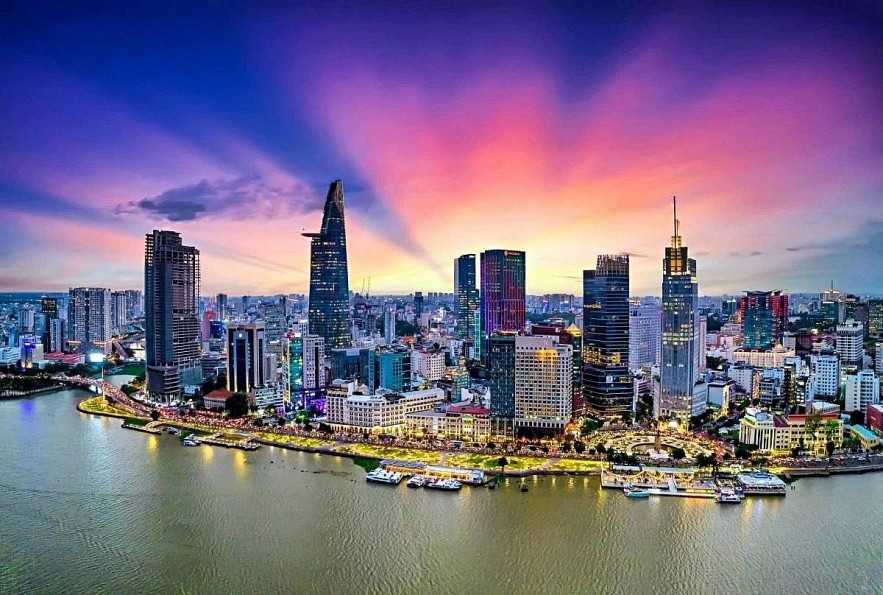 |
| Despite heightened global economic volatility, Vietnam’s economy has maintained a solid recovery, with key macroeconomic balances remaining stable. (Illustrative image) |
In the financial sector, policy space is narrowing. Banking system liquidity is under pressure, interest rate and exchange rate risks persist, and elevated property prices are constraining capital flows into productive sectors.
High growth ambitions and policy challenges in 2026
Looking ahead to 2026, global risks are expected to remain elevated, but Vietnam is set to benefit from the rollout of breakthrough policy resolutions, the accelerated implementation of strategic infrastructure projects, and the formal operation of the two-tier local government system.
The National Assembly has set a GDP growth target of at least 10% for 2026, with GDP per capita projected at US$5,400–$5,500, while maintaining inflation control and macroeconomic stability. To achieve these goals, fiscal policy should serve as the main growth anchor, supported by accommodative monetary policy, Can Van Luc says.
Policy priorities include stimulating domestic investment and consumption, safeguarding traditional export markets, boosting services exports, and unlocking new growth drivers such as the digital, green and circular economies. Stabilising key markets, including property, foreign exchange and gold, will be essential to contain systemic risks and sustain investor confidence.
“Capital attraction must go hand in hand with more efficient use, particularly through increased public investment in transport and energy infrastructure to generate spillover effects and support double-digit growth,” Luc explains.
From a longer-term perspective, Nguyen Quoc Anh, deputy head of the Institute of Strategy and Economic-Financial Policy at the Ministry of Finance, said Vietnam needs to shift from extensive to intensive growth, driven by innovation, technology and green development. Total factor productivity should become the central benchmark, supported by higher labour productivity, skilled human resources and modern governance.
He stresses that deep economic restructuring, coupled with reforms in institutions, infrastructure and workforce quality, will be crucial. The private sector should be positioned as the leading force in the growth transition, backed by fair competition and incentives to invest in high-tech and environmentally sustainable industries.
Quy Nhon among best cities to visit in 2026: Lonely Planet
Quy Nhon, with its beautiful beach and unique cuisine, has been noted as one of the best destinations in 2026.
In its “Best in Travel 2026”, Lonely Planet introduces 25 must-visit places to tourists to make their world’s most inspiring journeys for the year ahead in which Quy Nhon, now a ward of Gia Lai province, is suggested “best for coastal adventures and seafood delights”.
"Set between Vietnam’s rolling mountains and calm lagoons, Quy Nhon is a coastal city where natural beauty and culture seamlessly intertwine. Soft sandy beaches meet ancient Cham temples, fishing villages and a thriving culinary scene," the website wrote.
"The city’s biggest draw lies in its laid-back atmosphere, made all the more inviting by the absence of heavy tourist crowds. Stroll along the well-kept promenade at sunset, savour towering plates of fresh seafood, and end your evening at a cosy cocktail lounge or beachside bar."
The beaches of Quy Nhon are no doubt the key appeal for visitors to this untouched seaside city.
Unlike its neighboring Nha Trang and Hoi An where tourism has exploded, tourists can often find a whole beach to themselves. From the beautiful and well-maintained beach in the heart of the city to lesser-known shores tucked into fishing villages and stunning golden-sand coasts against dramatic cliffscape, each and every Quy Nhon beach has a holiday experience for everyone.
Lonely Planet suggested that to explore beyond Quy Nhon’s bounds, it'd better to "hop on a motorbike and wind your way to secluded coves and pristine beaches".
According to its experts, local favourites included the crescent-shaped Ky Co Beach and the peaceful cove of Bai Xep, which transformed into an open-air dining spot as night falls. Early risers could explore the maze-like alleyways of nearby villages, where street vendors tempt with delicacies like banh xeo muc (crispy squid pancakes) for breakfast.
"With Cham ruins scattered across the landscape, history is never far in Quy Nhon. The Twins Towers, set in the heart of the city, and the Banh It Towers, perched high on a hill, stand as silent reminders of a once-thriving civilisation," wrote Lonely Planet.
It added that a spiritual detour to Ong Nui Pagoda, north of Quy Nhon, was a good decision. After 600 steps, people would be rewarded with one of Southeast Asia’s largest seated Buddha statues, watching over the region’s rugged coastline. The statue sat atop a circular temple, with thousands of smaller gilded Buddhas in niches recessed into the walls, VNA reported.
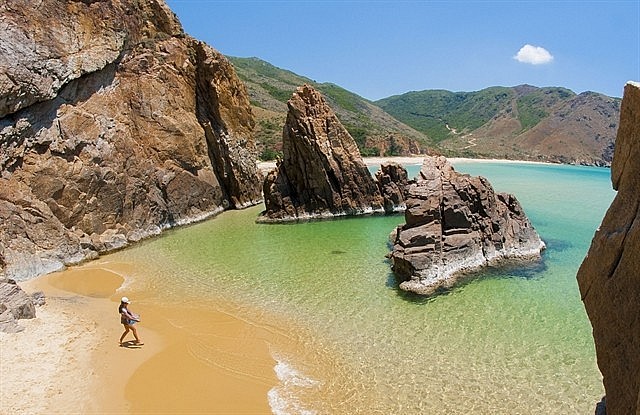 |
| Ky Co beach is currently one of the "hottest" tourist destinations, chosen by many visitors to explore during their holidays with family and friends. (Photo: vietnamtourism.gov.vn) |
Quy Nhon is home to other beautiful sightseeing locations such as Kho and Xanh Islands, Ghenh Rang Tien Sa tourist area, Vijaya Citadel, Queen Beach and Eo Gio Strait.
In Quy Nhon, local specialties such as fish cake noodle soup, rice vermicelli with pork intestines porridge and fresh seafood are top choice of not only locals but also visitors.
The weather is pleasant year-round in Quy Nhon with the daytime temperatures range from 22°C to 28°C. It is with mostly sunny days and little rain, ideal for sightseeing, swimming, and water sports. From June to August, temperatures reach a peak of 34°C, and this is the busiest season for domestic tourists while Lonely Planet recommended but the best time for foreigners is from December to April.
Other places in Lonely Planet's lists included Jeju (the Republic of Korea), Cadiz (Spain), Sardinia (Italy), Quezteltenango (Guatemala), Jaffna (Sri Lanka), Utrecht (the Netherlands), Cartagena (Colombia), and Siem Reap (Cambodia).
Citizen protection measures rolled out following bar fire in Switzerland
Vietnamese authorities have moved swiftly to implement citizen protection measures following a major fire that broke out at a bar in Switzerland, causing multiple casualties.
The Vietnamese Embassy in Switzerland has placed its citizen protection hotline on emergency standby and announced a contact number, +41 78 704 7887, to receive information and provide assistance to relatives and members of the Vietnamese community affected by the incident.
The blaze broke out on New Year’s Day (January 1, Switzerland time) at Le Constellation bar in the Crans-Montana ski resort in the canton of Valais.
Immediately after receiving information about the incident, the Vietnamese Embassy in Switzerland proactively contacted the Swiss Federal Department of Foreign Affairs (FDFA/EDA), requesting the earliest possible updates on the identities of the victims, particularly whether any Vietnamese nationals were among those killed, injured or missing.
As of now, Swiss authorities have not reported any Vietnamese nationals among the victims. Identification efforts are still ongoing, and the full list of victims has yet to be officially released.
The embassy continues to closely monitor developments and maintain regular contact with the Swiss Ministry of Foreign Affairs and the authorities of the canton of Valais. It has also advised the community to remain calm and follow official updates from the authorities and diplomatic missions, cited VNA.
 |
| The scene of the fire at Le Constellation bar in the Crans-Montana ski resort in the canton of Valais (Photo published by VNA) |
Local journal Le Temps reported that together with facilities in Lausanne, Lausanne University Hospital is currently treating 22 victims suffering from severe burns. Patients were transported by helicopter and are being cared for at the hospital’s burn treatment center as well as adult and paediatric intensive care units.
All patients are receiving treatment, and additional transfers from other hospitals remain possible. Meanwhile, injured victims have also been taken to Zurich for treatment. The Keystone-ATS news agency cited a spokesperson of Zurich University Hospital as confirming that more than 10 victims from the Crans-Montana fire are currently being treated there.
The same day, broadcaster RTS released a video featuring testimony from an eyewitness who observed the incident from outside the bar.
Alexis Laguerre, 18, recounted the moment the fire broke out.
“Suddenly, smoke started to rise. I called the police and while I was on the phone, there was an explosion and flames erupted. We saw people running outside. It was horrifying,” he said.
The witness added that people inside the bar attempted to smash windows with chairs before emergency services arrived, cordoned off the area and launched rescue operations.
Authorities in the canton of Vaud extended condolences to the victims’ families, noting that medical facilities in the canton had mobilised to treat numerous patients. Mobile medical units and psychological support teams were also dispatched to the scene. Swiss President Guy Parmelin cancelled his New Year address and travelled to the site to oversee rescue efforts and the investigation into the cause of the fire.
Cold air intensifies, mountain temperatures fall below 7°C
A reinforced cold air mass has affected most of northern Vietnam as of January 2, bringing widespread rain and thunderstorms in parts of the Northeast and causing temperatures to drop by 3–5°C, according to the National Centre for Hydro-Meteorological Forecasting.
Over the next 24–48 hours, the cold air is expected to continue spreading across the Northeastern region before affecting the Northwestern, North-central and parts of South-central regions. Inland areas will experience northeasterly winds at 12-19km/h, increasing to 20-38km/h in coastal regions, with gusts up 39-51km/h.
Northern and North-central regions will turn cold, with mountainous areas experiencing severe cold, and some high-altitude locations potentially facing hazardous cold conditions.
Minimum temperatures across northern Vietnam are forecast to range from 11–14°C, dropping to 8–11°C in mountainous areas and below 7°C in high mountain regions. Frost may occur in highland areas.
The capital city of Hanoi is expected to experience rain and colder weather, with minimum temperatures ranging between 12–14°C.
Thanh Hoa and Nghe An provinces are forecast to see scattered showers and thunderstorms, with risks of lightning, hail and strong gusts, VOV reported.
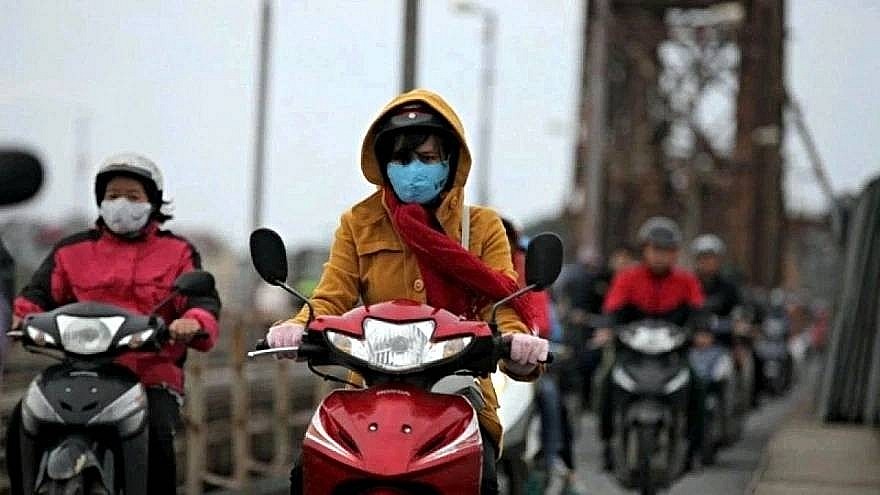 |
| The ongoing strong cold air mass is sweeping across the North and moving further toward the South, causing temperatures to drop by 3–5°C. |
From Ha Tinh to Da Nang, as well as eastern areas from Quang Ngai to Dak Lak, rain and thunderstorms are anticipated overnight and early morning, with localized heavy rainfall. Other regions may see isolated showers in the evening and at night, while daytime conditions remain mostly sunny.
Cold air is also spreading southward, bringing cooler mornings to Southern Vietnam. In Ho Chi Minh City, minimum temperatures during the first days of 2026 are expected to range from 20–21°C, dropping to around 19°C in northeastern suburban areas such as Hoc Mon and Cu Chi. Daytime highs will range from 30–32°C.
Meteorologists have advised residents, especially in mountainous and coastal areas, to closely monitor weather developments and take necessary precautions to protect health, property and maritime activities.
 | Vietnam News Today (Dec. 28): Official Calls for Stronger Vietnam – RoK Economic, Locality-to-Locality Links Vietnam News Today (Dec. 28): Official calls for stronger Vietnam – RoK economic, locality-to-locality links; Vietnam calls for stronger information cooperation with Russia; Vietnam boasts ... |
 | Vietnam News Today (Dec. 29): Vietnam, Laos Strengthen Cooperation in Border Management, Development Vietnam News Today (Dec. 29): Vietnam, Laos strengthen cooperation in border management, development; Vietnam-France friendship association marks 70 years of people-to-people ties; New bridge inaugurated ... |