| Vietnam News Today (July 31) notable headlines Cambodian scholar spotlights strategic messages of traditional friendship with Vietnam Vietnam, Southeast Asia Semiconductor Association deepen semiconductor cooperation Vietnam joins APEC economies to accelerate digital transformation for MSMEs Hanoi among world's top 10 most attractive cities for street food Vietnam aims to become highly developed socialist country by 2130 US Navy Carrier Strike Group visits Da Nang Party General Secretary and State President receives Korean minister India officially opens market to Vietnamese fresh durian Phu Quoc International Airport sees 44% rise in takeoffs, landings |
Cambodian scholar spotlights strategic messages of traditional friendship with Vietnam
Assoc. Prof. Dr. Neak Chandarith, Director of the Institute for International Studies and Public Policy (IISPP) at the Royal University of Phnom Penh (RUPP) has spotlighted three important strategic messages to the global and regional community following the July 27–29 Vietnam visit by President of the Cambodian National Assembly (NA) Samdech Maha Rathsapheathika Thipadei Khuon Sudary.
Talking with the Vietnam News Agency (VNA) reporters based in Phnom Penh, Chandarith said the first and most important message is political stability and confidence in institutional structures. In an increasingly unpredictable and fragmented world marked by geopolitical divisions, the visit made clear that Cambodia–Vietnam friendship is not a relationship of convenience but a strategic pillar systematically entrenched through the two countries’ legislatures, reported VNA.
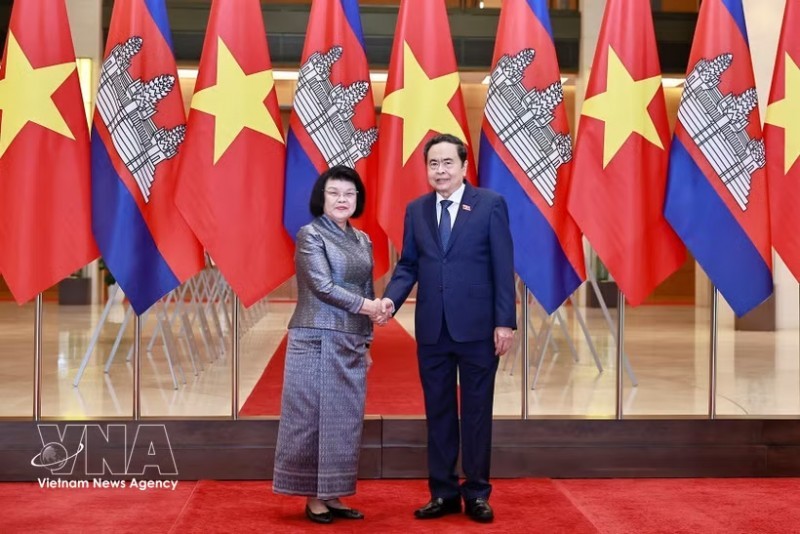 |
| NA Chairman Tran Thanh Man (R) meets with President of Cambodian NA Samdech Maha Rathsapheathika Thipadei Khuon Sudary in Hanoi on July 28. (Photo: VNA) |
Leaders from both sides have demonstrated consistent political will to turn the motto of good neighbourliness, traditional friendship, comprehensive cooperation and long-term sustainability into concrete results, based on the principles of respect for sovereignty and territorial integrity and non-interference in each other’s internal affairs, he said.
The second message, Chandarith said, revolves around multilateral coordination and ASEAN centrality. At global and regional forums such as the Inter-Parliamentary Union (IPU), the ASEAN Inter-Parliamentary Assembly (AIPA) and the Asia-Pacific Parliamentary Forum (APF), the visit affirmed both nations’ determination to become “strategic partners”.
As neighbouring Southeast Asian countries, Cambodia and Vietnam understand the value of maintaining peace and stability and developing a closely interconnected system. Mutual support and aligned diplomatic stances not only serve bilateral interests but also make considerable contributions to preserving ASEAN solidarity, safeguarding its centrality and preventing the region from being pulled into competing great-power blocs. He stressed the need for countries to maintain and strengthen strategic autonomy in the face of external interference.
Finally, he said the visit conveys a message of proactive response to global challenges. The two legislatures cooperate not only in bilateral issues but also in transnational threats such as cybercrime, non-traditional security risks, climate change and green economic development. These efforts, he noted, demonstrate that Cambodia–Vietnam relations are based on friendship, equal cooperation, and a forward-looking vision.
Dr. Chheang Vannarith, Deputy Secretary-General and Chairman of the Advisory Council of the Cambodian NA, said mutual understanding and trust between the two countries represent a profound and distinctive political strategy. However, he warned that the two sides still need to continue turning political trust into concrete outcomes for citizens through specific development projects and mutual backing on the global stage.
Vannarith told the VNA that at global and regional forums, leaders of the Vietnamese and Cambodian legislatures regularly hold bilateral meetings and share views on international issues, with a view to advancing peace, stability and common development.
Citing the upcoming bilateral engagement between the two NA leaders in November on the sidelines of the 47th AIPA General Assembly in the Philippines, Vannarith explained that political trust is paramount and maintaining it requires frequent meetings, both as friends and partners sharing strategic political trust.
He stressed that Cambodia and Vietnam enjoy a high level of political trust of a special nature, but what must now be pursued further is delivering tangible benefits to their people. To achieve more concrete results, he said, the two countries should support each other through a range of joint development projects.
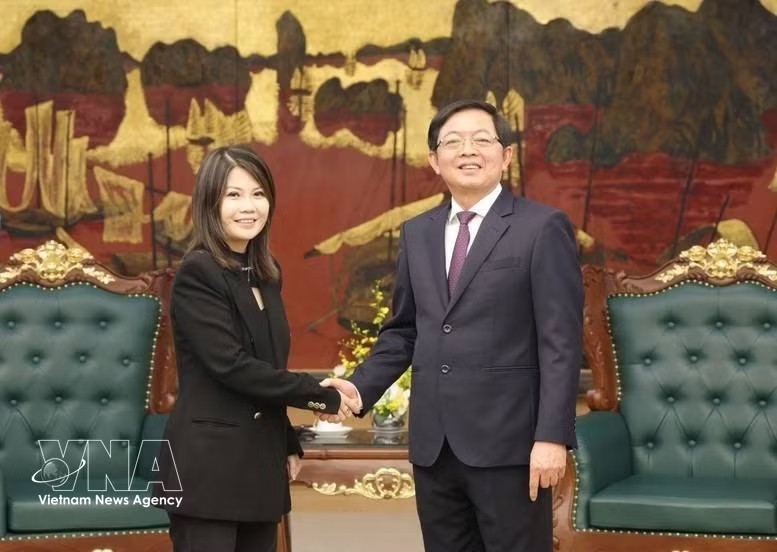 |
| Deputy Prime Minister Ho Quoc Dung (right) receives Linda Tan, President of the Southeast Asia Semiconductor Association. (Photo: VNA) |
Vietnam, Southeast Asia Semiconductor Association deepen semiconductor cooperation
Welcoming the SEMI Southeast Asia delegation, Deputy Prime Minister Ho Quoc Dung commended the association and its members for supporting Vietnamese ministries and agencies in advancing cooperation in science, technology, innovation and digital transformation, which he described as key drivers of the country's next phase of economic growth.
Deputy Prime Minister Ho Quoc Dung held a meeting in Hanoi on July 30 with Linda Tan, President of the Southeast Asia Semiconductor Association (SEMI Southeast Asia), and representatives of its member companies to discuss expanding cooperation in developing Vietnam's semiconductor industry and strengthening its integration into regional and global supply chains.
Welcoming the SEMI Southeast Asia delegation, the Deputy PM commended the association and its members for supporting Vietnamese ministries and agencies in advancing cooperation in science, technology, innovation and digital transformation, which he described as key drivers of the country's next phase of economic growth.
Deputy PM Dung said Vietnam aims to sustain double-digit economic growth between 2026 and 2045 as it strives to become a high-income country. To achieve this goal, the Government has identified science, technology, innovation and digital transformation as strategic priorities underpinning a new growth model, cited VNA.
He highlighted the semiconductor industry as one of Vietnam's priority sectors, expressing his hope that SEMI Southeast Asia would continue serving as a bridge between Vietnam and the global semiconductor business community.
The Deputy PM encouraged the association to connect its members with investment opportunities in Vietnam, expand partnerships with local enterprises, and provide policy advice and technical expertise to help Vietnam participate more actively in activities of the association as well as in regional and global semiconductor ecosystems.
He expressed his hope that SEMI Southeast Asia will promote Vietnam's investment environment to its more than 3,000 member companies and international partners, helping attract high-quality semiconductor investment projects. The Deputy PM stressed that cooperation in developing a highly skilled workforce, particularly semiconductor engineers, would be critical to supporting the industry's long-term growth.
He assigned the Ministry of Finance to work closely with SEMI Southeast Asia in preparing future cooperation programmes aimed at improving investment promotion efforts and attracting more investors in the semiconductor and innovation ecosystems.
Linda Tan reaffirmed SEMI Southeast Asia's commitment to supporting Vietnam's vision for building a globally competitive semiconductor industry. She said the Government's development strategy and the participation of relevant ministries at the meeting had given member companies a clearer understanding of Vietnam's priorities, needs and long-term commitment to the sector.
She thanked Vietnam's Ministry of Finance and National Innovation Centre for their coordination with SEMI Southeast Asia, which has contributed to the growth of the SEMI Expo into an important platform linking Vietnam with the global semiconductor ecosystem.
According to Tan, SEMI SEA will continue connecting Vietnam with the international semiconductor community, while its member companies remain committed to long-term cooperation and are ready to identify areas where they can further support the country's semiconductor development.
Also at the meeting, Dutch Deputy Ambassador to Vietnam Rick Slettenhaar praised the growing Vietnam–Netherlands partnership in the semiconductor sector. He noted that as a key player in the global semiconductor value chain, the Netherlands welcomes the increasing number of international semiconductor companies choosing Vietnam as an investment destination.
He said the Netherlands wishes to continue working with the Vietnamese Government to ensure that semiconductor incentive policies are implemented in a transparent, stable and predictable manner, thereby strengthening investor confidence among Dutch businesses.
Vietnam joins APEC economies to accelerate digital transformation for MSMEs
Vietnam and other APEC economies are stepping up cooperation to accelerate digital transformation for micro, small, and medium-sized enterprises (MSMEs) amid the rise of artificial intelligence, heard a workshop in Hanoi on July 30.
The two-day event themed “Empowering MSMEs through digital transformation in the AI-driven World”, co-organized by the APEC 2027 National Secretariat under the Ministry of Foreign Affairs and the Agency for Enterprise Development under the Ministry of Finance, is a Vietnamese initiative within the APEC Working Group on Small and Medium Enterprises. It aims to augment regional digital cooperation and innovation while laying the groundwork for APEC Vietnam 2027.
The workshop gathered nearly 150 delegates from APEC member economies, the International APEC Secretariat, international organizations such as the World Bank, the IMF, the OECD, the ADB, and UN Women, major tech corporations like Google, Meta, Toshiba, and CMC, as well as research institutes and the private sector.
Delivering the opening remarks, Deputy Foreign Minister and Head of the APEC 2027 National Secretariat Nguyen Minh Vu noted that MSMEs form the backbone of growth, innovation, and job creation, accounting for over 97% of businesses across the APEC region. As AI and digital technologies reshape the global economy, enhancing digital capacity for MSMEs is essential not only for adaptation but also for unlocking new drivers of productivity, efficiency, and competitiveness in the AI era.
Vu affirmed that for Vietnam, empowering the private sector and strengthening MSME competitiveness are strategic priorities in its new development phase, helping realize growth goals based on science, technology, innovation, and digital transformation. He expressed Vietnam's readiness to work closely with APEC economies on technology transfer, experience sharing, digital workforce development, and ecosystem building, cited VOV.
 |
| Delegates interacting with speakers at the workshop. (Photo: VNA) |
As the host of APEC 2027, Vu stated that Vietnam will continue collaborating with member economies to advance practical cooperation initiatives, creating fresh impetus for productivity growth, competitiveness, and regional economic resilience.
Trinh Thi Huong, Deputy Director of the Agency for Enterprise Development, suggested that digital transformation and AI adoption must align with the practical needs of MSMEs to spark meaningful changes in productivity, governance efficiency, and market access.
Pooling resources from international organizations and strengthening ties among APEC economies will help build a comprehensive support ecosystem for sustainable MSME growth.
Ichwan Nasution, Chair of the APEC Digital Economy Steering Group, outlined upcoming APEC priorities, including promoting digital and AI applications, enhancing digital connectivity, bridging the digital divide, and securing safe digital environments for MSMEs. He expressed confidence that policy recommendations from the workshop will shape APEC's digital economy agenda and support Vietnam's preparations for APEC 2027.
The event focuses on analyzing new trends in AI and digital transformation that are reshaping business models, supply chains, and labor markets.
Participants will share solutions and AI application models to help MSMEs join global value chains, discuss policies to build digital skills, expand access to finance and digital infrastructure, and secure ecosystems for responsible AI use.
The workshop's recommendations will be submitted to the APEC Working Group on Small and Medium Enterprises, feeding into the agenda of APEC Vietnam 2027 and highlighting Vietnam's active and responsible role in advancing regional economic cooperation.
Hanoi among world's top 10 most attractive cities for street food
Hanoi, the capital of Vietnam, has secured the 8th spot in a list of the world's top 10 cities for street food, according to a recent study by the online luggage storage platform Radical Storage.
The platform analyzed 6,897 street food establishments across 100 of the world's most visited tourist cities. Rankings were based on criteria such as the number of venues rated 4 stars or higher, culinary diversity, the proportion of affordable locations, options for vegetarian, vegan, and gluten-free diets, and establishment density per square kilometer. Vendor density and affordability carried the highest weight in the evaluation.
Paris topped the rankings with a score of 7.2 out of 10, followed by Athens and Thessaloniki in Greece. The remaining spots in the top 10 went to Barcelona, London, Rhodes, Rome, Hanoi, Budapest, and Amsterdam.
According to Radical Storage, the Vietnamese capital's appeal stems from a combination of traditional local flavors, affordable prices, and the unique experience of dining right on the streets and small alleys of the Old Quarter. The platform recommends visitors try iconic specialties such as pho (noodle soup), bun cha (grilled pork with noodles), banh mi (Vietnamese baguette), and egg coffee.
In recent years, Hanoi has consistently received high praise from international tourism organizations and travel magazines. The Michelin Guide has featured numerous Hanoi eateries, with several street food spots earning the Bib Gourmand designation for quality food at reasonable prices, VOV reported.
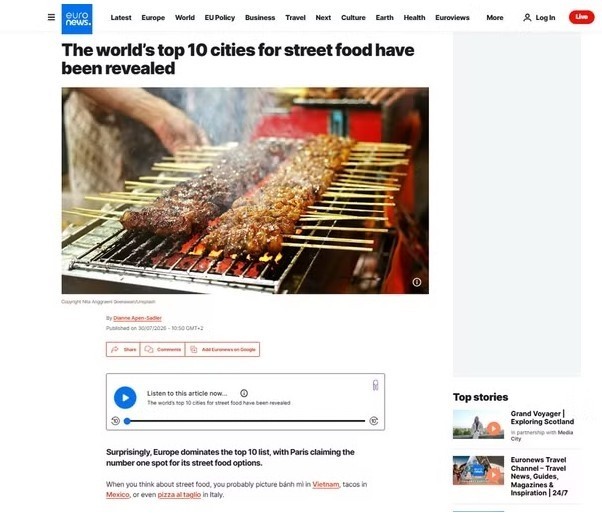 |
| Photo posted on euronews.com on July 30, 2026. (Photo: VNA) |
Additionally, the travel platform Tripadvisor has repeatedly honored Hanoi in its Travelers' Choice Best of the Best awards, recognizing it as one of the world's top culinary destinations. TasteAtlas also frequently ranks Vietnamese dishes such as pho, banh mi, and bun cha among the world's finest.
With its rich variety of dishes, distinct flavors, and affordable prices, street food has long been one of Hanoi's signature tourism products, helping to promote the capital's image and attract an increasing number of international visitors.
Vietnam aims to become highly developed socialist country by 2130
The Party Central Committee has set the vision that by 2130, Vietnam will become a highly developed socialist nation, according to Chairman of the Central Policy and Strategy Commission Nguyen Thanh Nghi.
Nguyen made the announcement on July 29 in Ha Noi at a national conference to disseminate the key contents of Resolution No. 19-NQ/TW on renewing the national development model.
By 2035, Vietnam aims to have basically completed the transition to a resilient, innovative, humane, sustainable, and integrated development model, with all component models established in a synchronized manner.
These include a high-performance, innovative, green, self-reliant, inclusive, and internationally integrated economic model; a modern, comprehensive, inclusive, and sustainable social development model; a comprehensive, modern, innovative, culturally distinctive, and humane model of cultural and human development; a modern, smart, sustainable, and climate-resilient ecological development model; a modern, self-reliant, smart, dual-use, and adaptive all-people national defense model; a comprehensive, proactive, modern, and smart national security model; a proactive, comprehensive, effective, identity-based, and development-oriented model of foreign affairs and international integration; and a democratic, modern, smart, transparent, effective, and efficient model of national governance.
By 2045, Vietnam is expected to become a developed, high-income country firmly advancing toward socialism. The national economy will be driven by knowledge, science, technology, innovation, green growth, the circular economy, strategic self-reliance, and deep international integration, while mastering key strategic technologies.
Vietnam targets to build an orderly, safe, civilized, harmonious, and prosperous society. Culture and people will serve as the country's intrinsic strength, soft power, and foundation for national development, VGP reported.
The ecological environment will be sustainable, while national defense and security will be modern and self-reliant. Foreign affairs and international integration will be proactive and effective, contributing to the country's stature and prestige while making meaningful contributions to global peace, sustainable development, and the common progress of humanity.
Looking ahead to 2130, Vietnam is envisioned to become a highly developed socialist nation that is civilized, modern, culturally distinctive, innovative, and endowed with enduring vitality. Vietnam will rank among Asia's leading green and innovation-driven economies and serve as one of the region's foremost smart manufacturing hubs.
Under this long-term vision, Vietnam will hold an important position in the global order in terms of knowledge, technology, the economy, national defense, and security. It will be a civilized, prosperous, equitable, inclusive, and happy society, with a strong cultural identity and well-rounded human development, fully capable of adapting to change and making meaningful contributions to humanity.

 Vietnam News Today (July 26): Vietnam, Bloomberg Seek Deeper Ties to Boost Financial Market Development
 Vietnam News Today (July 27): Political Trust Drives Vietnam-Cambodia Partnership Forward