
Vietnam News Today (Mar. 13): Preparations For Polling Day Completed on Schedule
 | Vietnam News Today (Mar. 10): Defense Minister Highlights Enduring Friendship with Cambodia |
| Vietnam News Today (Mar. 11): Vietnam and China Defense Ministers to Meet at Border Exchange |
| Vietnam News Today (Mar. 13) notable headlines: Preparations for polling day completed on schedule; Prime Minister calls for greater self-reliance in developing defence industry; Contest promotes Vietnam–Japan cultural exchange through tourism ideas; Vietnam, Saint Petersburg step up people-to-people exchanges; Vietnam, India promote maritime security cooperation through blue economy development; Vinh Long courts Korean investment in key sectors; Vietnam’s first peacekeeping training course gains UN certification; UOB remains upbeat on Vietnam’s economic outlook despite global uncertainty; Digital platform on overseas market development launched; Quang Tri tightens fishing fleet management ahead of EC inspection; Relic site receives valuable documentary photographs of President Ho Chi Minh; Vietnam to participate in Venice Art Biennale with its own pavilion; Vietnam Airlines adds nearly 1,000 seats on Europe routes. |
Preparations for polling day completed on schedule: Official
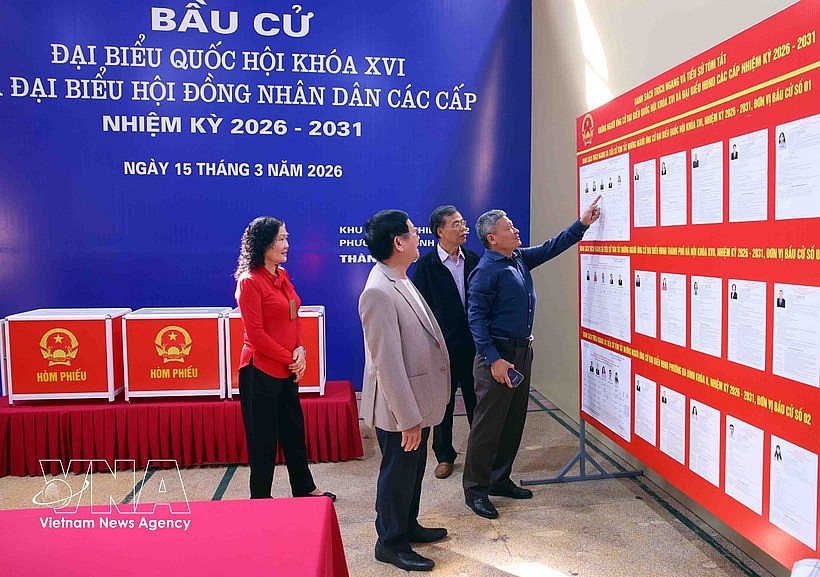 |
| Voters study information of candidates before the polling day. (Photo: VNA) |
Preparations for the election of deputies to the 16th National Assembly (NA) and People’s Councils at all levels for the 2026–2031 tenure have been basically completed in accordance with schedule and legal regulations, officials said at a press conference held in Hanoi on March 12.
The event was chaired by NA Vice Chairwoman Nguyen Thi Thanh, who is also a member of the National Election Council (NEC).
Thanh said only 68 hours and 40 minutes left before the polling begins. The election follows the 14th National Party Congress and coincides with the 80th anniversary of Vietnam’s first general election.
She described the election as a particularly important political event enabling voters nationwide to exercise democratic rights by selecting qualified representatives who reflect the people’s will and aspirations, while contributing to strengthening the socialist rule-of-law State, national unity, and public trust.
Agencies across the political system have actively implemented preparations in a comprehensive, democratic, lawful, safe, and cost-effective manner. Communication activities have been widely carried out, helping to create a positive public atmosphere ahead of the polling day, she added.
Preparations largely finalised
Presenting a summary report, Ta Thi Yen, Vice Chairwoman of the NA’s Committee for Deputy Affairs and Standing Deputy Chief of the NEC’s Office, said preparations have been carried out synchronously and strictly nationwide, with many tasks completed ahead of statutory deadlines.
At the central level, the NEC organised two nationwide online conferences on election implementation, two training sessions on election software, and four working sessions to direct preparations. All 27 guiding documents assigned to relevant agencies have been issued.
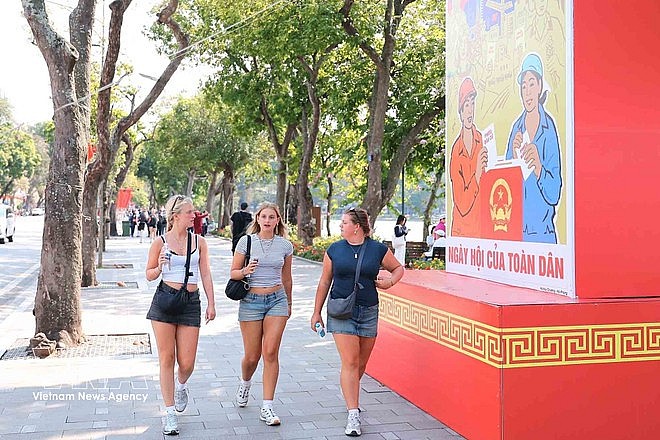 |
| Hanoi streets are decorated with banners on the general election. (Photo: VNA) |
The council and its subcommittees also released 31 resolutions, eight plans, and 46 guiding and explanatory documents to promptly address emerging issues, including early voting arrangements.
Inspections conducted across 34 provinces and cities showed strong coordination throughout the political system, with local authorities issuing 6,636 directives related to election preparations. Election bodies were established in full compliance with legal requirements regarding structure, composition, and timelines.
Nationwide, authorities have set up 34 provincial election committees, 3,320 commune-level election committees, 182 election boards for NA deputies, 724 boards for provincial People’s Councils, 22,401 boards for commune-level People’s Councils, and 72,191 polling teams.
Regarding personnel, Yen affirmed that candidate preparations were conducted carefully to ensure appropriate representation structures. A total of 864 candidates are running for 500 NA seats, averaging 1.73 candidates per seat, including four self-nominated candidates. Female candidates account for 45.37%, candidates under 40 years old make up 21.64%, ethnic minority candidates 21.76%, non-Party members 7.41%, and incumbent deputies seeking re-election 27.31%.
For provincial People’s Councils, 4,217 candidates are competing for 2,552 seats, while 120,873 candidates are contesting 72,611 commune-level People's Council seats, maintaining candidate-to-seat ratios in accordance with the law.
As of March 10, the country recorded 78,928,647 eligible voters who will cast ballots at 72,195 polling stations. Voter lists have been publicly posted since February 3 for verification and will continue to be updated until 24 hours before the polling begins.
Following the announcement of official candidate lists, localities organised voter meetings for candidates to present their action programmes, while competent forces implemented nationwide plans to ensure security and public order during the election.
The NEC has approved early voting at 217 polling stations in 11 provinces and centrally run cities. As of March 12, early voting had taken place at 34 polling stations in four localities - An Giang, Khanh Hoa, and Ho Chi Minh City - in compliance with the legal regulations.
“Up to now, preparations for the March 15 election have been basically completed on schedule and in accordance with the law. With thorough preparations and strong public engagement, the polling day is expected to truly become a nationwide festival of all people conducted democratically, safely, lawfully, and successfully,” Yen stressed.
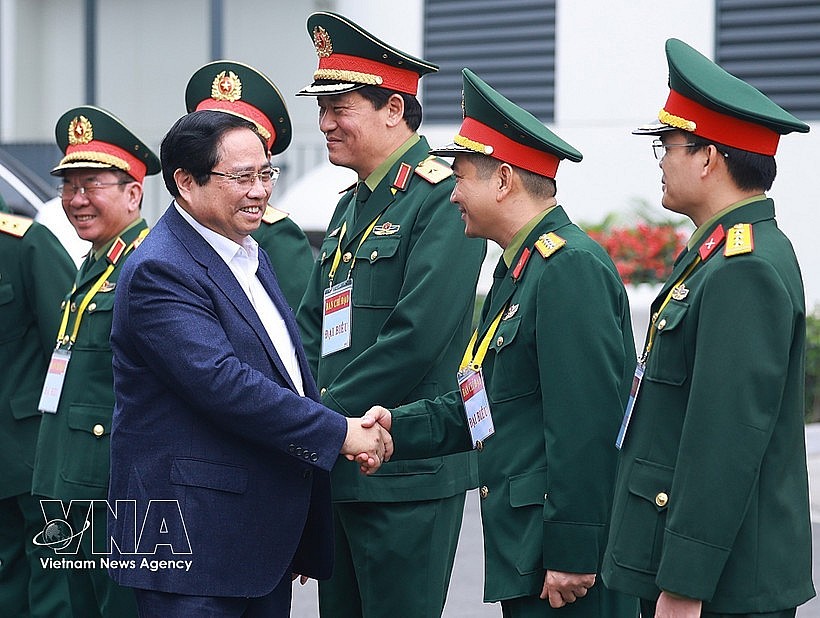 |
| Prime Minister Pham Minh Chinh meets with leaders of the Viettel Military Industry and Telecoms Group. (Photo: VNA) |
Prime Minister calls for greater self-reliance in developing defence industry
Prime Minister Pham Minh Chinh on March 12 chaired a working session with the Ministry of National Defence on the development of the defence industry during which he highlighted the importance of strengthening internal capacity, self-reliance, self-strengthening and strategic autonomy in this work.
PM Chinh commended the army for their outstanding achievements in developing the national defence industry over the past time, which, he said, have contributed to strengthening the country’s self-reliance and accelerating the building of a revolutionary, regular, elite and modern Vietnam People’s Army.
Analysing the evolving situation and future tasks, the Prime Minister urged the military to continue effectively implementing the mission of building and modernising the army, including the development of the defence industry in line with the Resolution of the 14th National Party Congress, resolutions of the Party as well as directions of the Central Military Commission and Party General Secretary To Lam.
The PM called on relevant agencies to enhance forecasting and strategic advisory work for the Party and State on military, defence and defence industry matters in order to flexibly and effectively respond to any emerging situations, according to VNA.
He also urged stronger efforts in science and technology development, innovation and digital transformation to achieve breakthroughs and master key technologies in designing, manufacturing, producing, repairing, upgrading and modernising weapons.
In addition, the Government leader called for effective implementation of major defence industry programmes and projects, particularly those involving high-tech products; improving human resources quality through training and capacity building; and strengthening the integration of defence development with socio-economic growth, including the promotion of dual-use products that serve both defence needs and civilian life.
Under the close and coordinated leadership of the Party, State, Central Military Commission and the Ministry of National Defence, Vietnam’s defence industry has made remarkable progress in the 2021–2025 term, contributing significantly to the country’s overall development. The sector has recorded important achievements in innovation and technology advancement, marking breakthroughs in research, design and production capabilities, as well as in the modernisation of a wide range of weapons and equipment bearing Vietnamese brands.
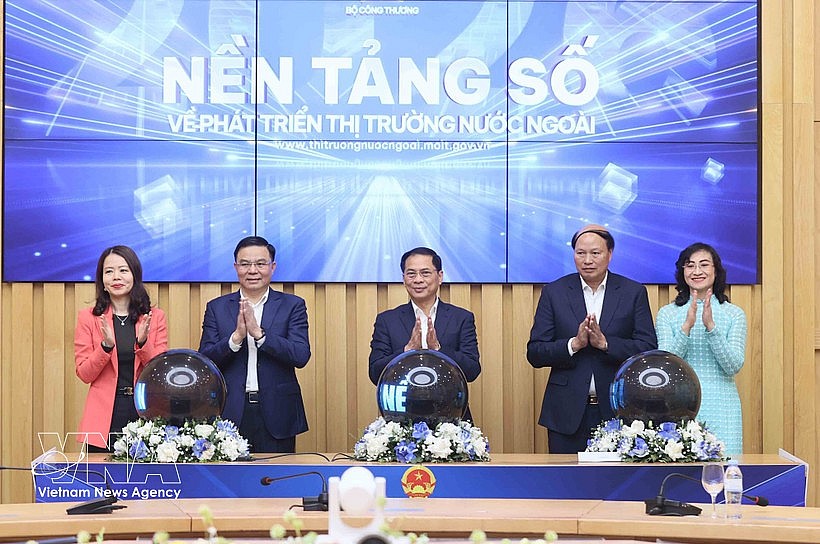 |
| Delegates at the launching ceremony (Photo: VNA) |
Digital platform on overseas market development launched
The Ministry of Industry and Trade (MoIT) on March 12 launched a digital platform on overseas market development, with Deputy Prime Minister Bui Thanh Son attending and delivering a keynote address.
Son affirmed that building an integrated digital platform connecting information from Vietnam’s trade offices abroad, domestic regulatory agencies and the business community is a timely and appropriate move that should be implemented decisively, systematically and effectively.
He stressed that the platform should pursue three major objectives. First, it is expected to enhance the quality of management and governance in international trade. By collecting, analysing and sharing real-time data, the system will enable authorities to promptly monitor market developments, forecast trade trends and identify risks and trade barriers at an early stage. This will provide an important basis for the Government, ministries and localities to make faster, more accurate and more effective policy decisions.
Second, the platform is designed to support enterprises in expanding export markets. According to the Deputy PM, one of the biggest challenges facing businesses, especially small and medium-sized enterprises, is the lack of reliable and up-to-date market information. The digital platform is expected to serve as a comprehensive “market information ecosystem”, allowing firms to access data on consumer demand, technical regulations, environmental standards, product trends and investment and trade cooperation opportunities in specific markets.
With Vietnam’s network of 64 trade offices overseas, he noted that connecting them through a modern digital platform could help establish a unified national trade information system that operates efficiently, transparently and with strong forecasting capacity. Such a system would not only improve trade promotion effectiveness but also contribute to investment attraction, supply chain connectivity and deeper international economic integration.
Son requested the MoIT to continue refining the platform to make it more modern and user-friendly, while ensuring connectivity, data sharing and cybersecurity. He also urged stronger application of new technologies such as artificial intelligence (AI), big data analytics and cloud computing to improve forecasting and decision-making support.
At the event, Deputy Minister of Industry and Trade Phan Thi Thang said the platform represents an important step in reforming governance methods and applying digital technologies to market development and international economic integration. She noted that the initiative helps implement the Party and Government's key resolutions on breakthroughs in science and technology, innovation and national digital transformation.
When operated effectively, the platform is expected to provide practical benefits for businesses, local authorities and policymakers by improving access to global market information, reducing information search costs and enhancing the quality of trade policy analysis and management amid rapidly changing global trade dynamics.
To maximise its effectiveness, relevant agencies, localities, industry associations and enterprises were encouraged to actively participate in data sharing and utilisation, thereby turning the platform into a dynamic ecosystem for cooperation and market expansion.
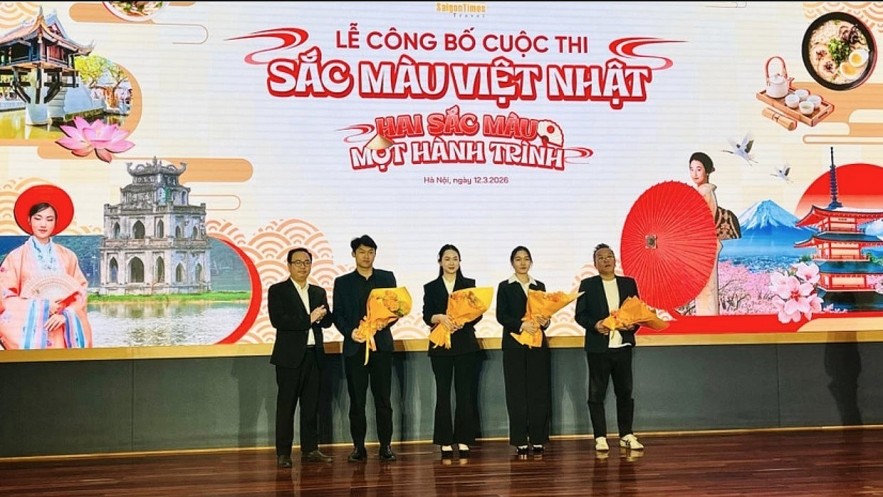 |
| Vietnam–Japan Colours organisers present flowers to members of the juding panel. (Photo: Saigontimes Travel) |
Contest promotes Vietnam - Japan cultural exchange through tourism ideas
The contest, themed “Two Colours – One Journey,” runs from March 12 to April 25 and includes four competition rounds, with total prizes worth more than VND500 million. The programme was announced on March 12 by Saigontimes Travel. According to the organisers, the contest is to help young people better understand national cultural values and develop innovative tourism promotion ideas from the perspective of the younger generation.
Through a combination of research, presentations and cultural experiences, participating teams will transform their understanding of local lifestyles, cultural identity and Vietnam–Japan cultural exchange into creative tourism concepts. The competition is open to students from universities and colleges across Vietnam, who will participate in teams of three to five members.
According to VOV, the judging panel will include representatives from Saigontimes Travel, lecturers from leading tourism universities and colleges in Vietnam, as well as tourism experts and KOLs.
Entries will be evaluated based on content quality, creativity, practicality and communication effectiveness. Beyond the official prizes, the top 50 teams will receive travel vouchers worth VND2 million per member for tours to Japan provided by Saigontimes Travel, valid between April and June 2026.
In addition to the competition, several side events will be organised to enhance cultural experiences for participants and visitors. These include cultural exhibition spaces, cultural exchange performances such as Áo dài (traditional Vietnamese dress) and Yukata fashion shows, traditional musical performances, and exhibition booths from companies involved in tourism, overseas study and student exchange programmes.
The organisers hoped the contest would become an annual event, generating new ideas for tourism promotion from the perspectives of young people in both countries. Through the programme, they also aim to build a network of students interested in tourism and international exchange, contributing innovative ideas to support the future development of the industry.
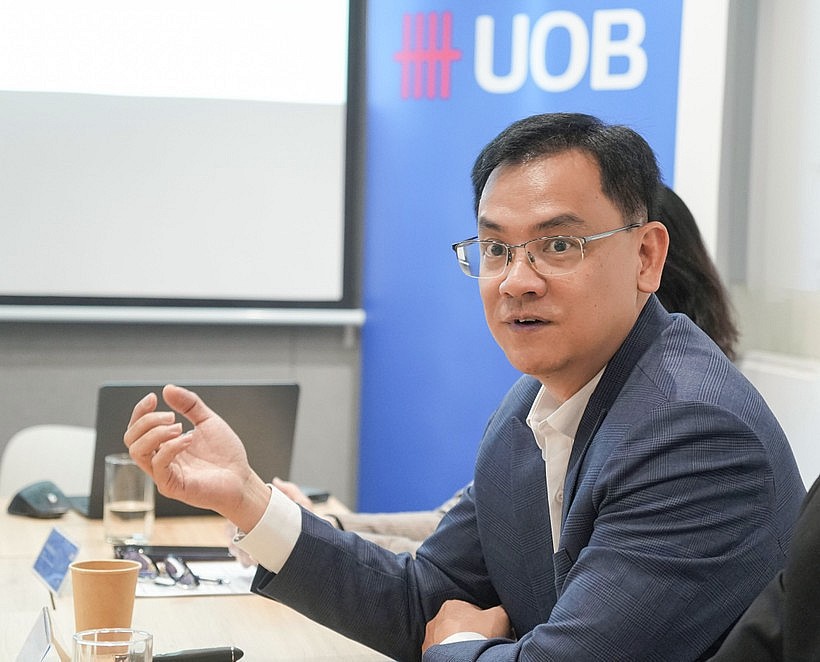 |
| Dinh Duc Quang, Managing Director of the Currency Business Division at UOB Vietnam (Photo: The Courtesy of UOB Vietnam) |
UOB remains upbeat on Vietnam’s economic outlook despite global uncertainty
Vietnam’s economic prospects for 2026 remain positive thanks to stable macroeconomic fundamentals and strong domestic growth drivers although global geopolitical tensions and trade policy shifts may pose new risks, analysts at United Overseas Bank (UOB) said in a recent report.
In its latest update on global and regional economic prospects, the Singapore-based bank noted that the world economy is likely to remain volatile in 2026 as geopolitical conflicts and policy changes continue to shape global markets.
Proposals related to new US tariffs are increasing risks to global trade, while geopolitical tensions in the Middle East, particularly conflicts involving the US, Israel, and Iran, are making energy and commodity markets more sensitive to political developments.
The Executive Director in Global Economics and Markets Research at UOB, Suan Teck Kin, said evolving US tariff policies and escalating tensions in the Middle East are key factors affecting economic stability in Asia.
An escalation of conflict in the Middle East and risks to the Strait of Hormuz have become key macroeconomic threats to Asia, mainly through higher oil prices, rising inflationary pressures, weaker domestic currencies, and deteriorating market sentiment, he said.
Despite these challenges, UOB has maintained its growth and inflation forecasts for most Asian economies, including Vietnam. It acknowledged downside risks to growth and upside risks to inflation.
The bank noted that Vietnam entered 2026 on a solid footing after posting economic growth of 8.02% in 2025, reflecting a strong rebound in manufacturing, exports, and domestic consumption.
On that basis, UOB maintained its forecast for Vietnam’s gross domestic product (GDP) growth at 7.5% in 2026, with first-quarter growth projected at around 7%.
Key growth drivers are expected to include the Government’s commitment to accelerating infrastructure investment, continued expansion of export-oriented manufacturing, and sustained inflows of foreign direct investment (FDI).
However, external uncertainty could still affect the outlook. A proposed global tariff of 10% by the US could impact trade flows and supply chains, while fluctuations in energy prices driven by geopolitical tensions may raise production and logistics costs.
Commenting on the potential impact of Middle East tensions on domestic fuel prices, Dinh Duc Quang, Managing Director of the Currency Business Division at UOB Vietnam, said the conflict remains a major factor influencing global oil prices, which in turn affects domestic fuel costs, an important input for manufacturing, transport, and other sectors.
Nevertheless, he noted that Vietnam has been working to diversify its energy supply sources in recent years and, at the same time, enhance energy self-sufficiency through exploiting crude oil, expanding domestic refining capacity, and accelerating the transition to renewable energy such as solar and wind power. These measures could help mitigate the impact of global fuel price volatility.
Regarding the monetary policy, UOB expects the State Bank of Vietnam to keep the refinancing rate unchanged at 4.5% as economic growth remains resilient and inflation is under control.
Vietnam’s inflation eased to 2.53% year-on-year in January 2026, down from 3.48% in December 2025 and lower than the market forecast of 3.1%, with price increases mainly driven by food, housing, and education.
Meanwhile, oil prices may rise in the short term due to tensions in the Middle East. Under UOB’s baseline scenario, Brent crude could climb to around 90 USD per barrel in the second quarter of 2026 before easing to about 80 USD by the end of the year.
Drawing from the experience of 2022, when oil prices surged to 128 USD per barrel following the Russia – Ukraine conflict, UOB estimates that every 10 USD increase in Brent crude could push Vietnam’s consumer price index (CPI) up by 0.3–0.4 percentage points after a lag of two to three months, while reducing GDP growth by about 0.6–0.9 percentage points over the following two to four quarters.
On the currency market, the Vietnamese dong has given up some of its early-year gains amid rising geopolitical tensions, with the USD/VND exchange rate rebounding to around 26,200 VND per USD in early March.
While global risk aversion may continue to pressure the Vietnamese dong in the near term, UOB expects its medium-term outlook to remain stable, supported by strong economic fundamentals, robust FDI inflows, and the possibility of Vietnam being upgraded to emerging market status later this year.
The bank forecasts the USD/VND exchange rate to fluctuate within a range of about 2–3% in 2026, reaching around 26,400 VND per USD in the second quarter, 26,200 VND in the third quarter, and easing to approximately 26,100 VND by the end of the year.
 | Vietnam News Today (Mar. 6): Vietnamese, Philippine Diplomats Hold Phone Talks Vietnam News Today (Mar. 6): Prime Minister calls for stronger Vietnam–Russia cooperation in emergency response; Vietnamese, Philippine diplomats hold phone talks; Vietnam takes Chair of ... |
 | Vietnam News Today (Mar. 8): Vietnam, Japan Expand Cooperation in Various Fields Vietnam News Today (Mar. 8): Vietnam, Japan expand cooperation in various fields; Agricultural exports rebound at Lang Son border gates after Lunar New Year; Vietnam–Japan ... |
Related Stories
 National
Vietnam News Today (July 21): Standard Chartered Raises 2026 GDP Growth Forecast for Vietnam to 9.5%
Recommended
 National
When Community Becomes an Anchor: Early Progress in Reducing HIV and TB Stigma in Champasak
 National
More Than 50 Records Provide New Leads for Identifying Fallen Soldiers
National
Vietnam News Today (July 21): Standard Chartered Raises 2026 GDP Growth Forecast for Vietnam to 9.5%
 National
Party Central Committee’s Third Meeting Opens in Hanoi
 National
Vietnam News Today (July 20): Diplomacy Opens New Pathways for Vietnam’s Development
 National
Vietnam News Today (July 18): EVFTA Supports Strong Growth in Vietnam-Nordic Trade
 National
Top Leader Calls for Better Care for Invalids, Revolutionary Contributors
 National