
Beyond the Classroom: Muong Nhe’s Teachers Help Families Escape Poverty
 | United Nations Population Fund Assists Vietnam in Poverty Reduction, Socio-economic Development |
| 40 Years of Doi Moi (Renewal): Journey from Poverty to Aspiration of National Strength |
As the sun rose above the mountain range behind Nam Po 2 village (Muong Nhe Commune, Dien Bien Province), Hang A Thao was already standing on his family’s hillside field. The Hmong man looked across the sloping land where his family planned to plant their first coffee trees, hoping they would gradually help improve their lives.
Digging holes for planting on the steep hillside had never been an easy task for a family lacking manpower. “At one point, I thought it would take us an entire month to finish,” Thao shared.
Then, on a late-May morning, the small road leading into the village became livelier than usual. Staff members, teachers, and employees of Nam Po Ethnic Boarding Primary School arrived carrying hoes and shovels to help Hang A Thao’s family dig holes for the coffee trees.
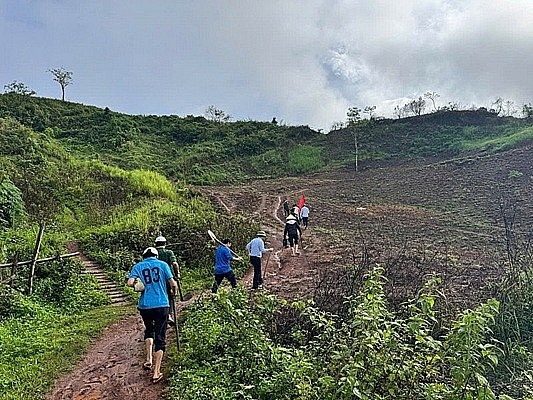 |
| The footsteps of teachers heading to the fields in the border region carried with them a spirit of connection and sharing with disadvantaged people in the country’s western frontier. (Photo: Duy Linh) |
Amid the scorching sun of the border highlands, the teachers, who are more familiar with blackboards and chalk, were covered in mud on the hillside. Some cleared weeds, others tilled the soil, while others measured the distance between each planting hole.
After only a few hours of work, the once uneven hillside gradually revealed rows of neatly arranged planting holes. Sweat soaked their shirts, and their hands turned red and sore from digging, but everyone worked hard to complete their assigned tasks.
Standing at the edge of the hillside, Hang A Thao was deeply moved as he watched the teachers working tirelessly. “The teachers helped us like family. I am very touched,” Thao said.
In addition to supporting Hang A Thao’s family in Nam Po 2 village, the school also helped the family of Sung A Dia in Huoi Ban village - another disadvantaged household in Muong Commune - during this volunteer effort. In total, 556 planting holes were dug for the two families.
According to Vu Van Nguyen, most of the school’s students are children from ethnic minority families, who face numerous hardships. Therefore, the school always prioritizes not only teaching literacy, but also supporting local people in their daily lives.
“Many families lack manpower, and reclaiming land for coffee cultivation is very difficult. When the school launched this initiative, all staff and teachers voluntarily took part with the hope of helping local people create additional livelihoods and gradually stabilize their lives. We believe that when family finances improve, students will also have better opportunities to continue their education,” said Nguyen.
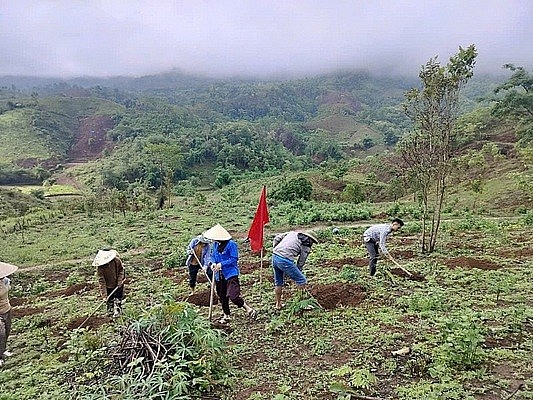 |
| Amidst the hills of the Muong Nhe border region, teachers from Nam Po Ethnic Boarding Primary School joined the locals in planting coffee, bringing hope for livelihoods in the far western part of Dien Bien. (Photo: Duy Linh) |
According to Nguyen, helping local people in the fields has become a regular activity of the school over many years. “In a border region like Muong , where many difficulties remain, the close connection between the school and the local people is extremely important. Teachers not only stand on the podium, but must also stay close to the people, understand their lives, and help them overcome hardships,” he said.
In many places, teachers are often associated only with the image of standing in the classroom. But in Nam Po, teachers also go to the fields alongside local people - tilling the soil, planting trees, and sharing the hardships of life in the highlands.
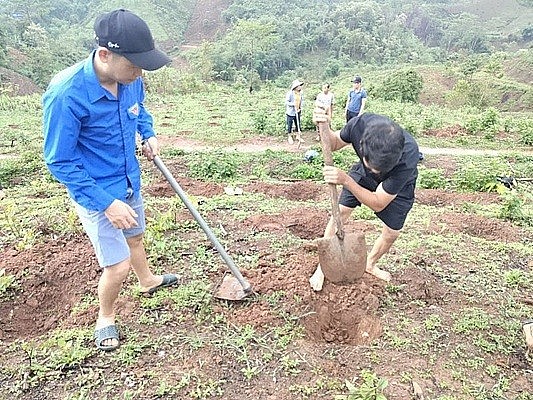 |
| People whose hands are used to holding chalks are now stained with mud from working on the hillsides of the Dien Bien border region. (Photo: Duy Linh) |
The significance of this activity lies not only in the days of labor contributed, but also in the spirit of solidarity between the school and the people in this border region, where many hardships still remain. For years, local authorities have encouraged residents to diversify crops by introducing coffee and macadamia cultivation to create more sustainable livelihoods. However, for many households, preparing the land, digging planting holes, raising seedlings, and caring for young trees remain overwhelming challenges.
Through their collective efforts, the teachers not only helped ease the heavy workload for local families, but also gave them greater confidence to embrace new economic opportunities and gradually improve their lives.
One teacher who joined the volunteer effort shared, “When parents have stable livelihoods, students will have better opportunities for education. We simply hope to contribute a small part in giving local people more motivation to improve their lives."
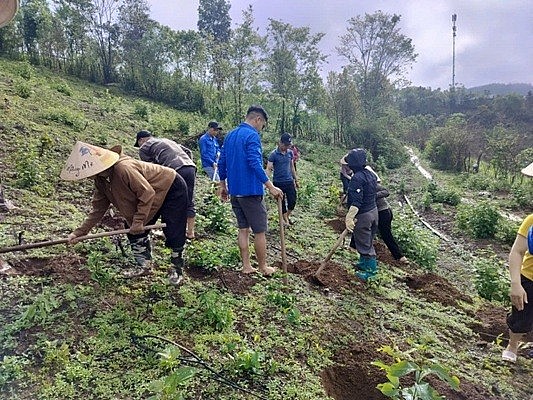 |
| The image of teachers from the highlands who went down to the fields to work alongside the people left a lasting impression in Dien Bien. (Photo: Duy Linh) |
For many years, alongside its teaching responsibilities, Nam Po Ethnic Boarding Primary School has consistently carried out community-oriented activities such as supporting disadvantaged students, helping local people with agricultural production, participating in environmental clean-up campaigns, and assisting families facing difficult circumstances. These efforts have helped strengthen the close and trusting relationship between the school, families, and the local community.
In the highlands along the border region, acts of kindness often begin with the simplest things: a day of labor, a hoe striking the soil, or a helping hand offered to those in hardship. The coffee trees planted today will one day turn the hillsides in the country’s far west green. And amidst the vast forests of Muong Nhe, the image of teachers covered in mud while helping local people in the fields will likely remain for a long time - a simple yet lasting symbol of hope being sown in the difficult border region of Dien Bien.
 | Plan International Vietnam Helps Ethnic Minority Youth in Ha Giang Escape Poverty Ethnic minority youth have seen a significant improvement in their lives thanks to Plan International's programs in pig breeding, black pig sausage production, organic gardening, ... |
 | United Nations Population Fund Assists Vietnam in Poverty Reduction, Socio-economic Development Chief Representative of the United Nations Population Fund (UNFPA) in Vietnam Matt Jackson said in a recent interview that Vietnam has achieved significant progress in ... |
Related Stories
 Viet's Home
When Books Open Door to Knowledge for Children in Border Area of Muong Nhe
 Friendship
Supports Given to Needy Students in Yen Bai, Da Nang
Recommended
 Viet's Home
9 Vietnamese Students Receive Full Scholarships from Fast Retailing Foundation in Japan
 Viet's Home
Many Fallen Soldiers' Remains Recovered in Da Nang and Cao Bang
 Viet's Home
Indian Ambassador Thanks Vietnam for Swift Response to Phu Quoc Speedboat Capsizing
 Viet's Home
Portugal Crowned Champion of 2026 Da Nang International Fireworks Festival
 Viet's Home
Ca Mau Enhances Capacity of Officials to Effectively Mobilize International Aid
 Viet's Home
Over 50 Calls and Messages Help Search for Fallen Soldiers at Tan Son Nhat Airport
 Viet's Home
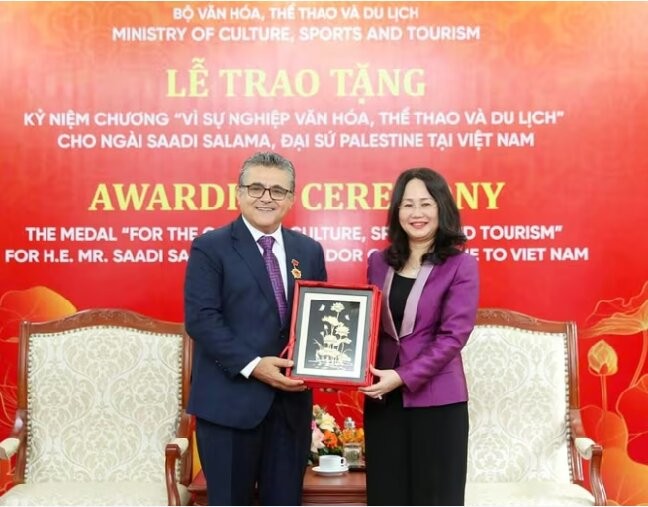
Palestinian Ambassador Saadi Salama Awarded "For the Cause of Culture, Sports and Tourism" Medal
 Viet's Home