
Fidel Castro's Legacy and Enduring Strength of Vietnam-Cuba Solidarity
| Special Buses Launched in HCM City Commemorating Cuban Leader Fidel’s First Visit to Vietnam Vietnamese Craftsman Depicts Portrait of Fidel Castro Using Cuban National Tree |
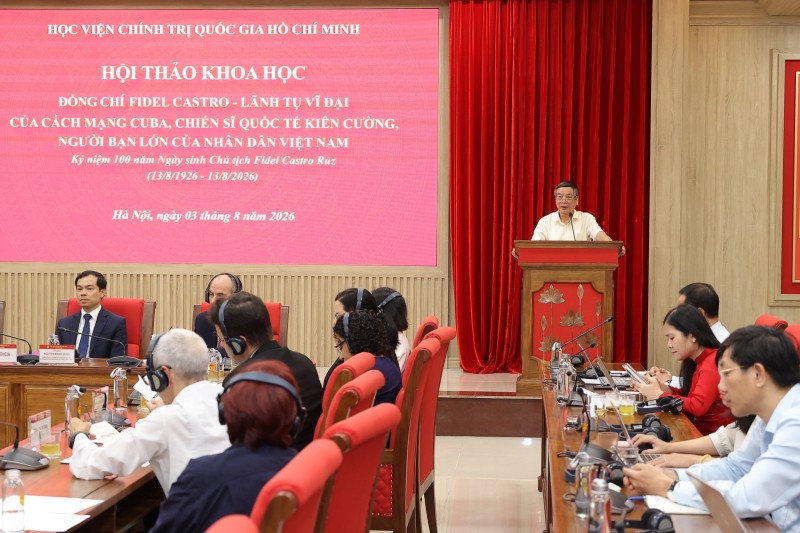
The seminar examined the formation of Fidel Castro's political thought, his influence across Latin America, his special affection for Vietnam, and prospects for contemporary cooperation between the two countries. The presentations highlighted that the Vietnam-Cuba solidarity continues to be preserved and strengthened in ways that meet the evolving needs of both nations.
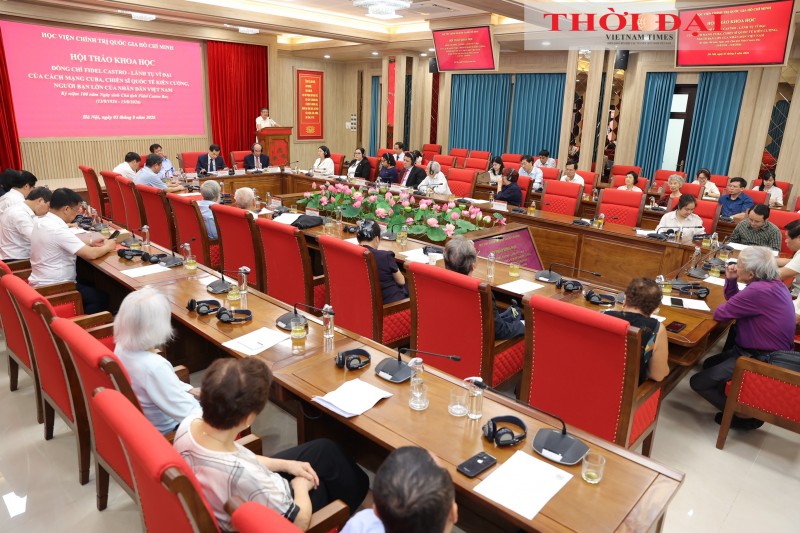 |
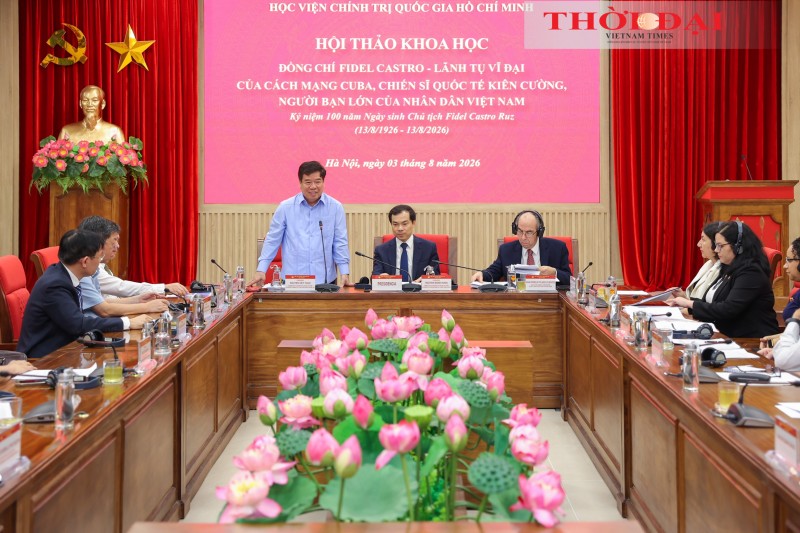
| The seminar was co-chaired by Associate Professor Dr. Nguyen Manh Hung, Vice President of the Ho Chi Minh National Academy of Politics and Vice Chairman of the Central Theoretical Council; Rogelio Polanco Fuentes, Ambassador of Cuba to Vietnam; and Associate Professor Dr. Nguyen Viet Thao, former Vice President of the Ho Chi Minh National Academy of Politics and Standing Vice President of the Vietnam-Cuba Friendship Association. (Photo: Dinh Hoa) |
The organizing committee received 30 papers and presentations from diplomats, experts, scholars, and historical witnesses, while seven speakers delivered presentations directly at the seminar. The discussions focused on Fidel Castro's life, career, and ideological legacy; his influence on the global revolutionary movement; and the special solidarity between Vietnam and Cuba.
The submitted papers also examined President Fidel Castro's views on social justice, human dignity, education, healthcare, youth affairs, and international solidarity. Several authors identified human dignity as the central principle connecting his views on equality, liberation, human development, and social responsibility. They also emphasized that young people serve not only as successors to the revolutionary cause but also as active participants in its creation and defense.
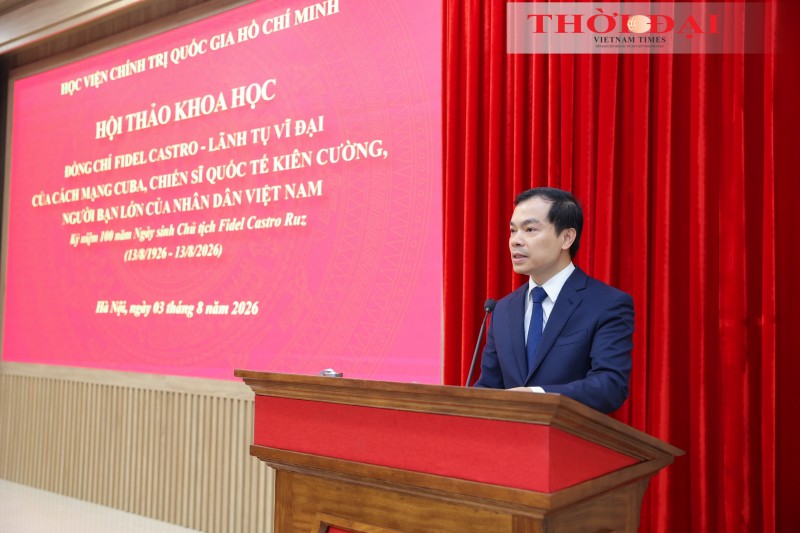
Associate Professor Dr. Nguyen Manh Hung, Vice President of the Ho Chi Minh National Academy of Politics and Vice Chairman of the Central Theoretical Council: Fidel Castro's legacy remains profoundly relevant todayThe seminar's primary academic mission was to conduct an in-depth analysis, systematize, and further elucidate the theoretical and practical values embodied in President Fidel Castro's ideological legacy. That legacy represents a creative and harmonious synthesis of Marxism-Leninism with the patriotic and progressive thought of Cuba's national hero José Martí, validated and affirmed through the dynamic realities of the Cuban Revolution and revolutionary movements across Latin America.
Fidel Castro's ideas on building a strong Party rooted in the people, harnessing the strength of national unity, promoting culture and education as the spiritual foundation of society, and, above all, advocating for a just international order opposed to imperialism, continue to retain their contemporary significance. Fidel's unwavering proletarian internationalism became a tremendous source of inspiration for oppressed peoples around the world. Tens of thousands of Cuban soldiers, doctors, and specialists traveled to Africa, Latin America, and Asia to assist friendly nations in achieving independence, building their countries, and protecting public health. Fidel Castro's noble ideals and indomitable spirit will forever remain a guiding light for progressive forces striving for peace, national independence, democracy, and social progress. |
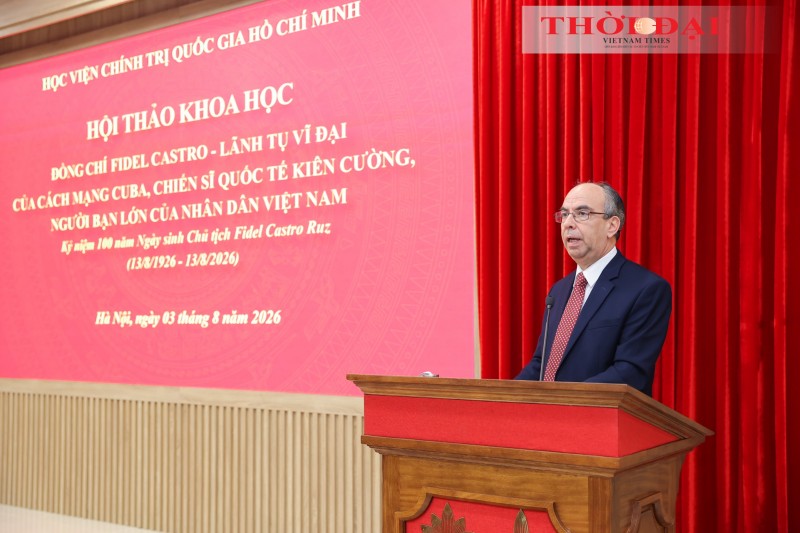
Rogelio Polanco Fuentes, Cuban Ambassador to Vietnam: Birán laid the foundation for Fidel Castro's sense of justice and spirit of resistanceIt is evident that Birán, Fidel Castro's birthplace, played a foundational and decisive role in shaping both his character and political thought.
The rural environment, cultural diversity, social inequality, and the perseverance of his parents together established a strong foundation for his enduring sense of justice and spirit of resistance. Nevertheless, although his family background and upbringing profoundly influenced him, it was ultimately his intellectual and political journey that forged his revolutionary class consciousness, transforming him into an exceptional leader whose influence transcended both his island homeland and the boundaries of his era. |
| Associate Professor Dr. Nguyen Viet Thao, Former Vice President of the Ho Chi Minh National Academy of Politics and Standing Vice President of the Vietnam-Cuba Friendship Association: Vietnam held a special place in Fidel Castro's heartFidel Castro opened a new chapter in the history of national liberation movements in Cuba, Latin America, and around the world - a chapter defined by the struggle against neo-colonialism, the upholding of genuine internationalism, the pursuit of true national independence, the integration of national independence with socialism, and the affirmation of every nation's right to determine its own development path under a socialist orientation.
Among the brotherly nations of the world, Vietnam occupied a special place in Fidel Castro's heart. He and the Cuban people closely followed developments in Vietnam's war of resistance day by day, shared every kilogram of sugar and every tablet of medicine, spoke out resolutely in defense of Vietnam at international forums, declared their readiness to shed blood alongside the Vietnamese people, and shared both tears and joy with Vietnam on the day of final victory. The people and armed forces of Vietnam will never forget the image of Commander-in-Chief Fidel Castro - the first and only foreign head of state to visit the Quang Tri battlefield while the war was still raging. There, he raised high the flag of the National Liberation Front, encouraged Vietnamese troops to advance toward Saigon, and vowed to meet again on the day of ultimate victory. |
Estela del Valle Quijada Suárez, Chargé d'Affaires of the Bolivarian Republic of Venezuela in Vietnam: Fidel Castro's contribution was not the transfer of a political modelFidel Castro's principal contribution to the Bolivarian process was not the transfer of a political model, but rather the laying of the foundations for an independent system and the establishment of a strategic framework to strengthen the international influence of the Bolivarian Revolution.
The institutionalization of mechanisms such as the Bolivarian Alliance for the Peoples of Our America-Peoples' Trade Treaty (ALBA-TCP) reflects a different vision of regional integration - one founded on solidarity, economic complementarity, and the protection of the peoples' right to self-determination, in contrast to integration initiatives driven primarily by market-oriented approaches. The relationship between Fidel Castro and Hugo Chávez shaped a shared body of doctrine that influenced the formulation of policies aimed at strengthening people's power, promoting South-South cooperation, advancing regional integration, and safeguarding a multipolar international order. |
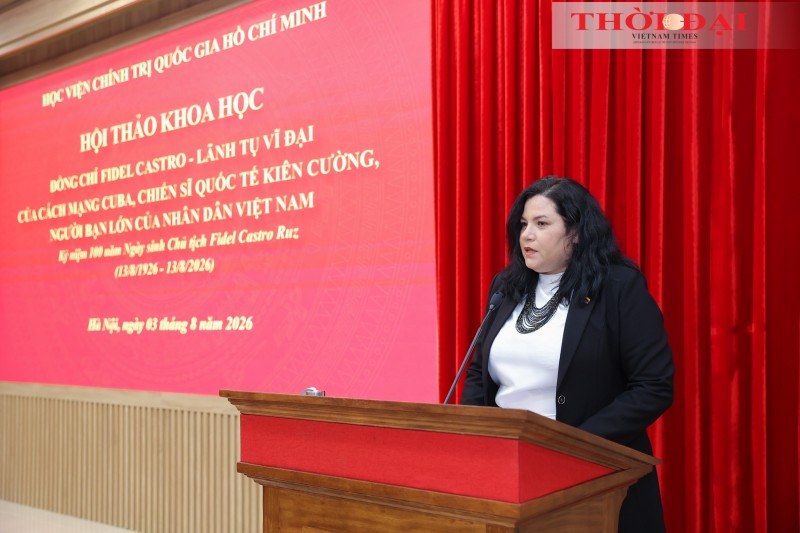
| Lieutenant General Le Phuc Nguyen, Member of the Standing Committee of the Vietnam-Cuba Friendship Association: Transforming solidarity into substantive and sustainable cooperationUnder current circumstances, Vietnam and Cuba need to translate their relationship of solidarity, friendship, selflessness, sincerity, and steadfast loyalty into strategic, practical, and sustainable actions.
As Cuba faces unprecedented difficulties and challenges in its history, Vietnam should support Cuba to ensure food security. This can be achieved by expanding cooperation projects in rice, maize, and aquaculture production, while transferring advanced agricultural technologies to Cuba. In the energy sector, Vietnam can share its experience and help attract investment in renewable energy infrastructure, including solar and wind power. The two countries should promote substantive investment, shifting from a relationship based solely on assistance to one of mutually beneficial economic cooperation. They should maximize the benefits of the Vietnam-Cuba Trade Agreement to increase bilateral trade turnover while addressing obstacles related to international payment mechanisms. It is also necessary to organize youth forums, international summer camps, and competitions on Vietnam-Cuba relations on a regular basis so that younger generations gain a deeper understanding of, and continue to cherish and preserve, the close and enduring friendship between the peoples of the two countries. |
In his concluding remarks, Associate Professor Dr. Nguyen Manh Hung stated that the papers and presentations had converged around three major themes: Fidel Castro's life and revolutionary career; his system of political thought and ideas; and the special relationship between Vietnam and Cuba. According to him, the seminar provided valuable recommendations for advancing comprehensive bilateral cooperation in the new era.
He also proposed transforming the seminar's academic resources into educational materials, public communication content, and digital media products to bring its scholarly findings closer to the public - especially young people in both countries. Such efforts, he said, would help foster a deeper appreciation of the values of independence, freedom, peace, justice, and the enduring foundations of Vietnam-Cuba friendship.
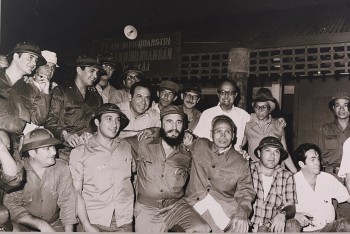 Fidel Castro in Quang Tri: Cuba’s Embrace Amid the Flames of War Fidel Castro in Quang Tri: Cuba’s Embrace Amid the Flames of War Fifty-two years ago, in September 1973, when Quang Tri was still engulfed in the smoke and fire of war, Fidel Castro - the leader of the Cuban Revolution - became the first foreign head of state to set foot in the liberated zone of South Vietnam. That visit not only marked an enduring solidarity but also stood as a vivid symbol of internationalist spirit between the two nations. |
 Seminar in Cuba Commemorates the 60th Anniversary of Fidel Castro’s Historic Statement on Vietnam Seminar in Cuba Commemorates the 60th Anniversary of Fidel Castro’s Historic Statement on Vietnam On February 5, a special seminar was held at the University of Havana (Cuba) to commemorate the 60th anniversary of the historic statement by Commander-in-Chief Fidel Castro: “For Vietnam, Cuba is ready to shed even its own blood.” The seminar was jointly organized by the Embassy of Vietnam in Cuba, the Ho Chi Minh Vietnam Studies Department (University of Havana), the Cuban Institute of Friendship with the Peoples (ICAP), and the Cuba-Vietnam Friendship Association. |
Most read


Related Stories
 Friendship
Understanding Builds Deeper Trust
 Friendship
"Two Vietnamese Friends Devoted to Fostering Vietnam-Cuba Friendship"
 National
Vietnam News Today (Aug. 13): Top Leader Begins NZ visit, Receives Acting President of NZ-VN Friendship Society
 Friendship
Memories of Fidel Castro - Great Friend of Vietnamese People
Recommended
 Friendship
A Misfortune Turned into Happiness
 Friendship
Hai Phong: Vietnamese and International Melodies Foster Friendship
 Friendship
I Was Never Just Passing Through Viet Nam
 Friendship
Strengthening People-to-People Exchanges, Nurturing Viet Nam-RoK Friendship
Popular article
 Friendship
More Than VND 1.46 Billion Supports School Meals for Children in Quang Tri
 Friendship
HCMC Promotes People-to-People Diplomacy to Mobilize International Resources
 Friendship
Some Volunteers Cannot Hold Back Their Tears When Saying Goodbye to Viet Nam
 Friendship