
People-to-People Diplomacy to Strengthen the Hegemony of Internationalism: The Practical Example of the Solidarity Between Viet Nam and Cuba
| Da Nang Taps Foreign NGO Resources to Promote Green Development Promoting People-to-People Diplomacy to Build a Solid Foundation Rooted in “the People’s Hearts” |
Decades of deep friendship shaped the diplomatic relations between Viet Nam and Cuba. In perspective of the three pillars of the foreign policy of the Socialist Republic of Viet Nam, the state diplomacy, the party diplomacy, and the people-to-people diplomacy, three important political aspect become combined [1] and create strong synergies.
First, the practical results of internationalist politics show that the material and spiritual living conditions of people have been improved. The concrete aid projects between Viet Nam and Cuba were support in times of deep crisis, reduced suffering and strengthened the socialist governments.
Second, the long-term relations, the diplomatic cohesion, and the adherence to international law led to economic interdependence, cultural exchange, as well as reinforcement of both nations' positions on the international stage. Consequently, active internationalism increased their soft power for peace, international integration and stability.
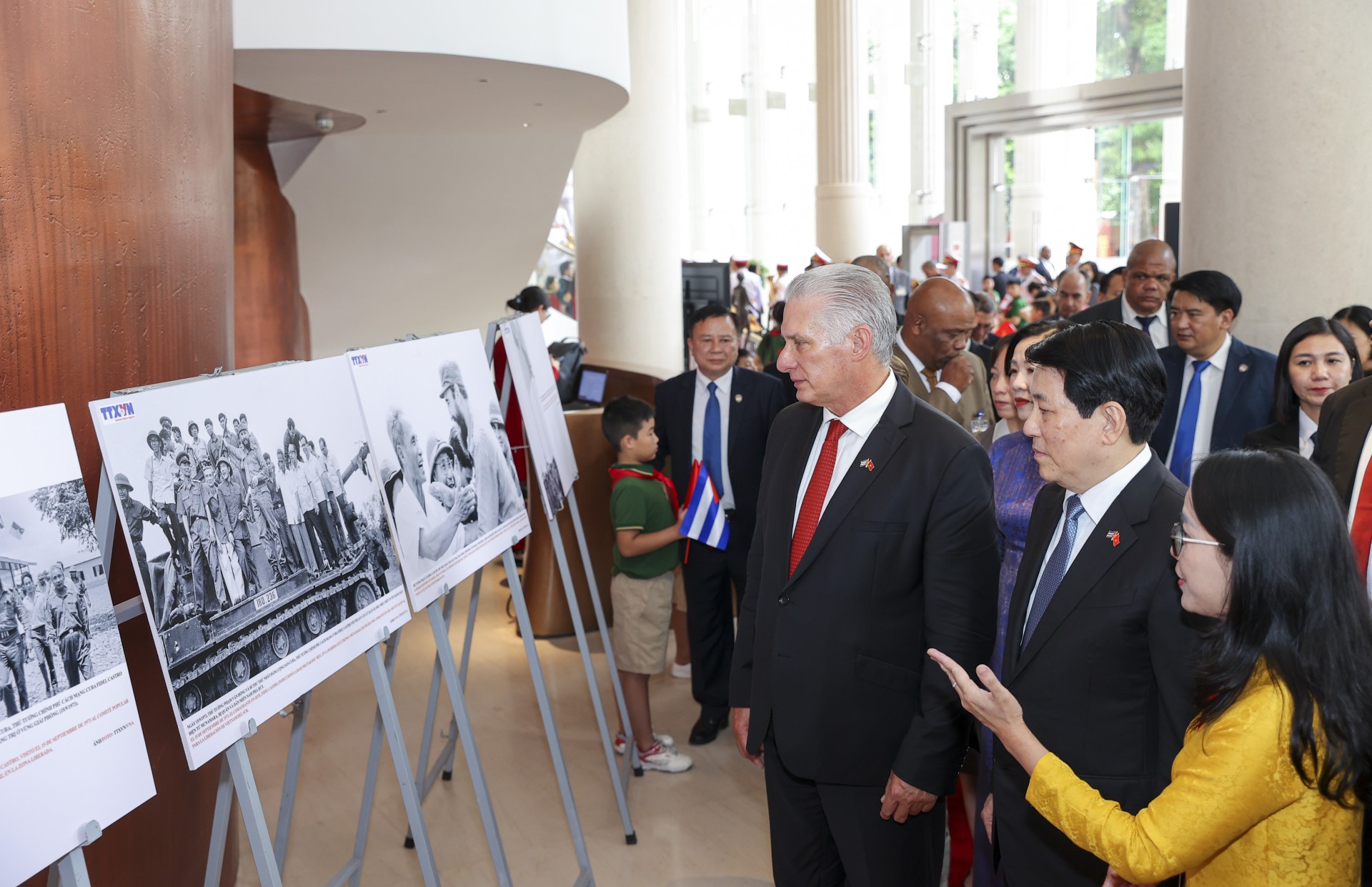 |
| State President Luong Cuong and his spouse, together with Miguel Díaz-Canel Bermúdez, First Secretary of the Central Committee of the Communist Party of Cuba and President of the Republic of Cuba, and his spouse, visit a photo exhibition marking the 65th anniversary of diplomatic relations between Viet Nam and Cuba in Hanoi on September 1, 2025. (Photo: Dinh Hoa) |
Third, people-to-people diplomacy contributes to the development of the hegemony of internationalism. The inclusion of mass organizations and the people into political praxis has a positive impact on the soft power of the socialist government in its stance among the population. This leads to an increase in political consciousness of the people, as well as their loyalty through active participation and shaping of the word around them.
In this sense, the article conceptualizes people-to-people diplomacy as an important complement to the state and party diplomacy, which embeds international solidarity in the social consciousness of society. Based on the theory of hegemony by the Italian Marxist Antonio Gramsci, it demonstrates that international solidarity is not only organized through official diplomatic channels, but also socially anchored through the active participation of people. In this way, people-to-people diplomacy strengthens the political appeal of socialist foreign policy and consolidates internationalist praxis in the consciousness of the population.
From a historical perspective, the development of this hegemony becomes visible: Viet Nam and Cuba share a common legacy and common history. Despite the great geographical distance between the two nations, their bond is exceptionally strong and has produced a unique relationship of fraternal solidarity. This relationship has been built through the three pillars of Vietnamese foreign policy and the Cuban principles of friendship among peoples, corresponding to the three theses outlined above.
The solidarity of Cuba
Already, José Martí, the intellectual forerunner of the Cuban Revolution, wrote in “La edad de oro”, a magazine that conveyed, and still conveys, to children the importance of truth, justice, and equality, about the heroic resistance of the Vietnamese people, referring to his work as “Adam”, against colonial oppression [2].
This understanding that solidarity can overcome thousands of kilometres, seas, and landmasses remained alive decades later. In this spirit, Ho Chi Minh stated in an interview with the Cuban journalist María Rojas in 1969: “Viet Nam and Cuba are thousands of kilometres apart, but the hearts of the two people are as close as brothers of the same family.” [3]
An equally meaningful statement by Fidel Castro, repeated both at the first Tricontinental Solidarity Conference in Havana in 1969 and during his first visit to the liberated zone of Quang Tri in 1973, captured the relationship between Cuba and Viet Nam in the following words:
For Viet Nam, Cuba is willing to shed even its own blood.” [4]
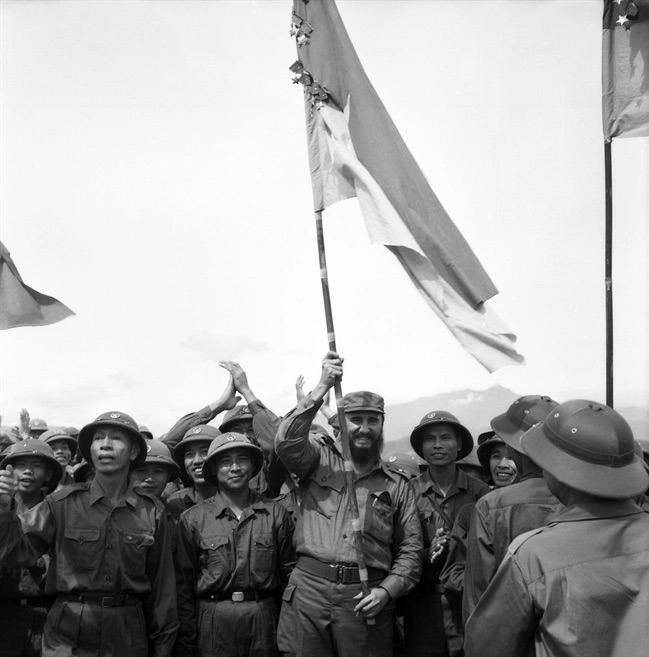 |
| Cuban leader Fidel Castro waves the Liberation Army flag at the Khe Sanh Battalion during his historic visit to the liberated zone in Quang Tri on September 15, 1973. (Photo: VNA) |
This close relationship is rooted in the establishment of formal state-to-state diplomatic relations in 1960 [5]. It marked the beginning of an intensive exchange that had a lasting impact on the socio-economic development of both countries. After only one year of diplomatic contact, the first 23 young Vietnamese were given the opportunity to study in Cuba and learn Spanish [6]. Since then, thousands of Vietnamese have been trained in Cuba as engineers and doctors.
Cuban technicians also played a significant supporting role in Viet Nam’s infrastructure development from the 1960s onward, including the construction of the Dong Hoi Friendship Hospital and the Thang Loi Hotel in Hanoi [7].
Both countries also strengthened each other on the international stage in the field of soft power. On December 20th, 1965, Cuba recognized the National Liberation Front of South Viet Nam [8]. As early as 1963, the South Viet Nam Solidarity Committee, established on Fidel Castro’s initiative, had supported the Vietnamese people’s struggle for liberation [9]. Cuba sent medical personnel, equipment, and infrastructure support to Viet Nam to care for the wounded and help build basic infrastructure. Particularly noteworthy was Cuba’s support for the Vietnamese armed forces in the construction of the Truong Son Trail. Working shoulder to shoulder with Vietnamese soldiers and Engineering Regiment 515, Cuban specialists helped pave and repair key sections of Road 42 and Road 14 with Cuban machinery [10].
Cuba also involved broad sections of its population in this solidarity. These socio-political activities can be understood within the framework of people-to-people diplomacy in the spirit of Hồ Chí Minh and contributed significantly to the cultural hegemony of internationalism.
For example, during the “All for Viet Nam” campaign, Cuban factories, city districts, neighbourhoods, and streets were named after Vietnamese heroes [11]. This stands as a unique example of how close the bonds between the two countries became in the context of imperialist aggression and friendship among peoples [12].
Cuba also helped to mobilize broad Latin American support for Viet Nam’s admission to the United Nations in 1977 [13]. To this day, both countries remain models of anticolonial and anti-imperialist liberation struggles.
The solidarity of Viet Nam
This friendship remains alive and vibrant to this day. Both sides actively cultivate friendship among peoples through the three pillars of Vietnamese foreign policy. Cooperation at the level of economic foundation, in particular, represents an admirable result of solidarity and mutual learning.
Viet Nam combines direct assistance, including medical equipment during the COVID-19 pandemic [14], 250 tons of rice, and budgetary support amounting to 385 billion VND in September 2025 [15], with long-term investment in Cuba’s economic development. Today, Viet Nam is Cuba’s second-largest investor and its largest trading partner in Asia.
Cuba’s agricultural development also plays an important role. With an investment of 43 million USD by Thai Binh Corporation, the first foreign company to invest in Cuba since the 1959 Revolution [16], and through the agricultural enterprise Agri VMA, solidarity becomes tangible at the economic level. On 1’000 hectares, the first rice harvest reached 7.2 tons per hectare, four times higher than the local average. The cultivated area is also expanded to 5’000 hectares [17].
In addition, Vietnamese researchers developed four resilient rice varieties named “ViBa”, a portmanteau of “Viet Nam” and “Cuba”, especially adapted to Cuban environmental conditions. Yet despite all this support, the pressure on Cuba caused by the embargo has sharply increased [18].
In light of this economic development and the serious difficulties caused by the US blockade, the Cuban government under Miguel Díaz-Canel has initiated economic reforms. These include, among other measures, the facilitation of foreign investment, for example through dollar-based transactions [19], as well as the strengthening of the private sector, including the authorization of state-private joint ventures and the possibility for Cubans living abroad to participate as investors. A new draft investment law is planned for the end of the year [20].
On the Vietnamese side, there is extensive experience with economic reforms through Doi Moi, and these experiences are shared at the level of Party diplomacy. Accordingly, a transfer of knowledge on the political implementation of reforms is being pursued, as shown, for example, by the phone call between CPV General Secretary To Lam and President Díaz-Canel in January 2026 [21], as well as by a meeting with former Prime Minister Pham Minh Chinh, during which concrete steps for such knowledge transfer were proposed.
At the level of the peoples, the Vietnamese Red Cross support campaign for Cuba in 2025, “Viet Nam is always with Cuba” [22], achieved enormous success and exceeded all expectations: the donation target was surpassed threefold. Within only 30 hours, 200 billion VND, approximately 8 million USD [23], had been collected. After 65 days, the total amount even reached more than 21.41 million USD [24], nine and a half times the original target [25].
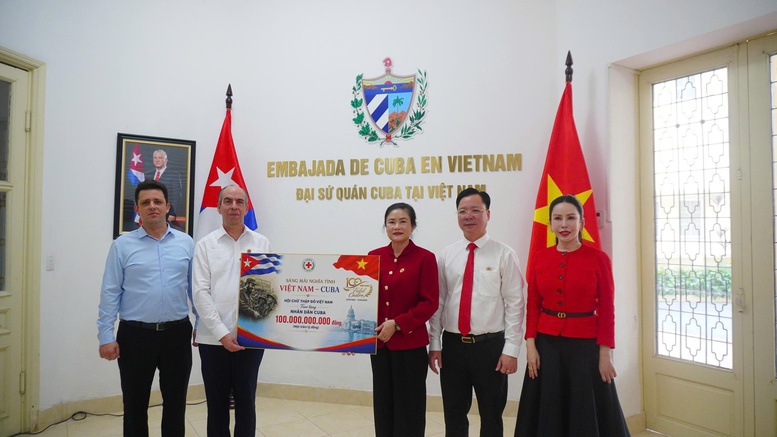 |
| The Viet Nam Red Cross Society symbolically hands over VND 100 billion in aid from the Vietnamese people to the Cuban people through the Cuban Embassy in Viet Nam on August 11, 2026. (Photo: Viet Nam Red Cross Society) |
Thousands of donors combined their contributions with explicit gratitude to the Cuban people for their support of the Vietnamese people in the struggle for liberation and in the construction of the country. This donation campaign was embedded in the Viet Nam-Cuba Friendship year 2025. To involve the younger generations and promote solidarity between the two peoples, events were organized throughout Vietnam, shaped by cultural exchange and the conscious renewal and refinement of existing practices [26].
The transmission of solidarity and friendship among peoples to and through the youth stands out in particular. In September 2025, for example, a youth exchange took place between the Cuban and Vietnamese youth unions, reaffirming the spirit of fraternity and aiming to expand cooperation and “create a common horizon for future generations, based on shared history, solidarity, and common victory.” [27]
This development shows that Vietnamese - Cuban solidarity does not consist merely of punctual assistance, but generates lasting political, economic, and diplomatic capacity for action. In this way, soft power is built, international integration promoted, and the position of both countries against imperialist pressure is strengthened.
Under changed historical conditions, this deepening and consolidation of the bonds of friendship and solidarity is thus repeated: While Cuba once carried solidarity with Viet Nam into its own population, Viet Nam today carries solidarity with Cuba back into its own society. The direction of assistance has changed, but its internationalist character has not.
Ideological foundation
As shown in the historical discussion, the three pillars of Vietnamese foreign policy have made a significant contribution to the socio-economic situation of both countries. State diplomacy enabled trade and solidarity, while party diplomacy strengthened both sides at the ideological level through continuous adaptation to changing historical conditions and contributed to the development of both countries’ soft power on the international stage.
The contribution of people-to-people diplomacy deserves particular attention, as it is reflected in the successful expansion of the hegemony of internationalism, demonstrated by the immense participation in Viet Nam’s solidarity campaign for Cuba in 2025. Understanding this requires an analysis of the interaction between Antonio Gramsci’s theory of hegemony and people-to-people diplomacy in the spirit of Ho Chi Minh.
People-to-people diplomacy plays a particular role in this context. It should be understood as solidarity-based understanding, learning, and mutual assistance in the spirit of Ho Chi Minh. The people are not to be understood as a mass to be governed or merely as a socio-economic subject, but as a socio-cultural force of the highest importance [28]. The interaction between party, state, and people-to-people diplomacy can be illustrated by the following quotation from Ho Chi Minh: “Helping friends means helping ourselves.” [29]
Consequently, the commitment to friendship among peoples and peace represents a central and actively practiced guiding principle of Vietnamese foreign policy. [30] These principles are historically rooted in Cuba’s support for the Vietnamese struggle for liberation and national construction, and they remain relevant today through Viet Nam’s assistance to Cuba. In view of the war and embargoes experienced by both countries, their diplomatic relations have been strengthened on the global level in the spirit of peace and respect for international law.
From a broader perspective, people-to-people diplomacy mobilizes additional forces beyond state and party diplomacy. It anchors international friendship among peoples in the social consciousness of the population. This function can be understood through Antonio Gramsci’s theory of hegemony: Hegemony operates through cultural leadership, moral orientation, shared values, and social consent. Political stability emerges where a social order anchors its values in the people’s everyday lives and where these values are experienced as meaningful, just, and necessary [31].
People-to-people diplomacy operates at the intersection between the economic base and the social superstructure. It connects material cooperation with political consciousness-building by involving mass organizations, youth unions, and broad sections of the population in concrete internationalist praxis. Material assistance, economic cooperation, historical memory, cultural exchange, and politics thereby appear as lived solidarity among peoples. International solidarity manifests itself as a social conviction [32].
This produces three central effects. First, concrete forms of cooperation improve the living conditions of people in both countries. Second, people-to-people diplomacy actively involves the population in this cooperation. Third, this participation shapes political consciousness because people experience and help create the benefits of internationalist praxis themselves. Solidarity, peace, sovereignty, and mutual responsibility are thus anchored in social consciousness.
Viet Nam’s solidarity campaign for Cuba in 2025 demonstrates this effect with clarity. Historical memory, material assistance, economic cooperation, and campaigns by mass organizations worked together and carried the relations between Viet Nam and Cuba into the consciousness of the population. This is precisely where the hegemonic power of people-to-people diplomacy lies: it strengthens the friendship between Vietnam and Cuba, mobilizes social resources beyond purely state structures, and can at the same time strengthen trust in one’s own socialist government.
The relations between Viet Nam and Cuba are therefore more than a historical legacy. They are living proof of how internationalism is socially anchored through people-to-people diplomacy. In the connection between material assistance, political praxis, and cultural memory, the hegemony of internationalism appears as a concrete force of socialist foreign policy.
References:
1. Ministry of Foreign Affairs of Vietnam. (2023, 4. August). People-to-people diplomacy must be strategic pillar in Vietnam’s foreign policy: Party official. https://mofa.gov.vn/en/web/ministry-of-foreign-affairs/detail/chi-tiet/people-to-people-diplomacy-must-be-strategic-pillar-in-vietnam-s-foreign-policy-party-official-58295-177.html
2. Granma, (2018, 6. April). Vietnam and Ho Chi Minh http://en.granma.cu/mundo/2018-04-06/vietnam-and-ho-chi-minh
3. Vietnam.vn. (2025, 21. September). The great solidarity between Vietnam and Cuba cannot be distorted. https://vietnam.vn/en/the-great-solidarity-between-vietnam-and-cuba-cannot-be-distorted/
4.VietnamPlus. (2025, 30. August). Vietnam – Cuba friendship a symbol of true international solidarity: Ambassador. https://en.vietnamplus.vn/vietnam-cuba-friendship-a-symbol-of-true-international-solidarity-ambassador-post295218.vnp
5.Parlamento Cubano. (2023, 22. September). 50 hitos en la historia de las relaciones entre Cuba y Vietnam (parteI). https://www.parlamentocubano.gob.cu/50-hitos-en-la-historia-de-las-relaciones-entre-cuba-y-vietnam-parte-i/
6.Vietnam.vn. (2025, 12. Februar). Vietnam-Cuba: 65 years of development together. https://vietnam.vn/en/vietnam-cuba-65-years-of-development-together/
7.VietnamPlus. (2025, 30. August). Vietnam – Cuba friendship a symbol of true international solidarity: Ambassador.https://en.vietnamplus.vn/vietnam-cuba-friendship-a-symbol-of-true-international-solidarity-ambassador-post295218.vnp
8.Parlamento Cubano. (2023, 22. September). 50 hitos en la historia de las relaciones entre Cuba y Vietnam (parteI). https://www.parlamentocubano.gob.cu/50-hitos-en-la-historia-de-las-relaciones-entre-cuba-y-vietnam-parte-i/
9.Progressive International. (2025, 15. September). PI Briefing No. 34: Socialist Internationalism in Action. https://progressive.international/wire/2025-09-15-pi-briefing-no-34-socialist-internationalism-in-action/en/
10.VietnamPlus. (2025, 30. August). Vietnam – Cuba friendship a symbol of true international solidarity: Ambassador. https://en.vietnamplus.vn/vietnam-cuba-friendship-a-symbol-of-true-international-solidarity-ambassador-post295218.vnp
11.Progressive International. (2025, 15. September). PI Briefing No. 34: Socialist Internationalism in Action. https://progressive.international/wire/2025-09-15-pi-briefing-no-34-socialist-internationalism-in-action/en/
12.Progressive International. (2025, 15. September). PI Briefing No. 34: Socialist Internationalism in Action. https://progressive.international/wire/2025-09-15-pi-briefing-no-34-socialist-internationalism-in-action/en/
13.Vietnam Law Magazine. (2023, 1. November). Vietnam, Cuba nurture decades-long special relations. https://vietnamlawmagazine.vn/vietnam-cuba-nurture-decades-long-special-relations-70994.html
14. VietnamPlus. (2020, 16. Juli). Defence Ministry donates medical supplies to help Cuba fight COVID-19. https://en.vietnamplus.vn/defence-ministry-donates-medical-supplies-to-help-cuba-fight-covid19/178696.vnp
15.VietnamPlus. (2025, 26. September). Vietnam provides Cuba with 385 billion VND in aid to overcome difficulties.https://en.vietnamplus.vn/vietnam-provides-cuba-with-385-billion-vnd-in-aid-to-overcome-difficulties-post296823.vnp
16.Vietnam.vn. (2025, 27. August). Vietnamesische Unternehmen engagieren sich für langfristige Investitionen in Kuba. https://vietnam.vn/de/vietnamesische-unternehmen-engagieren-sich-fur-langfristige-investitionen-in-kuba/
17. Vietnam.vn. (2025, 19. Juni). Internationale Medien heben einzigartiges Kooperationsmodell zwischen Vietnam und Kuba im Reisbereich hervor. https://vietnam.vn/de/internationale-medien-heben-einzigartiges-kooperationsmodell-zwischen-vietnam-und-kuba-im-reisbereich-hervor/
18.Vietnam.vn. (2025). VIBA - The golden seed of Vietnam-Cuba friendship. https://vietnam.vn/en/viba-the-golden-seed-of-vietnam-cuba-friendship/
19. Granma. (2025, 25. November). Anuncian nuevas medidas para flexibilizar y dinamizar la Inversión Extranjera en Cuba. https://www.granma.cu/cuba/2025-11-25/anuncian-nuevas-medidas-para-flexibilizar-y-dinamizar-la-inversion-extranjera-en-cuba
20.Granma. (2025, 19. Dezember). ¿Qué proyecta Cuba para su economía en 2026? https://www.granma.cu/cuba/2025-12-19/que-proyecta-cuba-para-su-economia-en-2026
21.Voice of Vietnam. (2026, 27. Januar). Vietnam, Cuba leaders discuss Party Congress outcomes, pledge closer ties. https://vovworld.vn/en-US/news/vietnam-cuba-leaders-discuss-party-congress-outcomes-pledge-closer-ties-1169166.vov
22. vietnam.vn (2025, 14. August). More than 125 billion VND to support the Cuban people after 2 days of launching. https://www.vietnam.vn/en/hon-125-ty-dong-ung-ho-nhan-dan-cuba-sau-2-ngay-phat-dong
23.Prensa Latina. (2025, 16. August). Cuba support campaign in Vietnam triples initial target. https://www.plenglish.com/news/2025/08/16/cuba-support-campaign-in-vietnam-triples-initial-target/
24.Nhan Dan. (2025, October 16). Viet Nam raises over 537 billion VND in support of Cuba. Nhan Dan. https://en.nhandan.vn/viet-nam-raises-over-537-billion-vnd-in-support-of-cuba-post154139.html
25.Viet nam News (2025, 18. Oktober). Over US$ 23.34 million raised for Cuban people. https://vietnamnews.vn/Politics%20-%20Laws/1727577/over-us-23-34-million-raised-for-cuban-people.html
26. Ministry of Foreign Affairs. (2026, February 2). Vietnamese, Cuban foreign ministers affirm party diplomacy as key political foundation of bilateral ties. Ministry of Foreign Affairs - Cổng Thông Tin Bộ Ngoại Giao. Retrieved May 27, 2026, from https://vnembassy-berlin.mofa.gov.vn/web/ministry-of-foreign-affairs/detail/chi-tiet/vietnamese-cuban-foreign-ministers-affirm-party-diplomacy-as-key-political-foundation-of-bilateral-ties-58679-1074.html
27.Cuban News Agency (2025, 15. September). Cuba-Vietnam youth exchange strengthens collaboration ties. http://www.cubanews.acn.cu/cuba/27568-cuba-vietnam-youth-exchange-strengthens-collaboration-ties
28.Lao Dong. (2024, 2. September). Đạo đức Hồ Chí Minh – biểu tượng văn hóa sáng ngời. https://news.laodong.vn/thoi-su/dao-duc-ho-chi-minh-bieu-tuong-van-hoa-sang-ngoi-1703777.ldo
29. Vietnam Union of Friendship Organizations. (o. D.). Homepage. Abgerufen am 22. Mai 2026, von https://vufo.org.vn/default.aspx?lang=en
30.Nhan Dan. (2024, 28. September). People-to-people diplomacy contributes to Vietnam‘s soft power. https://en.nhandan.vn/people-to-people-diplomacy-contributes-to-vietnams-soft-power-post143827.html
31. Gramsci, A. (2019). Gefängnishefte: Kritische Gesamtausgabe (K. Bochmann & W. F. Haug, Hrsg.). Argument Verlag.
32. Gramsci, A. (2019). Gefängnishefte: Kritische Gesamtausgabe (K. Bochmann & W. F. Haug, Hrsg.). Argument Verlag.
 Harnessing Strengths of Overseas Vietnamese to Drive New Momentum in Viet Nam-Russia People-to-People Diplomacy |
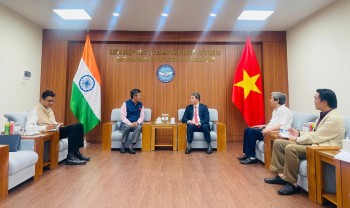 Expanding Viet Nam-India Partnership Network |


Related Stories
 Friendship
Deputy Minister Ho An Phong Elected President of Viet Nam-Belarus Friendship Association for 2026-2031
 Friendship
First Congress of the Dong Thap Union of Friendship Organizations for the 2026-2031 Term
 Friendship
Promoting People-to-People Diplomacy to Build a Solid Foundation Rooted in “the People’s Hearts”
 National
Da Nang Taps Foreign NGO Resources to Promote Green Development
Popular article
 Friendship
Students Who Brought Me to Viet Nam
 Friendship
More Than 900 Students in Tuyen Quang Learn About Green Living
 Friendship
American Friends Help Ease the Pain of Agent Orange
 Friendship