
From Wartime Solidarity to Lasting Friendship
| Understanding Builds Deeper Trust I Have Become a Citizen of Viet Nam |
The ceremony was attended by representatives of the Cuban Embassy and other Cuban representative agencies in Viet Nam; representatives of the Ministry of Foreign Affairs, Ministry of National Defence, Ministry of Public Security, Viet Nam Union of Friendship Organizations, Viet Nam-Cuba Friendship Association, and Literature Publishing House, as well as numerous delegates from both countries.
Speaking at the ceremony, Cuban Ambassador to Viet Nam Rogelio Polanco Fuentes emphasized that the visit 60 years ago was an important milestone in the history of the two countries' special relationship, demonstrating Cuba's strong support for the Vietnamese people's struggle for national independence and reunification.
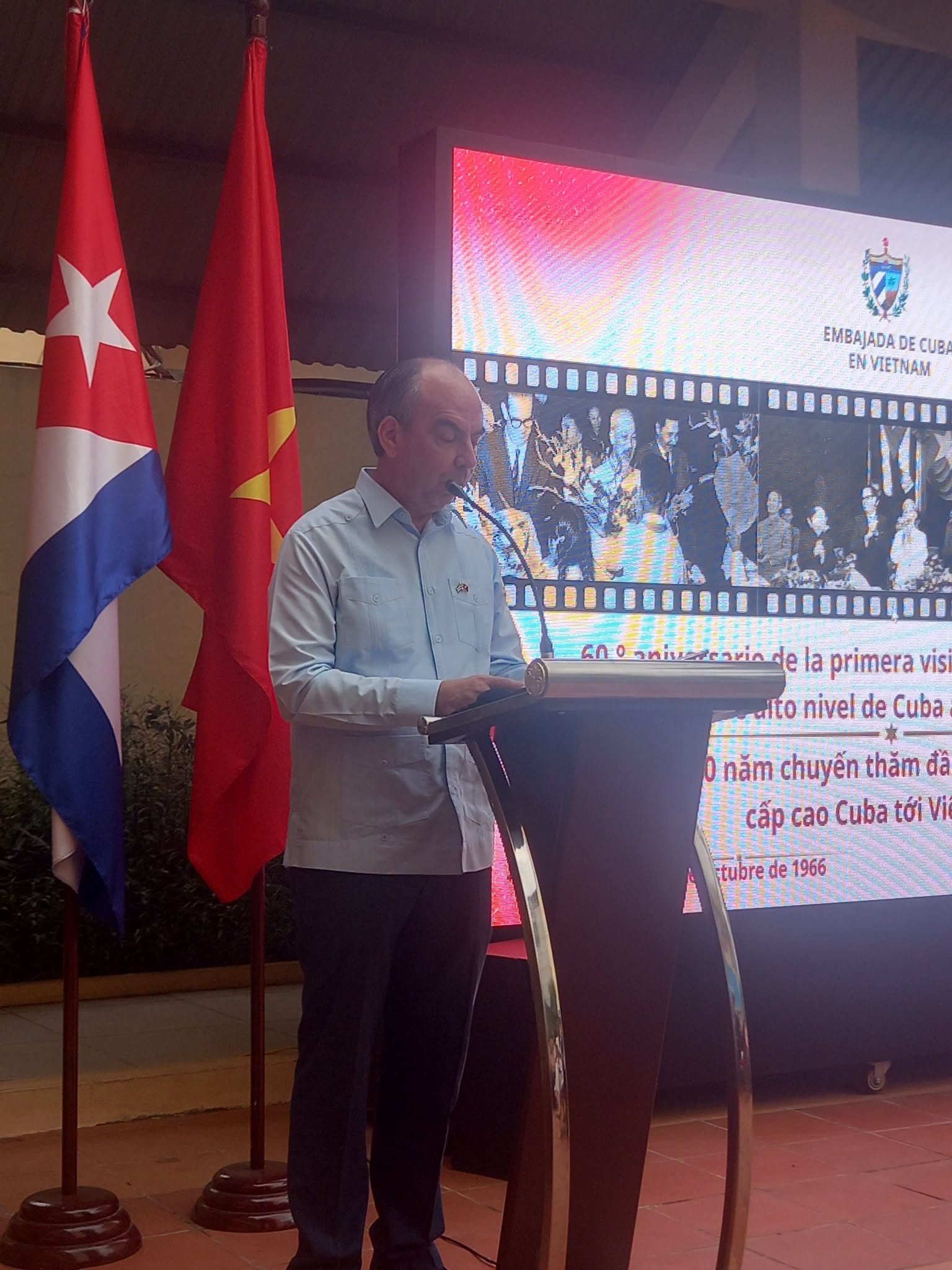 |
| Cuban Ambassador to Viet Nam Rogelio Polanco Fuentes speaks at the commemorative ceremony. |
Solidarity amid the hardships of war
On October 29, 1966, when the Vietnamese people's resistance war against the United States was at one of its most intense stages, a high-level delegation of the Cuban Party and Government arrived in Hanoi.
The delegation was led by President of the Republic of Cuba Osvaldo Dorticós Torrado. Its members included Commander Raúl Castro Ruz, then Second Secretary of the Central Committee of the Communist Party of Cuba, Deputy Prime Minister and Minister of the Revolutionary Armed Forces of Cuba; and Commander Sergio del Valle Jiménez, Deputy Minister of the Revolutionary Armed Forces of Cuba. This was the first high-level Cuban delegation to visit Viet Nam and also the first visit to Viet Nam by General Raúl Castro Ruz.
Documents preserved at the Ho Chi Minh Museum show that on October 29, 1966, President Ho Chi Minh personally went to Gia Lam Airport to welcome the delegation. At the welcoming ceremony, he delivered a speech and subsequently received the delegation, expressing the solidarity between the peoples of the two countries. President Osvaldo Dorticós was also received by President Ho Chi Minh at the stilt house in the Presidential Palace complex.
Other Vietnamese leaders welcoming the delegation included Prime Minister Pham Van Dong; Chairman of the Standing Committee of the National Assembly Truong Chinh; General Vo Nguyen Giap, Deputy Prime Minister and Minister of National Defence; and Nguyen Duy Trinh, Deputy Prime Minister and Minister of Foreign Affairs.
In the following days, leaders of the two countries held talks and exchanged views on the situations in Viet Nam and Cuba, as well as international issues. The Ho Chi Minh Museum's chronological records note that on November 2, 1966, President Ho Chi Minh attended talks between the Vietnamese Party and Government delegation and the Cuban delegation, and delivered remarks at a banquet held in honour of the guests.
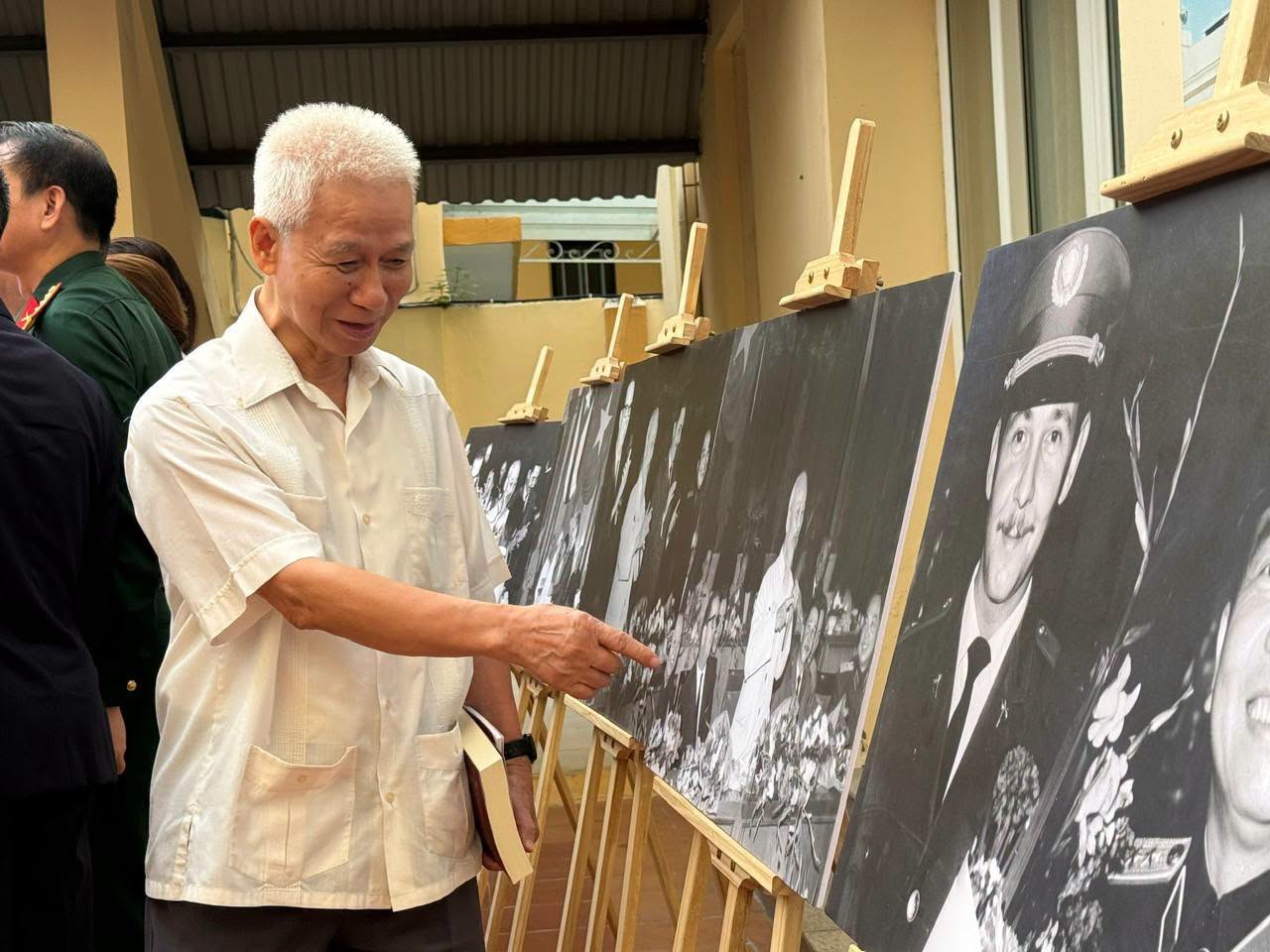 |
| At the ceremony. |
A rally attended by more than 1,000 representatives from all walks of life in Hanoi was also held to welcome the delegation. President Ho Chi Minh and senior Vietnamese leaders attended, demonstrating their special affection for their Cuban friends at a time when the war was raging.
During their meetings that year, President Ho Chi Minh emphasized that his affection for the Cuban people and leader Fidel Castro came “from the heart, not from diplomatic declarations”. These words have since often been recalled as a vivid expression of the special closeness between the two peoples, despite being separated by half the globe.
According to Ambassador Rogelio Polanco Fuentes, the visit reaffirmed the unwavering position of the Cuban Revolution in supporting the Vietnamese people's struggle, while further strengthening the shared commitment to national independence and nation-building that had taken shape in the early years of bilateral relations.
Prior to the visit, Cuba had become the first country in the Western Hemisphere to establish full diplomatic relations with Viet Nam on December 2, 1960. On September 25, 1963, Cuba established the Committee for Solidarity with South Viet Nam, the first organization of its kind in the world dedicated to solidarity with Viet Nam. By 1965, Cuba had taken further diplomatic steps to demonstrate its support for the National Liberation Front of South Viet Nam.
Following the 1966 visit, this solidarity continued to be demonstrated through numerous concrete actions. In early 1967, Cuban leader Fidel Castro proposed designating 1967 as the “Year of heroic Viet Nam”, thereby continuing to mobilize international support for Viet Nam.
A symbol of international solidarity
The September 1973 visit to Viet Nam by Cuban leader Fidel Castro further elevated Viet Nam-Cuba solidarity into an international symbol.
With this visit, Fidel Castro became the first and only foreign leader to visit the liberated areas of South Viet Nam while the war was still ongoing. He travelled to Quang Tri, where many dangers remained in the aftermath of the fighting, and demonstrated his direct support for the Vietnamese people's struggle.
Cuba subsequently assisted Viet Nam in building numerous socio-economic facilities to support the country's reconstruction. These included the Viet Nam-Cuba Friendship Hospital in Dong Hoi, Thang Loi Hotel, livestock facilities, transport routes and agricultural projects. Many of these structures are still remembered as tangible symbols of the friendship between the two countries.
Ambassador Rogelio Polanco Fuentes noted that it was precisely during the most difficult times that Viet Nam-Cuba relations went beyond the framework of conventional diplomatic declarations. Cuba not only voiced its support for Viet Nam at international forums but also provided material assistance, healthcare support, training and infrastructure development.
The Ambassador also expressed his appreciation for the support Viet Nam has extended to Cuba during difficult periods, including Viet Nam's positions at international forums on sovereignty, independence, the right to self-determination and issues concerning Cuba.
At the ceremony, the Embassy of Cuba in Viet Nam introduced the book “Viet Nam and Cuba: Brothers in one family”. The publication brings together documents directly related to the historic 1966 visit, including speeches by President Ho Chi Minh and President Osvaldo Dorticós Torrado, the joint communiqué issued by the two sides, an editorial from Nhan Dan Newspaper, and numerous photographs of meetings between the leaders of the two countries.
According to Ambassador Rogelio Polanco Fuentes, compiling and publishing these documents provides today's generations with greater opportunities to directly access the records and photographs of a period that laid important foundations for Viet Nam-Cuba relations.
The Embassy also introduced the Vietnamese-language edition of the first volume of “The Revolution: The most beautiful work”, published by the Literature Publishing House. The book is a selection of speeches, interviews and statements by General Raúl Castro Ruz from 2006 to 2011 and was first published in Cuba in 2021. It covers a range of domestic and international issues, reflecting the thoughts and perspectives associated with Raúl Castro's revolutionary activities.
As part of the programme, delegates also visited a photo exhibition, revisited historical images of the 1966 visit and watched a documentary film recreating the context of Viet Nam-Cuba relations during the war years.
 Continuing Story of Viet Nam-Cuba Friendship, Together |
 People-to-People Diplomacy to Strengthen the Hegemony of Internationalism: The Practical Example of the Solidarity Between Viet Nam and Cuba |

Most read


Related Stories
 Friendship
People-to-People Diplomacy to Strengthen the Hegemony of Internationalism: The Practical Example of the Solidarity Between Viet Nam and Cuba
 Friendship
Understanding Builds Deeper Trust
 Friendship
"Two Vietnamese Friends Devoted to Fostering Vietnam-Cuba Friendship"
 National
Vietnam News Today (Aug. 13): Top Leader Begins NZ visit, Receives Acting President of NZ-VN Friendship Society
Popular article
 Friendship
Promoting Role of People-to-People Diplomacy in Viet Nam-Spain Relations
 Friendship
Viet Nam-Sweden: A Friendship That Endures
 Focus
Viet Nam Union of Friendship Organizations Sets New Priorities for People-to-People Diplomacy
 Friendship